




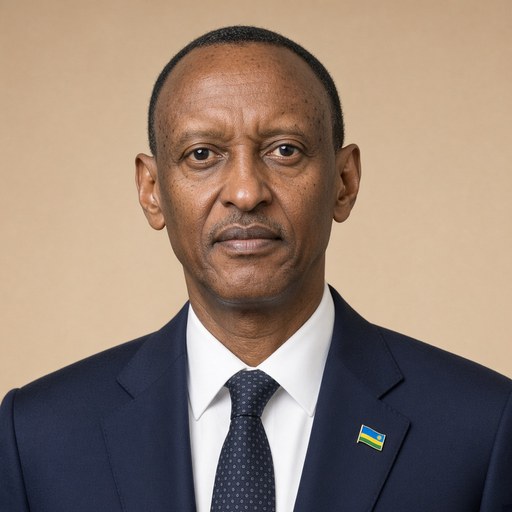
Remarks by President Kagame | Consultative Meeting of the EAC Heads of State on Regional Response to Covid-19 & the Free Movement of Goods
 Paul Kagame · President of Rwanda
- Context
- Kagame addressed an EAC Heads of State consultative meeting on 12 May 2020 to coordinate the regional COVID-19 response and ensure the free flow of goods.
- Main themes
- COVID-19 regional response, East African Community cooperation, free movement of goods and trade, truck drivers and transmission risk, regional task force and response plan, mobile testing facilities, economic hardship mitigation, focal persons coordination mechanism, flexible decision-making procedures, member state participation challenges
- Duration
- ~6 min
- Words
- 692
- Sentences
- 33
- Readability
- 50
- Grade
- 11.5
- Syntax
- 3.07
- Vocabulary
- 1.98
The broad sphere of national life a sentence belongs to. Every sentence has an Arena, so it is the denominator the other indices are read against.
Other33 sentences in 23 paragraphs
Excellencies, Good afternoon.
I wish to thank you for participating in this Consultative Meeting on COVID-19 response.
I thank the Council of Ministers for their report and the Deputy Secretary-General for the presentation that was made.
In Rwanda we now have 285 cases, 150 have fully recovered, and we have 135 people still undergoing treatment in isolation.
We also have a similar problem of truck drivers. These are, in actual fact, the new cases we have been registering in the recent past, to reach that 285 total. So we are very much interested in working with the region to see how to effectively manage the problem.
The outcomes of the ministerial meetings of March 25 th and May 8 th are clear and practical. Implementation of these measures by the East African Community will benefit our entire region.
I wish to congratulate the Regional Task Force on COVID-19 on completing the East African Community regional response plan and look forward to putting it into action.
We also appreciate the Secretariat’s work in arranging for the mobile testing facilities, which we look forward to seeing fully operational. It has been some time since they arrived and were allocated, but have so far not been operational.
This is undoubtedly a difficult period for our region and the entire world. We are working to minimise the economic hardship on our citizens while protecting their health.
But this will be more effective, as has been stated by Your Excellencies if we act in concert with one another.
To combat this pandemic, it is critically important to maintain the flow of trade within our region, working hand in hand with our private sector.
That is the key principle I wish to emphasise today. So long as any member of our community is vulnerable, we are all at risk.
Therefore, we must work very closely together in the months ahead, to face this challenge as a community of partners.
Excellencies, I wish to raise a few more points.
One is that we had agreed to put in place focal persons from each member state to regularly meet, analyse, coordinate with the Secretariat, and also inform the leaders of partner countries for quick and necessary decisions to be made. Not having the focal points undermines the whole essence of what we are trying to achieve.
The second point, I think for us to be effective, and to get the results we want in circumstances like these, some of the rules and regulations that bind us, which we have to respect, may not apply.
While the procedural matters of realising the quorum for the East African leaders to meet, discuss and make decisions is important, if that can’t be achieved, there are ways like this where consultations can be made.
Consultations may also result in important decisions, for example, today we agreed on some of the suggestions that have come up, on how to deal with the problem of transport, truck drivers and the transmission of COVID-19.
I think we can use these ways effectively, and when we meet again as the Summit, having realised the quorum, we might have to examine this particular point so that we are not tying our own hands in doing the very important things we have to do, just because of what we ourselves put in the books that guide us. So there have to be flexible ways, especially for situations like these.
We are meeting without some key players: the partner states of Tanzania and Burundi were not able to participate because of their own reasons. The Secretary-General of the East African Community could not avail himself.
But my point is, we need to work for our people. If we can’t all work together, the six of us, and have things moving, it doesn’t mean that two, three, four shouldn’t work, in these circumstances, to deal with the problems that we have to deal with.
Going forward we may also find a solution for the underlying problems that caused this situation to happen.
Otherwise, I wish to thank you, once again, for finding the time and treating all these matters as very important.