




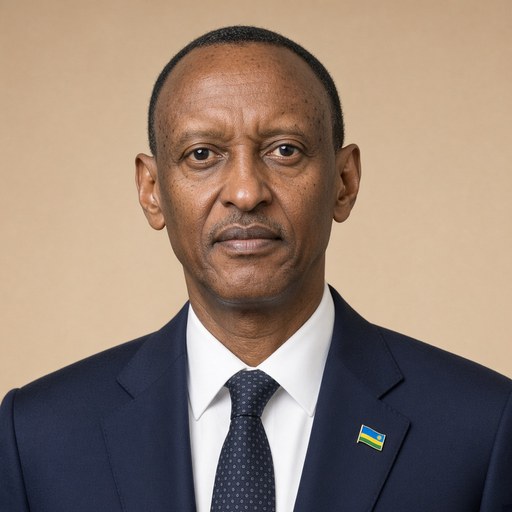
Unveiling of The Commemorative Plaque | Remarks by President Kagame | Riga, 2 October 2024
 Paul Kagame · President of Rwanda
- Context
- Kagame addressed a commemoration ceremony in Riga, Latvia on 2 October 2024, at the unveiling of a plaque honouring victims of the 1994 Genocide against the Tutsi.
- Main themes
- 1994 Genocide against the Tutsi commemoration, memory and truth preservation, Rwanda's resilience and national unity, reconciliation and identity, genocide denial, international solidarity, youth education, social media and misinformation, stability and prosperity
- Duration
- ~3 min
- Words
- 314
- Sentences
- 23
- Readability
- 57
- Grade
- 8.8
- Syntax
- 2.60
- Vocabulary
- 1.98
The broad sphere of national life a sentence belongs to. Every sentence has an Arena, so it is the denominator the other indices are read against.
Other23 sentences in 17 paragraphs
Good afternoon.
It is a deep honour to participate in unveiling a plaque to commemorate the 1994 Genocide against the Tutsi.
I thank the Government and people of Latvia for standing in solidarity with Rwanda, and for honouring the innocent lives that were taken. We do not take this moment for granted.
Thirty years after the genocide was stopped, Rwandans have regained our dignity and unity as a people.
The tragedy we suffered has only made us more determined, to do the hard work of becoming strong and prosperous. In that sense, I believe that Latvians and Rwandans can understand each other, at a deep level.
There are no shortcuts.
We began by restoring national unity and reconciliation, with a shared identity and common purpose.
We also established strong institutions to respond to the needs of our people. This is the foundation for stability and growth.
Three years ago, the Ministry of National Unity and Civic Engagement was created. It has a very important mandate to educate our youth about our culture and history, so they can play their part to speak up against genocide denial.
Unfortunately, I cannot say with confidence, that the world has truly learned the lessons, even as I say that what happened in Rwanda should never happen again, anywhere.
We see reason for concern, all over the world. Social media has made it easier to deny the truth about mass crimes. The ripple effects are very dangerous.
What is most important, is to speak out and preserve memory, no matter what powerful interests are made uncomfortable.
We must all work together.
That is why it is so moving to see Rwanda’s history reflected here in Latvia.
To close, I can only once again thank the Government and people of Latvia, and the National Library, for this very great honour.
We are very grateful.
Thank you for your kind attention.