




PM Lapid's Remarks at the State Memorial Ceremony for the Late PM Yitzhak Shamir
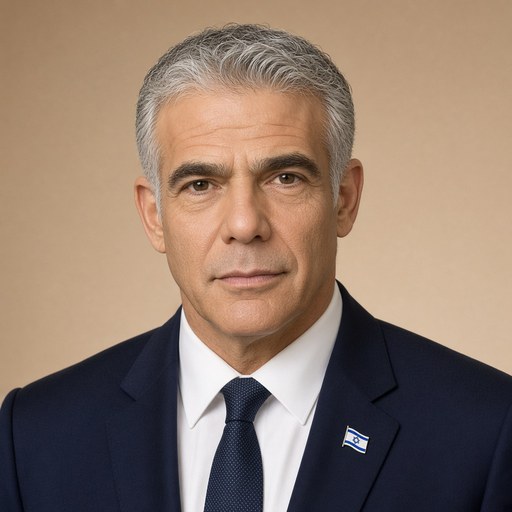
 Yair Lapid · Prime Minister of Israel
- Context
- Lapid addressed a state memorial ceremony for late Prime Minister Yitzhak Shamir on July 10, 2022, honoring his legacy of national unity.
- Main themes
- National unity, Yitzhak Shamir's legacy, political cooperation, Zionist leadership, Israeli identity, rejection of racism and fascism, courage and resilience, rotation government, Jewish history, moral responsibility, fighting terrorism, immigration to Israel
- Duration
- ~6 min
- Words
- 693
- Sentences
- 37
- Readability
- 51
- Grade
- 10.9
- Syntax
- 3.16
- Vocabulary
- 2.31
The broad sphere of national life a sentence belongs to. Every sentence has an Arena, so it is the denominator the other indices are read against.
Other37 sentences in 11 paragraphs
Shamir family, honored guests.
In 1984, the political system was stuck. None of the political camps had enough votes to form a government. Different leaders agreed to cooperate, but only if they themselves would rule. The State of Israel was on the precipice of an unprecedented political crisis. Doesn't sound familiar at all.
Israel got back on track when Yitzhak Shamir decided to put his ego aside and suggested to Shimon Peres that he serve first in the rotation. Shamir did not especially like Peres, to put it delicately out of respect for the deceased but he understood that love of Israel was more than a slogan. It is the responsibility that our leaders are charged with. 'National unity,' he declared at the swearing-in of the government, 'is not solely a matter of parliamentary convenience. Through its very establishment and existence, this government will project a message of unity, togetherness, love of Israel and genuine cooperation between the country's political leaders and among all sectors of the public in Israel.'
Shamir believed that there was one Israel, and that the role of leaders was to unite and bring its sons and daughters together, not to spur on disagreements.
I thought about Shamir a great deal when I formed the second rotation government in Israel – about his commitment to unity, about the way he always kept the national interest at the forefront, rather than his personal interests. I am proud to be a student of his. Shamir understood that the Israeli people, and certainly the Zionist majority, has more in common than what divides us. As someone who lost his family in the Holocaust, who was a bold underground fighter and a legendary spy: he refused to see his people torn apart. He refused to allow the country to stop functioning.
At the same time, Shamir understood that unity does not mean accepting any position or avoiding a moral battle. Shamir was an ideological right-wing figure of the most inflexible sort, but when the racist Rabbi Kahane would speak in the Knesset, Prime Minister Shamir would get up and leave the plenum. He knew that the people of Israel had no choice but to live by the sword, but Jewish history also requires us to denounce racism, reject fascism, and be moral people.
I would recommend that all film students take a look at Shamir's life in the Underground. In 1946, the British pursued him across Israel, and he evaded them using costumes and subterfuge, while continuing to lead the fight for the nascent country. He was captured by the British, escaped from prison, was recaptured while dressed as a rabbi from Bnei Brak, and they sent him to the infamous detention camp in Eritrea. Shamir dug his way out of that detention camp as well, slipped into Ethiopia, and made contacts that brought him to Czechoslovakia to procure weapons for Jewish fighters. This Jew, who was small in stature, with his heavy Eastern European accent, was in fact the James Bond of the Jewish people.
Later on, this daring fighter actually became known as a conservative and cautious prime minister. He was not prepared to risk the country for which he had fought his whole life. He knew that the fight for the freedom, sovereignty, and prosperity of the Zionist enterprise did not end in 1948.
He had a famous expression: _Nu, tof _ [Oh, well]. That was how he solved every problem. It was not accidental. He wanted the people around him to understand that his level-headedness was never affected. It was the Nu, tof of a leader who knew that the person guarding the nation does not despair, does not panic, never runs from responsibility.
He knew that he must fight for the Land of Israel, but also for the nation's soul; for his beliefs, but also for unity. This is how he eliminated inflation, fought terrorism, and brought Jews from Ethiopia and the Soviet Union to Israel.
However, Yitzhak Shamir's greatest project, his greatest legacy, was unity. 'The entire nation of Israel must maintain maximal unity, avoid civil war, abstain from slander and mutual derision, and respect one another,