




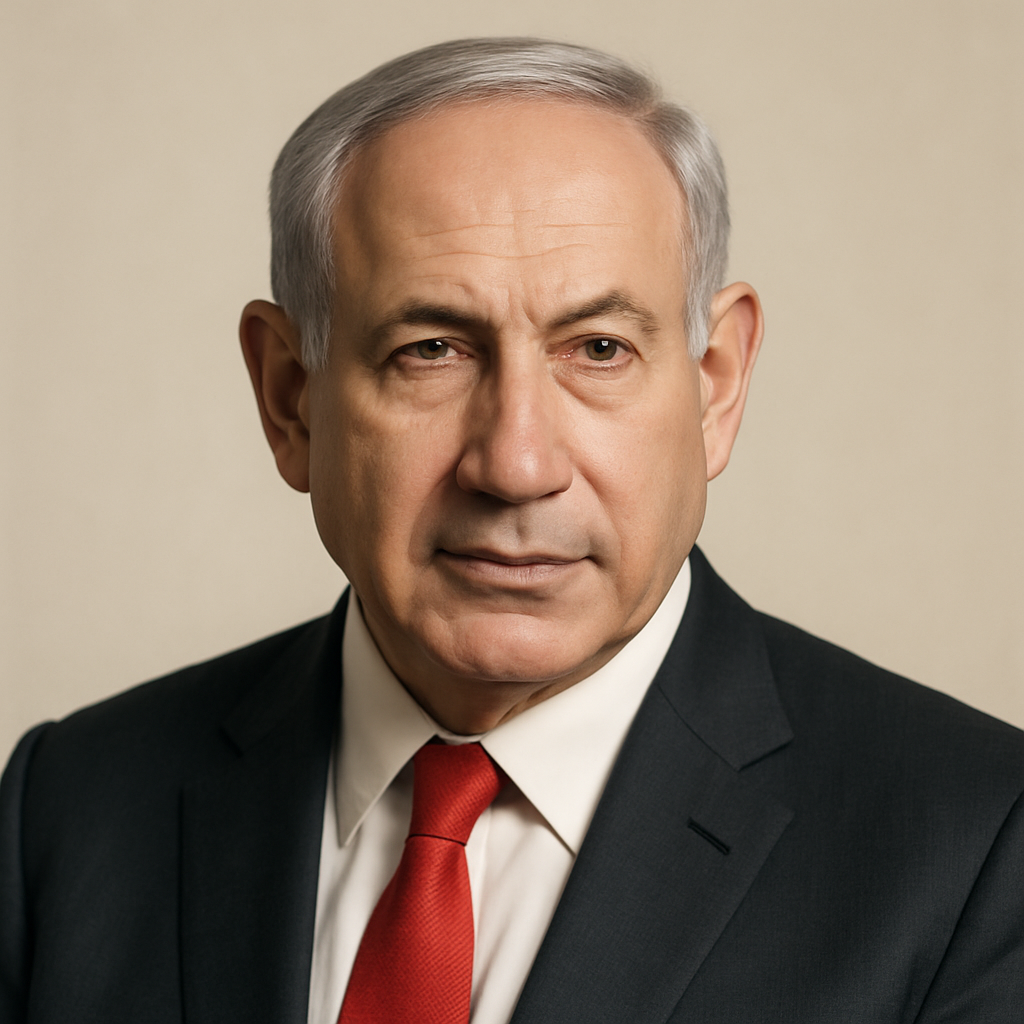
PM Netanyahu at the Knesset’s “Unto Every Person There is a Name” Ceremony on Holocaust Martyrs' and Heroes' Remembrance Day
 Benjamin Netanyahu · Prime Minister of Israel
- Context
- Netanyahu addressed the Knesset's 'Unto Every Person There is a Name' ceremony on Holocaust Martyrs' and Heroes' Remembrance Day on April 24, 2025.
- Main themes
- Holocaust remembrance, personal family history, immigration to the Land of Israel, Zionist pioneering spirit, loss and survival, Jewish identity, Yom HaShoah ceremony
- Duration
- ~2 min
- Words
- 199
- Sentences
- 13
- Readability
- 72
- Grade
- 7.0
- Syntax
- 2.74
- Vocabulary
- 2.19
The broad sphere of national life a sentence belongs to. Every sentence has an Arena, so it is the denominator the other indices are read against.
Other13 sentences in 4 paragraphs
In 1933, my late father-in-law, Shmuel Ben-Artzi, then Shmuel Hahn, left his hometown of Biłgoraj, and via Warsaw, immigrated to the Land of Israel. His father Moshe accompanied him along the way and tried to persuade him in every way not to immigrate to the Land of Israel.
He tried to persuade him by using some of the values he learned at home, which he really loved. He also told him: 'You have nothing over there. What will you do there? Look at what’s right here.'
Shmuel was very conflicted, because on the one Hahnd he really loved his father and his brothers and sisters, especially his twin sister Yehudit. But on the other Hahnd, he wanted with all his heart to be a pioneer in the Land of Israel and also a pioneer of the Novardok Yeshiva, an elite unit. He would build the foundation in Bnei Brak.
In the end, he decided to go. He worked in an orchard for eight years. Later, he became an educator, and one who left his mark on many generations, including people who passed through the Knesset as well as those in the media who also talked about him. “The educator