




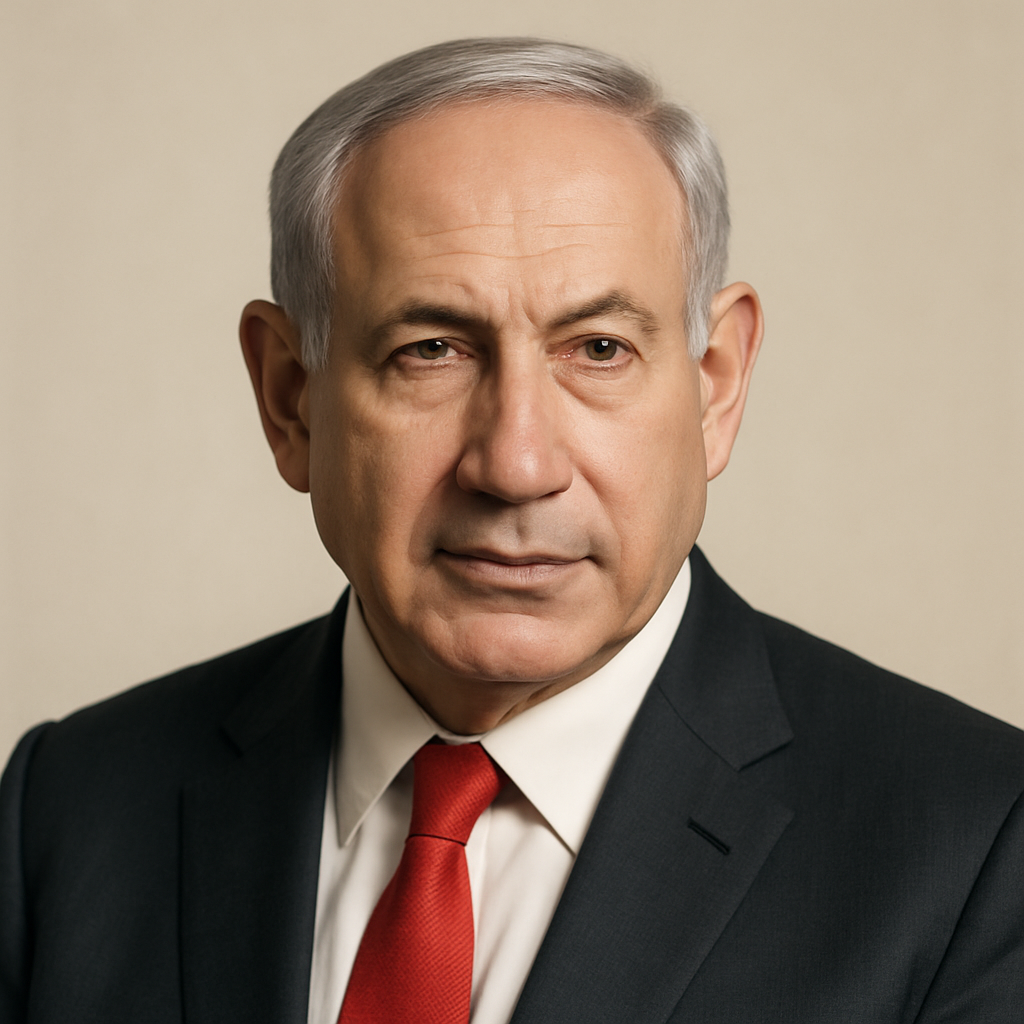
Remarks by PM Netanyahu at the State Ceremony Marking Holocaust Martyrs' and Heroes' Remembrance Day at Yad Vashem
 Benjamin Netanyahu · Prime Minister of Israel
- Context
- Netanyahu addressed Israel's State Ceremony marking Holocaust Remembrance Day at Yad Vashem on April 20, 2020, drawing parallels between the Holocaust and the COVID-19 pandemic.
- Main themes
- Holocaust remembrance, coronavirus pandemic comparison, Jewish sovereignty and self-reliance, antisemitism and Iran's threats, national unity, IDF security readiness, Israeli achievements, Arab-Muslim relations, Warsaw Ghetto Uprising, lessons of the Holocaust
- Duration
- ~9 min
- Words
- 1,027
- Sentences
- 64
- Readability
- 58
- Grade
- 9.2
- Syntax
- 2.64
- Vocabulary
- 2.26
The broad sphere of national life a sentence belongs to. Every sentence has an Arena, so it is the denominator the other indices are read against.
Other64 sentences in 12 paragraphs
Citizens of Israel, first and foremost our brothers and sisters, Holocaust survivors,
We all embrace you at this time, and we do so with profound appreciation and love. We grieve the Holocaust survivors who were recently taken from us by the coronavirus and we send our condolences to their families. We share in your pain.
Today I spoke with Luba, Michael Katz’s niece. Michael was a child when his family was killed in the Holocaust. His house was bombed. He experienced hardships and was forced to wander the world. He reached Kazakhstan and eventually made his way to Israel. Today, he is 92 years old. He survived the Holocaust and he beat the coronavirus. I am filled with admiration and wonder for his spirit and his strength. Especially in light of what I remember hearing as a child, what I heard Yehiel De-Nur (Ka-Tsetnik) say when he testified at Eichmann’s trial and spoke of 'the other planet.'
There was great suffering on that planet, in the death camps, and there were different rules of nature. Every fraction of a second lasted forever. The very air they breathed was different. The sun did not shine there. I head Ka-Tsetnik and the other survivors say, 'You can never understand what we experienced.' They were right; we will never be able to understand because there is nothing similar to the Holocaust. This is also true of the coronavirus pandemic. Some people view it as the greatest challenge humanity has faced since World War II.
We face many difficulties at this time, but—by any measure—they cannot and do not compare with the methodical, diabolical extinction of six million Jews. We are currently facing a dangerous plague—but plagues ravaged the ghettos and camps. The confinement of tens of thousands of Jews in a very small area claimed countless victims who died from typhus and dysentery.
Of course, the situation today is entirely different. Today, we have a national home, we have our own country—a strong, advanced and highly appreciated country. Three months ago, we hosted the World Holocaust Forum in Jerusalem, and leaders from all over the world marked the 75th anniversary of the liberation of Auschwitz. I saw them. I spoke with them. They were deeply impressed with our success in transforming helplessness into strength and tremendous achievements. And all the leaders who were there committed to fighting against antisemitism and other expressions of racism. Of course, we all welcomed that, but at the same time—and this was my central message at the Holocaust Forum—Israel must always be responsible for its own destiny. In any event, at any time, we must have the strength and the willingness to defend ourselves by ourselves.
In the months since then, we received proof of this on a daily basis. The coronavirus outbreak requires a global fight against the virus—nothing less—and it demonstrates the importance of national sovereignty. Unlike the Holocaust, this time we identified the danger in time. We made important decision, such as closing the country’s borders, and we mobilized all the state’s systems in the war against the coronavirus. We especially mobilized your willingness, your commitment and your sense of responsibility, citizens of Israel. Our accomplishments serve as a role model for many countries around the world.
Alongside our fight for our health and our lives, citizens of Israel, the fight to safeguard the country’s security continues at all times. The lessons of the Holocaust obligate us to be as alert as ever. Radical Islam, led by Iran, continues to threaten to destroy us. These threats did not dissipate in the coronavirus storm. They still exist, and we are as determined as ever to respond to them. The IDF and the other security bodies are currently helping citizens through the coronavirus crisis, but make no mistake: we are as careful as ever to maintain our operational readiness to stop any danger—on our borders and far beyond them.
The coronavirus has changed priorities around the world, and it may also change priorities in the Middle East. I am hopeful that we will strengthen even more our ties with Arab and moderate Muslim countries. I was deeply impressed some time ago to see a delegation of Muslim religious leaders visiting Auschwitz for International Holocaust Day. On behalf of the Holocaust survivors, I wish to thank these religious leaders. They unhesitatingly recognized the scope of the crime committed against us and they firmly condemned it.
Citizens of Israel, the challenges we face require broad unity in the people and the country. This is also a fundamental lesson we learned from the Holocaust. During the Warsaw Ghetto Uprising in 1943, the fight against the Nazis was led by two opposing organizations: one headed by Mordechai Anielewicz, a member of the Jewish Combat Organization, and other headed by Paweł Frenkiel, a member of Beitar. My mentor and friend, the late Moshe Arens, who investigated the history of the uprising, lamented until his dying day the failure of the two organizations to unite. At our last meeting just days before he passed away, Moshe said to me, 'How, in the face of this hateful enemy, could they not set aside their rivalry and unite?' But their ideological rivalry was stronger than their ability to stand united against their enemy. After 77 years, we must act differently. We must have unity.
You, who are lighting the torches of remembrance and heroism, represent unity in all its glory. This year, my wife and I were unable to visit you because of the coronavirus. However, we listened to your life stories with amazement: The childhoods that were stolen from you, the years of terror and agony, the painful loss of your family members, your rescue from the inferno, your welcome contribution to building our country.
We salute you and honor you with boundless appreciation: Zohar Arnon, Aviva Blum-Wachs, Haim Arbiv, Lea Miriam Reuveni, Avraham Cami, Yehuda Bellis and Naomi Cassuto. You are all role models for our people’s tremendous strength. As is written in Psalms 113:7, 'He raises the poor from the dust and lifts the needy from the ash heap,' from helplessness to independence, slavery to redemption, death to life.