




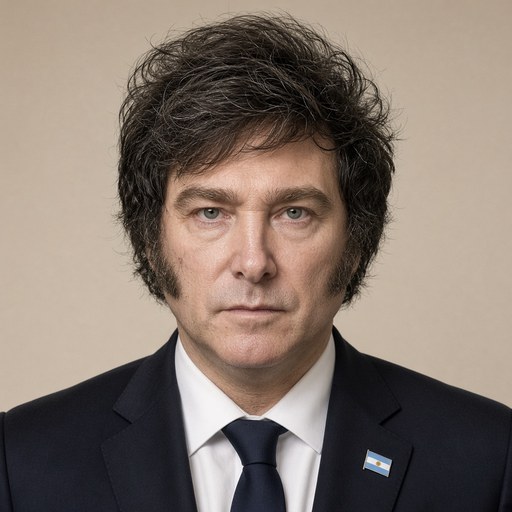
Words of the President of the Nation, Javier Milei, after receiving the Röpke Prize from the Liberal Institute in Switzerland.
 Javier Milei · President of Argentina
- Context
- Milei addressed the Liberal Institute in Switzerland on January 24, 2025, upon receiving the Wilhelm Röpke Prize, highlighting Argentina's economic reforms.
- Main themes
- Economic liberalism, fiscal austerity, monetary rigor, inflation, Argentine economic miracle, Wilhelm Röpke Prize, Ludwig Erhard and German economic miracle, poverty reduction, deficit elimination, critique of Keynesianism, free market principles, intellectual courage
- Duration
- ~25 min
- Words
- 2,944
- Sentences
- 113
- Readability
- 48
- Grade
- 12.9
- Syntax
- 3.28
- Vocabulary
- 2.19
Translated from Spanish
The broad sphere of national life a sentence belongs to. Every sentence has an Arena, so it is the denominator the other indices are read against.
Other113 sentences in 20 paragraphs
Hello everyone! I feel like I'm in Buenos Aires. It is an honor for me to have been invited here today by the Liberal Institute and all the organizers, and to be awarded the Wilhelm Röpke Prize in honor of one of the greatest representatives of liberalism in recent history. Everyone here knows that Professor Röpke grew up and studied while facing the destructive jaws of inflation. After World War I, Germany went through long periods of inflation as it abandoned the gold standard and began issuing unbacked fiat money to finance the war. After the war ended, it continued printing banknotes by the ton, which ultimately led to hyperinflation that, within two years, saw the exchange rate of the mark against the dollar rise from 60 to 4.2 trillion, in Spanish, four trillion in English, that is, a 4, a 2, and 11 zeros.
Mises said that while socialists keep repeating their lies, we must keep repeating the same truths, for example, the monetary nature of inflation. That is why it is hard for me; I look at the numbers, and it is truly shocking that we have to discuss certain things. All of this motivated Wilhelm to dedicate his life to understanding inflation, ignoring what his professors advised and reading those whom his professors condemned. This ultimately helped him lay the theoretical foundations of what became the great German economic miracle, serving as an advisor to Adenauer. He dedicated the last years of his life to harshly criticizing the monetary policies of Keynesian politicians, whom he accused of intentionally generating inflation, despite trying to whitewash the phenomenon under the title of "expansionism" or "liquidity injection."
Why do I tell all this? For two reasons: first, because I admire the conviction with which he defended reason, honesty, and common sense in the midst of the moral decay and intellectual dishonesty that prevailed at the time. He even confronted one of the bloodiest regimes our species has ever known, which cost him his exile. I wish there were more Wilhelm Röpke in life who defend what is right and true without fear of the reprisals of a totalitarian majority. Because, as Saint Augustine said: "What is right is right, even if no one does it, while what is wrong is wrong, even if everyone does it." Second, because I find several parallels striking. Without intending to place myself on the same level as a man like Röpke, I find it curious that, just as so many years ago in Germany, today the world speaks of the Argentine economic miracle for having returned exactly to the same foundations: fiscal austerity and monetary rigor. Fiscal austerity as a form of respect for the citizen who pays their taxes by force, since a leader cannot squander the citizens' money as if it were infinite, and monetary rigor to avoid defrauding the population with currency seigniorage, issuing banknotes as if this had no consequences or, even, as if it were beneficial, as some fiscal degenerates try to make us believe.
I also find it curious that simply doing things right is considered a miracle, because it shows how normalized it is to do things wrong, and that is simply a tragedy. In fact, there is a very interesting quote from Thomas Sowell that says the first law of economics is scarcity, meaning that there is not enough for everyone; and the first law of politics is to ignore the first law of economics.
In the words of Ludwig Erhard himself, the chancellor who carried out the German economic miracle: "Economic well-being is not a miracle, but the consequence of the honest effort of an entire people, according to the principles of freedom, when they have been given the opportunities to use their human initiative and human energy." That is why I long for what we now call the "Argentine miracle" to spread throughout the world as a multiplying germ of wealth. And for that reason, I want to briefly share our experience during the first year of our presidency.
At the beginning of our administration, we had a consolidated fiscal deficit of 15 points, of which five were in the Treasury and ten were swept under the rug at the Central Bank. This deficit was the source of all our ills, since without a deficit, there is no debt, no issuance, and no inflation. After having made the largest adjustment in the history of humanity, today we find ourselves with a sustained fiscal surplus and free of default for the first time in the last 123 years. At the same time, at the beginning of our administration, the inflation rate was traveling at a pace of 17,000% annualized in the wholesale index. Today, the same annualized index is traveling at 10% annually, meaning we have reduced inflation by 1,700 times, and we are getting closer every day to it being just a bad memory. As a direct consequence of having annihilated inflation, we reduced poverty from 54% in the first quarter of 2024 to 38% in the third, and we are confident that this path will continue. In fact, the monthly frequency data is already at 36%. That is, we have lifted more than 10 million Argentines out of poverty.
At the beginning of our administration, the exchange rate gap between the official dollar and the free dollar was 180%. Today, the exchange rate gap is practically dead. We work day and night to finish cleaning up the balance sheet of the Central Bank so that we can lift the currency controls once and for all. During 2024, we saw a strong appreciation of our currency, something almost unprecedented for our country, which caused the average basic salary to grow from 300 dollars to 1,100 dollars. At the beginning of our administration, we had a country risk of 1,900 points, which had even been higher, as at the time we won the election it was at 3,000, and sovereign bonds were trading between 20 and 35 dollars. Today, the country risk is around 600 basis points, and our bonds are now hovering around 70 dollars. Reducing the country risk at this pace allows us to lower the interest rate in our economy, which we have already reduced from 133% to 32%, thus improving the ability of Argentines to access cheap credit, facilitating investment and job creation. It is for this reason that, during 2024, we saw an unprecedented boom in mortgage loans in our history. That is, we went from discussing hyperinflation to discussing 30-year mortgage loans.
At the beginning of our administration, our economy was oppressed by regulations that complicated life for everyone and scared off any hint of investment. To date, we have already eliminated more than 900 regulations at a rate of more than 3 per day. And, if you consider that the Ministry of Deregulation started acting in the middle of the year, it means that, basically, we are removing 6 regulations per day. At the same time, with the Bases Law and Decree 70 as a whole, we have made the largest structural reform in Argentine history, eight times larger than the one President Menem made in the early 1990s. And I tell you something: we still have 3,200 structural reforms left, and we are going to make Argentina the freest country in the world.
At the beginning of our administration, Argentina was a global example of everything that should not be done or said. Today, we are viewed favorably by investors and citizens from all over the world, to the point that we have gone from being one of the countries with the worst economic results in the last 40 years to being one of the best projected for the next 40. This growth projection is based on various reasons. First, the economy has entered a cyclical recovery based on two factors: on one hand, we are seeing a sustained rebound in real wages and pensions due to the collapse of inflation; on the other hand, companies have normalized their inventories after having overstocked throughout 2023 due to the inflationary spiral. These two cyclical phenomena have energized our economy and explain the phenomenal growth of the last quarter of last year. To give you an idea, the last quarterly figure is 3.9%, which annualized is 17%, at that pace the Argentine economy is traveling.
In addition, we have the 15 points of GDP that we adjusted and, by definition, returned to the private sector in the form of savings, which generates an increase in both investment and then consumption. This is joined by another factor: the reduction of the tax burden, either through the elimination of the inflation tax or through the reduction of taxes that we have already begun and will deepen this year. In fact, yesterday, we announced the elimination of withholdings for regional economies and have begun a reduction of withholdings for the main agricultural products.
That is why we are working on a structural tax reform to reduce the number of national taxes by 90% and return to the provinces the tax autonomies they should never have lost. Thus, we aim to achieve a federalism marked by fiscal competition among our provinces to see who attracts more investments. In this matter, here in Switzerland, they have several centuries of advantage over us.
The fourth foundation on which the growth project we will see this year rests has to do with the monetary issue. The convergence of the parallel exchange rate to the official exchange rate, which we have been seeing for months, brings us closer every day to the definitive exit from currency controls, a monstrosity that should never have existed and that this year will end once and for all. I repeat: a monstrosity that should never have existed and that this year will end once and for all.
For this, we are working on different alternatives to provide a definitive solution to the problem of the Central Bank's stocks. In that sense, the meetings we have had with the IMF in Washington have been very positive. In parallel, to be able to close the Central Bank, as we have promised, and thus end inflation in our country forever, we are advancing… if I were populist, I would have made the point for this to happen… I didn't do it, but it happened anyway. Spontaneous order is wonderful and, obviously, the will of the individual to be free is much, much more. In this sense, we are moving towards a currency competition scheme so that all Argentines can use the currency they want in their daily transactions, except for tax payments for now. I mention all this to make it clear that growth has come to stay alongside the fiscal surplus. In fact, recent studies show that a surplus of the characteristics we have achieved, along with financial balance, gives us a basis for sustained growth of 4.5% per capita annually. This would imply that in 50 years Argentina could be catching up to the United States. And if we add to that… in dynamics, right? And, if we add to that, the adjustment was made by cutting spending, not raising taxes; if we add the 800 structural reforms and the 900 deregulations, without a doubt, Argentina could grow much faster. And, without a doubt, with the contributions being made by the brilliant head of the Council of Advisors, Dr. Demian Reidel, to advance the implementation of artificial intelligence in Argentina, we will undoubtedly achieve this much sooner.
To deepen growth, it is also essential to free ourselves from the straitjacket of foreign trade that is currently squeezing us, so that we can import and export more goods and services, moving from having a handful of regional clients to having almost 200 global clients. This will initiate a growth process that will bring us closer to the levels of prosperity of the great powers, just as we did more than 100 years ago. That is why we are seeking that our first step on this path is to achieve the enactment of a free trade agreement with the United States and begin to take advantage of all our capabilities that are currently being wasted. We must leverage our diversity and unique ecosystem, something that only two or three countries in the world can boast of, given that we have mountains, forests, glaciers, deserts, jungles, beaches, plateaus, lakes, marshes, steppes, and vast plains. Each of these biomes represents different potential units. Not to mention, our mountain range has abundant lithium, silver, copper, gold, and uranium, minerals that the global economy needs and that, due to negligence, expulsion of investments, and lack of long-term vision, we currently export zero.
In 2024, we took the first steps with an incentive regime for large investments that provided a logical fiscal and legal framework for investments of over 200 million dollars. This resulted in approval requests for more than 12 billion dollars and announcements for other billions in sectors such as infrastructure, mining, steel, automotive, technology, oil, and gas. In some sense, this regime is a glimpse of what the tax system should look like in Argentina: reducing taxes, simplifying them, favoring innovation, generating wealth, and, above all, the accumulation of capital. And if we were able to achieve all this in just over 12 months, with the entire political and propaganda apparatus against us, and despite having only 15% of the deputies and 10% of the senators, imagine what we are capable of doing in the next three years with favorable winds.
Argentina has all the potential to become a Western mecca for business opportunities and growth for its inhabitants, with freedom as the main driving force. For that reason, and as a closing remark, I would like to dedicate a few words to you, defenders of freedom. Do not let yourselves be swayed by the diatribes of collectivism that seeks to destroy any dissent. What makes us so special and dangerous to any type of regime is our eloquence, our ability to speak the truth. That is why they do not hate us: they invent laws to censor us and seek to imprison us or exile us, because they try to deny reality in order to sustain their lies. But what they will never be able to do is deny the overwhelming results of reality.
There is a phrase that Mises used, which was from Virgil, which is: "One must not yield to evil, one must combat it with greater strength." And you know this, because yesterday I stood up to him right in the dragon's den. Because just as was demonstrated in Germany, thanks to the ideas of Wilhelm Röpke, miracles exist, and it is enough to apply a model based on some elementary truths: that the State, no matter its size, cannot spend more than it collects in taxes; that inflation, which is destructive for an economy, is the result of monetary emission, and as such, to end it, one must not emit more money. Moreover, money should return to being private, as Hayek advocated. We must promote that the State be as small as possible so that society can be as free as possible, and we must defend life, liberty, and private property. If the countries of the West adhere to this small set of elementary ideas, I am sure that our future will be more prosperous than our present.
Thank you very much for this recognition, it is a true honor for me.
I am going to step out of protocol, sorry Walter, Walter is my interpreter. The case of Röpke is very moving for me because what led him to study economics so deeply was precisely inflation. And he had to dismiss the things that forced him to study and had to embrace other ideas. When Argentina fell into hyperinflation in 1989, I was a football player, I was a goalkeeper. And one day, accompanying my mother to the supermarket, I was in my first year of Economics, and I saw prices rising and people rushing for products. And, faced with that situation, I said: “Either what I am studying is wrong or I am stupid.” So the dignified solution was to stop playing football and dedicate myself to studying economics seriously. And that obsession with economics led me to write my first academic article at the age of 20, called “Hyperinflation and Market Distortion.” And, after that, the obsession never stopped. The great fight was to dismantle all those stupid theories that have been defended in my country for about 80 to 90 years, and this time, we stood up saying that inflation is always and everywhere a monetary phenomenon and we are defeating inflation, therefore, they want to kill us. And if the elite is afraid, it is because they are going to be left without jobs; we need more unemployed politicians.
I also find Röpke's role very appealing in trying to strike that balance between theory and what it implies in terms of political implications, something I am trying to resolve as successfully as possible; if I don’t succeed, they would have already fired me, obviously. So, above all things, I want to thank you not only for the award but also for this warm reception. The truth is that you have surprised me; I must confess that you have moved me, and I have nothing but words of gratitude for such generosity towards me. So have a very good afternoon, may God bless you, may the forces of heaven accompany us. And long live freedom, damn it! Thank you very much.
The original Spanish. The tags above are read on the English translation's sentences.
¡Hola a todos! I feel like I'm in Buenos Aires. Es un honor para mí haber sido invitado hoy aquí por el Liberal Institute y todos los organizadores, y ser galardonado con el premio Wilhelm Röpke en honor a uno de los más grandes representantes del liberalismo de la historia reciente. Todos aquí saben que el profesor Röpke creció y estudió atravesando las fauces destructivas de la inflación. Tras la Primera Guerra Mundial, Alemania atravesó largos períodos de inflación dado que abandonó el patrón oro y se dedicó a emitir papel fiduciario sin respaldo para financiar la guerra. Tras el fin de la guerra, siguió imprimiendo billetes a toneladas, lo que terminó derivando en una hiperinflación que llevó en el lapso de dos años, el tipo de cambio del marco contra el dólar pasó de 60 a 4.2 billones, en español, cuatro trillones en inglés, es decir, un 4, un 2 y 11 ceros.
Mises decía que mientras los socialistas sigan repitiendo sus mentiras, nosotros tenemos que seguir repitiendo las mismas verdades, en ejemplo, la naturaleza monetaria de la inflación. Por eso, me cuesta, miro los números y, verdaderamente, es impactante que tengamos que discutir ciertas cosas. Todo esto motivó a Wilhelm a dedicar su vida a entender la inflación desoyendo lo que sus profesores aconsejaban y leyendo a quienes sus profesores condenaban. Esto le terminó sirviendo para sentar las bases teóricas de lo que fue el gran milagro económico alemán, siendo asesor de Adenauer. Dedicó los últimos años de su vida a criticar duramente las políticas monetarias de los políticos keynesianos, a quienes acusaba de generar inflación intencionadamente, a pesar de intentar lavarle la cara al fenómeno bajo el título de "expansionismo" o "inyección de liquidez".
¿Por qué cuento todo esto? Por dos motivos: en primer lugar, porque me resulta admirable la convicción con la que defendió la razón, la honestidad y el sentido común en medio de la decadencia moral y la deshonestidad intelectual que reinaba en la época. Incluso le hizo frente a uno de los regímenes más sanguinarios que haya conocido nuestra especie, lo que le costó el exilio. Ojalá hubiera más Wilhelm Röpke en la vida que defiendan lo correcto y lo verdadero sin miedo a las represalias de una mayoría totalitaria. Porque, como decía San Agustín: "Lo correcto es correcto, aunque nadie lo haga, mientras que lo incorrecto es incorrecto, aunque lo haga todo el mundo". En segundo lugar, porque me llama la atención varios paralelismos. Sin ánimo de ponerme a la altura de un hombre como Röpke, me resulta curioso que, tal como hace tantos años en Alemania, hoy el mundo habla del milagro económico argentino por haber vuelto exactamente a las mismas bases: la austeridad fiscal y rigurosidad monetaria. Austeridad fiscal como forma de respeto al ciudadano que paga sus impuestos por la fuerza, dado que un dirigente no puede despilfarrar el dinero de la ciudadanía como si fuese infinito y, rigurosidad monetaria para no estafar a la población con señoreaje de la moneda, emitiendo billetes como si esto no tuviera consecuencia alguna o, incluso, como si fuese beneficioso, como intentan hacer creer algunos degenerados fiscales.
También me resulta curioso que simplemente hacer las cosas bien sea considerado un milagro, porque denota lo naturalizado que está hacer las cosas mal, y eso es lisa y llanamente, una tragedia. De hecho, hay una frase muy interesante de Thomas Sowell que dice que la primera ley de la economía es la escasez, es decir, que no hay de todo para todos; y la primera ley de la política es ignorar la primera ley de la economía.
En palabras del propio Ludwig Erhard, el canciller que llevó adelante el milagro económico alemán: "El bienestar económico no es un milagro, sino la consecuencia del esfuerzo honesto de todo un pueblo, según los principios de la libertad, cuando le han sido otorgadas las posibilidades de usar su iniciativa humana y su energía humana". Por eso, anhelo que lo que hoy llamamos "milagro argentino" se contagie por todo el mundo como un germen multiplicador de riqueza. Y, por ello, quiero contarles brevemente nuestra experiencia durante el primer año de nuestra presidencia.
Al inicio de nuestra gestión teníamos 15 puntos de déficit fiscal consolidados, de los cuales cinco estaban en el Tesoro y diez estaban barridos debajo de la alfombra en el Banco Central. Este déficit era el origen de todos nuestros males, ya que, sin déficit, no hay deuda ni emisión ni inflación. Tras haber hecho el ajuste más grande de la historia de la humanidad, hoy nos encontramos con superávit fiscal sostenido y libre de default por primera vez en los últimos 123 años. A su vez, al inicio de nuestra gestión, la tasa de inflación viajaba a un ritmo de 17.000% anualizado en el índice mayorista. Hoy, el mismo índice anualizado se encuentra viajando al 10% anual, es decir, bajamos 1.700 veces la inflación, y estamos cada día más cerca de que solo sea un mal recuerdo. Como consecuencia directa de haber aniquilado la inflación, bajamos la pobreza del 54% en el primer trimestre de 2024 a 38% en el tercero, y confiamos en que continuará esta senda. De hecho, el dato en frecuencia mensual ya está en el 36%. Es decir, bajamos la pobreza en más de 21 puntos en la frecuencia mensual, quiere decir que hemos sacado de la pobreza a más de 10 millones de argentinos.
Al inicio de nuestra gestión, la brecha cambiaria entre el dólar oficial y el dólar libre era del 180%. Hoy, la brecha cambiaria está prácticamente muerta. Trabajamos día y noche para terminar de sanear el balance del Banco Central para poder levantar el cepo cambiario de una vez y para siempre. Durante el 2024 vimos una fuerte apreciación de nuestra moneda, algo casi sin precedentes para nuestro país, lo que provocó que el salario básico promedio crezca de 300 dólares a 1.100 dólares. Al inicio de nuestra gestión, teníamos un riesgo país de 1.900 puntos, que venía de ser incluso más alto, ya que al momento que habíamos ganado la elección estaba en 3.000, y los bonos soberanos cotizaban entre 20 y 35 dólares. Hoy, el riesgo país se encuentra cerca de los 600 puntos básicos, y nuestros bonos ya se encuentran rondando los 70 dólares. Bajar el riesgo país a este ritmo nos permite bajar la tasa de interés de nuestra economía, la cual ya la bajamos del 133% al 32%, mejorando así la capacidad de los argentinos para acceder al crédito barato, facilitando la inversión y la generación de puestos de trabajo. Es por esto mismo que, durante el 2024, vimos un boom de créditos hipotecarios sin comparación en nuestra historia. Es decir, pasamos de discutir la hiperinflación a discutir créditos hipotecarios a 30 años.
Al inicio de nuestra gestión, nuestra economía se encontraba oprimida por regulaciones que complicaban la vida a todos y espantaban cualquier atisbo de inversión. Al día de hoy ya eliminamos más de 900 normativas a razón de más de 3 por día. Y, si ustedes consideran que el Ministerio de Desregulación empezó a actuar a mitad de año, quiere decir que, básicamente, estamos sacando 6 regulaciones por día. A su vez, la Ley Bases y el DNU 70 en su conjunto, hemos hecho la reforma estructural más grande de la historia argentina, ocho veces más grande que la que hizo el Presidente Menem a principios de los años 90. Y les digo algo: aún nos quedan 3.200 reformas estructurales más y vamos a hacer de Argentina el país más libre del mundo.
Al inicio de nuestra gestión, Argentina era ejemplo a nivel global de todo lo que no debía hacerse ni decirse. Hoy, somos vistos con buenos ojos por inversores y ciudadanos de todo el mundo, a punto tal que pasamos de ser uno de los países con peores resultados económicos en los últimos 40 años a ser uno de los mejores que se proyectan para los próximos 40. Esa proyección de crecimiento está sostenida en diversas razones. En primer lugar, la economía ha entrado en una recuperación cíclica basada en dos factores: por un lado, estamos viendo un repunte sostenido en los salarios reales y las jubilaciones por el derrumbe de la inflación; por otro lado, las empresas normalizaron sus inventarios luego de haberse sobrestockeado durante todo el año 2023 producto de la espiral inflacionaria. Estos dos fenómenos cíclicos han dinamizado nuestra economía y explica el fenomenal crecimiento del último trimestre del año pasado. Para tener una idea, el último dato trimestral es del 3,9% que anualizado es de 17%, a ese ritmo viene viajando la economía argentina.
Además, tenemos los 15 puntos del PBI que ajustamos y, por definición, le devolvimos al sector privado en forma de ahorro, lo que genera un aumento tanto de la inversión como luego del consumo. A esto se suma otro factor: la baja de la carga impositiva, ya sea por la eliminación del impuesto inflacionario o por la reducción de impuestos que ya hemos comenzado y vamos a profundizar durante este año. De hecho, en el día de ayer, hemos anunciamos la eliminación de retenciones para las economías regionales y hemos iniciado una reducción de las retenciones para los principales productos del agro.
Es por ello que estamos trabajando en una reforma impositiva estructural para reducir en un 90% la cantidad de impuestos nacionales y devolverle a las provincias, las autonomías impositivas que nunca debieron haber perdido. Así, apuntamos a lograr un federalismo marcado por la competencia fiscal entre nuestras provincias para ver a quién atrae más inversiones. En esta materia, acá en Suiza, nos llevan varios siglos de ventaja.
La cuarta base sobre la que se sostiene el proyecto de crecimiento que veremos este año tiene que ver con la cuestión monetaria. La convergencia del tipo de cambio paralelo al tipo de cambio oficial, que estamos viendo desde hace meses, nos acerca cada día un poco más a la salida definitiva del cepo cambiario, un mamarracho que nunca debería haber existido y que este año se termina de una vez por todas. Lo repito: un mamarracho que nunca debería haber existido y que este año se termina de una vez por todas.
Para ello, estamos trabajando en diferentes alternativas para darle una solución definitiva al problema de los stocks del Banco Central. En ese sentido, han sido muy positivas las reuniones con el FMI que hemos tenido en Washington. En paralelo, para poder cerrar el Banco Central, como hemos prometido, y así acabar para siempre con la inflación en nuestro país, estamos avanzando… si fuera populista, hubiera hecho el punto para que justamente pasara esto… no lo hice, pero pasó igual. El orden espontáneo es maravilloso y, obviamente que la voluntad del individuo por ser libre más, muchísimo más. En este sentido, estamos avanzando hacia un esquema de competencia de monedas para que todos los argentinos puedan utilizar la moneda que quieran en sus transacciones cotidianas, exceptuando el pago de impuestos por ahora. Menciono todo esto para dejar en claro que el crecimiento llegó para quedarse de la mano del superávit fiscal. De hecho, estudios recientes muestran que un superávit de las características como el que hemos conseguido, junto con el equilibrio financiero, nos da una base de crecimiento sostenido del 4,5% per cápita anual. Eso implicaría que en 50 años Argentina podría estar alcanzando a los Estados Unidos. Y si a eso… en dinámica ¿no? Y, si a eso, le sumamos que el ajuste se hizo bajando gastos, no subiendo impuestos; si se suman las 800 reformas estructurales y las 900 desregulaciones, sin lugar a dudas, Argentina podría crecer mucho más rápido. Y, sin lugar a dudas, con los aportes que está haciendo el genial jefe del Consejo de Asesores, el doctor Demian Reidel, para avanzar en la implementación de la inteligencia artificial en Argentina, sin dudas, lo vamos a lograr mucho antes.
Para profundizar el crecimiento, también es imprescindible liberarnos del corset del comercio exterior que hoy nos estruja, para poder importar y exportar más bienes y servicios, dejando de tener un puñado de clientes regionales para tener casi 200 clientes globales. Esto iniciará un proceso de crecimiento que nos hará converger a los niveles de prosperidad de las grandes potencias, tal como supimos hacer hace más de 100 años. Por eso estamos buscando que nuestro primer paso en este sendero sea lograr promulgar un tratado de libre comercio con Estados Unidos y comenzar a aprovechar todas nuestras capacidades que hoy están siendo desaprovechadas. Poder aprovechar nuestra diversidad y ecosistema único, algo de lo que solo dos o tres países del mundo pueden hacer alarde, dado que contamos con montañas, bosques, glaciares, desiertos, selvas, playas, altiplanos, lagos, esteros, estepas y extensas llanuras. Cada uno de estos biomas representa diferentes unidades potenciales. Sin ir más lejos, nuestra cordillera cuenta con abundante litio, plata, cobre, oro y uranio, minerales que la economía global necesita y que, por desidia, expulsión de inversiones y falta de visión a largo plazo, hoy exportamos cero.
En 2024 dimos los primeros pasos con un régimen de incentivos a las grandes inversiones que le dieron un marco fiscal y jurídico lógico a las inversiones de más de 200 millones de dólares. Esto redundó en pedidos de aprobación por más de 12.000 millones de dólares y anuncios por otros tantos miles de millones en sectores como infraestructura, minería, siderurgia, automotriz, tecnología, petróleo y gas. En algún sentido, este régimen es un atisbo de hacia qué sistema impositivo debiera ir la Argentina: reducción de impuestos, simplificándolos, favoreciendo la innovación, generación de riqueza y, sobre todas las cosas, la acumulación de capital. Y si pudimos lograr todo esto en poco más de 12 meses, con todo el aparato político y propagandístico en contra, y a pesar de contar con solo el 15% de los diputados y el 10% de los senadores, imaginen de lo que somos capaces de hacer en los próximos tres años con viento a favor.
Argentina tiene todo el potencial para convertirse en una meca occidental en materia de oportunidades comerciales y crecimiento para sus habitantes, con la libertad como principal motor. Por eso mismo, y a modo de cierre, me gustaría dedicarles unas palabras a ustedes, defensores de la libertad. No se dejen doblegar por las diatribas del colectivismo que busca destruir cualquier disidencia. Lo que nos hace tan especiales y peligrosos para cualquier tipo de régimen es nuestra elocuencia, nuestra capacidad para hablar con la verdad. Por eso no nos odian: inventan leyes para censurarnos y buscan meternos presos o exiliarnos, porque intentan negar la realidad para poder sostener sus mentiras. Pero lo que nunca podrán será negar los aplastantes resultados de la realidad.
Hay una frase que usaba Mises, que era de Virgilio que es: "No hay que ceder frente al mal, hay que combatirlo con más fuerza". Y eso les consta, porque ayer me le paré al de frente en la propia casa del dragón. Porque tal como se demostró en Alemania, gracias a las ideas de Wilhelm Röpke, los milagros existen, y alcanza con aplicar un modelo basado en algunas verdades elementales: que el Estado, tenga el tamaño que tenga, no pueda gastar más de lo que recauda con impuestos; que la inflación, que es destructiva para una economía, es producto de la emisión monetaria, y como tal, para terminar con ella no hay que emitir más dinero. Es más, el dinero debería volver a ser privado, tal como pregonaba Hayek. Hay que promover que el Estado sea lo más chico posible para que la sociedad sea lo más libre posible, y hay que defender la vida, la libertad y la propiedad privada. Si los países de Occidente nos atenemos a este pequeño set de ideas elementales, estoy seguro que nuestro futuro será más próspero que nuestro presente.
Muchas gracias por este reconocimiento, es un verdadero orgullo para mí.
Voy a salir del protocolo, perdón Walter, Walter is my intérprete. Me es muy movilizador el caso de Röpke porque lo que a él lo llevó a estudiar tan profundamente la economía fue justamente la inflación. Y tuvo que desestimar las cosas que le obligaban a estudiar y tuvo que abrazar otras ideas. Cuando Argentina cayó en hiperinflación en el año 1989, yo era un jugador de fútbol, era un arquero. Y un día, acompañando a mi mamá al supermercado, yo estaba en primer año de Economía, y veía que los precios subían y la gente se abalanzaba sobre los productos. Y, entonces ante esa situación, dije: “O lo que estoy estudiando está mal o soy tonto”. Entonces la solución de dignidad fue dejar de jugar al fútbol y dedicarme a estudiar economía, en serio. Y esa obsesión por la economía me llevó a escribir mi primer artículo académico a los 20 años, que se llama “La hiperinflación y la distorsión de los mercados”. Y, después de eso, la obsesión no paró nunca más. La gran pelea fue derribar todas esas teorías estúpidas que han defendido en mi país durante cerca de 80 a 90 años, y que esta vez, nos paramos de frente diciendo que la inflación es siempre y en todo lugar un fenómeno monetario y estamos derrotando la inflación, por ende, se quieren matar. Y si la casta tiene miedo es porque se va a quedar sin trabajo, necesitamos más políticos desempleados.
También me resulta muy atractivo el rol de Röpke tratando de hacer ese equilibrio entre la teoría y lo que implica la política, por lo que entraña en términos de entramado social, algo que estoy tratando de resolver lo más exitosamente posible, que si no me sale ya me hubieran echado, obvio. Así que, sobre todas las cosas, quiero darles las gracias no solo por el premio, sino también por esta tan cálida recepción. La verdad es que me han sorprendido, debo confesar que me han emocionado y no tengo más que palabras de agradecimiento por tanta generosidad para conmigo. Así que tengan muy buenas tardes, que Dios los bendiga, que las fuerzas del cielo nos acompañen. Y ¡Viva la libertad carajo! Muchas gracias.