




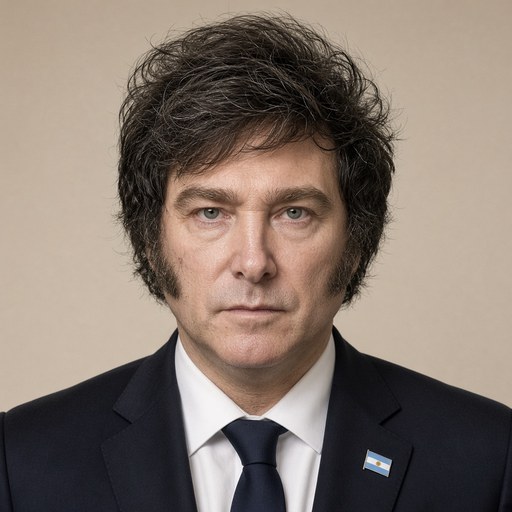
Words of the President of the Nation, Javier Milei, at the official event of the International Day in Memory of the Victims of the Holocaust.
 Javier Milei · President of Argentina
- Context
- Milei addressed a Holocaust Remembrance Day ceremony in Argentina on January 27, 2025, marking 80 years since the liberation of Auschwitz-Birkenau.
- Main themes
- Holocaust remembrance, antisemitism, defense of Israel, terrorism and Hamas, freedom vs. oppression, moral duty to speak out, hostages in Gaza, Argentine-Jewish solidarity, lessons of history, Torah and Jewish tradition, indifference as complicity
- Duration
- ~8 min
- Words
- 935
- Sentences
- 31
- Readability
- 44
- Grade
- 14.6
- Syntax
- 3.37
- Vocabulary
- 2.16
Translated from Spanish
The broad sphere of national life a sentence belongs to. Every sentence has an Arena, so it is the denominator the other indices are read against.
Other31 sentences in 11 paragraphs
Good morning everyone. I want to greet and thank the authorities of the Museum led by its president Marcelo Mindlin - who has invited me and part of my Cabinet to this important event - as well as the Holocaust survivors and their families who are with us today, and all those present who have come together on this very moving date. Today, like every January 27 for the past 19 years, we gather in different parts of the world to commemorate a new International Day of Remembrance of the Victims of the Holocaust.
This particular anniversary holds a very special emotional and symbolic weight for me. On one hand, because it marks 80 years since the liberation of Auschwitz-Birkenau, and on the other, because of the liberation of the hostages in Gaza, which began a few days ago. Undoubtedly, the Holocaust was one of the greatest horrors that humanity has suffered throughout its history, and it leaves an indelible stain on the conscience of past, present, and future generations. That is why we are here today with the duty and responsibility to remember, to continue honoring all the victims of that time and all the victims that the cult of intolerance, hatred, and death continues to claim; yesterday disguised as Nazism, today disguised as fundamentalism.
And beware of those who, in a trivial manner, throw around accusations and categorizations of Nazi at anyone who does not agree with their way of thinking, just as expressions from the left have done around the world, for example, with my friend Elon Musk, who is an unwavering defender of the State of Israel. But we should not be surprised because often these false accusations come from the same people who defend the terrorists of Hamas and rant against the State of Israel.
But what sense would the remembrance of the tragedy have if we do not draw a lesson from it that fits our times? During World War II, many of the leaders at that time did not raise their voices when the massacre was happening right in front of their noses. With their silence, they also became, in some way, complicit in the tragedy - because as I always say - it is the silence of the good that allows the barbarity of the bad. In the words of Elie Wiesel, a survivor of Auschwitz and Nobel Peace Prize laureate: “Indifference is not a beginning; it is an end, and therefore, indifference is always the friend of the enemy because it benefits the aggressor, never his victim whose pain is magnified when he feels forgotten.”
Today, unfortunately, the world is experiencing a situation that increasingly resembles what was happening before the onset of the Holocaust. The current global hour shows us daily, with each attack on Israel, that antisemitism and hatred towards Western civilization are more present than ever, which compels us not to relent in our struggle. As I mentioned before: the enemy may change its banner, but its miserable cause remains intact. The terrorist groups that exist today - if they had the capacity - would exterminate the Jewish people without a second thought and erase the State of Israel if they could.
That is why those of us who lead nations today have the obligation and responsibility not to make the same mistakes as the leaders of the past. Silence or looking the other way is no longer an option. Raising our voices against antisemitic intolerance and against terrorism is a duty.
Nothing is casual; this week's Parashah speaks of the epic of the Jewish people to escape slavery and conquer freedom. There was a Pharaoh who wanted to enslave and exterminate a people, but there was also a Moses who - with firmness and conviction - raised his voice and fearlessly exclaimed: “Yes, all of you are wrong, the Pharaoh and all his nation: freedom is not only possible but mandatory.”
But at that moment, the Torah tells us that not only did Pharaoh not listen, but even the Hebrew people did not listen to him. In fact, this week, in the Parashah, we are remembering the last three plagues: the plague of locusts, the plague when it was dark for three days, the eclipse of three days, and the plague of the firstborn, which was what ultimately unlocked the Jewish people's exit to the Promised Land. Therefore, this week must also give us hope that we will triumph and prevail over evil, as was achieved back in Egypt.
The Pasuk says: “And the people did not listen to Moses because of their broken spirit and hard work.” They were so immersed in their slavery that they could not even dream of freedom. Sometimes the world is so narrow and short-minded that many are not even prepared to hear the message of freedom. And that is why I want to take this opportunity to thank the commitment of the President of the United States, Donald Trump, for taking on the negotiations that will allow the hostages to return home; among them, the nine Argentines who are still kidnapped and for whose release we demand the utmost urgency.
Because, after all, regarding past and present tragedies, there is a historical thread of intolerant fundamentalism, an ideology of destruction that has had different faces, but which, in essence, represents the greatest obstacle to building a free world, a world for which we will not cease to fight until the last day of our lives.
That is why, just like yesterday, today we say and will continue to say time and again: Long live freedom!
The original Spanish. The tags above are read on the English translation's sentences.
Buenos días a todos. Quiero saludar y agradecer a las autoridades del Museo encabezadas por su presidente Marcelo Mindlin -que me ha invitado a mí y parte de mi Gabinete a tan importante acto-, también a los sobrevivientes del Holocausto y sus familias que hoy nos acompañan, y a todos los presentes que se han acercado en esta fecha tan conmovedora. Hoy, como todos los 27 de enero, desde hace ya 19 años, en distintas partes del mundo, nos juntamos para recordar un nuevo Día Internacional en Memoria de las Víctimas del Holocausto.
Este aniversario particular tiene para mí una carga emocional y simbólica muy especial. Por un lado, porque se cumplen 80 años de la liberación de Auschwitz-Birkenau, y por el otro, por la liberación de los rehenes en Gaza, que ha comenzado hace algunos días. Sin duda, el Holocausto fue uno de los horrores más grandes que ha sufrido la humanidad en toda su historia, y que -a su vez- deja una mancha imborrable en la conciencia de generaciones pasadas, presentes y futuras. Por eso, hoy estamos aquí con el deber y la responsabilidad de no olvidar, de seguir recordando por todas las víctimas de aquel entonces y por todas las víctimas que se sigue cobrando el culto a la intolerancia, el odio y la muerte; ayer disfrazado de nazismo, hoy disfrazado de fundamentalismo.
Y ojo con los que, de forma banal, revolean acusaciones y categorizaciones de nazi a cualquiera que no coincida con su forma de pensar, tal como lo hicieron expresiones de izquierda en todo el mundo, por ejemplo, con mi amigo Elon Musk, que es un defensor intachable del Estado de Israel. Pero no nos debería sorprender porque hartas veces estas falsas acusaciones vienen de los mismos que defienden a los terroristas de Hamás y despotrican en contra del Estado de Israel.
Pero ¿qué sentido tendría el recuerdo de la tragedia si no obtenemos de ella una lección que se ajuste en nuestros tiempos? Durante la Segunda Guerra muchos de los líderes, por aquel entonces, no alzaron su voz cuando la masacre ocurría delante de sus narices. Con su silencio también se volvieron, de alguna forma, cómplices de la tragedia - porque como siempre digo - es el silencio de los buenos lo que permite la barbarie de los malos. En palabras de Elie Wiesel, sobreviviente de Auschwitz y Premio Nobel de la Paz: “la indiferencia no es un principio, es un fin y, por lo tanto, la indiferencia siempre es amiga del enemigo porque beneficia al agresor, nunca a su víctima cuyo dolor se magnifica cuando se siente olvidada”.
Hoy, lamentablemente, el mundo está viviendo una situación que cada vez tiene mayores similitudes con lo que ocurría previo al inicio del Holocausto. La presente hora mundial nos demuestra, a diario, con cada ataque a Israel, que el antisemitismo y el odio hacia la civilización occidental están más vigentes que nunca, lo que nos obliga a no claudicar en nuestra lucha. Como ya lo mencioné antes: el enemigo puede cambiar de estandarte, pero su miserable causa permanece intacta. Los grupos terroristas que hoy existen -de tener la capacidad- exterminarían sin pensar al pueblo judío y borrarían si pudieran al Estado de Israel.
Por eso, los que hoy comandamos naciones tenemos la obligación y la responsabilidad de no cometer los mismos errores que los líderes del pasado. El silencio o mirar para el costado ya no es una opción. Alzar la voz en contra de la intolerancia antisemita y en contra del terrorismo es un deber.
Nada es casual, la Parashá de esta semana habla de la epopeya del pueblo judío para salir de la esclavitud y conquistar la libertad. Existía un faraón que quería esclavizar y exterminar a un pueblo, pero también un Moisés que -con firmeza y convicción- alzó su voz y sin miedo exclamó: “Sí, todos ustedes están equivocados, el Faraón y toda su nación: la libertad no sólo es posible sino obligatoria”.
Pero, en aquel momento, la Torá nos cuenta que no solo el faraón no escuchó, sino que, incluso, el mismo pueblo hebreo tampoco lo escuchaba. De hecho, esta semana, en la Parashá estamos recordando las últimas tres plagas: la plaga de las langostas, la plaga cuando se oscureció tres días, el eclipse de tres días, y la de los primogénitos, que fue lo que terminó destrabando la salida del pueblo judío hacia la Tierra Prometida. Por lo tanto, también, esta semana nos tiene que dar esperanza de que vamos a triunfar y nos vamos a imponer sobre el mal, como se logró allá en Egipto.
El Pasuk dice: “Y el pueblo no escuchó a Moisés debido a su estrechez de espíritu y a su duro trabajo”. Estaban tan sumidos en su esclavitud que ni siquiera ellos podían soñar con la libertad. A veces el mundo es tan angosto y corto de mente que muchos no están siquiera preparados para escuchar el mensaje de la libertad. Y, por eso, quiero aprovechar para agradecer el compromiso al presidente de los Estados Unidos, Donald Trump, al cargarse al hombro las negociaciones que permitirán que los rehenes puedan volver a casa; entre ellos, los nueve argentinos que aún permanecen secuestrados y por cuya liberación exigimos la máxima celeridad.
Porque, al fin y al cabo, en lo que respecta a las tragedias pasadas y presentes, existe un hilo conductor histórico de fundamentalismo intolerante, una ideología de destrucción que ha tenido diferentes caras, pero que, en esencia, representa el mayor obstáculo hacia la construcción de un mundo libre, un mundo por el que no dejaremos de luchar hasta el último día de nuestras vidas.
Por eso, al igual que ayer, hoy decimos y seguiremos diciendo una y otra vez: ¡Viva la libertad!