




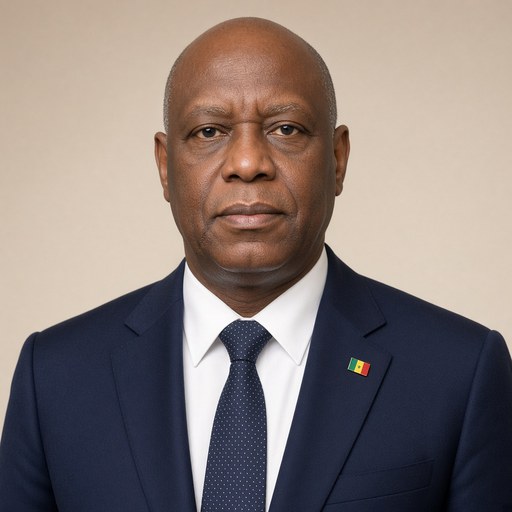
Celebration of the 75th anniversary of the Universal Declaration of Human Rights
 Macky Sall · President of Senegal
- Context
- Sall addressed a UN roundtable on December 12, 2023, marking the 75th anniversary of the Universal Declaration of Human Rights, hosted by the High Commissioner for Human Rights.
- Main themes
- Universal Declaration of Human Rights 75th anniversary, right to development, human dignity and equality, non-selectivity and impartiality in human rights, global governance reform, fight against terrorism, women's and youth rights, poverty and social exclusion, International Criminal Court, cultural diversity and shared values, international peace and security, Africa's role in global institutions
- Duration
- ~9 min
- Words
- 1,050
- Sentences
- 50
- Readability
- 29
- Grade
- 14.4
- Syntax
- 3.00
- Vocabulary
- 2.34
The broad sphere of national life a sentence belongs to. Every sentence has an Arena, so it is the denominator the other indices are read against.
Other50 sentences in 47 paragraphs
Dear colleagues,
Ladies and gentlemen, ambassadors,
Mr. High Commissioner for Human Rights,
Ladies and gentlemen,
I am delighted to join you for these historic moments marking the 75th anniversary of the Universal Declaration of Human Rights.
Thank you, Mr. High Commissioner, for your kind invitation.
I see this as a recognition of Senegal’s ongoing commitment to the ideals of our common Organization.
I commend your efforts in service to the member states in a global context of multiple crises.
By proclaiming the Universal Declaration of Human Rights on December 10, 1948, the 58 states that then made up the United Nations set, for posterity, the international standards they deemed inherent to the protection of human dignity.
They recognized that all human beings are born free and equal in dignity and rights.
A paradox of the time is that some of the signatories of 1948, who were colonial powers, denied other human beings the enjoyment of the same rights and freedoms they proclaimed in the Declaration.
Since then, the family of United Nations member states has expanded to 193 today.
Furthermore, other texts and mechanisms for monitoring and evaluation, including the Universal Periodic Review at the Human Rights Council, which is unique in its kind, have enriched the nomenclature of human rights.
Under the theme of this round table, which addresses the future of human rights, peace, and security, we reaffirm our common commitment to promoting social progress and establishing better living conditions in peace, security, and the rule of law.
We will succeed if we converge on shared values, not imposed ones.
This is what President Léopold Sédar Senghor, one of my illustrious predecessors, called “rooting and opening,” at the crossroads of giving and receiving, the prelude to the civilization of the Universal, a symbiosis of all cultures and civilizations.
Senegal believes that among free peoples, whose histories and sociocultural realities are diverse, a single civilizational space cannot define how everyone should behave in rights and duties.
Consensus remains the golden rule of diversity; hence the importance of the principles of non-selectivity, impartiality, and objectivity that must govern the mechanisms for evaluating respect for human rights.
On the other hand, for us, developing countries, the three generations of human rights are of equal importance. They constitute inseparable pieces of a single architecture.
That is why, in accordance with Article 25 of the 1948 Declaration, we consider the right to development as a fundamental human right; because the enjoyment of economic, social, and cultural rights is as indispensable to the human condition as the exercise of civil rights and political freedoms.
Human beings do not live by freedom alone. They also need their daily bread. Poverty, marginalization, and social exclusion dehumanize, fuel frustration and extremism, and pose threats to peace, stability, and social cohesion.
Beyond legal formalism, it is through action that we can fight injustices and inequalities with the same determination.
Everywhere, we must resolutely reject supremacy, racism and racial discrimination, xenophobia, violent extremism, religious intolerance, and violations of international humanitarian law.
If we yield to the logic of double standards, we run the risk of weakening the international human rights architecture, of which the Universal Declaration of Human Rights remains the fundamental pillar.
The International Criminal Court, of which Senegal was the first country to ratify the Statute, must particularly assume its universal vocation regarding investigation, prosecution, and judgment.
The full realization of human rights is also contingent upon a fairer and more inclusive global political, economic, and financial governance, because the rules of the international system largely condition national public policies.
Achievements have been made with Africa’s admission to the G20 and the granting of a third seat to the continent on the IMF Board of Governors.
Reforming decision-making bodies such as the Security Council, the IMF, and the World Bank will further contribute to the emergence of a more inclusive and peaceful world order.
Conversely, the status quo will exacerbate discontent and the risk of disintegration of the international system, leading to the formation of rival, even antagonistic blocs, to the detriment of international peace and security.
The urgent issue for human rights is also the fight against terrorism, which continues to gain ground in Africa.
The Security Council must fully assume its responsibilities in the fight against terrorism, which poses both a threat to international peace and security and a violation of the most fundamental human rights: the right to life, security, and safety.
Similarly, let us work more to promote the rights of women and youth, including their empowerment through economic and financial mechanisms tailored to their needs.
Let us fight more vigorously against violence against women and girls.
Let us combat populism, radicalism, and violent extremism without rest.
Under all skies, and whatever their modus operandi, populism, radicalism, and extremism are the worst threats to human rights, democracy, and freedom.
Dear colleagues,
Mr. High Commissioner,
Ladies and gentlemen,
On this occasion that brings us together, I am keen to renew Senegal’s international commitments in favor of human rights.
It is in this spirit that we hosted the retreat of the Human Rights Council held in Dakar in November 2019.
For 2022 and 2023, we engaged in dialogue with the Committee on the Elimination of Discrimination against Women and the Committee on the Elimination of Racial Discrimination.
In January, our country will present itself for the fourth time before the Universal Periodic Review mechanism.
Regarding internal monitoring, we have just adopted in the Council of Ministers the bill establishing the National Human Rights Commission as an independent authority, replacing the Senegalese Human Rights Committee.
Finally, as I indicated last September before the 78th ordinary session of the United Nations General Assembly, our country will hold its presidential election on February 25, 2024, in accordance with its constitution.
Like previous elections, this election will be democratic, free, and transparent; and on April 2, I will hand over power to my successor, confident that our country will continue its trajectory, driven by the values of democracy, freedom, and respect for human rights.
This is the message I have come to convey to you; one of profound faith in the ideals that unite us for a better world, a fairer world, a world of equal dignity for peoples, cultures, and civilizations.
I thank you for your kind attention.