




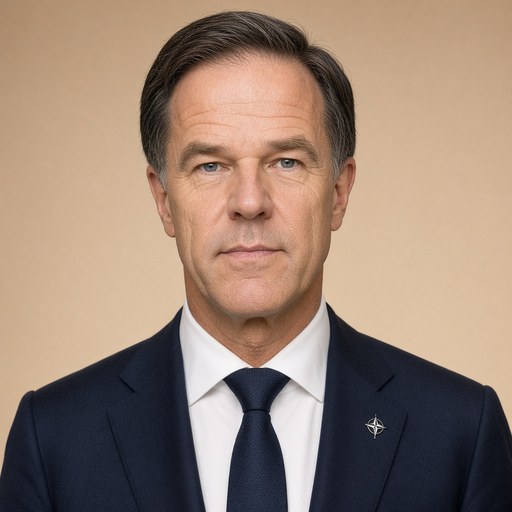
Speech by Prime Minister Mark Rutte during the National Holocaust Remembrance Day
 Mark Rutte · Prime Minister of the Netherlands
- Context
- Rutte addressed a National Holocaust Remembrance Day ceremony in the Netherlands on 28 January 2017, commemorating victims of the Nazi genocide.
- Main themes
- Holocaust remembrance, persecution of Jews in the Netherlands, individual victims and their stories, anti-Semitism and discrimination, collective memory and moral duty, Sinti and Roma genocide, Westerbork transit camp, preserving victims' names and humanity, vigilance against hatred today
- Duration
- ~4 min
- Words
- 457
- Sentences
- 40
- Readability
- 67
- Grade
- 6.7
- Syntax
- 2.40
- Vocabulary
- 2.50
Translated from Dutch
The broad sphere of national life a sentence belongs to. Every sentence has an Arena, so it is the denominator the other indices are read against.
Other40 sentences in 26 paragraphs
In the spring of 1943, a poem appeared in the illegal press in which a Jewish man describes how the woman he loved dearly was taken away during a raid and never returned home.
Her name was Debora Appel.
The husband and poet turned out to be the historian Jacques Presser, who later wrote so profoundly about the persecution of Jews in the Netherlands.
I quote a few lines from the poem:
‘On a spring morning you stepped out of our house
In a thin blouse, sunny and content
And neither of us heard the soft rustling
Saw the pale shadow gliding down
From fate hovering above the young head
That smilingly turned to me.’
That smile turned out to be a final farewell. Six days after her arrest, Debora Appel died in the gas chambers of Sobibor.
Not long after, at the beginning of summer, a young woman from Amsterdam recorded in her diary with horror how Jewish families were driven from their homes during merciless manhunts and taken away like beasts. To Westerbork. ‘What must that misery be like there,’ she noted. And: ‘What will we still learn after the war, if we ever learn anything.’
Ladies and gentlemen, we know.
Westerbork was for nearly 102,000 Jewish Dutch and hundreds of Dutch Sinti and Roma the gateway to an inhumane fate and certain death. Victims of mass murder on an industrial scale.
Across Europe, 6 million Jews and half a million Sinti and Roma were systematically dehumanized and hunted to death for who they were. With Auschwitz as the ultimate symbol of mechanical destruction.
We know. We know the facts, the injustice, the cruelty. And yet our imagination can hardly grasp the horrific truth. In the face of such great and unspeakable evil, reason—our understanding—almost comes to a standstill. Until the unspeakable becomes speakable. Until suffering receives a name.
Abel Herzberg wrote it a few years after the war: ‘There were not 6 million Jews murdered, there was 1 Jew murdered, and that happened 6 million times.’
That realization compels us to remember. 6 million times. And another half a million times.
How else can we comprehend the past?
How else can we restore the humanity of the victims?
How else can we remain vigilant in the here and now?
For exclusion, anti-Semitism, and discrimination are not a completed past.
Remembrance is a necessity. To do justice to all the women, men, and children who lost their lives under barbaric circumstances, doomed to remain forever nameless.
Let us say: their names matter.
In the book of Isaiah in the Tanakh, it says: ‘I give him an everlasting name, a name that will not be cut off.’
Ladies and gentlemen, those who are remembered live on.
The original Dutch. The tags above are read on the English translation's sentences.
In het voorjaar van 1943 verscheen in de illegale pers een gedicht waarin een Joodse man beschrijft hoe de vrouw van wie hij zielsveel hield, tijdens een razzia werd opgepakt en nooit meer terugkeerde naar huis.
Haar naam was Debora Appel.
De echtgenoot en dichter bleek na de oorlog de historicus Jacques Presser te zijn, die later zo indringend schreef over de Jodenvervolging in Nederland.
Ik citeer een paar regels uit het gedicht:
‘Een lentemorgen trad je uit ons huis
In een dun bloesje, zonnig en tevreden
En geen van beiden hoorde 't zacht geruisch
Zag de vale schaduw neergegleden
Van 't noodlot wiekend boven 't jonge hoofd
Dat glimlachend zich nog naar me wendde.’
Die glimlach bleek een definitieve afscheidsgroet. 6 dagen na haar arrestatie stierf Debora Appel in de gaskamers van Sobibor.
Niet veel later, aan het begin van de zomer, tekende een jonge Amsterdamse vrouw in haar dagboek met afgrijzen op hoe om haar heen Joodse gezinnen tijdens meedogenloze klopjachten uit hun huizen werden verdreven en als beesten afgevoerd. Naar Westerbork. ‘Wat moet die ellende daar onbeschrijflijk zijn,’ noteerde zij. En: ‘Wat zullen we na de oorlog nog allemaal te weten komen, als we het ooit te weten komen.’
Dames en heren, wij weten het.
Westerbork was voor bijna 102.000 Joodse Nederlanders en honderden Nederlandse Sinti en Roma het voorportaal van een onmenselijk lot en een zekere dood. Slachtoffers van een massamoord op industriële schaal.
In heel Europa werden 6 miljoen Joden en een half miljoen Sinti en Roma systematisch ontmenselijkt en de dood ingejaagd, om wie zij waren. Met Auschwitz als ultiem symbool van mechanische vernietiging.
Wij weten het. Wij kennen de feiten, het onrecht, de wreedheid. En toch kan ons voorstellingsvermogen de gruwelijke waarheid nauwelijks aan. Bij zo’n groot en onzegbaar kwaad staat het verstand - staat ons bevattingsvermogen bijna stil. Tot het onzegbare zegbaar wordt. Tot het leed een naam krijgt.
Abel Herzberg schreef het enkele jaren na de oorlog: ‘Er zijn geen 6 miljoen Joden vermoord, er is 1 Jood vermoord en dat is 6 miljoen keer gebeurd.’
Dat besef dwingt tot herdenken. 6 miljoen keer. En nog een half miljoen keer.
Hoe anders kunnen wij het verleden bevatten?
Hoe anders kunnen wij de slachtoffers hun menselijkheid teruggeven?
Hoe anders blijven wij waakzaam in het hier en nu?
Want uitsluiting, antisemitisme en discriminatie zijn geen voltooid verleden.
Herdenken is noodzaak. Om recht te doen aan alle vrouwen, mannen en kinderen die onder barbaarse omstandigheden hun leven verloren, gedoemd om voorgoed naamloos te blijven.
Laat ons zeggen: hun namen doen ertoe.
In het boek Jesaja in de Tenach staat: ‘Ik geef hem een eeuwige naam, een naam die onvergankelijk is.’
Dames en heren, wie in herinnering blijft, leeft voort.