




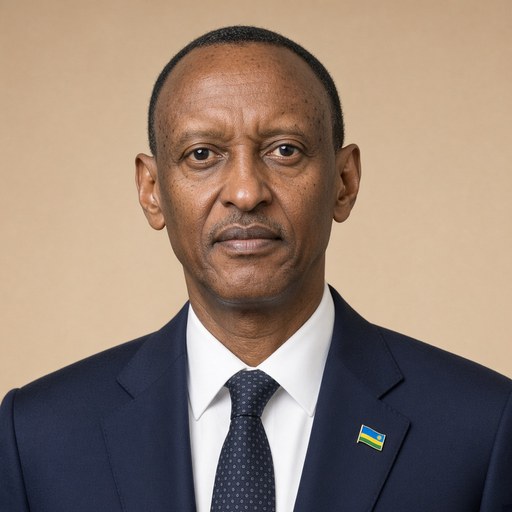
G20 Session 1: Global Economy and Global Health | Remarks by President Kagame | Rome, 30 October 2021
 Paul Kagame · President of Rwanda
- Context
- Kagame addressed the G20 Summit Session on the Global Economy and Global Health in Rome on 30 October 2021, speaking on behalf of NEPAD/African Union Development Agency.
- Main themes
- Global vaccine equity, COVID-19 pandemic response, African vaccine manufacturing capacity, economic recovery, COVAX deliveries, health system strengthening, mRNA vaccine production, AU-EU partnership, pandemic preparedness, World Health Organization support
- Duration
- ~3 min
- Words
- 299
- Sentences
- 17
- Readability
- 43
- Grade
- 11.6
- Syntax
- 3.03
- Vocabulary
- 2.54
The broad sphere of national life a sentence belongs to. Every sentence has an Arena, so it is the denominator the other indices are read against.
Other17 sentences in 16 paragraphs
I am pleased to speak today on behalf of NEPAD, the African Union Development Agency.
The Covid-19 pandemic cannot be brought under control without global vaccine equity, and this is also the precondition for economic recovery.
Africans represent nearly 18% of the world’s people, but less than 5% of Covid vaccine doses have reached our continent.
Closing the gap has three components requiring active commitment by the G20, as has already happened.
First, we must ensure a consistent supply of vaccines for low-income countries to meet the target of 70% vaccination by mid-2022.
After a slow start, Covax deliveries have picked up, thanks to increased pledges from different countries, among them the United States, the European Union, and its member states, among others.
Second, national health systems need to be upgraded to efficiently handle mass vaccination.
Third, we have to build manufacturing capacity for vaccines in developing countries.
Africa imports 99% of its vaccines. By 2040, we aim to produce 60%.
This week, Rwanda and Senegal concluded agreements with BioNTech to build end-to-end mRNA vaccine production facilities, starting in mid-2022.
Technology and know-how will be transferred to build the capacity of local companies, and the doses produced will be distributed in Africa.
This is an important milestone in which the European Union and the African Union are also playing a key role.
Finally, continued strengthening of the World Health Organization and Africa CDC is critical, along with support for the new African Medicines Agency.
We would also do well to implement the clear and actionable recommendations of the G20 High-Level Independent Panel on Pandemic Preparedness, co-chaired by Tharman Shanmugaratnam, Lawrence Summers, and Ngozi Okonjo-Iweala.
I conclude with thanks to the Government of Italy and the people of Rome for the warm welcome and hospitality.
I thank you, Prime Minister.