




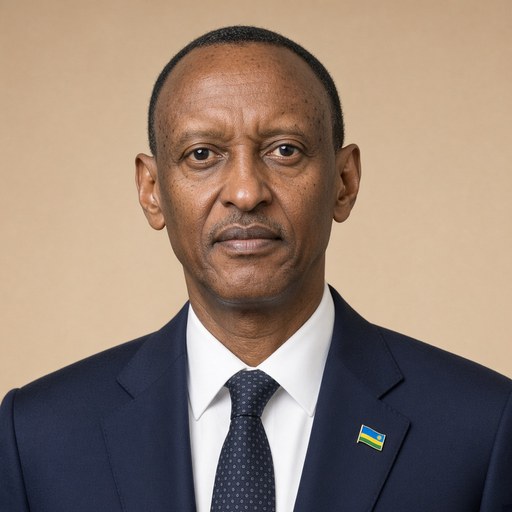
Land Forces Commanders Symposium | Remarks by President Kagame | Kigali, 21 October 2025
 Paul Kagame · President of Rwanda
- Context
- Kagame addressed international land forces commanders at a symposium in Kigali on 21 October 2025, welcoming them and urging cooperation on shared security challenges.
- Main themes
- Global security landscape, land forces effectiveness, speed and accuracy balance, civil-military cooperation, cybersecurity and disinformation, African security challenges, continental partnerships, sovereignty, operational effectiveness, military professionalism, bureaucratic constraints in field operations
- Duration
- ~3 min
- Words
- 382
- Sentences
- 34
- Readability
- 40
- Grade
- 10.5
- Syntax
- 2.56
- Vocabulary
- 2.17
The broad sphere of national life a sentence belongs to. Every sentence has an Arena, so it is the denominator the other indices are read against.
Other34 sentences in 28 paragraphs
A good morning to you all.
Let me start by welcoming you all to Kigali.
Many of you have travelled great distances to be here, which reflects the determination to confront our shared security challenges, together.
Thank you all, very much.
The global security landscape today is marked by unpredictability.
Conflicts are increasingly asymmetric. And the response to crises, whether political, humanitarian, or environmental, often has a military component.
In these complex situations, land forces are vital. You are the first to deploy, and the last to leave.
Your swiftness and precision, make all the difference between success and failure.
But too often, setbacks arise from excessive bureaucracy, or caveats imposed from afar, which limit the ability of field commanders to intervene effectively.
Speed matters, because conditions on the ground often evolve rapidly, and delays are costly.
The dilemma, however, is that speed without accuracy is dangerous, and accuracy without speed is pointless.
There has to be a balance between the two.
Equally important is civil-military cooperation.
Land forces operate closest to citizens. Everything that you do, must serve their safety and well-being.
The discipline and professionalism that you show, are what either build or break the public’s trust.
Meanwhile, new frontiers of conflict are emerging. Our economies and security systems rely on digital networks that transcend geography.
Cyberattacks and disinformation can destabilize nations, as effectively as armed attacks.
Methods may evolve, but the principle remains the same: Our strength lies in effective teamwork.
Beyond operational effectiveness, sovereignty today is not just about borders. It is also about our ability to choose our partners from a position of strength, and align our interests.
Africa still experiences the highest number of active conflicts in the world.
Addressing this reality, requires strong continental partnerships, and coordination mechanisms.
We cannot expect others to carry the responsibility for Africa’s security.
None of the challenges that we face, are beyond our capacity to manage or resolve.
We have seen what is possible. Our armies already work side by side under regional and continental frameworks.
Over the next two days, I urge you to be frank with one another, share experiences, and challenge assumptions.
This is how progress is going to be made.
I wish you productive deliberations, and a successful symposium.
Thank you for your kind attention.