




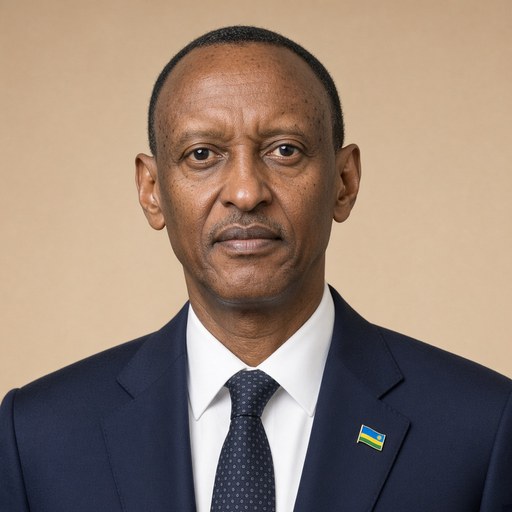
Mobile World Congress (MWC) 2025 | Remarks by President Kagame | Kigali, 21 October 2025
 Paul Kagame · President of Rwanda
- Context
- Kagame addressed delegates at Mobile World Congress 2025 hosted in Kigali on 21 October 2025, welcoming global partners to advance Africa's digital transformation.
- Main themes
- Africa's digital future, mobile connectivity, digital inclusion, artificial intelligence, financial inclusion and mobile money, digital skills, knowledge-based economy, innovation, cross-border data and payment systems, African single digital market, public-private collaboration, Rwanda's technology vision
- Duration
- ~3 min
- Words
- 406
- Sentences
- 26
- Readability
- 40
- Grade
- 11.6
- Syntax
- 3.09
- Vocabulary
- 2.14
The broad sphere of national life a sentence belongs to. Every sentence has an Arena, so it is the denominator the other indices are read against.
Other26 sentences in 25 paragraphs
It is a pleasure to join you today, and to all our guests, welcome to Kigali.
We are honoured to host this year’s Mobile World Congress, and build Africa’s digital future, together.
To Doreen Bogdan-Martin, whose solid leadership of ITU we greatly appreciate, we are very happy to see you back in Rwanda, once again.
Rwanda believes deeply in the power of technology to connect people, and foster real transformation.
In just a few years, Africa has gone from limited connectivity, to a mobile-driven economy.
Broadband and smartphones have become implements of daily life, advancing commerce, education, finance, and other key sectors.
Mobile money is a good example of this.
What began as a solution for those excluded from formal banking, has grown into a global model of financial inclusion.
It has empowered small businesses and women entrepreneurs, while linking rural communities to the broader economy.
This initiative proves that innovation does not belong to one part of the world alone. It can emerge anywhere, from anyone, given the chance.
Now, new technologies are taking us even further ahead.
Artificial intelligence, next-generation networks, and smart devices are transforming every field, unlocking endless possibilities.
But despite the progress we have made, only a fraction of Africans are connected, compared to the global average.
If this gap persists, the same technology meant to expand access, will instead widen inequality.
The most important conversation we should have is about people, and how digital skills and tools can reach everyone.
In Rwanda, we see this journey, as part of our larger vision to build a knowledge-based economy.
We are integrating artificial intelligence into our planning, prioritizing research, and human capital development to boost productivity, and improve public service delivery.
While the challenges Africa faces are significant, they also offer great growth potential, if we collaborate.
Governments, the private sector, and other partners, should harmonize policies, and create the right environment for innovation.
This will enable our data and payment systems, to flow securely across borders, and connect our economies.
The African Union, regional blocs, and Smart Africa are already advancing this vision, through efforts to cut costs, reduce barriers, and create a single digital market.
Such cooperation will scale African solutions globally, while retaining their value here.
The future we must build, is an Africa that is bold, connected, and competitive.
I wish you productive discussions, and a very pleasant stay with us.
I thank you for your kind attention.