




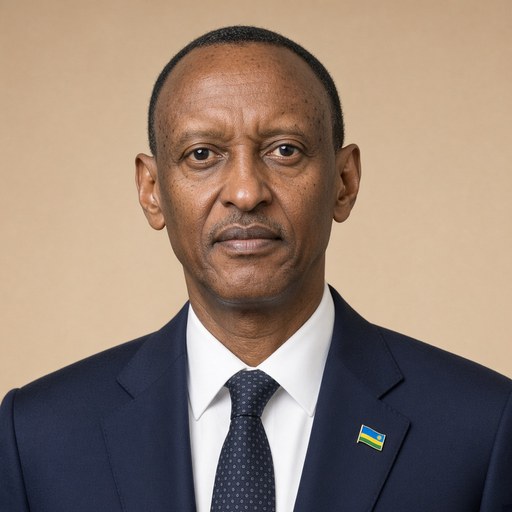
Second World Summit for Social Development | Remarks by President Kagame | Doha, 4 November 2025
 Paul Kagame · President of Rwanda
- Context
- Kagame addressed the Second World Summit for Social Development in Doha, Qatar on 4 November 2025, speaking on global inequality and development priorities.
- Main themes
- Social development, human capital development, inequality reduction, global governance reform, multilateral partnerships, poverty alleviation, social protection, Rwanda's development model, inclusive growth, global financial institutions
- Duration
- ~3 min
- Words
- 322
- Sentences
- 24
- Readability
- 40
- Grade
- 11.1
- Syntax
- 2.72
- Vocabulary
- 2.21
The broad sphere of national life a sentence belongs to. Every sentence has an Arena, so it is the denominator the other indices are read against.
Other24 sentences in 24 paragraphs
To begin, I want to thank His Highness, for hosting us in Qatar, for the second World Summit for Social Development.
As always, the welcome and the facilities in Doha, are perfect.
Thirty years since Copenhagen, significant progress has been made.
We have seen successful efforts to reduce extreme poverty, and expand access to education, healthcare, and social protection.
However, inequalities still persist, especially between regions, with millions of people still struggling to make ends meet.
These challenges are not new, but our governance systems have not evolved fast enough, to solve them.
Social development is a continuous journey, that requires adaptability.
Right now, the priority is to keep the pendulum swinging in the right direction, and build on what has already been achieved.
Success will depend on many factors, but the most important, is keeping human capital development at the centre.
For development to be sustainable, it cannot be outsourced.
This approach has guided Rwanda’s transformation.
Social protection, community participation, and accountability, are firmly embedded in how we govern.
Every policy decision by our institutions, is concerned with advancing quality of life.
We must also redefine our approach to partnerships.
Too often, global cooperation is not balanced.
We must move away from outdated practices that exclude the majority of the world.
For multilateral engagements to be effective, they will need to be tailored to delivering universal, measurable and timely results, not promises.
Lastly, everything cannot be a priority.
The world is changing rapidly.
We should expect more challenges in the near future, and prepare to prevent and manage them.
Here, global financial institutions must be more fit-for-purpose, and provide the fiscal space to pivot and grow.
If we are serious about social development, then our solutions must serve the needs of all countries, not just a few.
Rwanda stands ready to work with all our partners, to build a more inclusive and resilient future.
I thank you for your kind attention.