




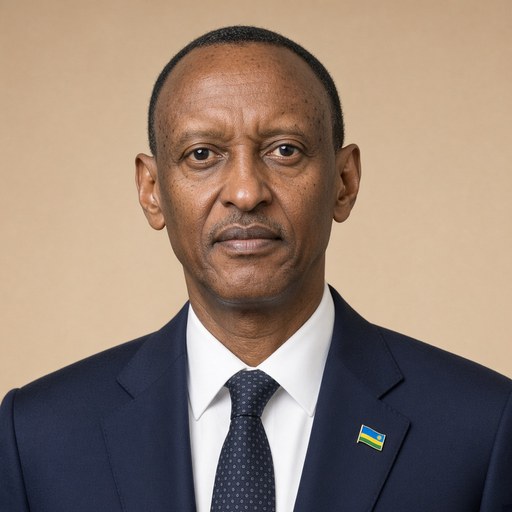
Speech by H.E Paul Kagame at the official closing of Gacaca Courts
 Paul Kagame · President of Rwanda
- Context
- Kagame addressed a distinguished audience at the official closing ceremony of Rwanda's Gacaca community courts on June 19, 2012, marking the end of the genocide justice process.
- Main themes
- Gacaca courts closure, post-genocide justice and reconciliation, national healing and unity, community-based justice, truth-telling, accountability for genocide perpetrators, comparison with ICTR, citizen empowerment, Rwanda's recovery and progress, traditional conflict resolution, forgiveness and social harmony
- Duration
- ~9 min
- Words
- 1,049
- Sentences
- 51
- Readability
- 37
- Grade
- 13.0
- Syntax
- 2.95
- Vocabulary
- 2.45
The broad sphere of national life a sentence belongs to. Every sentence has an Arena, so it is the denominator the other indices are read against.
Other51 sentences in 30 paragraphs
Distinguished Audience;
The Gacaca process and experience has been an important phase in the history of our country. It has been a period when we sought to reunite our nation, inspire confidence in the administration of justice and hold each other accountable for our actions.
Gacaca, granted, had its imperfections. It received criticism both from within and outside Rwanda, yet those criticizing offered no viable alternatives that could deliver the results we needed. Despite all this, Gacaca has served us very well, and even exceeded our expectations.
It challenged every Rwandan into introspection and soul-searching that resulted in truth-telling, national healing, reconciliation and justice. And it worked because Rwandans largely believed in it.
We are still convinced that there could have been no better alternative, and welcome the continued discussion in legal, judicial and academic circles to adapt and improve it.
At different times in their history, nations are faced with unique challenges for which they have to make unique choices. Their response becomes the defining moment, determining whether they prosper, falter or fail. If you stick to convention, you may lose touch with reality – which sometimes demands imaginative and unorthodox solutions.
Let’s reflect for a moment, on the immediate aftermath of the genocide, and the amount of challenges our country faced, many of which tested us all to the limit. One of these challenges was how to provide redress for victims, hold perpetrators accountable for their crimes, and restore harmony among Rwandans.
Given the magnitude of the problem, including the numbers involved and limited resources at our disposal, conventional justice as we know it could not deliver the results that we sought.
We had three choices: first was the more dangerous path of revenge, or secondly, grant general amnesty, both of which would have led to further anarchy and destruction. But we chose the third and more difficult course of dealing with the matter decisively and restoring the unity and integrity of the nation.
We turned to Gacaca, our traditional conflict resolution mechanism, and adapted it to respond to the challenges facing us.
Today, Rwandans have rediscovered their collective self-worth and confidence to help us find solutions to other challenges we have.
Equally, the value and effectiveness of Gacaca will be measured against the record of other courts, principally the International Criminal Tribunal for Rwanda (ICTR). The ICTR has tried about sixty cases, cost about 1.7 billion dollars and left justice wanting.
Yet, at significantly less cost, the Gacaca process has had the highest impact in terms of cases handled, and has delivered justice and reconciliation at a much higher scale.
Distinguished Audience;
For us the lessons of Gacaca go beyond justice and embrace other facets of national life.
Gacaca has empowered Rwandans in ways few could have envisaged. It has illustrated the liberating value of truth. When truth came out in court, from both the perpetrators and survivors of genocide, from witnesses and the community – freely, not at the prompting or tutoring of paid lawyers – it set everyone free and prepared the ground for the restoration of social harmony.
It was then possible to genuinely seek and be granted forgiveness. This has been at the heart of our unity and reconciliation efforts, and we are stronger as a nation as a result. Gacaca was an important end in itself, for justice and reconciliation – and in fact, it served a purpose far greater than that. With reconciliation – and peace, calm, and sense of purpose it brings – Rwanda has been able to make progress that is evident.
The spirit of openness and readiness to break with the past and start afresh that has been embedded in everything we do will undoubtedly be one of the key legacies of Gacaca.
Central to everything we do has been the need to empower citizens to make decisions about what directly affects their lives. Nowhere has this been more evident than in Gacaca where there has been community level discussions and collective decision making, from the vetting of judges, gathering of evidence and hearing of cases to delivering the verdict.
It has been a process where the contribution of every Rwandan has been valued. This has led to mobilizing our cumulative strength towards common goals, and restoring respect for the sanctity of life, resulting in increased productivity of our country in many ways.
It is often said that in conventional judicial systems, justice is rendered in the name of the people, even when they really have had very little to do with it.
Gacaca has been justice literally administered by and in the name of the people.This has resulted in selflessness and patriotism in the citizenry, as exemplified by the Inyangamugayo. It is the spirit of the new Rwanda – bold enough to tackle complex challenges together.
Distinguished audience; Ladies and Gentlemen;
Although we are closing Gacaca courts today, we are aware that they have not resolved all problems. Many issues remain outstanding and will be dealt with through the formal courts.
I would like to conclude by noting that the legacy of Gacaca will be with us for generations to come because it is part of our heritage. The practice of discussion and consensus – best captured in the Kinyarwanda phrase, “kujya inama” – will continue to be at the centre of our governance and development agenda.
Gacaca has achieved what it has because of the contributions of many individuals, organisations, and governments. I wish to pay particular gratitude to our Development Partners, and in particular, the UNDP and the Governments of Austria, Belgium, the Netherlands and Switzerland for their invaluable support to Gacaca’s success.
I also extend our gratitude to the many friends of Rwanda across the globe in academia, the media, industry and in ordinary life for supporting the process in various ways.
But above all, I want to thank Rwandans for their full participation, especially the Inyangamugayo, for their commitment and dedication to hearing and judging the many cases that came before them. We should all be pleased that today, Rwandans live and work together for their wellbeing and common good as we look forward to the start of another chapter in our nation’s development.
It is now my solemn duty to declare Gacaca Courts officially closed.
Thank you for your kind attention