




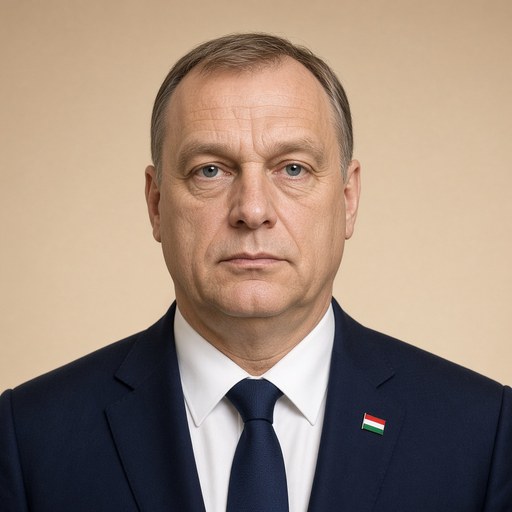
Funeral speech by Viktor Orbán delivered at the funeral of Géza Erdélyi, former bishop of the Reformed Christian Church of Slovakia.
 Viktor Orbán · Prime Minister of Hungary
- Context
- Orbán delivered a eulogy at the funeral of Géza Erdélyi, former bishop of the Reformed Christian Church of Slovakia, in December 2025.
- Main themes
- Funeral tribute, Hungarian Reformed Church in Slovakia, Hungarian national identity, Christianity and nationhood, community leadership, church-state relations, resilience under communism, Hungarian diaspora in the Highlands, faith and politics, personal loss
- Duration
- ~13 min
- Words
- 1,588
- Sentences
- 98
- Readability
- 60
- Grade
- 8.9
- Syntax
- 2.82
- Vocabulary
- 2.40
Translated from French
The broad sphere of national life a sentence belongs to. Every sentence has an Arena, so it is the denominator the other indices are read against.
Other98 sentences in 10 paragraphs
Dear grieving assembly, Bishops, Dear Brothers,
It is with a heavy heart that we stand here, beside the coffin of our bishop, Géza Erdélyi. The pain of personal loss is profound. It always is. The closer a person was to us, the sharper the pain. And Géza Erdélyi, our bishop, was close to us. But there is more at stake here. For the very safety of our lives, we need men we can always count on, men whose commitment never falters. Even when life has separated you from one another, even when you have not spoken for a long time. To know that there exists, somewhere in the Highlands, in the town of Rimaszombat, on Sídlisko Rimava Street, a man who, if you are in trouble, will come to your aid; who, if doubt assails you, will strengthen you; who, if your strength wanes, will support you; who, if you have faltered, will comfort you. There are men whom Providence designates to offer all this not just to one or another, but to all. Men who are not only pastors but also pillars, men upon whom the arch of an entire community can rest. Géza Erdélyi, our bishop, was one of those. That is why this loss is ours to bear: that of the Reformed Church, that of the Hungarian community of the Highlands, and that of the entire Hungarian nation. It was in difficult times, at the heart of the storms of regime change, that he took the lead of the Hungarian Reformed in the Highlands. He had to guide his people at a time when the Hungarians of this region had to relearn to walk with their heads held high, after the inhumane decrees of the communist regime and decades of silencing. At a moment when it was not only necessary to rebuild churches and schools, but also to reclaim self-awareness, dignity, and self-confidence. So that one day, finally, everything could return to how it once was. He worked so that the Hungarians of the Highlands could once again feel at home in their native land, so that they could speak, learn, and pray in their mother tongue. Today, we see clearly: without his work, the very foundation upon which we were able to build after 2010 would not have existed. In the long history of Hungarian Protestantism, there have been periods of greatness and moments of trial. Géza Erdélyi, our bishop, belongs to those who revealed their greatness in adversity. In times of trial, he remained faithful to his role as a servant of God and of the Hungarian nation. He is part of that great chain of figures, from Gábor Bethlen to László Ravasz, who always knew that the cause of faith is also that of the nation. As the Hungarian Fundamental Law proclaims: "We recognize the role of Christianity in the preservation of the nation."
Dear mourners,
Even at this moment, as I speak, his gaze is before me. Those who knew him only from afar saw in him a gentle, pious, and kind man. He spoke softly; he was a man inhabited by peace, from whom great serenity emanated. But those who looked closer quickly understood that this gentleness was not a weakness, but a disciplined strength. Like basalt: smooth to the touch, but unbreakable. He was unshakeable. When it came to the truth of the Hungarian nation or that of the Church, he knew no compromise. He understood that the shepherd's staff serves not only as support but also to defend the flock against wolves. It is this silent firmness, this contained steel strength, that gave him an authority respected by both his friends and his adversaries. I give thanks to Providence for having counted among those who could honor in him not only the bishop who built the Church but also the man of knowledge. We corresponded. He shared with me his reflections on the Hungarian nation, on Christianity, and on Europe. We shared the idea that it is a false doctrine to claim that the affairs of God belong exclusively to the Church, and those of the world exclusively to politics. Our adversaries speak every day of the separation of Church and State. But we know well that behind these words, they actually mean the expulsion of Christianity from public life, the removal of God from history, and from the great narrative of the survival of the Hungarian nation. As if mere chance explains that, a thousand years later, we are still here, in the heart of Europe, alive, speaking Hungarian and Christian. Géza Erdélyi knew this and proclaimed it: nations also have a mission. And he also knew that this is the great dividing line. A philosophical and political dividing line that distinguishes, among the servants of God, those who see, understand, and serve in unity Christianity and the nation, Jesus Christ and the homeland. The Hungarian mission is inseparable from our Christian identity. As the Hungarian Constitution wisely formulates, avoiding the liberal and cunning trap of separation: the State and the Church operate distinctly. The objectives may be common, in accordance with the profession of faith of the government that directs the State, but the means, methods, and paths taken are always different. As one of our bishops expressed: "One must conquer with gentleness, like the wind." And indeed, the pastor, the spiritual guide, the bishop, conquers with gentleness. He brings back the lost sheep, confronts evil, overcomes doubt within himself – and always with spiritual weapons. For us, fighters in the cage of public combat, this is not always granted. We often advance against the wind and build in the heart of the storm. Gentleness is not always effective. Sometimes we need firmness, sometimes even intransigence. Including towards ourselves. But we must know this: the future of the Hungarians cannot be built on the brutality of politics, on the insensitivity of public struggles, nor even on the raw truth of mere rational arguments. Even, and especially, in the most tense periods, the national community needs the balancing spirit of gentle men. Those who, amid the passions of the moment, remind us that the future of the nation can only be built on love, on the example of Jesus Christ. The Church of Bishop Géza Erdélyi needed his gentle strength. His nation needed it. And we all need it, and will need it again.
Dear grieving assembly,
In the spring of 2005, the Hungarian State awarded His Excellency the bishop an official distinction for services rendered to the Hungarian nation. But history decided otherwise: the award was to take place after the referendum of December 5. It was during this referendum that the left-wing government turned against the Hungarians living beyond the borders. Géza Erdélyi did not accept to receive this distinction from the hands of the Prime Minister. When asked why he made this decision, he replied that he was deeply pleased with the distinction awarded by Hungary, that he would have accepted it from anyone, but, I quote, "after that, how could I look my faithful in the eye?" It is as simple as that. Without detour, and without appeal. In that one sentence lies his entire life. Not glory. Not protocol. Not the changing winds of politics. Not the interest of the moment. One single measure, one single criterion: the gaze of the faithful. The trust of the community. Righteousness before God. This natural, obvious, unconditional fidelity, without which no nation can survive. I am here, I cannot do otherwise. Who knows for how many centuries the confession of faith of this long line of "Géza Erdélyi" has kept the Hungarians standing? At the presentation of the Hungarian Heritage Award, he said: "We have known many forms of oppression, we have always had to move forward against the wind. But today, I address this message to all the young: it is worth it, for that is how one can remain truly faithful to oneself, and that is how one can stand tall."
Dear mourners,
Holy Scripture teaches us that the life of the righteous man does not end with earthly farewell. Before the Lord, there is no disappearance, only a return home. Today, it is with pain that we let go of our bishop, but we know that he who has entrusted his life to God is carried by that same hand towards eternal light. That is why this day is not only a loss but also an accomplishment: our bishop has fought the good fight, he has finished his race, he has kept the faith. Thank you for teaching us through your sermons, and for proving through your life that faith is not a mere balm against pain, but an inner strength, an uprightness. That being Hungarian is not a choice, but a mission: a mission that can only be fully accomplished by living in the palm of God. As we now accompany you to your final resting place, we know that a legacy has been entrusted to us. We also know that this legacy cannot be locked in a chest. It is a legacy that we must always carry with us, and above all keep close to our hearts – so that in following you, we too may know how to be both gentle and unyielding, and conquer with gentleness, like the wind.
Dear brother Géza, we will try. Your Excellency the bishop, thank you for your service. It was an honor to fight alongside you. Rest in peace.
Soli Deo gloria!
The original French. The tags above are read on the English translation's sentences.
Chère assemblée endeuillée, Messieurs les Évêques, Chers Frères,
C’est le cœur lourd que nous nous tenons ici, auprès du cercueil de notre évêque, Géza Erdélyi. La douleur de la perte personnelle est profonde. Elle l’est toujours. Plus une personne nous était proche, plus la douleur est vive. Et Géza Erdélyi, notre évêque, nous était proche. Mais il est ici question de plus encore. Pour la sécurité même de nos vies, nous avons besoin d’hommes sur lesquels nous pouvons toujours compter, d’hommes dont l’engagement ne fait jamais défaut. Même lorsque la vie vous a éloignés l’un de l’autre, même lorsque vous ne vous êtes pas parlé depuis longtemps. Savoir qu’il existe, quelque part dans les Hautes-Terres, dans la ville de Rimaszombat, rue Sídlisko Rimava, un homme qui, si vous êtes dans l’épreuve, vous viendra en aide ; qui, si le doute vous assaille, vous affermira ; qui, si vos forces déclinent, vous soutiendra ; qui, si vous avez failli, vous consolera. Il est des hommes que la Providence désigne pour offrir tout cela non pas à l’un ou à l’autre seulement, mais à tous. Des hommes qui ne sont pas seulement des pasteurs, mais aussi des piliers, des hommes sur lesquels peut reposer la voûte d’une communauté tout entière. Géza Erdélyi, notre évêque, était de ceux-là. C’est pourquoi cette perte est la nôtre à tous : celle de l’Église réformée, celle de la communauté hongroise des Hautes-Terres, et celle de toute la nation hongroise. C’est en des temps difficiles, au cœur des tempêtes du changement de régime, qu’il a pris la tête des réformés hongrois des Hautes-Terres. Il a dû guider son peuple à une époque où les Hongrois de cette région devaient réapprendre à marcher la tête haute, après les décrets inhumains du régime communiste et des décennies de mise au silence. À un moment où il ne fallait pas seulement reconstruire des églises et des écoles, mais aussi reconquérir la conscience de soi, la dignité, la confiance en soi. Afin qu’un jour, enfin, tout puisse redevenir comme autrefois. Il œuvra pour que les Hongrois des Hautes-Terres puissent à nouveau se sentir chez eux sur leur terre natale, pour qu’ils puissent parler, apprendre et prier dans leur langue maternelle. Aujourd’hui, nous le voyons clairement : sans son œuvre, le socle même sur lequel nous avons pu bâtir après 2010 n’aurait pas existé. Dans la longue histoire du protestantisme hongrois, il y eut des périodes de grandeur et des moments d’épreuve. Géza Erdélyi, notre évêque, appartient à ceux qui ont révélé leur grandeur dans l’adversité. Au temps des épreuves, il est resté fidèle à son rôle de serviteur de Dieu et de la nation hongroise. Il s’inscrit dans cette grande chaîne de figures, de Gábor Bethlen à László Ravasz, qui ont toujours su que la cause de la foi est aussi celle de la nation. Comme le proclame enfin la Loi fondamentale hongroise : « Nous reconnaissons le rôle de la chrétienté dans la préservation de la nation. »
Chers endeuillés,
Même à cet instant, tandis que je parle, son regard est devant moi. Ceux qui ne le connaissaient que de loin voyaient en lui un homme doux, pieux et bienveillant. Il parlait à voix basse, c’était un homme habité par la paix, dont émanait une grande sérénité. Mais ceux qui regardaient de plus près comprenaient vite que cette douceur n’était pas une faiblesse, mais une force disciplinée. Comme le basalte : lisse au toucher, mais incassable. Il était inébranlable. Lorsqu’il s’agissait de la vérité de la nation hongroise ou de celle de l’Église, il ne connaissait aucun compromis. Il savait que le bâton du pasteur ne sert pas seulement d’appui, mais aussi à défendre le troupeau contre les loups. C’est cette fermeté silencieuse, cette force d’acier contenue, qui lui conférait une autorité respectée tant par ses amis que par ses adversaires. Je rends grâce à la Providence d’avoir compté parmi ceux qui n’ont pas seulement pu honorer en lui l’évêque bâtisseur d’Église, mais aussi l’homme de savoir. Nous correspondions. Il partageait avec moi ses réflexions sur la nation hongroise, sur le christianisme et sur l’Europe. Nous partagions l’idée qu’il est une fausse doctrine de prétendre que les affaires de Dieu relèveraient exclusivement de l’Église, et celles du monde exclusivement de la politique. Nos adversaires parlent chaque jour de la séparation de l’Église et de l’État. Mais nous savons bien que, derrière ces mots, ils entendent en réalité l’expulsion du christianisme de la vie publique, le retrait de Dieu de l’histoire, et du grand récit de la survie de la nation hongroise. Comme si le simple hasard expliquait que, mille ans plus tard, nous soyons encore ici, au cœur de l’Europe, vivants, parlant hongrois et chrétiens. Géza Erdélyi le savait et le proclamait : les nations aussi ont une mission. Et il savait également que c’est là la grande ligne de partage. Une ligne de partage philosophique et politique, qui distingue, parmi les serviteurs de Dieu, ceux qui voient, comprennent et servent dans une unité le christianisme et la nation, Jésus-Christ et la patrie. La mission hongroise est indissociable de notre identité chrétienne. Comme le formule la Constitution hongroise, évitant avec sagesse le piège libéral et rusé de la séparation : l’État et l’Église fonctionnent de manière distincte. Les objectifs peuvent être communs, conformément à la profession de foi du gouvernement qui dirige l’État, mais les moyens, les méthodes, les chemins empruntés sont toujours différents. Comme l’a exprimé l’un de nos évêques : « Il faut vaincre avec douceur, comme le vent. » Et en effet, le pasteur, le guide spirituel, l’évêque, vainc avec douceur. Il ramène la brebis égarée, affronte le mal, vainc en lui-même le doute – et toujours par des armes spirituelles. À nous, combattants de la cage du combat public, cela n’est pas toujours accordé. Nous avançons souvent contre le vent et bâtissons au cœur de la tempête. La douceur n’est pas toujours efficace. Il nous faut parfois de la fermeté, parfois même de l’intransigeance. Y compris envers nous-mêmes. Mais nous devons savoir ceci : l’avenir des Hongrois ne peut se construire sur la brutalité de la politique, sur l’insensibilité des luttes publiques, ni même sur la vérité brute des seuls arguments rationnels. Même, et surtout, dans les périodes les plus tendues, la communauté nationale a besoin de l’esprit équilibrant des hommes doux. De ceux qui, au milieu des passions de l’instant, nous rappellent que l’avenir de la nation ne peut être bâti que sur l’amour, sur l’exemple de Jésus-Christ. L’Église de l’évêque Géza Erdélyi avait besoin de sa force douce. Sa nation en avait besoin. Et nous tous en avons besoin, et en aurons besoin encore.
Chère assemblée endeuillée,
Au printemps 2005, l’État hongrois a décerné à Monseigneur l’évêque une distinction officielle pour les services rendus à la nation hongroise. Mais l’histoire en décida autrement : la remise devait avoir lieu après le référendum du 5 décembre. C’était ce référendum au cours duquel le gouvernement de gauche s’est retourné contre les Hongrois vivant au-delà des frontières. Géza Erdélyi n’a pas accepté de recevoir cette distinction des mains du Premier ministre. Lorsqu’on lui a demandé pourquoi il avait pris cette décision, il a répondu qu’il se réjouissait profondément de la distinction accordée par la Hongrie, qu’il l’aurait acceptée de n’importe qui, mais, je cite, « après cela, comment pourrais-je regarder mes fidèles dans les yeux ? » C’est aussi simplement que cela. Sans détour, et sans appel. Dans cette seule phrase se trouve toute sa vie. Pas la gloire. Pas le protocole. Pas les vents changeants de la politique. Pas l’intérêt du moment. Une seule mesure, un seul critère : le regard des fidèles. La confiance de la communauté. La droiture devant Dieu. Cette fidélité naturelle, évidente, inconditionnelle, sans laquelle aucune nation ne peut survivre. Je suis là, je ne peux faire autrement. Qui sait depuis combien de siècles la confession de foi de cette longue lignée de « Géza Erdélyi » maintient les Hongrois debout ? Lors de la remise du Prix de l’Héritage hongrois, il a dit : « Nous avons connu bien des formes d’oppression, nous avons toujours dû avancer face au vent. Mais aujourd’hui, j’adresse ce message à tous les jeunes : cela en vaut la peine, car c’est ainsi que l’on peut rester véritablement fidèle à soi-même, et c’est ainsi que l’on peut rester debout. »
Chers endeuillés,
L’Écriture sainte nous enseigne que la vie de l’homme juste ne s’achève pas avec l’adieu terrestre. Devant le Seigneur, il n’y a pas de disparition, seulement un retour à la maison. Aujourd’hui, c’est dans la douleur que nous laissons partir notre évêque, mais nous savons que celui qui a remis sa vie entre les mains de Dieu est porté par cette même main vers la lumière éternelle. C’est pourquoi ce jour n’est pas seulement une perte, mais aussi un accomplissement : notre évêque a mené le bon combat, il a achevé sa course, il a gardé la foi. Merci de nous avoir enseignés par tes prédications, et d’avoir prouvé par ta vie que la foi n’est pas un simple baume contre la douleur, mais une force intérieure, une tenue droite. Que le fait d’être hongrois n’est pas un choix, mais une mission : une mission qui ne peut s’accomplir pleinement qu’en vivant dans la paume de Dieu. Alors que nous t’accompagnons maintenant vers ton dernier repos, nous savons qu’un héritage nous est confié. Nous savons aussi que cet héritage ne peut être enfermé dans un coffre. C’est un héritage qu’il nous faut toujours porter avec nous, et surtout garder sur notre cœur – afin qu’en te suivant, nous sachions, nous aussi, être à la fois doux et inflexibles, et vaincre avec douceur, comme le vent.
Cher frère Géza, nous essaierons. Monseigneur l’évêque, merci pour ton service. Ce fut un honneur de combattre à tes côtés. Repose en paix.
Soli Deo gloria !