




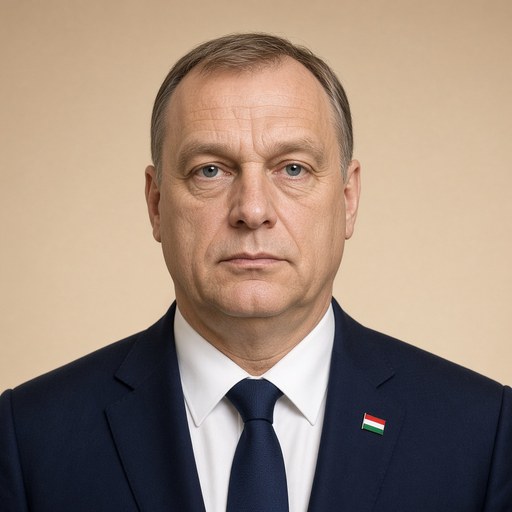
Press conference given by Prime Minister Viktor Orbán during his visit to the renovated MAZSIHISZ Charity Hospital
 Viktor Orbán · Prime Minister of Hungary
- Context
- Orbán addressed a press conference at the renovated MAZSIHISZ Charity Hospital in Budapest on 3 December 2025, marking the completion of state-funded renovation works.
- Main themes
- Hospital renovation and healthcare reconstruction, Hungarian Jewish community relations, faith-based healthcare institutions, historical memory and Jewish hospitals, peace versus war, government commitments to MAZSIHISZ, interfaith cooperation, Arrow Cross history and restitution
- Duration
- ~5 min
- Words
- 595
- Sentences
- 29
- Readability
- 58
- Grade
- 10.1
- Syntax
- 2.91
- Vocabulary
- 1.94
The broad sphere of national life a sentence belongs to. Every sentence has an Arena, so it is the denominator the other indices are read against.
Other29 sentences in 6 paragraphs
Thank you very much, President Grósz.
Good morning everyone. I would like to thank the President for inviting me here and allowing me to take part in this tour. My first words are also words of thanks. I would like to thank everyone who has been involved here, who has supported the expansion of this hospital with their good intentions and their thoughts, or indeed their actions.
When the President won the trust of the Jewish community in Hungary, I made three agreements with him – three major agreements. The first was about this hospital, and so I have made good on one of my obligations. There are two more, and these will be made good on in the near future. Together with the President we have just reviewed the status of those and, for example, the renovation of the rabbinical seminary – and we are both optimistic. We have also contributed to that investment. The President said that this is a process that began in 2018, and the Hungarian state has been able to contribute 8.5 billion forints to it. We are in the midst of a complete programme of healthcare reconstruction at a national scale: we have renovated 91 hospitals, 54 clinics, and 107 ambulance stations. Here in Budapest we have developed 13 hospitals. But the Jewish hospital is particularly close to my heart, because I have found that when patients are cared for in institutions run by faith communities, something special emerges. State hospitals also perform well, and there is a sense of civic duty that goes with every profession, but in faith-based institutions there is also an additional religious commitment, which can somehow be felt in the atmosphere and care of the entire institution, indicating that we are in such an institution. I am glad that we have finally reached the point at which we do not have to be ashamed, as Catholics, Protestants and the Jewish community all have decent, presentable, high-quality hospitals in Budapest. And this is how it should be.
History offers us lessons. The question is, are there any among us who will learn from them? When I came here, I looked into the history of this hospital, and I think the following is worth mentioning. Before the Second World War, there were four Jewish hospitals in Budapest. Two of them were subsequently nationalised and never returned to the Jewish community, and one was burned down by the Arrow Cross Party. This is the only one that was returned to the Jewish community. Therefore it is fitting – also in light of its history – that this hospital should be the focus of our attention: since three of the four were eliminated, the fourth should be something we can all be proud of. The primary cause of this destruction was war, and all the evil that war brings out in people. And so it is very important that today we remind ourselves that war is bad and peace is good, and that it is good for Hungary’s neighbours to also enjoy peaceful lives, rather than experience war.
I have already spoken about the promise I made to the President. We could argue that war blocks economic growth, because that is the case; but it would not be fair to change an agreement on that basis, and so I reiterate that all agreements we have made with MAZSIHISZ will be fulfilled – regardless of the war and its economic impact.
In conclusion, President Grósz, I wish the Jewish community in Hungary a peaceful, safe, and happy Jewish life.