




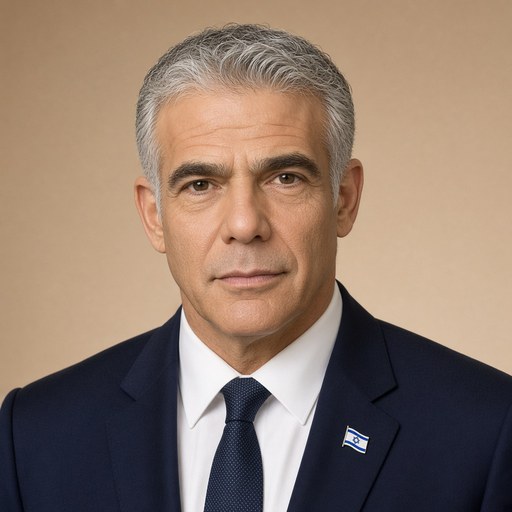
PM Lapid and President of the United States Biden opened the Virtual Meeting of the I2U2
 Yair Lapid · Prime Minister of Israel
- Context
- Lapid addressed the virtual I2U2 summit on July 14, 2022, alongside leaders of the US, India, and UAE to launch new multilateral cooperation initiatives.
- Main themes
- I2U2 quad cooperation, food security, energy transition, international partnerships, climate crisis, technology and innovation, trade and economic development, regional cooperation, COVID-19 pandemic recovery, water technology, private sector engagement, Ukraine war economic impact
- Duration
- ~7 min
- Words
- 869
- Sentences
- 40
- Readability
- 54
- Grade
- 11.0
- Syntax
- 2.95
- Vocabulary
- 1.95
The broad sphere of national life a sentence belongs to. Every sentence has an Arena, so it is the denominator the other indices are read against.
Other40 sentences in 10 paragraphs
The Honorable President of the United States, Joe Biden; The Honorable Prime Minister of India, Narendra Modi; The Honorable President of the United Arab Emirates, His Royal Highness Sheikh Mohammed bin Zayed Al Nahyan, Friends, This group was born several months ago during a dinner at the home of the UAE ambassador in Washington, DC.
We sat around the table and spoke about how, after we get control over the pandemic, anyone trying to go back to how things used to be would fail. Anyone who understands that we live in a new world with new challenges would succeed and flourish. That dinner was on a Wednesday evening. A few days later – in what might be a world record in the field of international relations – my friend Dr. Jaishankar, the Minister of External Affairs of India, was in my office in Jerusalem, Tony Blinken and Sheikh Abdullah bin Zayed were on Zoom, and we held the first summit of this quad, the I2U2 forum.
Our starting point was that in the new world we live in, we need to improve our ability to cooperate quickly, to make the most of our comparative advantages, to put the right advanced tech together with the right resources. We need to think in new terms when it comes to energy; food security and water tech; defense and trade. Each one of our countries brings very different challenges and very different qualities to the table, but that is what makes our potential even greater. In the 21st century, challenges are local, but solutions are global.
Let me give you two examples: The entire world is dealing with issues relating to food security. The combination of the climate crisis, the war in Europe and the COVID-19 pandemic has created global food insecurity. Food security is going to be the main issue in Africa and Latin America, in East Asia and in the Middle East. An initiative like the food corridor between India and the UAE, which was put together by this group, is a clear example of a creative solution to a problem we're all facing. The fast transportation of food, preservation technologies, the ability to connect relative advantages together—this is the solution to the problem.
Another example is the solar and wind energy storage project. In this case as well, the idea is to make the most of technological capabilities, some of which are still being developed, in order to deal with an energy market that is facing a serious crisis. Since the war in Ukraine broke out, each one of us has had to deal with this crisis on the local level. Its effect on the cost of living has been immediate and dramatic, and of course this has political implications. Real solutions will only come through cooperation between countries that know how to put their brainpower, knowledge and resources on the same table.
I would like to emphasize: This is not a philanthropic group. We want to change the world for the better, but we are also creating relative advantages for our countries, for our businesses, for our science sector. In both projects I just mentioned, lists of local companies and relevant technologies have already been shared. Our goal is for the private market to be a full partner in this initiative.
This group is interesting because we are four very different countries, but when we started talking, it became clear we all want the same things: for our children to be warm in the winter, for them to have food on the table and clean water from the tap, for them to enjoy a quality education and advanced health and transportation infrastructure. We also want to reduce the damage our generation inflicted on the climate and the environment. These are big challenges. No single country, no matter how big or how rich, can deal with them alone.
On the other hand, I also believe—and this is part of the idea behind this meeting — that groups that are too big, may end up being ineffective. This quad is, in my view, the correct model. Our advantages are clear to one another, and so are all our needs. We can create enough flexibility and a mechanism that can make fast and smart decisions. At the same time, we can always find ways to create ad-hoc connections with countries that want to advance projects with us.
The projects I mentioned are just the beginning. The list is ongoing. Our role as leaders is to push our teams as hard as possible to research the fields in which real change can be made, to examine new projects, to bring them to the table, to connect them with the scientific and business communities.
The world is watching this meeting. This shows that something special is happening here. A new kind of economic and regional cooperation, cooperation that is more flexible and better adapted to the problems we face. The diplomatic and economic results that will emerge from this meeting will highlight our commitment to a new kind of cooperation. In this partnership, each country and each partner brings their own strengths so that the whole is greater than the sum of its parts.