




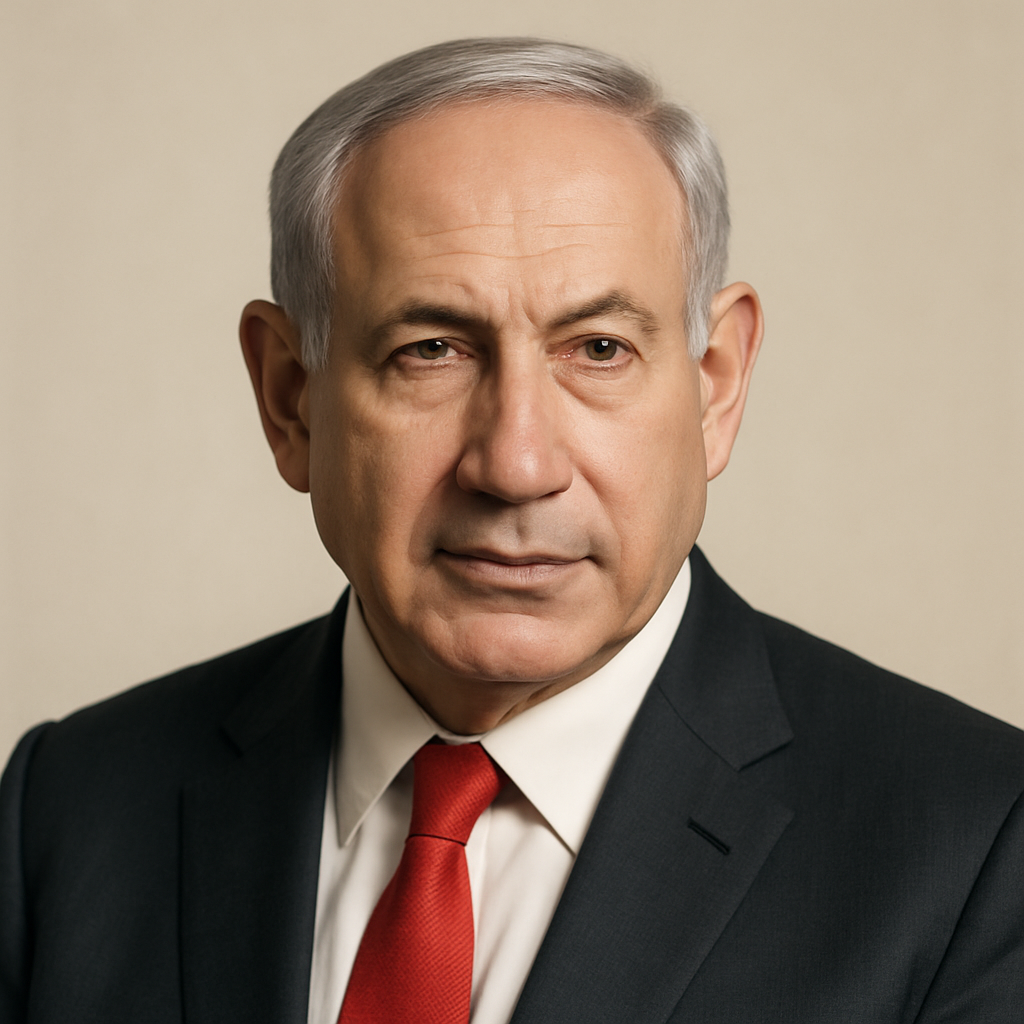
PM Netanyahu's Remarks at the Economic Press Conference
 Benjamin Netanyahu · Prime Minister of Israel
- Context
- Netanyahu addressed Israeli citizens on July 9, 2020, announcing an economic relief package while urging compliance with COVID-19 health directives amid a second wave.
- Main themes
- COVID-19 second wave response, economic safety net, health and economy balance, personal responsibility, mask-wearing and social distancing, government decision-making, trial-and-error policy approach, business and worker relief, pandemic restrictions, public cooperation
- Duration
- ~15 min
- Words
- 1,832
- Sentences
- 105
- Readability
- 62
- Grade
- 8.9
- Syntax
- 2.86
- Vocabulary
- 2.07
The broad sphere of national life a sentence belongs to. Every sentence has an Arena, so it is the denominator the other indices are read against.
Other105 sentences in 18 paragraphs
Citizens of Israel, I will immediately present to you the economic safety net that we have prepared for the coming year. This safety net is for wage-earners, the self-employed and businesses. The Finance Minister and our teams worked on this plain around the clock in recent days. We worked so that you will receive the money, as quickly as possible.
But before everything, I would like to say something from the depths of my heart: We are in the midst of a growing global storm. We are in the midst of a second wave of the coronavirus. It came to us and to other countries. I do not think it will pass over almost any country. We are steering our national ship between high waves and health dangers, the likes of which the world has not seen in over 100 years. Dealing with the coronavirus demands that fateful decisions be made on a daily basis. We must constantly find the balance between ensuring your health and lives, citizens of Israel, and opening up the economy and getting it back on a stable track. Simply put, the decisions are made on a trial-and-error basis. You try something, err and fix it. This is how all governments and every world leader that I speak with – all the time, including today – operate.
In the first wave of the coronavirus, we had amazing success. We closed the skies and the borders very early. We put people in quarantine. We used digital tools and we imposed shutdowns. As a result of this, we lowered the morbidity data to a handful of cases daily. Even though all loss of life is tragic, and I share in the families' grief, I know the price of loss, despite all this, the number of our dead was – and remains – very small, relative to the thousands who have died in countries the size of ours. This is an achievement that we must continue to maintain.
But there is also the other side: The steps that we have taken, which have brought great success in the health sphere – have exacted a heavy price from us in the economic sphere. So that the economy might recover, we started to open it up. We first went back to work, then we opened stores, malls, schools and restaurants. Lastly, we open event halls, clubs, bars and other places in which there are gatherings and close contact.
In retrospect, as part of the trial-and-error, it is possible to say that this last stage was too soon. True, many people pushed us to do so, to open up the economy with abandon. By the way, this did not prevent those same people from telling us today 'Why did you open up?' However, we did this not because of them but because we listened to your plight, citizens of Israel, and in order to put as many people as possible back to work. I take upon myself the responsibility for this step and I also take upon myself the responsibility to fix it. To this end, we have now closed places of social gathering in closed spaces. We will take other steps if necessary.
I want to tell you, citizens of Israel, including our dear brothers in the ultra-orthodox public, all of our decisions are made on a professional and substantive basis, on a statistical basis, out of genuine concern for the health of all citizens of Israel. There is no discrimination against any public.
Unfortunately, contrary to our latest directives, I am hearing about pirate initiatives among certain publics to hold large weddings. Instead of in event halls – in villas and private homes. I would like to tell you: Do not do this. You cannot cheat the virus. We have banned weddings in order to prevent funerals. You cannot cheat the virus. Have small weddings and do not gather more than 20 people in any place. Wear masks. Research has proven that when two people wear masks at a distance of two meters from each other, the chance of infection is infinitesimal. Therefore, I again request your cooperation, citizens of Israel: Wear masks and maintain distance. If we carefully adhere to the health directives, we will flatten the morbidity curve. But I want you to know that even if we do this, the curve will still rise due to infections that have already occurred. Only after additional time, several weeks, will it go back down.
We are doing everything to avoid a full shutdown. Personal responsibility and mutual guarantee are required. The government is continuing to implement the lessons, to exercise oversight and control, to shorten the wait for coronavirus test results. But remember, carrying out the directives is a necessary condition for success. This is the health issue.
Now I would like to speak about the economic issue, about the economic safety net for the coming year, for you, citizens of Israel. I am attentive to your plight. I hear the cries. I speak to you on Zoom and speak with you face-to-face, genuine, pointed talks from the heart. I am determined to give solutions. I see before my eyes the restaurant owner, the taxi driver, the falafel seller, the barber and the cosmetician, those who work on stage and the artists, business owners, the managers and the employees. I am working night and day for you.
From the onset of the crisis, we initiated various economic assistance programs: We expanded the eligibility for unemployment compensation. We gave incentives to go back to work and we allocated large grants, and also many loans. We made major efforts to overcome the Israeli bureaucracy. You can believe me, this is a heavy struggle, sumo wrestling. I know that in the first weeks there were more than a few mishaps and delays. They stemmed from the severe birth pangs of our previous plans, from chronic bureaucracy which is also in the system. Some of these delays are still with us. Therefore, yesterday, the Finance Minister and I instructed the Tax Authority to hurry up with, and increase, the advances to the business owners whose evaluations are still not concluded – and transfer them the money quickly.
Here are our guiding principles: First, certainty for the coming year, speed in transferring the money and third, I want you to listen to me because I know that all of you are watching – immediate grants for the self-employed. People are waiting to receive money, therefore we insisted – immediate grants for the self-employed. I will go into details presently. This is to say, what is needed now is an additional plan that provides economic certainty for the coming year, the next 12 months, and quickly puts money in bank accounts. This is a safety net for all citizens of Israel. I would like each and every one of you to know that the state will do whatever is necessary to ease the economic distress.
I will present the main points of the new plan and Finance Minister Yisrael Katz will expand on it later. The first component is a safety net for wage earners – those who are unemployed and are on unpaid leave. In the plan that we will submit for Cabinet approval next week, you will receive unemployment compensation until the end of June 2021, i.e. we are extending the eligibility for unemployment compensation, and the validity of all of the benefits that we have enacted since the onset of the crisis. It is important to say – all of this will be in effect until the unemployment rate drops below 10%. We hope that we will get there. We are working to get there.
The second component is a safety net for the coming year – for the self-employed and business owners who were hurt by the coronavirus. First, as I told you, I have directed that grants be given immediately, that they reach your bank accounts by next week. On this matter as well, we must overcome almost impossible bureaucratic obstacles. We had to put in one room the person responsible for the computers, the person responsible for income tax, the Finance Ministry Legal Adviser, and the Finance Ministry and National Insurance Institute leaderships and in the end we did it.
Next week we will give NIS 7,500 advances to those people whom we assisted at the start of May – without doing additional calculations, new content and new conditions. This is the immediate payment that you see here. The Finance Minister will go into details about the other payments to the self-employed and business owners for the rest of the year.
The third component in the new plan is an additional safety net for businesses in the coming year. Small businesses – with annual turnovers of up to NIS 300,00 – that have been hurt will receive grants of up to NIS 6,000, once every two months. Larger businesses – with annual turnovers of NIS 300,000-NIS 1,000,000 – that were hurt will receive up to NIS 500,000 assistance in financing their fixed costs, once every two months. Let it be clear – the assistance funds depend on the extent to which the business was hurt.
We will also submit other decisions for Cabinet approval next week. For example, cancelling the need to renew business licenses next year and dramatically increasing state-guaranteed loans under improved conditions.
If necessary, we will submit additional plans in the coming weeks. We are discussing this, in both the economic and health spheres. We can do this and invest this huge amount of money because the Israeli economy is very strong. It has garnered quite a reputation; we enacted many reforms here. We have brought unique growth, I am very proud of this, but it gives us the ability to borrow money at very low interest. Stanley Fisher, the economist who was Governor of the Bank of Israel, told me yesterday this was a unique situation, that we could borrow money today at very low interest rates. I do not want to give you the illusion that this will solve every problem but I can assure you that I personally will be constantly involved to see to it that the money goes to you, that you will be able to maintain yourselves and your families in this difficult period.
Citizens of Israel, today [the 17th of the Hebrew month of Tammuz] begins the Three Weeks. We are a people that remembers the past, the great events in our history as well as the difficult events. Our strong roots have always enabled us to withstand the fiercest storms. We have known destruction and exile but thanks to the mighty spirit that beats within us, we have stood up anew. We established a strong and prosperous state and with G-d's help, with personal responsibility and mutual guarantee, it will reach new heights for the benefit of all citizens of Israel. All of us together we will defeat the virus.