




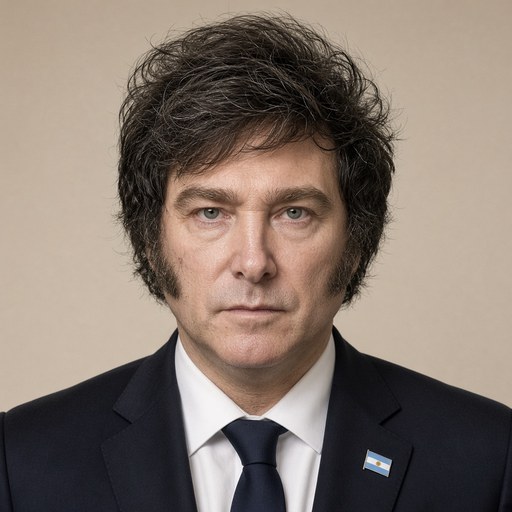
Announcements by the President of the Nation, Javier Milei, via national broadcast, from the White Room of the Casa Rosada.
 Javier Milei · President of Argentina
- Context
- Milei addressed Argentinians via national broadcast on December 20, 2023, announcing his Shock Stabilization Plan eight days after taking office.
- Main themes
- Fiscal stabilization plan, economic crisis, anti-collectivism and libertarianism, state interference, political caste critique, fiscal deficit, inflation, monetary policy, individual liberty, Argentina's economic decline
- Duration
- ~18 min
- Words
- 2,127
- Sentences
- 82
- Readability
- 32
- Grade
- 15.2
- Syntax
- 3.07
- Vocabulary
- 2.36
Translated from Spanish
The broad sphere of national life a sentence belongs to. Every sentence has an Arena, so it is the denominator the other indices are read against.
Other82 sentences in 24 paragraphs
Argentinians, today is a historic day for our country. After decades of failures, impoverishment, decline, and anomie, today we formally begin the path of reconstruction. Since we took office just 8 business days ago, we have been focused on trying to contain the enormous crisis we inherited; for that, we designed a Shock Stabilization Plan that includes a fiscal adjustment plan, a currency policy that aligned the exchange rate with market value, and a monetary policy that includes the cleaning up of the Central Bank.
We are making our utmost effort to try to lessen the tragic effects of what could be the worst crisis in our history, the result of decades of governments that have insisted on failed recipes, because as we have said throughout these months: "The problem is not the chef, but the recipe." Those ideas that failed in Argentina are the same ideas that have failed across the globe, because wherever they have been tried, they have been an economic failure, a social failure, a cultural failure, and on top of that, they have cost the lives of millions of human beings. That doctrine, which some might call leftist, socialism, fascism, communism, and which we like to categorize as collectivism, is a way of thinking that dilutes the individual in favor of the power of the State. It is the basic foundation of the caste model; it is a doctrine of thought that starts from the premise that the reason of State is more important than the individuals that make up the Nation; that the individual is only recognized if they submit to the State, and that, therefore, citizens owe allegiance to their representatives, the political caste. That is to say, that individuals are nothing but a means to the ends of the State; it is a way of seeing the world that consists of the belief that a group of men, the politicians, are superior to the rest of the individuals and that therefore it should be they who govern the destinies of their compatriots. A doctrine that starts from the idea that a group of bureaucrats, sitting in an office, can plan the lives of millions of human beings, considering their desires, capacities, preferences, and circumstances. It is a doctrine that considers that politicians, consequently, are omnipresent, omniscient, and omnipotent; that is to say, that in essence it is a doctrine that considers that politicians are God.
Well, we have come to tell you that politicians are not only not God, but they are the cause of our problems. They are the cause of our problems because for decades they have defended these impoverishing ideas we speak of, while they became richer and richer; because it is the relentless implementation of these ideas for more than 100 years that has led us little by little, step by step, to the economic hell we live in today.
The process has been gradual, and along this path we have become accustomed to and taken as normal state intrusions that are the causes of our problems. The result is the country we received, the worst inheritance in history, a country with a consolidated deficit of 15% of GDP, where 5% of the deficit is from the Treasury and 10% from the Central Bank; a country that spends so much that it cannot even afford to pay for it with the highest tax pressure in the world; a country without reserves in the Central Bank and with its creditworthiness destroyed; a country that has issued money equivalent to 20 points of GDP to finance that public spending, and that now, as a result of that reckless issuance, faces its worst crisis in 40 years; a country that was on the path to crashing against an annual inflation of 15,000%, and that requires an urgent change of course to avoid disaster. That change begins today.
A central aspect of the failure of the last 100 years is the interference that the State has had in the lives of citizens; from that belief that politicians are superior beings who must govern the destinies of each one of us, an institutional framework emerges that makes it so that no one can work, trade, move, or educate themselves without their permission; while in a free society everything is permitted, except what is prohibited. In a collectivist society like Argentina, everything is prohibited, except what is permitted by politicians.
In clear opposition to the spirit of our Liberal Constitution, which aimed to restrict the arbitrary power of the State in defense of the life, liberty, and property of individuals. For the last 100 years, politicians have been concerned with expanding the power of the State to the detriment of good Argentinians; this expansion of the State has been accompanied by the greatest destruction of wealth of a country on record. Our country, which at the beginning of the 20th century was the world's leading power, has been caught in an endless cycle of crises over the last 100 years, all of which have the same cause at their origins: the fiscal deficit. In fact, of the last 123 years, in 113 of them, we have had a fiscal deficit, and of the 22 crises that Argentinians have suffered in our history, 20 have had a fiscal origin. But since the political class has never wanted to tackle the cause of our problems, they have systematically resorted to debt, monetary issuance, or tax increases to alleviate this deficit.
The consequence of those decisions is that Argentina is the world's leading serial defaulter. We have removed 13 zeros from the currency, we have destroyed five monetary signs, we have had two hyperinflations without wars, and we have the highest tax pressure in the world.
What must be understood is that the problem is the deficit and that the solutions to which politicians resort, far from fixing the problem, worsen it. The use of debt as a mechanism for financing the deficit, the inevitable default, results in an increase in country risk. The rise in interest rates, the fall in investment, and, ultimately, miserable real wages.
Monetary issuance, as has been demonstrated theoretically and empirically, is the only cause of inflation, which is a hidden regressive tax that distorts price signals, destroys investment, and the purchasing power of Argentinians.
The indiscriminate and continuous increase in taxes undermines the property rights of Argentinians, against savings, investment, and consequently also generates miserable real wages.
To solve the problems caused by the different politicians who try to finance the deficit instead of addressing the cause, which is the fiscal deficit, politicians introduce regulations, price controls, restrictions, bureaucratic hurdles, and norms that violate the freedom and property rights of Argentinians, hinder economic calculation, and destroy wealth generation.
Consequently, the State – as a whole – has become a machine for preventing trade, work, production, savings, investment, wealth generation, economic growth, and, fundamentally, freedom.
The consequence of this is that Argentina is a country where 50 percent of the population is below the poverty line, more than 10 percent of the population is indigent in a country that produces food for 400 million human beings, with a tax pressure on the agricultural sector of 70 percent, and the State keeps the food of 280 million human beings while there are 5 million Argentinians who cannot afford to eat.
Private employment has been stagnant at 6 million jobs for more than a decade. Per capita GDP is 15 percent lower than in 2011; one-third of formal workers are poor. Furthermore, we have a low unemployment rate, but this is explained by precarious employment and miserable real wages, and 6 out of 10 children – between 0 and 14 years old – are poor.
I want to pause for a second on this figure you just heard: 6 out of 10 children, between 0 and 14 years old, are poor. That is the tragedy we are living, the result of a political and economic model that undermines freedom. Nothing is more important than reversing this tragic trend, which mortgages our future, and that is why we focus on the importance of human capital as a driver of economic growth. Well, today, we take the first step to end the model of decay.
Today, I have signed a Decree of Necessity and Urgency (DNU) to begin to dismantle this oppressive legal and institutional framework that has destroyed our country.
As our economic model, unlike everything that has been done in the last hundred years, tackles the deficit that is the cause of our problems and not the consequences of it. We can begin, today, to dismantle all these regulations that pretend to provide solutions but only generate problems.
The Decree of Necessity and Urgency we are presenting today aims to begin the process of economic deregulation that Argentina so desperately needs to start growing. Among many reforms, the decree includes:
1- Repeal of the Rental Law so that the real estate market can function smoothly and renting is not an odyssey. 2- Repeal of the Supply Law so that the State never again attacks the property rights of individuals. 3- Repeal of the Shelving Law so that the State stops interfering in the decisions of Argentine merchants. 4- Repeal of the National Purchase Law, which only benefits certain actors in power. 5- Repeal of the Price Observatory of the Ministry of Economy, to avoid any persecution of companies. 6- Repeal of the Industrial Promotion Law. 7- Repeal of the Commercial Promotion Law. 8- Repeal of the regulations that prevent the privatization of public companies. 9- Repeal of the State Companies Regime. 10- Transformation of all State companies into anonymous societies for subsequent privatization. 11- Modernization of the labor regime to facilitate the process of generating genuine employment. 12- Reform of the Customs Code to facilitate international trade. From today, it is prohibited to prohibit exports. 13- Repeal of the Land Law to promote investments. 14- Modification of the Fire Law. 15- Repeal of the obligations of sugar mills regarding sugar production. 16- Deregulation of the legal regime applicable to the wine sector. 17- Repeal of the national mining trade system and the mining information bank. 18- Authorization for the transfer of the total or partial shareholding of Aerolíneas Argentinas. 19- Implementation of the Open Skies policy. 20- Modification of the Civil and Commercial Code to reinforce the principle of contractual freedom between the parties. 21- Modification of the Civil and Commercial Code to guarantee that obligations contracted in foreign currency must be settled in the agreed currency. 22- Modification of the regulatory framework for prepaid medicine and social security. 23- Elimination of price restrictions on the prepaid industry. 24- Inclusion of prepaid medicine companies in the social security regime. 25- Restoration of electronic prescriptions to streamline service and minimize costs. 26- Modifications to the pharmaceutical companies regime to promote competition and reduce costs. 27- Modification of the Companies Law so that football clubs can become anonymous societies if they wish. 28- Deregulation of satellite internet services to allow the entry of companies like Starlink. 29- Deregulation of the tourism sector by eliminating the monopoly of travel agencies. 30- Inclusion of digital tools for procedures in the Motor Vehicle Registries.
These reforms, of which I have only mentioned 30, out of more than 300 included, are some of the reforms contemplated in the DNU that we signed today.
The goal is to begin the path of reconstruction of our country, to return freedom and autonomy to individuals, and to start dismantling the enormous amount of regulations that have impeded, hindered, and halted economic growth in our country. But this is just the first step, as in the coming days we will call for extraordinary sessions of the National Congress and send a package of laws asking Congress for collaboration to advance in this process of changes that society chose, in a context of crisis, which requires immediate action.
The Deputies and Senators of the Nation will face the historic responsibility of choosing between being part of this change or obstructing the most ambitious reform project of the last 40 years to finally set in motion the productive forces of Argentinians and begin to walk the path to becoming a world power again.
I trust that our representatives will defend the interests of Argentinians and not those of the castes that have benefited for decades from this impoverishing system. If we move forward on this path and do so with determination and decisiveness, I am sure that our country will return to the path of growth and progress that we once knew how to walk.
Therefore, I want to thank you, may God bless Argentinians, and may the Forces of Heaven accompany us.
The original Spanish. The tags above are read on the English translation's sentences.
Argentinos, hoy es un día histórico para nuestro país. Después de décadas de fracasos, empobrecimiento, decadencia y anomia, hoy comenzamos formalmente el camino de la reconstrucción. Desde que asumimos, hace tan solo 8 días hábiles, hemos estado enfocados en intentar contener la enorme crisis que heredamos, para eso diseñamos un plan de estabilización de Shock que comprende un plan de ajuste fiscal, una política cambiaria que sinceró el tipo de cambio al valor del mercado, y una política monetaria que incluye el saneamiento del Banco Central.
Estamos haciendo nuestro máximo esfuerzo para intentar disminuir los efectos trágicos de lo que puede ser la peor crisis de nuestra historia, producto de décadas de gobiernos que han insistido con recetas fracasadas, porque como dijimos durante todos estos meses: “El problema no es el chef, sino la receta”. Esas ideas que fracasaron en la Argentina son las mismas ideas que han fracasado a lo largo y a lo ancho del planeta, porque allí donde se intentaron han sido un fracaso económico, han sido un fracaso en lo social, han sido un fracaso en lo cultural, y encima les han costado la vida a millones de seres humanos. Esa doctrina, que algunos podrían llamar izquierda, socialismo, fascismo, comunismo, y que a nosotros nos gusta catalogar como colectivismo, es una forma de pensamiento que diluye al individuo en favor del poder del Estado. Es el fundamento básico del modelo de la casta, es una doctrina de pensamiento que parte de la premisa de que la razón de Estado es más importante que los individuos que componen la Nación; que el individuo solo es reconocido si se somete al Estado, y que, por lo tanto, los ciudadanos le debemos pleitesía a sus representantes, la casta política. Es decir, que los individuos no son sino un medio para los fines del Estado; es una forma de ver el mundo que consiste en la creencia de que un grupo de hombres, los políticos, son superiores al resto de los individuos y que por lo tanto deben ser ellos quienes rijan los destinos de sus compatriotas. Una doctrina que parte de la idea de que un grupo de burócratas, sentados en una oficina, pueden planificar la vida de millones de seres humanos, considerando sus deseos, capacidades, preferencias y circunstancias. Es una doctrina que considera que los políticos, en consecuencia, son omnipresentes, omniscientes y omnipotentes, es decir, que en esencia es una doctrina que considera que los políticos son Dios.
Pues bien, nosotros hemos venido a decirles que los políticos no solo no son Dios, sino que son la causa de nuestros problemas. Son la causa de nuestros problemas porque durante décadas han defendido estas ideas empobrecedoras de las que hablamos, mientras ellos se hacían cada vez más ricos; porque es la implementación inclemente de estas ideas por más de 100 años, lo que nos llevó poco a poco, peldaño por peldaño, al infierno económico que vivimos hoy.
El proceso ha sido paulatino, y en este camino nos hemos acostumbrado y tomado como normales intromisiones estatales que son las causas de nuestros problemas. El saldo es el país que recibimos, la peor herencia de la historia, un país con déficit consolidado de 15% del PBI, donde 5% del déficit es del Tesoro y 10% del Banco Central; un país que gasta tanto que no le alcanza para pagarlo ni siquiera con la presión impositiva en blanco más alta del mundo; un país sin reservas en el Banco Central y con su confianza crediticia destruida; un país que ha emitido dinero por 20 puntos del PBI para financiar ese gasto público, y que ahora producto de esa emisión desenfrenada, enfrenta su peor crisis en 40 años; un país que iba camino a estrellarse contra una inflación anual del 15.000 %, y que requiere un cambio de rumbo urgente para evitar el desastre. Ese cambio comienza hoy.
Un aspecto central del fracaso de los últimos 100 años es la injerencia que el Estado ha tenido en la vida de los ciudadanos, de esa creencia de que los políticos son seres superiores que deben regir los destinos de cada uno de nosotros, se desprende un andamiaje institucional que hace que nadie pueda trabajar, comerciar, circular o educarse sin el permiso de ellos; mientras que en una sociedad libre todo está permitido, salvo lo que está prohibido. En una sociedad colectivista como en la Argentina, todo está prohibido, salvo lo que está permitido por los políticos.
En clara oposición al el espíritu de nuestra Constitución Liberal, que pretendía restringir el poder arbitrario del Estado en defensa de la vida, la libertad y la propiedad de los individuos. Durante los últimos 100 años los políticos se han ocupado de expandir el poder del Estado en detrimento de los argentinos de bien; esta expansión del Estado ha venido acompañado de la mayor destrucción de riqueza de un país en lo que se tenga registro. Nuestro país, que a principios del siglo XX era la primera potencia mundial, a lo largo de los últimos 100 años, se ha visto enfrascado en un ciclo interminable de crisis que todas tienen en sus orígenes la misma causa: el déficit fiscal. De hecho, de los últimos 123 años, en 113 de ellos, hemos tenido déficit fiscal y de las 22 crisis que los argentinos sufrimos en nuestra historia, 20 han tenido origen fiscal. Pero como la clase política no ha querido atacar nunca la causa de nuestros problemas, han recurrido sistemáticamente a la deuda, la emisión monetaria o la suba de impuestos para paliar este déficit.
La consecuencia de esas decisiones es que la Argentina es el máximo defaulteador serial del mundo. Le hemos quitado 13 ceros a la moneda, hemos destruido cinco signos monetarios, hemos tenido dos hiperinflaciones sin guerras y tenemos la presión impositiva en blanco más alta del mundo.
Lo que debe entenderse es que el problema es el déficit y que las soluciones a las que los políticos recurren lejos de arreglar el problema, lo empeoran. La utilización de la deuda como mecanismo de financiamiento del déficit, el inevitable default, lo que produce es el incremento del riesgo país. La suba de la tasa de interés, la caída de la inversión y, finalmente, salarios reales miserables.
La emisión monetaria como ya ha sido demostrado teórica y empíricamente es la única causa de la inflación, que es un impuesto regresivo encubierto, que entorpece la señal de precios, destruye la inversión y el poder adquisitivo de los argentinos.
El aumento indiscriminado y continuo de impuesto atenta contra el derecho de propiedad de los argentinos, contra el ahorro, la inversión y en consecuencia genera también salarios reales miserables.
Para solucionar los problemas que causan los distintos políticos que intentan financiar el déficit en vez de afrontar la causa, que es el déficit fiscal los políticos introducen regulaciones, controles de precios, cepos, trabas burocráticas y normativas, que violan la libertad y el derecho de propiedad de los argentinos, entorpece el cálculo económico y destruye la generación de riqueza.
En consecuencia, el Estado – en su conjunto – se ha vuelto una máquina de impedir el comercio, el trabajo, la producción, el ahorro, la inversión, la generación de riqueza, el crecimiento económico y, fundamentalmente, la libertad.
La consecuencia de eso es que, la Argentina, es un país donde el 50 por ciento de la población está por debajo de la línea de la pobreza, más de 10 por ciento de la población es indigente en un país, que produce alimentos para 400 millones de seres humanos, con una presión impositiva sobre el sector agropecuario del 70 por ciento y el Estado se queda con el alimento de 280 millones de seres humanos y hay 5 millones de argentinos, que no les alcanza para comer.
El empleo privado está estancado en 6 millones de puestos de trabajo, desde hace más de una década. El PBI per cápita es 15 por ciento inferior al del 2011; un tercio de los trabajadores formales son pobres. Además, tenemos una tasa de desempleo baja, pero que se explica con empleo precario y salarios reales miserables y 6 de cada 10 chicos – entre cero y 14 años – son pobres.
Quiero detenerme un segundo en esta cifra que acaban de escuchar: 6 de cada 10 chicos, de entre 0 y 14 años, son pobres. Esa es la tragedia que estamos viviendo, producto de un modelo político y económico, que atenta contra la libertad. Nada es más importante que revertir esta tendencia trágica, que hipoteca nuestro futuro y por eso nuestro foco en la importancia del capital humano como motor del crecimiento económico. Pues bien, hoy, damos el primer paso para terminar con el modelo de la decadencia.
En el día de hoy, he firmado un Decreto de Necesidad y Urgencia (DNU) para comenzar a destrabar este andamiaje jurídico e institucional opresor que ha destruido nuestro país.
Como nuestro modelo económico, a diferencia de todo lo que se ha hecho, en los últimos cien años, ataca el déficit que es la causa de nuestros problemas y no las consecuencias del mismo. Podemos comenzar, hoy, a destrabar todas estas regulaciones que pretenden aportar soluciones, pero sólo generan problemas.
El Decreto de Necesidad y Urgencia que estamos presentando hoy, tiene por fin comenzar el proceso de regulación económica que la Argentina tanto necesita para poder comenzar a crecer. Entre muchas reformas el decreto incluye:
1- Derogación de la Ley de Alquileres para que el mercado inmobiliario vuelva a funcionar sin problemas y alquilar no sea una odisea. 2- Derogación de la Ley de Abastecimiento para que el Estado nunca más atente contra el derecho de propiedad de los individuos. 3- Derogación de la Ley de Góndolas para que el Estado deje de entrometerse en las decisiones de los comerciantes argentinos. 4- Derogación de la Ley del Compre Nacional, que sólo beneficia a determinados actores del poder. 5- Derogación del Observatorio de Precios, del ministerio de Economía, para evitar toda persecución de las empresas. 6- Derogación de la Ley de Promoción Industrial. 7- Derogación de la Ley de Promoción Comercial. 8- Derogación de la normativa que impide la privatización de las empresas públicas. 9- Derogación del Régimen de Sociedades del Estado. 10- Transformación de todas las empresas del Estado en sociedades anónimas para su posterior privatización. 11- Modernización del régimen laboral para facilitar el proceso de generación de empleo genuino. 12- Reforma del Código Aduanero para facilitar el comercio internacional. Desde el día de hoy queda prohibido prohibir las exportaciones. 13- Derogación de la Ley de Tierras para promover las inversiones. 14- Modificación de la Ley de Fuego. 15-Derogación de las obligaciones de los ingenios azucareros, que tienen en materia de producción azucarera. 16- Liberación del régimen jurídico aplicable al sector vitivinícola. 17- Derogación del sistema nacional de comercio minero y el banco de información minera. 18- Autorización para la cesión del paquete accionario total o parcial de Aerolíneas Argentinas. 19- Implementación de la política de Cielos Abiertos. 20- Modificación del Código Civil y Comercial para reforzar el principio de libertad contractual entre las partes. 21- Modificación del Código Civil y Comercial para garantizar que las obligaciones contraídas en moneda extranjera deban ser canceladas en la moneda pactada. 22- Modificación del marco de regulación de la medicina prepaga y las obras sociales. 23- Eliminación de las restricciones de precios a la industria prepaga. 24- Incorporación de las empresas de medicina prepaga al régimen de obras sociales. 25- Restablecimiento de la receta electrónica para agilizar el servicio y minimizar costos. 26- Modificaciones al régimen de empresas farmacéuticas para fomentar la competencia y reducir costos. 27- Modificación de la Ley de Sociedades para que los clubes de fútbol puedan convertirse en sociedades anónimas, si así lo quisieren. 28- Desregulación de los servicios de Internet satelital para permitir el ingreso de empresas, como Starlink. 29- Desregulación del sector turístico eliminando el monopolio de las agencias de turismo. 30- Incorporación de herramientas digitales para trámites de los Registros Automotores.
Estas reformas, de las cuales sólo he mencionado 30, de las más de 300 incluidas, son algunas de las reformas que están contempladas en el DNU, que firmamos hoy.
El objetivo es comenzar el camino de reconstrucción de nuestro país, devolverles la libertad y la autonomía a los individuos y empezar a desarmar la enorme cantidad de regulaciones que han impedido, entorpecido y detenido el crecimiento económico en nuestro país. Pero este es sólo el primer paso, pues, en los próximos días llamaremos a sesiones extraordinarias del Congreso Nacional y enviaremos un paquete de leyes pidiéndole al Congreso la colaboración para avanzar en este proceso de cambios, que la sociedad eligió, en un contexto de crisis, que requiere acción inmediata.
Los Diputados y Senadores de la Nación enfrentarán la responsabilidad histórica de elegir entre ser parte de este cambio u obstruir el proyecto de reformas más ambiciosa de los últimos 40 años para poder lograr, finalmente, poner en marcha las fuerzas productivas de los argentinos y comenzar a transitar el camino para volver a ser una potencia mundial.
Confío en que nuestros representantes defenderán los intereses de los argentinos y no los de las castas, que se han beneficiado, durante décadas de este sistema empobrecedor. Si avanzamos en este camino y lo hacemos con decisión y contundencia estoy seguro que nuestro país volverá a la senda del crecimiento y el progreso que alguna vez supimos transitar.
Por lo tanto, quiero darles las gracias, que Dios bendiga a los argentinos y que las Fuerzas del Cielo nos acompañen.