




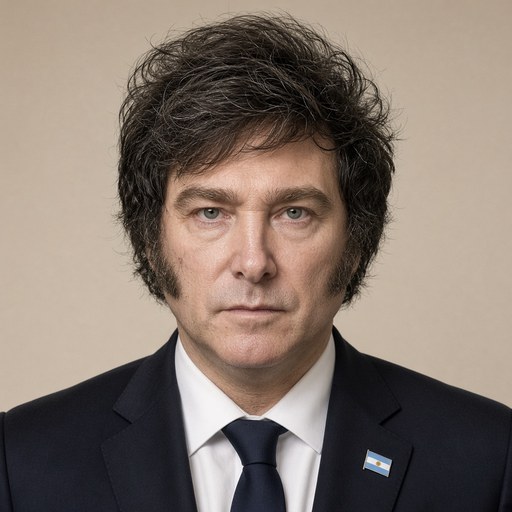
National Address by President Javier Milei on the Presentation of the National Budget 2026
 Javier Milei · President of Argentina
- Context
- Milei addressed the Argentine nation on September 16, 2025, presenting the 2026 national budget to Congress and reaffirming his government's commitment to fiscal balance.
- Main themes
- Fiscal balance, 2026 national budget, economic stabilization, inflation reduction, poverty reduction, public debt, monetary order, exchange rate policy, Keynesian economics critique, Argentina's economic history, currency controls, growth and prosperity
- Duration
- ~19 min
- Words
- 2,233
- Sentences
- 95
- Readability
- 50
- Grade
- 12.1
- Syntax
- 3.05
- Vocabulary
- 2.14
Translated from Spanish
The broad sphere of national life a sentence belongs to. Every sentence has an Arena, so it is the denominator the other indices are read against.
Other95 sentences in 19 paragraphs
PRESIDENT.- Argentinians, good evening. In accordance with our national Constitution, tonight we will be sending the 2026 budget proposal to the National Congress for its evaluation. This budget maintains, just like the budget sent last year, fiscal balance. Today, the future of Argentina fundamentally depends on one thing: that the people and politics commit to fiscal order.
If we respect fiscal balance, if we achieve that basic consensus, we are assured unimaginable growth after decades of stagnation. If we fail, we will fall back into the pit of uncontrolled inflation and the destruction of all expectations about the country. In this sense, the National Budget is not just a mere bill; it is the ratification of our unbreakable commitment to move the country forward.
Fiscal balance is the cornerstone of our government plan. And it is a non-negotiable principle that we have presented to society since the beginning of our management. No country in the world can function properly without a balanced budget; that is why politicians around the world find consensus and agreements to enact the law of laws. We understand that fiscal balance may seem like a mere whim, but it is nothing more and nothing less than the definitive solution to the problems that have plagued Argentina for decades. However, this solution has long development timelines, like any true solution. Along that path, the successes that our program has had and continues to have are similar to the foundations in the construction of a building. They are the necessary first step to develop the work; they are its essential components, since without the foundations, the building collapses.
We celebrate these successes because we know their importance. We celebrate the sustained decrease in inflation, the decrease in poverty, the decrease in taxes, and the lifting of the currency controls as great achievements, because they truly are. But it is also true that during these 20 long years, many Argentinians have lost everything and have fared worse and worse. That is why I want to tell all Argentinians, regardless of the success our management has had in correcting the chaos of decades, we understand that many still do not perceive it in their material reality. I would like to highlight that due to how the government plan was configured, the hardest years to face were the first ones. And that is why we can affirm, as we have done so many other times and despite the temporary turbulence, that the worst is already over. That is why I want to thank you once again for the enormous support you have shown throughout this first term.
You are the protagonists of this process. You are the ones who have embarked on the arduous path of growth and embracing the ideas of freedom, which are nothing other than those of a mature nation. The spirit of Argentinians is heroic, and that is why I want to thank you, but I also want to be clear about one thing: when I say that the course is set in stone and that fiscal balance is non-negotiable, I do not say it out of whim or personal preference; I say it because doing what we are doing is the only way for Argentina to definitively emerge from the cycle of consecutive disillusionment in which we have lived for decades. There is no other path than that of fiscal balance, monetary order, and therefore, exchange rate order.
We must understand once and for all that there is a direct relationship between fiscal order, the decrease in country risk, economic growth, and prosperity. All other paths have already been attempted and have failed. They have failed miserably. We must not fall prey to false dilemmas that they want to propose to us; it is not through fiscal deficit that we will meet the needs of the most vulnerable. In fact, that remedy has proven to be worse than the disease. The path of fiscal deficit financed by issuance has already been tested and has led us back to uncontrolled inflation and stagnation. The path of fiscal deficit financed by debt has already been tested and has led us to inherit a public debt of 500 billion dollars and a history that has shown us as serial defaulters, which is why the markets punish us, even being one of the five countries in the world with fiscal balance.
That is to say, all possible experiments have been tried in this country, by the most varied alchemists of the economy. For more than 100 years, we have been the laboratory of the most outlandish theories because politicians claimed to have the recipe to spend more without consequences. For decades, they told us that we could get out of the crisis supposedly by stimulating consumption, which is a euphemism for saying issuing more money. And thus, all kinds of politicians passed through the Government, trying to apply this supposed magic recipe, invented by John Maynard Keynes, of fiscal deficit, monetary issuance, regulation, and control. The result is that we are the only country that went from being a developed country to a developing country.
We even reached the point of becoming the only country in the region that did not grow in the last 15 years. For this reason, from the very beginning, we stated that the problem was not the cook, but the recipe, and although some believe they have seen this before, those who say this are mistaken; they have never seen anything like what our management is carrying out, because what has changed is the recipe. The last time Argentina had a fiscal surplus, without being in default, was more than 120 years ago. No living Argentine has ever experienced the Argentina we are building. It is precisely for this reason that sometimes we get overly excited because we are thrilled by the future we see on the horizon, but it is also precisely for this reason that this time the effort that all Argentinians are making is worth it. This project that we are presenting today, just like the one we presented last year, seeks for our economic and reformist program to have legal and administrative support and to have the backing of Congress.
This project adheres to an unbreakable fiscal rule: as I mentioned, it is proposed with a primary surplus so that, at the end of the fiscal year, Argentina finds itself with a fiscal surplus or, at worst, in fiscal balance. Our commitment to the path of fiscal balance is such that this budget presents the lowest level of national spending in relation to GDP in the last 30 years. To give you an idea, the level of national spending is below the level of spending of the provinces for the first time since the 1990s. Furthermore, this budget includes financing restrictions, preventing the Treasury from financing itself through the Central Bank, because this would imply monetary issuance and a return to inflationary hell. It also presents a rule of fiscal stability, meaning that if revenues fall or expenses exceed expectations, budget items must be adjusted to maintain fiscal balance.
This budget allocates 4.8 trillion pesos to national universities, increases spending on pensions by 5%, and on health by 17%, both items above inflation. Spending on education also increases by 8% above inflation. On the other hand, having conducted the relevant audits, the amount received by each disability pensioner will also increase by 5% above the inflation of 2026. In short, if the budget is the government plan and 85% of this budget will be allocated to education, health, and pensions, that means that the priority of this Government, as we have always said, is human capital.
Moreover, this Budget is the first budget in Argentine history to include the regime for the extinction of reciprocal obligations, to continue restoring the relationship between the national State and the provinces. This is a historical debt that we must resolve as a country, but it must be addressed with a firm commitment to fiscal balance and will therefore have a specific budget within the law of laws. Additionally, we will insist on restoring the much-abused presumption of fiscal innocence; for that reason, we seek to create a simplified regime for income tax declarations. That absurd idea that the State considers all its citizens as criminals preventively is over. But the Budget is not just a piece of paper without consequences; it is the roadmap of where we are going, and that is why it is important for Argentinians to understand what a country with fiscal balance and without inflation looks like.
Just by achieving fiscal balance and maintaining it over time, Argentina would reach, according to various studies, a growth base of 5% annually. To put it in context, between 2011 and 2023, Argentina's GDP per capita fell by just over 10%, while in neighboring countries it grew by 15% or 20% in the same period. Fiscal order and surplus are the difference between being able to dream of a better future or living trapped in a stormy and decaying present. And if we add the reforms we want to carry out to fiscal balance, we could be talking about sustained growth of 7% or 8% annually. To give you an idea, growing at those rates would mean that in 10 years we would resemble high-income countries, in 20 years we would be among the richest countries in the world, and in 30 years we would be on the podium of world powers.
But that would not happen by magic, nor is there a magic formula for all that progress to materialize today. It needs time for work to acquire greater value. Because as we have said on some occasions: Rome was not built in a day. What we are proposing is not a chimera; it is what we can achieve if we obtain the necessary consensus to make the fundamental reforms that the country needs.
I am sure that by working hand in hand with the governors, deputies, and senators who want a different Argentina, we will achieve it. The surplus is, for example, what will allow us to grant financing to the Treasury for those private sector actors who want to invest in the country in the large concessions that we will carry out.
That is to say, for the first time in decades, instead of the private sector financing the public sector, this primary surplus will allow the public sector to finance the private sector to develop fundamental works that improve the infrastructure and logistics of the country. Argentina is a country that has much to offer the world and that for decades refused to trade with the rest of the planet. We must embark on the path that all currently prosperous countries have taken and seek to flood the world by exporting our talent. On the contrary, if we decide to abandon this virtuous circle of fiscal balance and economic growth to return to the path of deficit, indebtedness, issuance, and/or tax increases, we will return to the stagnation and inflation that have characterized our country for so many years and that have plunged us into the most abject poverty.
For that reason, Argentina must, once and for all, abandon the constant economic self-sabotage of recent decades. We must abandon magical thinking. It is not possible to reinvent the wheel. No one is to blame for our problems but ourselves. And no one but ourselves can save us. We depend exclusively on our effort and our commitment to do, once and for all, things right. Because we have no other option left. It is time to finally assume that if we want there to be less poverty, we need more employment. If we want there to be more employment, we need more companies investing. And if we want more companies investing, we must stop seeing entrepreneurs as public enemies. Instead, we must create the conditions for companies to prosper and make money without their property rights being threatened.
And those conditions also imply, by definition, lower interest rates, which are not achieved by issuing money, but by reducing country risk based on fiscal balance and stimulating savings. Because a company that does not make money is a company that closes or a company that never opens. And that is what happens when taxes are systematically raised, fiscal balance is undermined, country risk rises, property rights are violated, and the rules of the game are changed on the fly, as we have done for so many decades.
Finally, I want to end with a brief reflection: it has cost us a lot to get here. We have all made enormous efforts to get out of the pit we were in when we took office. In fact, the salaries of the Executive Power have been frozen since the same date we took office. Therefore, we know that the path is arduous, but we also know that the course is correct.
We must understand as a country and as a society that if we do not complete the process of change we have undertaken, we will have thrown away all the effort we have made. Let us not give up; let us make all this effort worthwhile. May God bless the Argentinians, may the forces of heaven accompany us. Thank you all very much. Good night.
The original Spanish. The tags above are read on the English translation's sentences.
PRESIDENTE.- Argentinos, buenas noches. Conforme a lo que dicta nuestra Constitución nacional, esta noche estaremos enviando el proyecto de presupuesto de 2026 al Congreso de la Nación para su evaluación. Este presupuesto sostiene, al igual que el presupuesto enviado el año pasado, el equilibrio fiscal. Hoy el futuro de la Argentina depende fundamentalmente de una sola cosa: que el pueblo y la política se comprometan con el orden fiscal.
Si respetamos el equilibrio fiscal, si logramos ese consenso básico, tenemos asegurado un crecimiento inimaginable luego de décadas de estancamiento. Si fallamos, volveremos a caer en el pozo de la inflación descontrolada y la destrucción de toda expectativa sobre el país. En este sentido, el Presupuesto Nacional no es un mero proyecto de ley, es la ratificación de nuestro compromiso inquebrantable con sacar al país adelante.
El equilibrio fiscal es la piedra angular de nuestro plan de gobierno. Y es un principio no negociable que le hemos planteado a la sociedad desde el comienzo de nuestra gestión. Ningún país del mundo puede funcionar correctamente sin un presupuesto equilibrado, por eso los políticos en todo el mundo encuentran consensos y acuerdos para sancionar la ley de leyes. Entendemos que el equilibrio fiscal parezca un mero capricho, pero no es ni más ni menos que la solución definitiva a los problemas que azotan desde hace décadas a la Argentina. Sin embargo, esta solución tiene plazos de desarrollo largos, como cualquier solución verdadera. En ese recorrido, los éxitos que nuestro programa tuvo y sigue teniendo son parecidos a los cimientos en la construcción de un edificio. Son el primer paso necesario para desarrollar la obra, son sus componentes esenciales, dado que sin los cimientos el edificio colapsa.
Nosotros celebramos estos éxitos porque sabemos la importancia que tienen. Celebramos la baja sostenida de la inflación, la baja de la pobreza, la baja de los impuestos y la salida del cepo como grandes logros, porque efectivamente lo son. Pero también es cierto que durante estos 20 largos años muchísimos argentinos lo han perdido todo y les ha ido cada vez peor. Por eso quiero decirles a todos los argentinos, más allá del éxito que haya tenido nuestra gestión en corregir el descalabro de décadas, entendemos que muchos aún no lo perciban en su realidad material. Quisiera destacar que por cómo fue configurado el plan de gobierno los años más duros de afrontar fueron los primeros. Y por eso podemos afirmar, como hemos hecho en tantas otras veces y pese a las turbulencias coyunturales, que lo peor ya pasó. Es por eso que una vez más quiero agradecerles a ustedes por el enorme apoyo que han demostrado a lo largo de este primer periodo.
Ustedes son los protagonistas de este proceso. Ustedes son quienes han emprendido el arduo camino de crecer y abrazar las ideas de la libertad, que no son otras cosas que las de una nación madura. El temple de los argentinos es heroico y por eso les quiero dar las gracias, pero también quiero ser claro con una cosa, cuando yo digo que al rumbo está fijado en piedra y que el equilibrio fiscal no se negocia, no lo digo por capricho o preferencia personal, lo digo porque hacer lo que estamos haciendo es el único camino para que la Argentina salga de forma definitiva del ciclo del desencanto consecutivo en que vivimos a hace décadas. No hay otro camino que el de equilibrio fiscal, el orden monetario y por ende, el orden cambiario.
Tenemos que entender de una vez y para siempre que hay una relación directa entre el orden fiscal, la baja del riesgo país, el crecimiento económico y la prosperidad. Todos los demás caminos ya se intentaron y fracasaron. Fracasaron rotundamente. No debemos caer presos de falsos dilemas que nos quieren proponer, no es a través del déficit fiscal que atenderemos la necesidad de los más vulnerables. De hecho, ese remedio probó ser peor que la enfermedad. El camino del déficit fiscal financiado con emisión ya se probó y nos llevó al retorno de la inflación descontrolada y el estancamiento. El camino del déficit fiscal financiado con deuda, ya se probó, y nos llevó a heredar una deuda pública de 500.000 millones de dólares y una historia que nos ha mostrado como defaulteadores seriales, motivo por el cual los mercados nos castigan, aún siendo uno de los cinco países en el mundo que tienen equilibrio fiscal.
Es decir, todos los experimentos posibles fueron ensayados en este país, por los más variados alquimistas de la economía. Durante más de 100 años fuimos el laboratorio de las teorías más descabelladas porque los políticos decían tener la receta para poder gastar de más sin consecuencias. Durante décadas nos dijeron que se podría salir de la crisis supuestamente estimulando el consumo, que es un eufemismo para decir emitir más dinero. Y así pasaron toda clase de políticos por el Gobierno, intentando aplicar esta supuesta receta mágica, inventada por John Maynard Keynes, del déficit fiscal, emisión monetaria, regulación y control. El resultado es que somos el único país que pasó de ser un país desarrollado a un país subdesarrollado.
Incluso llegamos al punto de convertirnos en el único país de la región que no creció en los últimos 15 años. Por esto mismo, desde el primer momento planteamos que el problema no era el cocinero, sino la receta y aunque algunos crean que esto ya lo vieron, los que digan esto están equivocados, nunca vieron algo como lo que está llevando adelante nuestra gestión, porque lo que cambió es la receta. La última vez que Argentina tuvo superávit fiscal, sin estar en default, fue hace más de 120 años. Ningún argentino vivo experimentó jamás la Argentina que estamos construyendo. Es precisamente por esto que a veces nos entusiasmamos de más, porque nos emociona el futuro que vemos en el horizonte, pero también es precisamente por esto que esta vez el esfuerzo que todos los argentinos estamos haciendo vale la pena. Este proyecto que hoy estamos presentando, al igual que el que presentamos el año pasado, busca que nuestro programa económico y reformista pueda tener un soporte legal y administrativo y pueda contar con el respaldo del Congreso.
Este proyecto se ciñe a una regla fiscal inquebrantable: como ya mencioné, está planteado con superávit primario tal que, al cierre del ejercicio, Argentina se encuentre con superávit fiscal o, en el peor de los casos, en equilibrio fiscal. Es tal nuestro compromiso con el camino del equilibrio fiscal que este presupuesto presenta el menor nivel de gasto a nivel nacional en relación al PBI de los últimos 30 años. Para que se den una idea, el nivel de gasto de Nación está por debajo del nivel de gasto de las provincias por primera vez desde la década del 90. A su vez, este presupuesto cuenta con restricciones de financiamiento, impidiéndole al Tesoro financiarse a través del Banco Central, porque esto implicaría emisión monetaria y el retorno al infierno inflacionario. También presenta una regla de estabilidad fiscal, es decir, que si los ingresos caen o los gastos superan a lo previsto se deberán ajustar partidas para mantener el equilibrio fiscal.
Este presupuesto le asigna 4.8 billones de pesos a las Universidades nacionales, aumenta el gasto en jubilaciones un 5% y en salud un 17%, ambas partidas por encima de la inflación. El gasto en educación también aumenta un 8% por encima de la inflación. Por otro lado, habiendo realizado las auditorías pertinentes, el monto recibido por cada pensionado por discapacidad también aumentará en un 5% por encima de la inflación del 2026. En definitiva, si el presupuesto es el plan de gobierno y el 85% de este presupuesto será destinado a educación, salud y jubilaciones, eso quiere decir que la prioridad de este Gobierno, tal como siempre dijimos, es el capital humano.
Asimismo, este Presupuesto es el primer presupuesto de la historia argentina en incluir el régimen de extinción de obligaciones recíprocas, para seguir recomponiendo la relación entre el Estado nacional y las provincias. Esta es una deuda histórica que debemos resolver como país, pero que debe ser atendida con un férreo compromiso con el equilibrio fiscal y que por eso contará con un presupuesto específico dentro de la ley de leyes. Además, insistiremos en restituir la tan bastardeada presunción de inocencia fiscal, para eso mismo buscamos crear un régimen simplificado de declaración jurada de ganancias. Se acabó esa absurda idea de que el Estado considera a todos sus ciudadanos como criminales de manera preventiva. Pero el Presupuesto no es un mero papel sin consecuencias, es la hoja de ruta de hacia dónde vamos y por eso es importante que los argentinos entiendan cómo es un país con equilibrio fiscal y sin inflación.
Solo por haber alcanzado el equilibrio fiscal y por mantenerlo a lo largo del tiempo, Argentina alcanzaría, según diversos estudios, una base de crecimiento del 5% anual. Para poner en contexto, entre 2011 y 2023, el PBI per cápita de Argentina cayó poco más de 10%, mientras que en países vecinos creció un 15% o un 20% en el mismo periodo. El orden fiscal y el superávit son la diferencia entre poder soñar con un futuro mejor o vivir encerrados en un tormentoso y decadente presente. Y si al equilibrio fiscal le sumamos las reformas que queremos llevar adelante podríamos estar hablando de un crecimiento del 7 u 8% anual de manera sostenida. Para que se den una idea, crecer a esas tasas implicaría que en 10 años nos pareceríamos a países de altos ingresos, en 20 años estaríamos entre los países más ricos del mundo y en 30 años estaríamos en el podio de las potencias mundiales.
Pero eso no sucedería por arte de magia, ni existe una fórmula mágica para que todo ese progreso se materialice hoy. Necesita de tiempo para que el trabajo pueda adquirir cada vez mayor valor. Porque como ya hemos dicho en alguna ocasión: Roma no se construyó en un día. Esto que estamos planteando no es una quimera, es lo que podemos lograr si conseguimos los consensos necesarios para hacer las reformas de fondo que el país necesita.
Estoy seguro que trabajando codo a codo con los gobernadores, diputados y senadores que quieren una Argentina distinta, vamos a lograrlo. El superávit es por ejemplo los que nos permitirá otorgar financiamiento el tesoro para aquellos actores del sector privado que quieran invertir en el país en las grandes concesiones que vamos a llevar adelante.
Es decir, por primera vez en décadas, en vez de que el sector privado financia el sector público, este superávit primario permitirá al sector público financiar al sector privado para que desarrolle obras fundamentales que hacen en la infraestructura y logística del país. Argentina es un país que tiene mucho para ofrecerle al mundo y que durante décadas se negó a comerciar con el resto del planeta. Debemos emprender el camino que emprendieron todos los países que actualmente son prósperos y buscar inundar el mundo exportando nuestro talento. Por el contrario, si decidimos abandonar este círculo virtuoso del equilibrio fiscal y el crecimiento económico para volver al sendero del déficit, el endeudamiento, la emisión y/o suba de impuestos, volveremos al estancamiento y a la inflación que caracterizaron a nuestro país durante tantos años y que nos sumieron en la más abyecta pobreza.
Por eso mismo Argentina debe, de una vez por todas, abandonar el autosabotaje económico constante de las últimas décadas. Debemos abandonar el pensamiento mágico. No es posible reinventar la rueda. Nadie tiene la culpa de nuestros problemas más que nosotros mismos. Y nadie más que nosotros mismos puede salvarnos. Dependemos exclusivamente de nuestro esfuerzo y nuestro compromiso con hacer, de una vez por todas, las cosas bien. Porque ya no nos queda ninguna otra opción. Es hora de asumir, finalmente, que si queremos que haya menos pobreza necesitamos más empleo. Si queremos que haya más empleo necesitamos que haya más empresas invirtiendo. Y si queremos que haya más empresas invirtiendo tenemos que dejar de ver a los empresarios como enemigos públicos. En lugar de esto, debemos generar las condiciones para que las empresas puedan prosperar y ganar dinero sin que vean amenazados sus derechos de propiedad.
Y esas condiciones también implican por definición menores tasas de interés, que no se logran emitiendo dinero, sino reduciendo el riesgo país en base al equilibrio fiscal y estimulando el ahorro. Porque una empresa que no gana dinero es una empresa que cierra o una empresa que directamente nunca se abre. Y eso es lo que sucede cuando se le suben sistemáticamente los impuestos, se torpedea el equilibrio fiscal haciendo subir el riesgo país, se vulneran los derechos de propiedad y se les cambia las reglas de juego sobre la marcha, como hemos hecho durante tantas décadas.
Finalmente quiero terminar con una breve reflexión: nos ha costado mucho llegar aquí. Todos hemos hecho enormes esfuerzos para salir del pozo en el que estábamos cuando asumimos. De hecho los sueldos del Poder Ejecutivo están congelados desde la misma fecha en que hemos asumido. Por lo tanto, sabemos que el camino es arduo pero también sabemos que el rumbo es el correcto.
Tenemos que entender como país y como sociedad, que si no terminamos el proceso de cambio que hemos emprendido, habremos tirado a la basura todo el esfuerzo que hemos hecho. No aflojemos, hagamos que todo este esfuerzo valga la pena. Que Dios bendiga a los argentinos, que las fuerzas del cielo nos acompañen. Muchas gracias a todos. Buenas noches.