




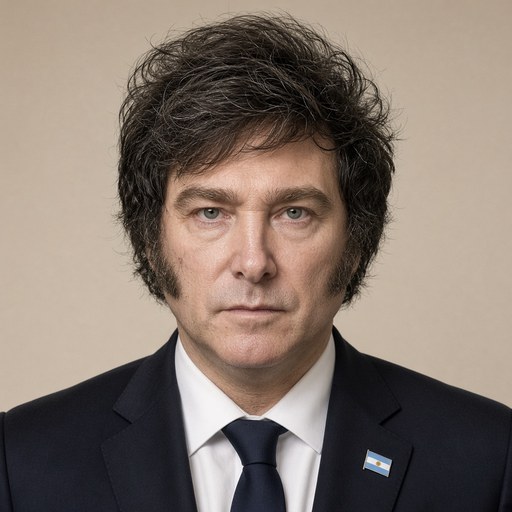
Speech by President Javier Milei at Expoagro 2025, in San Nicolás
 Javier Milei · President of Argentina
- Context
- Milei addressed Expoagro 2025 in San Nicolás on March 14, 2025, celebrating Argentina's agricultural sector and defending his government's economic stabilization plan.
- Main themes
- Agricultural sector and national prosperity, stabilization plan success, agro-export model, rejection of import substitution industrialization, political exploitation of the countryside, Argentine economic history, taxation and regulation of agriculture, technological innovation in agriculture, social justice model critique, free market liberalism
- Duration
- ~40 min
- Words
- 4,834
- Sentences
- 177
- Readability
- 53
- Grade
- 12.4
- Syntax
- 3.33
- Vocabulary
- 2.13
Translated from Spanish
The broad sphere of national life a sentence belongs to. Every sentence has an Arena, so it is the denominator the other indices are read against.
Other177 sentences in 29 paragraphs
Good afternoon everyone: it is an honor to speak to all of you. First of all, thank you to those present, to the organizers, and to Expoagro, not only for the invitation but also for proving that our stabilization plan is working, given that the number of people at the event increased by 33% compared to last year, so we are on the rise. I also want to thank Dr. Patricia Bullrich for joining me at this exhibition and for her enormous work, upholding and defending the values of the Republic in all areas where it is required. So my gratitude goes to Dr. Bullrich for accompanying me.
I also want to thank the dear Professor Espert, who is the President of the Budget Committee of the Chamber of Deputies, who accompanied me last year as well, and who is also doing a titanic, cyclopean job in Congress. So my thanks go to them for deciding to accompany me today.
And I also want to thank – especially – all the producers, whether large, medium, or small, who daily serve the homeland by cultivating Argentine soil. Our soil has been blessed with a unique fertility in the world, combined with Argentine ingenuity and the liberal ideas of our Constitution, it was for a good part of our history an inexhaustible source of prosperity for our country. I speak of when we were the breadbasket of the world and had nothing to envy any world power; when we were a land of opportunities that attracted immigrants from all corners of the earth; when we were the first to eradicate illiteracy, when we had a Gross Domestic Product higher than Brazil, Mexico, Paraguay, and Peru combined. In short, when we were that beacon of beacons that – today – we want to be again. At the center of that golden age, as a great protagonist and engine of that unprecedented prosperity, were the agricultural producers pulling the cart. It was the times of the agro-export model: a term that became pejorative as the country sank into misery, thanks to the arrival of the disastrous model of social justice. This was not a coincidence; the systematic plan to plunder the countryside was deliberately completed with its demonization by politics, while the forced distribution of wealth was installed as an act of justice.
And as a result of the implementation of this model, Argentina began a long descent into misery and servitude; that period that we call “the century of Argentine humiliation.” In simple words: when the countryside did well, the country did well; when the countryside did poorly, Argentina also did poorly. And it got much worse when the political caste began to see the countryside as an infinite gold mine, through which to finance their radical plan for state expansion. That is to say, this happened when it began to be believed that the countryside was making too much money. Money that – supposedly – should be used for better purposes, such as financing industries, energy, implementing hidden subsidies in the form of public employment, and paying for any other delusional project of the politician in charge.
Basically, the prosperity of a prolific sector like agriculture was used to finance deficit-ridden and uncompetitive sectors, in the name of an absurd stubbornness to have a national industry to replace imports, at any cost, sheltering under the discourse of the "infant industry," which had to be developed while ignoring market demand.
There is no doubt that this approach has failed, and sufficient proof is the oxymoron that our industry is the only 90-year-old infant in the world. We learned the hard way that it will never happen that an industry knocks on the door of the National Government and says: "Thank you for your help, now I am ready to compete; open the market." That clearly does not happen. So we are going to precipitate it, that’s how we take the foot off the head of the countryside.
But – although for a century – politics decided to deny the law of gravity, it is time to recognize that the only truth is reality, as that famous politician in our history said. It is false that industrial development must occur by trampling the countryside. That was just one of the many arguments of the caste to suffocate them with taxes and regulations. Because there is no contradiction between agriculture and industry.
Expoagro is a clear proof that industrialization and technological innovation are a natural consequence of the successful development of primary activity. Just one harvester involves hundreds of different economic sectors, from metallurgy to software development, and the same applies to all technological development in the sector. If we review history, the greatest period of industrial expansion in Argentine history was during the agro-export model, and not as the politicians of yesteryear wanted to install with the failed model of import substitution. It is also a lie that the countryside does not generate added value, given that the work of the sector is to add value to the soil to make food production more efficient and multiply it. Thanks to direct sowing and genetic innovation, of which Argentina has always been a proud protagonist, we can today produce food for 500 million human beings, a true miracle. And it could be hundreds of millions more if we take the weight of the State off their backs.
Another of the great lies spread by the caste is that agriculture does not generate jobs, when – according to data from the last year – the participation of the agro-industrial sector in formal employment is approximately 25%, including the processing of its raw materials, trade, and derived services. But still – despite the suffocating weight of the State – which even tried to carry out the disastrous Resolution 125 to plunder it like never before, the sector remains competitive worldwide. Let us imagine – then – how much more could be achieved with a State that does not hinder.
Our government is the first in a long time or perhaps in Argentine history that rejects the idea of the State as a mechanism for the compulsive appropriation of others' wealth. In fact, we are at the antipodes of this thinking: we come to limit the arbitrary power of the government and to free the private sector and – of course – we come to take the weight of the State off the backs of the producers. It is because we know that a small State equals a large society, because we know that prosperity is inevitably linked to freedom and – in this case – the freedom of the agricultural sector, and because we understand that entrepreneurs are social benefactors and that their pursuit of profit results in a benefit for society as a whole. And it was with that same north that we undertook all the steps taken – during our first year in government – that I will now enumerate some of them.
Because it is interesting. Because…, how are you, Nicolás? How are you? Because last year we were talking and they were promises: now we are talking about concrete facts that we have achieved. So, I find it interesting to make these accounts in a more compelling way. And, for example, the first objective has always been clear and was to order the macroeconomy so that all Argentines could begin to enjoy a better economic situation. Thus, we saw a notable reduction in inflation, as well as in the exchange rate gap, which was around 200%, punishing the profitability of all of you, forcing you to access inputs at a very high dollar and forcing you to sell your production at a very low dollar. Today the same gap is around 15%, with a special regime for exports, through which up to 20% of what is exported can be liquidated at the free rate.
I remember – during the campaign and when I spoke with representatives of the sector – clearly, there were two very marked problems: one was the gap and the other was the withholdings. And if we put it in quantitative terms, the issue of the gap was much more significant, since the gap was around 200%. That is to say, it was a 3 to 1 relationship. This does not mean that I do not consider withholdings to be an aberration. What I say is that – in terms of magnitude – the problem was much more important. And one of the things I committed to was to order the macro and to pulverize the gap.
In fact, we took office with an inflation rate traveling at 17,000 percent annually; that is to say, 54% monthly, which was the wholesale inflation. And today, the wholesale inflation in the last part of 2024, in fact, was traveling below 2% and – in dollar terms – we were in deflation in the last months. Moreover, when we made the stabilization plan, with a cut in public spending of 15 points of GDP: 5 in the Treasury, and 10 in the Central Bank, which they said was impossible to do and which we did, that we solved the Treasury problem in one month; that we solved the Central Bank problem in 6 months, let’s say as a result of that stabilization they told us that the level of activity would be destroyed, that the poor would multiply in an impossible way. And yet, none of that happened. We said we would recover in a V and – effectively – the recovery was in V. And when one takes the seasonally adjusted GDP in the monthly version, we ended 5% above the year 2023. And to that, poverty – after the initial adjustment – which reached to climb in the monthly frequency measured by the Torcuato Di Tella University which – methodologically – is the same as what La Plata does, what UCA does, and what we do in Human Capital and in INDEC, just that they are different forms of frequencies, whether taken monthly, quarterly, or semi-annually. That number of 57% dropped to 33%, the last monthly frequency data, meaning that poverty fell by 24 percentage points. Which may seem like impressive numbers but is even more impressive when we think that as a result of this stabilization with order, we managed to lift more than 10 million Argentines out of poverty. And that is indeed a huge achievement that I believe is worth highlighting.
At the same time, it is also no coincidence that during our first year in government, the demand for credit for agricultural machinery increased by 50% compared to the previous year. Just before entering this room, I was talking with Salvador Di Stefano, who is here, and he told me that yesterday, the Banco Nación…, how are you? How are you? I also see you now. I think there were more than 100 meters of line, given the credits…, ah, 200, well, that’s fine, even better for me as a result. So it’s good for you to see how you are being supported and that this is giving a huge boost to one of the pillars of what is our expansion model. So that, too, is a good sign because when we took office, hyperinflation was being discussed, and today even mortgage loans for 30 years have returned. This is increasingly resembling a miracle. It has nothing to do with miracles; it is simply applying good economic theory.
It is also not by coincidence that agro-industrial exports have grown by 56% in volume and 26% in revenue or that – last month – we saw a bond of exports of more than 7 million tons of grains and derivatives. Nor is it by coincidence that the area planted in the 24/25 campaign has grown almost 20%, greatly exceeding any previous record, but it is due to our firm commitment to remove the State from business so that it stops hindering those who produce. In just one year, we repealed and simplified more than 350 bureaucratic regulations that hindered value generation; we repealed regulations in SENASA and INASE; we eliminated useless sworn statements; we exterminated forever prohibitions and quotas on the export of grains and meats; we eliminated trusts and maximum prices for food; we reduced tariffs on the import of fertilizers, herbicides, and irrigation systems; we also began to implement the free competition of currencies that we promised, offering the first credits in liters of milk for dairy farmers and now in kilos of ham for pork producers.
This is very interesting, and one of the things we proposed throughout the campaign was to move to a system of currency competition. Obviously — as everything gets distorted in the campaign — they called it dollarization, and, in reality, one of the things I explained is that the currency competition system works like a basket of currencies, where, unlike the baskets of currencies managed by a Central Bank, which are determined at will by the Central Bank, in this case, it is determined endogenously by the decisions of individuals. I also explained that the currency — in reality — did not have to be the dollar or the euro; it could be any currency, but there were other cases where the currency could be, for example, for an oil producer it could be WTI; for someone in the gas sector, it could be BTU, and, clearly, for agriculture, it could be soybeans or any of the products. Thus, this is very important because it eliminates the risk of currency mismatch, and by eliminating the risk of currency mismatch, you go into a business that has less risk, therefore you have a lower discount rate, and that allows you to amplify value, and that amplification of value is confirmed when you expand the capital base. So, not only do you produce more, but also, jobs are created, and the economy grows. Therefore, this also eliminates this type of risk, which fundamentally leads to greater prosperity.
And I could stay here — until Sunday — enumerating the things we did and plan to continue doing to improve the competitiveness of the sector. What I say about being able to stay — clearly — until Sunday is not a metaphor. One of the things that started happening when we reviewed the networks is that we were publishing things we were doing, and — in that context — we found a lot of satisfaction from the people saying: “this is much more than what I voted for.” So, one of the things that my brilliant spokesperson came up with — who is Manuel Adorni — thank you for joining us here as well. How nice, today I came surrounded by people who irritate leftists everywhere! They will say, “This is a provocateur.” I love it. Aside from that, we — clearly — had made a government program, a proposal, that they said was basically impossible to implement. I mean, each of the things we said we wanted to do, they said was impossible. And not only that, but there were not a few measures; there were many and very demanding, which made it very complicated in both dimensions. And there, one of the things we see is that what Manuel did was measure what degree of progress we had. So, if in the 25% of the government period, the first year of these four, if we had fulfilled 25% of the promises, we would be doing well, to put it one way.
And what was revealed — the work that Manuel did — is that we fulfilled 78% of the promises. But, in addition, we also did some things that we hadn’t planned to do, and, in that context, when you incorporate these things we did even when they weren’t planned, basically the degree of compliance is 97%. I mean, going from governments that promised things and fulfilled nothing, we moved to a hyper-demanding program where only in a quarter of the period we fulfilled 97% of the promises. That indeed is working.
Ah, and I will make some generic comments about the terms of the campaign because I think they are important. I was very clear, without a doubt, in what the campaign was, because — in terms of fiscal policy — we talked about the chainsaw. Today, the chainsaw is a global emblem of economic policy. Moreover, in the case of the work being done by that giant I have as a minister — who is Federico Sturzenegger — he has created an export model in terms of deregulation. ‘Toto’ Caputo was elected the best Minister of Economy in the world. In the most prestigious universities in the world, they talk about how it is possible that we made such an adjustment and instead of being hyper-contractive and sinking into a great depression, we emerged with such strength. At the same time — in the monetary realm — it was identified with dollarization, and so, people were going around with dollar bills with my face, which were quite amusing. In foreign policy, we said we would align with the United States and Israel, and I think it is clear that we are fulfilling that. And I left for last something very concrete, which is the issue of security because — not coincidentally — my slogan coincided with someone who competed with me and whose greatness allowed him to join this Government, which was in terms of security “he who does it, pays for it.” The good ones are the ones in blue, and the sons of bitches who walk around with rags on their faces, breaking cars, burning cars, and threatening everyone because they don’t want to lose their jobs, those are the bad ones, and those are the ones who need to go to jail, and we are going to put them in jail. We are going to defend the Republic because it’s not that they are coming against me; they are coming for you; I am just in the middle.
So imagine that if I accelerate in the curves, now I am going to accelerate much more. Returning to the speech, we do all this because it is our duty to apply again the ideas that made Argentina the richest country in the world 100 years ago. For that, we need to understand together that we must think of Argentina in generations, with the intention that our actions in the present have a positive impact on future generations, being willing to replant trees from which we may not enjoy the shade. The agricultural sector has this mentality, but the political caste does not. And the imposition of the caste model has ruined more than five generations with its ridiculous interventions.
This is also very interesting because Argentina — clearly — could become one of the 5 world powers within a span of forty years if we maintained the ideas. And sometimes there are people who say: “no, well, but that is a long time.” Look: the most interesting thing is that two-thirds of that improvement occurs in one-third of the time. That is to say that — in a span that can range between ten and fifteen years — we can see wonderful things. What needs to be done is to put in the will and have the will to embrace the ideas of freedom and move forward. Clearly, embracing the ideas of freedom ends the scams for a lot of criminals, who are the ones who then organize marches. That is to say, remember that every time you see someone kicking and screaming, it’s because we cut off a scam. That is to say, what you have seen in these days is politics; when they say: “where did the adjustment fall?”, look at those who are kicking and you will see where the adjustment fell. It fell on those who have ruined Argentina, and we are not going to stop because we govern for the good Argentines, for those who want to live off the fruits of their labor, not for the criminals.
Because when we stopped being the richest country in the world, because we stopped embracing these ideas, we went to having 50% of the population in poverty. And we went from being the first country in the world to eradicate illiteracy to having high school graduates who cannot read or do basic math. For that reason, we need to make changes in a lasting way, instead of a quick way without diminishing the urgency of it. We understand the pressing need to lower export taxes, but it does not help anyone if we lower them to gain political advantage in the elections and then the model bursts, and we have to put them back, as has happened in other governments. We want to eliminate the currency controls and export taxes forever so that the country can sustain itself without plundering its most productive sector. But for it to be lasting, it must be done the right way, so that in the future no fiscal degenerate comes back to stick their whole arm in the pocket.
We have already lowered export taxes by 20% on the main grains of the country and eliminated them completely for regional economies. And as the virtuous path continues to consolidate, the fiscal surplus and the reduction of spending, we will continue to lower them until they reach zero and stay there once and for all. At the same time, to understand a bit why the fiscal surplus is so important — on one hand — because it allows us to lower taxes and return productivity to the private sector; on the other hand, because it allows us to face unexpected situations and unpredictable tragedies like the storm in Bahía Blanca a few days ago. Thanks to the fiscal surplus, we were able to send 200 billion pesos to the city to help them get back on their feet. Had the surplus not existed, we would have had to resort to printing money, diluting the salaries of all Argentines with inflation and increasing poverty in the process.
This is very interesting because — while some take advantage of misfortunes for cheap political gain, typical of the politicians who have impoverished us throughout history — of the 8 ministries we have, 6 were actively working to help Bahía Blanca. From day one, Dr. Bullrich, in charge of the Security Forces; Dr. Petri, in charge of Defense, were working in those moments of greatest emergency, where the situation was more complicated, where everything seemed chaotic, they went to restore order. And not only that, but also the assistance from the Ministry of Human Capital and the Ministry of Health basically collaborated in setting up a field hospital. And not only that, but also — Minister Caputo, with Secretary of Finance Guberman — worked intensively to find how we could obtain funds to provide assistance to Bahía Blanca. And that is how we managed to reallocate funds and secure resources for 200 billion pesos. That is to say, while many talk, cluck, and continue to spend on nonsense, like bribing media with official advertising, decorating journalists, spending on wooden penises and on sex education and all that stuff — we put resources where people need them to solve the concrete problems of the people. At the same time, I should mention one more ministry, which is the Foreign Ministry, where in light of the support we have received from abroad, we are also working on how we can provide more help.
So, once the crisis situation and the most urgent situation were overcome and where the path to reconstruction had to begin, that was the moment when I could go, because if I had done it earlier, I would have been a hindrance. They would have taken a very nice photo, but we would have wasted a lot of time for each of the groups assigned to solve those problems, at a moment… because this is how it is, believe me, it is like this, if I go, on the first day, each of the groups starts to explain to me what they have to do. Therefore, that task can take at least 5 hours, and every minute counts to save human lives. Therefore, I had to choose between the nice photo — which politicians like — or saving lives. I preferred to save lives; others preferred the nice photos.
For that reason, our focus is also on reducing spending as quickly and deeply as possible, to increase the surplus, and this must also be done in the provinces and municipalities, not just at the national level. The Argentine population will no longer tolerate this game of parasitic politicians raising taxes to eat into the profitability that remains available with the tax cuts we are making from the national level. So I want to dedicate a reflection, to reflect, on those governors who play this perverse game, who ask for tax cuts and demand tax cuts, but when it comes time to do it themselves, they do not do it or they raise them. So, be clear about that.
That is to say, we said we would lower taxes, and we lowered more than 13 taxes, including the inflation tax, which with seigniorage robbed Argentines of fifteen points of GDP. Therefore, part of our duty is to protect citizens from this cynical behavior that politics has relied on for a long time. For this reason, we want to return to a truly federal model in which there is fiscal competition among the provinces, and the private sector can discern the tax cost of working in such or such district and what returns and services it receives in exchange, so that politicians stop hiding behind the prices of goods and services and in the revenue-sharing, and the fiscal voracity of the state apparatus they want to maintain becomes evident. For example, one of the things that happened to me when I met Elon Musk, I went to his Tesla plant, which is in Austin, Texas, but was previously in Los Angeles, and why did it leave? Because of taxes, that is to say, there was a Hungarian economist named Tiebout who said: “vote with your feet.” So, we are going to open fiscal competition so that both companies and individuals can vote with their feet and get rid of the thieving politicians who only want to rob them of the fruits of their labor.
For this reason, we want to return to a truly federal model, in which there is fiscal competition among the provinces, and the private sector can discern the tax cost of working in one district or another and what returns and services it receives in exchange, so that politicians stop hiding... I had already said this... I repeat it because it is good to repeat it. Thank you, Espert. A condescending professor. You have to lower me 1 point there, Espert. I would have lowered it for a student. Thank you, so I repeat it. That is to say, as I had said, so that politicians stop hiding behind the prices of goods and services and in the revenue-sharing, and that the fiscal voracity of the state apparatus they want to sustain becomes evident. The endpoint for this and for all our reforms is conceptually simple: we want to be a country where life is easier for those who do things right and much more difficult for those who do things wrong. A society in which doing the right thing is simple and acting incorrectly is costly, very costly, and those who do wrong, pay.
In short, that inverted model is over in which honest workers struggle to survive month to month, and parasitic freeloaders are guaranteed a burdensome life for generations. That model in which victims are treated as perpetrators and perpetrators are treated as victims. That model that was tired of reviewing the past because it could not promise any future. In our first year, we made it clear that our government will mark a turning point for our great nation, because, for the first time in decades, we looked forward again, thinking about how to grow instead of how to distribute an ever-smaller profit. We left behind the scarcity mentality to see the world again through the eyes of abundance. And Argentina is the most abundant country in the world: we have the most fertile land on the planet and the best human capital. Thus, we learned to squeeze water from stones. Now we have to shed the weight of the caste from our backs to become the great nation we once knew how to be. May you all have an excellent day. May the forces of heaven be with us, and long live freedom, damn it! Thank you very much.
The original Spanish. The tags above are read on the English translation's sentences.
Muy buenas tardes a todos: es un honor hablar para todos ustedes. Y antes que nada, gracias a los presentes, a los organizadores y a Expoagro, no solo por la invitación, sino también por comprobar que nuestro plan de estabilización está funcionando dado que la cantidad de gente en el evento subió 33% respecto al año pasado, así que estamos yendo para arriba. También quiero agradecer la presencia de la doctora Patricia Bullrich, que vino a acompañarme a esta exposición y por su enorme trabajo, sosteniendo y defendiendo los valores de la República en todos los terrenos que ello lo requiera. Asi que mi agradecimiento a la doctora Bullrich por acompañarme.
También quiero dar las gracias al queridísimo profe Espert, que es el Presidente de la Comisión de Presupuesto de la Cámara de Diputados, que me acompañó el año pasado también, y que también está haciendo una tarea titánica, ciclópea, ahí dentro del Congreso. Así que mis agradecimientos para con ellos que han decidido acompañarme en el día de hoy.
Y también quiero dar las gracias – especialmente - a todos los productores, ya sean grandes, medianos o pequeños, que diariamente sirven a la patria cultivando el suelo argentino. Nuestro suelo ha sido bendecido con una fertilidad única en el mundo, combinado con el ingenio argentino y con las ideas liberales de nuestra Constitución, fue durante buena parte de nuestra historia una fuente inagotable de prosperidad para nuestro país. Hablo de cuando fuimos el granero del mundo y no teníamos nada que envidiarle a ninguna potencia mundial; cuando éramos una tierra de oportunidades que atraía inmigrantes de todos los confines de la tierra; cuando fuimos los primeros en erradicar el analfabetismo, cuando teníamos un Producto Bruto Interno total superior a Brasil, México, Paraguay y Perú juntos. En resumen, cuando éramos ese faro de faros que – hoy - queremos volver a ser. En el centro de esa era dorada, como gran protagonista y motor de esa prosperidad sin precedentes, estaban los productores agropecuarios tirando del carro. Eran las épocas del modelo agroexportador: un término que fue transformándose en peyorativo, a medida que el país se fue hundiendo en la miseria, gracias a la llegada del modelo nefasto de la justicia social. Esto no fue casualidad, el plan sistemático de saqueo al campo fue deliberadamente completado con su demonización por parte de la política, a la vez que se comenzó a instalar la distribución forzosa de la riqueza como un acto de justicia.
Y como resultado de la implementación de este modelo la Argentina comenzó un largo descenso hacia la miseria y servidumbre; aquel período que nosotros llamamos “el siglo de la humillación argentina”. En palabras sencillas: cuando le fue bien al campo, le fue bien al país; cuando al campo le fue mal a Argentina también le fue mal. Y le fue mucho peor cuando la casta política comenzó a ver al campo como una mina de oro infinita, mediante la cual financiar su plan radical de expansión del Estado. Es decir, esto ocurrió cuando se comenzó a creer que el campo ganaba demasiado dinero. Dinero que - supuestamente - debía usarse para fines mejores, como financiar industrias, energía, implementar subsidios encubiertos en forma de empleo público y pagar por cualquier otro proyecto delirante del político de turno.
Básicamente, se utilizó la prosperidad de un sector prolífico como el agropecuario para financiar sectores deficitarios y poco competitivos, en nombre de un empecinamiento absurdo por tener una industria nacional para sustituir importaciones, costara lo que costara, amparándose en el discurso de la "industria infante", que tenía que desarrollarse y haciendo caso omiso a la demanda del mercado.
No queda ninguna duda de que este abordaje ha fracasado, y suficiente prueba es el oxímoron de que nuestra industria es el único infante de 90 años del mundo. Aprendimos por las malas que nunca va a ocurrir que una industria le toque la puerta al Gobierno Nacional y le diga: "Gracias por tu ayuda, ahora ya estoy listo para competir; abrí al mercado". Eso, claramente, no ocurre. Así es que se lo vamos a precipitar, así le sacamos el pie de la cabeza al campo.
Pero - aunque durante un siglo - la política decidió negar la ley de la gravedad, es hora de reconocer que la única verdad es la realidad, como dijo aquel famoso político de nuestra historia. Es falso que el desarrollo industrial deba darse pisoteando al campo. Eso solo fue uno de los tantos argumentos de la casta para ahogarlos a impuestos y regulaciones. Porque no hay ninguna contradicción entre campo e industria.
Expoagro es una prueba cabal de que la industrialización y la innovación tecnológica son una consecuencia natural del desarrollo exitoso de la actividad primaria. Tan sólo una cosechadora involucra cientos de sectores económicos diferentes, desde la metalurgia hasta el desarrollo del software, y lo mismo aplica para todo el desarrollo tecnológico del sector. Si repasamos la historia, el mayor periodo de expansión industrial de la historia Argentina fue durante el modelo agroexportador, y no como quisieron Instalar los políticos de antaño con el modelo fracasado de la sustitución de importaciones. Así como también es mentira que el campo no genera valor agregado, dado que la labor del sector está en añadirle valor al suelo para eficientizar y multiplicar la producción de alimentos. Gracias a la siembra directa y a la innovación genética, de la cual Argentina siempre fue una orgullosa protagonista, es que hoy podemos producir alimentos para 500 millones de seres humanos, un verdadero milagro. Y podrían ser cientos de millones más si le sacamos el peso del Estado de encima.
Otra de las grandes mentiras difundidas por la casta es que el agro no genera puestos de trabajo, cuando - según datos del último año - la participación del sector agroindustrial en empleo formal es de aproximadamente el 25%, incluyendo el procesamiento de sus materias primas, el comercio y los servicios derivados. Pero aún - a pesar del peso asfixiante del Estado - que hasta intentó llevar adelante la nefasta Resolución 125 para saquearlo como nunca antes, el sector sigue siendo competitivo en todo el mundo. Imaginemos – entonces - cuánto más se podría lograr con un Estado que no estorbe.
Nuestro gobierno es el primero en mucho tiempo o quizás en la historia argentina que rechaza la idea del Estado como un mecanismo de apropiación compulsiva de la riqueza ajena. De hecho, estamos en las antípodas de este pensamiento: venimos a limitar el poder arbitrario del gobierno y a liberar al sector privado y - por supuesto - venimos a sacarle el peso del Estado de las espaldas de los productores. Es porque sabemos que un Estado chico equivale a una sociedad grande, porque sabemos que la prosperidad va indefectiblemente de la mano de la libertad y - en este caso - la libertad del sector agropecuario, y porque entendemos que los empresarios son benefactores sociales y que su búsqueda de ganancia redunda en un beneficio para el conjunto de la sociedad. Y fue con ese mismo norte que encaramos todos los pasos dados - durante nuestro primer año de gobierno - que pasaré enumerar algunos de ellos.
Porque es interesante. Porque…, ¿qué tal, Nicolás? ¿Cómo estás? Porque el año pasado hablábamos y eran promesas: ahora estamos hablando de hechos concretos que hemos logrado. Entonces, me parece interesante hacer estos raccontos, de una manera más contundente. Y, por ejemplo, el primer objetivo siempre estuvo claro y fue ordenar la macroeconomía para que todos los argentinos pudieran empezar a gozar de un mejor pasar económico. Así vimos una reducción notable de la inflación, como de la brecha cambiaria, que se ubicaba en torno al 200%, castigando la rentabilidad de todos ustedes, obligándolos a acceder a insumos a un dólar altísimo y obligándolos a vender su producción a un dólar bajísimo. Hoy la misma brecha se encuentra rondando el 15%, con un régimen especial para exportaciones, mediante el cual hasta un 20% de lo exportado puede liquidarse al valor libre.
Yo recuerdo - durante la campaña y cuando hablaba con los representantes del sector - claramente, había dos problemáticas muy marcadas: uno era la brecha y el otro eran las retenciones. Y que si lo poníamos en términos cuantitativos era mucho más significativo el tema de la brecha, ya que la brecha rondaba en torno al 200%. Es decir, una relación 3 a 1 era. Esto no quiere decir que no considere que las retenciones sean una aberración. Lo que digo es que - en términos de magnitud - el problema era mucho más importante. Y una de las cosas que yo me comprometí, fue a ordenar la macro y a pulverizar la brecha.
De hecho, nosotros asumimos con una inflación que viajaba al ritmo del 17.000 por ciento anual; es decir 54% mensual, que era la inflación mayorista. Y, hoy, la inflación mayorista en la última parte del año 2024, de hecho, viajaba por debajo del 2% y - en términos de dólares - estábamos en deflación los últimos meses. Es más, cuando hicimos el plan de estabilización, con un recorte del gasto público de 15 puntos del PBI: 5 en el Tesoro, y 10 en el Banco Central, que decían que era imposible de hacer y que nosotros hicimos, que resolvimos el problema del Tesoro, en un mes; que resolvimos el problema del Banco Central en 6 meses, digamos como fruto de esa estabilización nos dijeron que se iba a destruir el nivel de actividad, que se iban a multiplicar los pobres de manera imposible. Y, sin embargo, nada de eso ocurrió. Nosotros decíamos que íbamos a recuperarnos en un V y – efectivamente - la recuperación fue en V. Y cuando uno toma el PBI desestacionalizado en la versión mensual, terminamos 5% arriba del año 2023. Y a eso, la pobreza - después del sinceramiento inicial - que llegó a trepar en la frecuencia mensual medida por la Universidad Torcuato Di Tella que – metodológicamente - es igual a lo que hace La Plata, lo que hace la UCA y lo que hacemos nosotros en Capital Humano y en el INDEC, nada más que son distintas formas de frecuencias, si se toman mensuales, trimestrales o semestrales. Ese número del 57% pasó al 33%, el último dato de frecuencia mensual, es decir que la pobreza cayó en 24 puntos porcentuales. Lo cual, parecen números impresionante pero es más impresionante cuando pensamos que fruto de esta estabilización con orden, logramos sacar de la pobreza a más de 10 millones de argentinos. Y eso sí que también es un logro enorme que creo que vale la pena destacar.
A su vez, tampoco es casualidad que durante nuestro primer año de gobierno la demanda de crédito para maquinaria agrícola haya aumentado un 50%, respecto del año anterior. Recién, en la previa a ingresar a esta sala, hablaba con Salvador Di Stefano, que está acá, y me contaba que ayer, el Banco Nación…, ¿qué hacés? ¿Cómo estás? También, ahora te veo. Creo que había más de 100 metros de cola, dado los créditos…, ah, 200, bueno, está bien, mejor todavía, más para mí como resultado. Así es que está bueno que vean cómo están siendo apoyados y que esto les está dando un motor importantísimo a uno de los pilares de lo que es nuestro modelo de expansión. Así es que eso, también, es una buena señal porque cuando nosotros asumimos se discutía la hiperinflación, y hoy hasta volvieron los créditos hipotecarios a 30 años. Vaya que esto cada día se parece más a un milagro. No tiene nada de milagro, es solamente aplicar la buena teoría económica.
Tampoco es por casualidad que las exportaciones agroindustriales hayan crecido un 56% en volumen y un 26% en facturación o que - el mes pasado - hayamos visto un bond de exportaciones por más de 7 millones de toneladas de granos y derivados. Ni es por casualidad que la superficie sembrada en la campaña 24/25 haya crecido casi un 20%, superando altamente cualquier récord anterior, sino que es por un compromiso férreo de nuestra parte por correr al Estado de los negocios para que deje de entorpecer a quienes producen. En tan solo un año, derogamos y simplificamos más de 350 normas burocráticas que atentaban contra la generación de valor; derogamos normas en SENASA y en el INASE; eliminamos declaraciones juradas inútiles; exterminamos para siempre prohibiciones y cupos en la exportación de granos y carnes; eliminamos fideicomisos y precios máximos para los alimentos; redujimos aranceles a la importación de fertilizantes, herbicidas y sistemas de riego; también comenzamos a poner en práctica la libre competencia de monedas que prometimos, ofreciendo los primeros créditos en litros de leche para tamberos y ahora en kilos de jamón para los productores porcinos.
Esto es muy interesante y una de las cosas que nosotros habíamos propuesto a lo largo de la campaña era ir a un sistema de competencia de monedas. Obviamente - como todo se deforma en la campaña - lo llamaban dolarización, y, en realidad, una de las cosas que yo explicaba es que el sistema de competencia monedas funciona como un sistema de canastas de moneda, donde a diferencia de las canastas de monedas administradas por un Banco Central, que las determina a dedo el Banco Central, en este caso se determina endógenamente por las decisiones de los individuos. Y también expliqué que la moneda - en realidad - no tenía por qué ser el dólar o el euro, podía ser cualquier moneda, pero que había otros casos que la moneda podía ser, por ejemplo, para un petrolero podía ser el WTI; para alguien que estaba en el sector del gas el BTU, y, claramente, por ejemplo, para el campo podría ser la soja o cualquiera de los productos. De modo tal, que esto es muy importante porque se elimina el riesgo de descalce de moneda, y al eliminarse el riesgo de descalce de monedas, ustedes van a un negocio que tiene menos riesgo, por ende tienen menor tasa de descuento y eso les permite amplificar el valor, y esa amplificación de valor se ve constatada cuando ustedes amplían la base de capital. Con lo cual, no solo producen más, sino que, además, se genera empleo y, además, la economía crece. Por lo tanto, esto de también eliminar este tipo de riesgos hace que, básicamente, haya mayor prosperidad.
Y así podría quedarme - hasta el domingo - enumerando las cosas que hicimos y pensamos seguir haciendo para mejorar la competitividad del sector. Esto que digo de podría estar – claramente - hasta el domingo no es una metáfora. Una de las cosas que nos empezó a pasar cuando revisamos las redes, es que íbamos publicando cosas que íbamos haciendo y - en ese contexto- nos encontrábamos con mucha satisfacción, por parte de la gente y diciendo: “esto es mucho más de lo que voté”. Entonces, una de las cosas que se le ocurrió al brillante Vocero que tengo - que es Manuel Adorni - que gracias por acompañarnos también acá. ¡Qué lindo, hoy me vine rodeado de toda gente que irrita zurdos por doquier! Van a decir “Este es un provocador”. Me encanta. Al margen de eso, entonces nosotros – claramente - habíamos hecho un programa de gobierno, una propuesta, que decían que básicamente era imposible de hacer. O sea, cada una de las cosas que nosotros decíamos que queríamos hacer, decían que era imposible. Y no sólo eso, sino que no eran pocas medidas, eran muchas y muy exigentes, con lo cual era en la doble dimensión era muy complicado. Y ahí una de las cosas que nosotros vemos es que, lo que hizo Manuel, fue medir qué grado de avance teníamos. Entonces, si en el 25% de lo que lleva el periodo de gobierno, el primer año de estos cuatro, si hubiéramos cumplido el 25% de las promesas estaríamos bien, por decirlo de alguna manera.
Y lo que reveló - el trabajo que hizo Manuel - es que cumplimos con el 78% de las promesas. Pero, además, también hicimos algunas cosas que tampoco teníamos planeadas hacer, y, en ese contexto, cuando uno incorpora estas cosas que hicimos aún cuando no estuvieran planeadas hacer, básicamente el grado de cumplimiento es 97%. O sea, de pasar de gobiernos que prometían cosas y no cumplían nada, pasamos a un programa hiperexigente y donde solo en un cuarto del periodo cumplimos el 97% de las promesas. Vaya que eso sí es trabajar.
Ah, y voy a hacer algunos comentarios genéricos de los términos de la campaña porque creo que son importantes. Fui muy claro, sin lugar a dudas, en lo que era la campaña, porque - en materia de política fiscal - hablábamos de la motosierra. Hoy la motosierra es un emblema mundial de política económica. Es más, en el caso del trabajo que está haciendo ese coloso que tengo como ministro - que es Federico Sturzenegger - ha creado un modelo de exportación en materia de desregulación. ‘Toto’ Caputo fue elegido el mejor Ministro de Economía del mundo. En las universidades más prestigiosas del mundo se habla de cómo puede ser que hicimos semejante ajuste y en lugar de ser hipercontractivo y hundirnos en una gran depresión, salimos con tanta fuerza. Al mismo tiempo - en el plano monetario - se identificó con la dolarización y, entonces, la gente iba con billetes de dólares con mi cara, que eran bastante simpáticos. En política exterior dijimos que nos íbamos a alinear con Estados Unidos e Israel, y creo que está claro que lo estamos cumpliendo. Y dejé para el final algo muy concreto, que es el tema de seguridad porque - no casualmente - mi eslogan coincidía con alguien que compitió conmigo y que su grandeza permitió que se sumara a este Gobierno, que era en materia de seguridad “el que las hace, las paga”. Los buenos son los de azul, y los hijos de puta que andan con trapos en la cara y rompen autos, queman autos y amenazan a toda la gente porque no quieren perder sus curros, esos son los malos y esos son los que tienen que ir presos y los vamos a meter presos. Vamos a defender a la República porque no es que vienen contra mí, vienen por ustedes; yo solo estoy en el medio.
Así que imaginen que si acelero en las curvas, ahora voy a acelerar mucho más. Volviendo al discurso, todo esto lo hacemos porque es nuestro deber aplicar nuevamente las ideas que hace 100 años hicieron de la Argentina el país más rico del mundo. Para eso, necesitamos entender entre todos que debemos volver a pensar - a la Argentina - en generaciones, con la intención de que nuestros actos del presente tengan repercusión positiva en las generaciones del futuro, estar dispuestos a volver a sembrar árboles de los que quizás no disfrutemos la sombra. El campo tiene esta mentalidad, pero la casta política no. Y la imposición del modelo de la casta arruinó a más de cinco generaciones con sus intervenciones ridículas.
Esto también es muy interesante porque Argentina - claramente - podría convertirse en una de las 5 potencias mundiales, en un lapso de cuarenta años, si mantuviéramos las ideas. Y a veces hay gente que dice: “no, bueno, pero eso es mucho tiempo”. Miren: lo más interesante es que dos tercios de esa mejora ocurre en un tercio del tiempo. Es decir que - en un lapso que puede ir entre diez y quince años - podemos ver cosas maravillosas. Lo que hay que hacer es poner la voluntad y tener la voluntad de volver a abrazar las ideas de la libertad e ir para adelante. Claramente, abrazar la ideas de la libertad les termina con el curro a un montón de delincuentes, que son los que después organizan marchas. Es decir, recuerden que cada vez que ustedes vean a alguien pataleando es porque le terminamos cortando un curro. Es decir, lo que han visto en estos días es la política, cuando dicen: “¿dónde cayó el ajuste?”, vean los que patalean y van a ver dónde cayó el ajuste. Cayó sobre los que han arruinado la Argentina y no vamos a parar porque nosotros gobernamos para los argentinos de bien, para los que quieren vivir del fruto de su trabajo, no para los delincuentes.
Porque cuando dejamos de ser el país más rico del mundo, porque dejamos de abrazar estas ideas, pasamos a tener 50% de pobres. Y pasamos de ser el primer país del mundo en erradicar el analfabetismo, a tener egresados del secundario que no saben leer ni hacer cuentas básicas. Por eso mismo, necesitamos hacer los cambios de una forma duradera, en lugar de una forma rápida sin restarle importancia a su urgencia. Entendemos la necesidad imperante de bajar las retenciones, pero no le sirve a nadie que las bajemos para sacar rédito político en las elecciones y después el modelo revienta y tengamos que volver a ponerlas, como ha pasado en otros gobiernos. Nosotros queremos eliminar el cepo y las retenciones para siempre y que el país pueda sostenerse sin saquear a su sector más productivo. Pero para que sea duradero hay que hacerlo de la forma correcta, para que en el futuro no venga ningún degenerado fiscal a volver a meterle el brazo entero en el bolsillo.
Ya bajamos 20% las retenciones a los principales granos del país y las eliminamos por completo para las economías regionales. Y a medida que se siga consolidando el sendero virtuoso, el superávit fiscal y la baja del gasto, las continuaremos bajando hasta que lleguen a cero y se queden ahí de una vez y para siempre. A su vez, para entender un poco por qué es tan importante el superávit fiscal - por un lado - porque nos permite bajar impuestos y devolverle productividad al sector privado; por otro lado, porque nos permite hacer frente a situaciones inesperadas y tragedias impredecibles como el temporal en Bahía Blanca hace unos pocos días. Gracias al superávit fiscal pudimos enviar 200 mil millones de pesos a la ciudad para ayudarlos a ponerse de pie nuevamente. De no haber existido el superávit, hubiéramos tenido que recurrir a imprimir dinero, licuándole el salario a todos los argentinos con inflación y aumentando la pobreza en el proceso.
Esto es muy interesante porque - mientras que algunos aprovechan las desgracias para carancheo político, berreta, propio de los políticos que nos han empobrecido a lo largo de la historia - de los 8 ministerios que tenemos, 6 estuvieron trabajando de modo activo en ayudar a Bahía Blanca. Desde el primer día, la Doctora Bullrich, a cargo de las Fuerzas de Seguridad; el Doctor Petri, a cargo de Defensa, estuvieron trabajando en esos momentos de mayor emergencia, donde la situación era más complicada, donde todo era que parecía un caos, ellos fueron a poner orden. Y, no solo eso, sino que además llegaron las ayudas del Ministerio de Capital Humano y además el Ministerio de Salud, básicamente, hasta colaboró armando un hospital de campaña. Y no solo eso, sino que además - el Ministro Caputo, con el Secretario de Hacienda Guberman - trabajaron intensamente para encontrar cómo podíamos hacernos de fondos para poder darle asistencia a Bahía Blanca. Y así es que logramos asignar poder reasignar partidas y conseguir recursos por 200 mil millones de pesos. Es decir, así que - mientras que muchos hablan, cacarean y siguen gastando en boludeces, como sobornar medios de comunicación con pauta oficial, adornar periodistas, gastar en penes de madera y en la ESI y en toda esa cosa - nosotros ponemos los recursos donde la gente la necesita para resolver los problemas concretos de la gente. Al mismo tiempo, falta que mencione un ministerio más, que es la Cancillería, donde a la luz de los apoyos que hemos conseguido del exterior, también estamos trabajando en ver cómo podemos aportar más ayuda.
O sea, una vez que se superó la situación de crisis y la situación más urgente y donde había que iniciar el camino a la reconstrucción, ese fue el momento en el que yo podía ir, porque si lo hubiera hecho antes hubiera estado estorbando. Hubieran puesto una foto muy linda, pero le hubiéramos hecho perder un montón de tiempo a cada uno de los grupos asignados a resolver esos problemas, en un momento…, porque esto es así, créanme que es así, si yo voy, el primer día, cada uno de los grupos se ponen a explicarme lo que tienen que hacer. Por lo tanto, esa tarea puede demandar por lo menos 5 horas y ahí cada minuto cuenta para salvar vidas humanas. Por lo tanto, yo tenía que elegir entre la foto linda - que le gusta a la política - o salvar vidas. Yo preferí salvar vidas; otros prefirieron las fotos lindas.
Por eso, también, nuestro foco está puesto en bajar el gasto tan rápido y tan profundo como sea posible, para así acrecentar el superávit y esto mismo debe ser hecho en las provincias y en los municipios, no solo a nivel nacional. La población argentina ya no va a tolerar este juego de políticos caranchos de subir impuestos para comer la rentabilidad que queda disponible con la baja de impuestos que hacemos desde Nación. Así que quiero dedicar una reflexión, que reflexionen, sobre aquellos gobernadores que hacen este jueguito perverso, que piden bajas de impuestos y reclaman baja de impuestos, pero que - cuando llega el momento de hacerlo en la propia - no lo hacen o lo suben. Entonces, tengan claro eso.
Es decir, nosotros dijimos que íbamos a bajar impuestos y bajamos más de 13 impuestos, entre ellos el impuesto inflacionario, que con el señoriaje le robaba, a los argentinos quince puntos del PBI. Por lo tanto, parte de nuestro deber es proteger a la ciudadanía de este cinismo rascavotos del que se sirvió la política durante ya mucho tiempo. Por esto mismo, nosotros queremos volver a un modelo verdaderamente federal en el que haya competencia fiscal entre las provincias y el sector privado pueda discernir el costo tributario de trabajar en tal o cual distrito y qué retribuciones y servicios recibe a cambio, para que los políticos dejen de esconderse detrás de los precios de los bienes y servicios y en la coparticipación, y quede en evidencia la voracidad fiscal del aparato estatal que quieren sostener. Por ejemplo, una de las cosas que a mí me pasó cuando lo conocí a Elon Musk, fui a su planta de Tesla, que queda en Austin, Texas, pero antes estaba en Los Ángeles, ¿y por qué se fue? Por los impuestos, es decir había un economista húngaro que se llamaba Tiebout y decía: “votar con los pies”. Entonces, vamos a abrir la competencia fiscal para que tanto las empresas como los individuos puedan votar con los pies y se saquen de encima a los políticos ladrones que lo único que quieren hacer es robarle el fruto de su trabajo.
Por esto mismo, nosotros queremos volver a un modelo verdaderamente federal, en el que haya competencia fiscal entre las provincias, y al sector privado pueda discernir el costo tributario de trabajar en tal o cual distrito y qué retribuciones y servicios recibe a cambio, para que los políticos dejen de esconderse… Este ya lo había dicho… Lo repito porque es bueno repetirlo. Gracias Espert. Un profe condescendiente. Me tenés que bajar 1 punto ahí, Espert. Yo a un alumno se lo hubiera bajado. Gracias, entonces lo repito. Es decir que, como había dicho, para que los políticos dejen de esconderse en los precios de los bienes y servicios y en la coparticipación y que queden evidencia la voracidad fiscal del aparato estatal que quieren sostener. El lugar de llegada para este y para todas nuestras reformas es conceptualmente simple: queremos ser un país en el que la vida sea más fácil para el que hace las cosas bien y sea mucho más difícil para aquel que hace las cosas mal. Una sociedad en la que hacer lo correcto sea sencillo y actuar incorrectamente sea costoso, muy costoso y el que las hace, las paga.
En definitiva, se acabó ese modelo invertido en el que los trabajadores honestos luchan para sobrevivir mes a mes, y los parásitos vividores tienen asegurada una vida onerosa por generaciones. Ese modelo en el que las víctimas son tratadas como victimarios y los victimarios tratados como víctimas. Ese modelo que se cansaba de revisar el pasado porque no podía prometer ningún futuro. En nuestro primer año, dejamos en claro que nuestro gobierno va a marcar un punto de inflexión para nuestra gran nación, porque, por primera vez en décadas volvimos a mirar hacia adelante, pensando cómo crecer en lugar de cómo distribuir una ganancia cada vez más pequeña. Dejamos atrás la mentalidad de la escasez para volver a ver el mundo bajo los ojos de la abundancia. Y Argentina es el país más abundante del mundo: tenemos la tierra más fértil del planeta y el mejor capital humano. Así, aprendimos a sacarle agua hasta a las piedras. Ahora nos queda sacarnos el peso de la mochila de la casta de nuestras espaldas para volver a ser la gran nación que ya supimos ser. Que tengan todos un excelente día. Que las fuerza del cielo nos acompañen y ¡viva la libertad, carajo! Muchas gracias.