




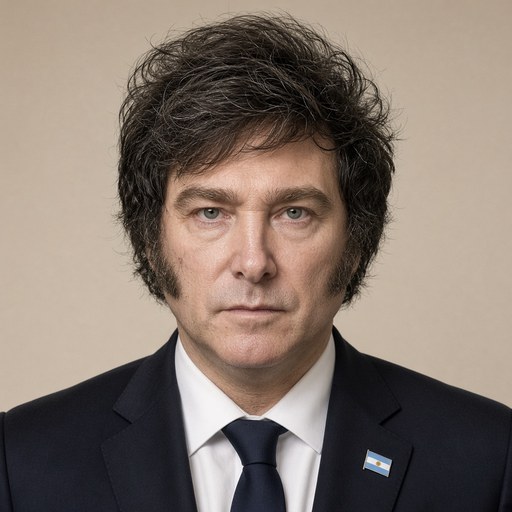
Speech by President Javier Milei at the Sidersa factory in San Nicolás - Presentation of the Argentina Grande Otra Vez Plan.
 Javier Milei · President of Argentina
- Context
- Milei addressed workers and SME representatives at the Sidersa factory in San Nicolás on October 10, 2025, to launch the Argentina Grande Otra Vez economic reform plan.
- Main themes
- Large-scale foreign investment, Argentina Grande Otra Vez Plan, labor reform, SME support, macroeconomic stabilization, energy sector investment, artificial intelligence investment, formal job creation, RIGI investment framework, steel industry, economic growth
- Duration
- ~21 min
- Words
- 2,486
- Sentences
- 98
- Readability
- 44
- Grade
- 13.5
- Syntax
- 3.33
- Vocabulary
- 2.20
Translated from Spanish
The broad sphere of national life a sentence belongs to. Every sentence has an Arena, so it is the denominator the other indices are read against.
Other98 sentences in 21 paragraphs
Please, take a seat. I mean, standing on top of sitting, right? Well, good afternoon everyone. Today is a great day for the economic future of our country. Yesterday, we achieved historic support from the United States for the Argentine Republic to provide us with stability in this moment of political turbulence. The course that Argentina has embarked on since 2023 has earned recognition from the entire world. The courage, effort, and patience of all Argentines are an example for the nations of the West, and the United States, among them, has chosen to accompany this feat by providing us with financial support at a time when the forces of the past are fighting with all their might to ruin the future once again.
This backing is nothing less than historic for our nations, on a scale that is very difficult for ordinary people to imagine. I trust that this will be a foundational milestone of this new era that, as a country, we are beginning, and it will allow us to move forward in building the Argentina that I am convinced we all desire.
This happened just yesterday. Today, early in the morning, we celebrated the signing of the largest investment in Argentine history. This is an agreement between YPF and ENI, the Italian capital hydrocarbon company, which will allow the export of between 12 and 20 billion dollars of liquefied natural gas per year. In total, it will involve an investment of 30 billion dollars in Argentina over the next five years. This makes it one of the most important energy developments in all of Latin America.
But not only that: within a few hours, OpenAI, the most important artificial intelligence company in the world, announced its intention to invest 25 billion dollars in developing data centers in our country. They want to turn Argentina into the third artificial intelligence hub in the world. So, within a span of six hours, we had the pleasure of announcing investments totaling 55 billion dollars in Argentina. Investments that will mean tens of thousands of direct and indirect jobs, and that will forever change our country's role in the world. As I tell you, the world is once again looking at Argentina because they see that the future will be different from the past. That is why it is no coincidence that we are here today, at Sidersa, one of the first companies to join the RIGI, to celebrate another milestone of great investments on our soil. With an investment of almost 300 million dollars, Sidersa is building a long steel plant with a capacity of 360,000 tons per year. Congratulations to its directors and workers. Congratulations! And, in that sense, I take this opportunity to thank the owner and leader of Sidersa, Hernán Spoto, for receiving us so generously, and Mayor Santiago Passaglia for helping us coordinate this visit.
As you all know, over the last year and a half, we have dedicated ourselves to stabilizing the macroeconomy at all costs, because we know it is the foundation of economic growth. That is why today we also want to announce a series of economic reforms aimed at bolstering this unprecedented growth process in our history. With the macroeconomy sailing smoothly, reforms that energize the microeconomy are urgent. These reforms will benefit the entire economy: they will benefit more than half a million SMEs that exist today in the country, as well as large companies, and fundamentally, workers—whether employees, self-employed, or informal—because they will drive the creation of hundreds of thousands of formal jobs in the private sector. That is why we have invited representatives of SMEs of different types and sizes, hailing from San Nicolás, yes, but also from Zárate, Arrecifes, Campana, Capital Sarmiento, and Pergamino. You will be the protagonists of this paradigm shift.
As you surely know, we come from 15 years of job destruction due to bad policies, on two fronts. While, on one hand, productivity decreased due to macroeconomic uncertainty, on the other hand, labor costs increased due to litigation: that not a single registered job has been created in the private sector during this time should not surprise anyone. That is why I want to announce that we will be promoting a general reform of the labor regime to provide predictability to companies and incentivize formal hiring. For too long, legal uncertainty regarding the content of employment contracts, costs, and fears faced by SMEs with each hiring has pushed hundreds of thousands of workers into informality.
For these reasons, owning an SME has become a high-risk task that consumes the life and health of any Argentine in charge, because in addition to the inherent risks of any business, especially in Argentina, there is the labor risk. But if no one wants to create companies, job creation stops, because SMEs generate 70% of employment in this country. There is no doubt that, apart from macroeconomic stabilization, SMEs need, in order to take off, a profound reform in the labor world. This means that workers also need it, because when there is more demand for jobs with the same supply, the price of labor—which is the salary—rises. And this is particularly important for young people, as 50% of the labor force today is under 35. As we always say, there is nothing better for a worker than a company, and there is nothing better for a company than a worker. We need to restore this sacred bond so that there are more companies hiring and more workers working.
We need a clear, simple, and predictable legal framework in labor matters. A framework that ceases to be an obstacle to hiring and becomes a tool for growth, development, and prosperity. That is why, first of all, we intend to promote the negotiation of collective labor agreements. The goal is to encourage new collective negotiations that adapt contractual frameworks to the current productive and labor reality, leaving behind structures that have been in place for more than 70 years. This will foster negotiation and the relationship between employers and unions.
With this new reform, chambers and unions will be able to sit down to negotiate. Those who want to return to the schemes established more than 70 years ago will be able to do so, but it must be the result of a negotiation that seeks to put the country first. That is to say, if no one wants to change the frameworks, they will be agreed upon and those frameworks will continue, and those who want to modify them will have the option to do so. In other words, what we are providing is the flexibility to move towards situations with greater possibilities so that a greater number of jobs and better salaries can be generated.
We will also reduce bureaucratic hurdles so that registration processes can be done digitally, saving time and costs for everyone. The goal is simple: we want it to be unnecessary to hire an accountant or a lawyer to set up a company and generate formal employment. To restore this bond between workers and employers, it is also necessary to take power away from those who seek to harm it for their own benefit, such as labor vultures, who are capable of driving an SME to bankruptcy and pushing its workers into unemployment just to collect a lawsuit. This labor reform is aimed at putting an end once and for all to the nefarious lawsuit industry, which has resulted in not generating a single genuine net job in Argentina in the last 15 years. To this end, we will seek to eliminate the discretion of labor judges when issuing rulings. These judges, in many circumstances, through the imposition of high interest rates and arbitrary rulings, directly send SMEs into bankruptcy due to the impossibility of meeting payments.
Finally, we intend to grant greater freedoms when it comes to negotiating labor contracts, such as the possibility of setting the contract in the currency that both parties decide, without the caps that currently exist. If someone wants to receive 100% of their salary in dollars, they will be able to do so. At the same time, we foresee the possibility of incorporating a system of hour banks, which facilitates the compensation of variable workdays to respond to seasonal or temporary demands, promoting a balance between productivity and well-being.
As I said, the aim of this plan is to energize the economy from the largest to the smallest, because the large companies that access the RIGI also need to procure the goods and services offered by smaller companies. A floating liquefaction plant may require long steel for its construction; a long steel plant may, in turn, require manufacturers of furnaces, suppliers of control and automation systems, transporters, laboratories to assess the quality of steel, and many other sectors, because in the real economy, everything is interconnected. That is why energizing the labor market is something that will improve the situation for everyone, encouraging more companies to invest in Argentina, enhancing this virtuous circle that will make Argentina great once again.
Secondly, we want to carry out a tax reform that has the simplification of taxes as its guiding principle. For this reason, we will seek to eliminate about 20 taxes that hinder the Argentine economy, without having a revenue impact. Argentines seem to be fans of inventing ridiculous and distorting taxes that complicate more than they collect. We come to cut this addiction at its root and to simplify our tax system once and for all. The second component of our tax reform is a renewal of the income tax regime for individuals. In this sense, our proposal will expand the conditions for deductibility of expenses to reduce the personal burden of the tax and, in turn, encourage billing. The increase in formal transactions in the economy will, in turn, increase the tax base and improve revenue collection.
The guiding principle is simple: if you ask for the invoice, you will be able to pay less in income tax. Argentina has a very serious problem of informality, and for this reason, it distributes the fiscal burden of the State inefficiently. This is not the fault of the taxpayer, but of the policies that for years have made life impossible for those who do things right. That is why the challenge of this reform is to put the incentives in order, so that formalizing becomes more beneficial than evading.
If we want to sustainably lower taxes in the future, we need to broaden the tax base, and that will never happen if the tax authorities continue to treat taxpayers like criminals. That is why these reforms go hand in hand with the principle of fiscal innocence, announced a few weeks ago, configuring an unprecedented bureaucratic and fiscal liberation in the history of Argentina.
All of this is just the first stage of the reforms we want to carry out, as soon as the new Congress is established, and for the first time in 25 years, approving it will be possible, given that the next Congress will undoubtedly be more reformist than the current one. I say this mainly because of the dozens of deputies and senators that La Libertad Avanza will add, but also because we know that, apart from the usual misfits who believe that the economy can be solved by doing a rain dance, there are many deputies and senators who, without belonging to the ruling party, share the destiny of the country to which these reforms lead.
Once these proposals are approved in the chamber, we will move forward with the second stage of reforms to improve the lives of all Argentines. These reforms include a sustained reduction of the main taxes in the economy that affect the vast majority. This will be possible due to the increase in the tax base that the labor and tax reform I just presented will bring. It also includes a trade opening, so as not to limit Argentine companies to a market of 50 million people and to offer them, for the first time, a market of 8 billion people. This will place Argentine talent on the shelves and sales points of the entire planet, and at the same time stimulate the generation of more talent here.
At the same time, understanding that foreign trade functions as a two-way highway, we will open the doors of our country to the entry of goods and services from all over the world, so that Argentine shelves have Argentine products, but also those products that are on the shelves of Montevideo, Mexico City, New York, Barcelona, and, why not, Bangladesh or Tokyo.
Of course, this process will have a safeguard of competitiveness for our productive sector, because it will be undertaken once the various dimensions of Argentine costs have been drastically reduced, among which are mainly taxes, bureaucracy, and the cost of credit. We are talking, no more and no less, about a paradigm shift in the Argentine economic life and, consequently, in the life of all Argentines. Thanks to the reduction of bureaucratic obstacles, in which we have already made significant progress; to the reduction of taxes; to the reduction of interest rates, as a consequence of the lower country risk; and to the reduction of labor litigation, we will see an unprecedented productive revolution in our history. This will result in the generation of hundreds of thousands of new registered jobs by 2027, and we will leave behind, once and for all, the dark period that the last 15 years of our history have represented, in which not a single genuine net job was created. That is why we have named this plan “The Plan Argentina Grande Otra Vez,” because it is about unlocking the powerful domino effect of economic growth. This is what I mean with the greatest depth possible when I tell Argentines that we are halfway down a path that leads to only one place: prosperity.
Just two years ago, we dared to embark on this path of deep reform. Taking that leap, which some said was into the void, meant a very high risk for many; it involved risking the unknown. But abandoning the false comfort of the ideas that led us to failure is the only way to reach the other side. The only way to reach the other side is by freeing ourselves from the shackles of the past.
That is why, let us move forward. Let us not lower our arms, let us not give up on the effort we are making, and let us make the effort we have already made worthwhile. The road is arduous, but today we are closer than ever to consolidating this course that will change the country definitively. Finally, may God bless all of you, all Argentines, and may the forces of heaven accompany us. Thank you very much to all.
The original Spanish. The tags above are read on the English translation's sentences.
Por favor, tomen asiento. O sea, encima de parado, ¿no? Bueno, buenas tardes a todos. Hoy es un gran día para el futuro económico de nuestro país. Ayer hemos logrado un apoyo histórico de los Estados Unidos a la República Argentina para proveernos de estabilidad en este momento de turbulencia política. El rumbo que la Argentina ha emprendido desde el 2023 le ha valido el reconocimiento del mundo entero. El coraje, el esfuerzo y la paciencia de todos los argentinos son un ejemplo para las naciones de Occidente, y Estados Unidos, entre ellas, ha elegido acompañar esta hazaña brindándonos su apoyo financiero en un momento en el que las fuerzas del pasado luchan con todas sus fuerzas para arruinar de nuevo el futuro.
Este respaldo no es ni más ni menos que histórico para nuestras naciones, de una escala que, para la gente de a pie, es muy difícil imaginar. Confío en que este será un hito fundacional de esta nueva era que, como país, estamos comenzando y nos permitirá avanzar en la construcción de la Argentina que estoy convencido de que todos deseamos.
Esto ocurrió tan solo ayer. Hoy, a primera hora de la mañana, celebramos la firma de la inversión más grande de la historia argentina. Se trata de un acuerdo entre YPF y la ENI, la empresa de hidrocarburos de capitales italianos, que permitirá exportar entre 12 y 20 mil millones de dólares de gas natural licuado al año. En total, comprenderá una inversión de 30 mil millones de dólares en Argentina a lo largo de los próximos cinco años. Esto lo convierte en uno de los desarrollos energéticos más importantes de toda América Latina.
Pero no solo eso: a las pocas horas, OpenAI, la empresa de inteligencia artificial más importante del mundo, anunció su intención de invertir 25.000 millones de dólares en desarrollar data centers en nuestro país. Quieren convertir a la Argentina en el tercer hub de inteligencia artificial del mundo. O sea que, en el rango de seis horas, hemos tenido el gusto de que se anuncien inversiones por un total de 55.000 millones de dólares en la Argentina. Inversiones que van a significar decenas de miles de puestos de trabajo directos e indirectos, y que vienen a cambiar para siempre el rol de nuestro país en el mundo. Como les digo, el mundo vuelve a mirar a la Argentina porque ven que el futuro será distinto al pasado. Por eso no es casualidad que hoy estemos aquí, en Sidersa, una de las primeras empresas en adherirse al RIGI, para celebrar otro hito de grandes inversiones en nuestro suelo. Con una inversión de casi 300 millones de dólares, Sidersa está construyendo una planta de aceros largos con una capacidad de 360.000 toneladas anuales. Enhorabuena para sus directores y trabajadores. ¡Felicitaciones! Y, en ese sentido, aprovecho para agradecer al dueño y líder de Sidersa, Hernán Spoto, por habernos recibido de forma tan generosa, y al Intendente Santiago Passaglia por ayudarnos a coordinar esta visita.
Como todos saben, durante el último año y medio nos dedicamos a ordenar la macro a toda costa, porque sabemos que es la base del crecimiento económico. Es por ello que hoy también queremos anunciar una serie de reformas económicas dirigidas a apuntalar este proceso de crecimiento inédito en nuestra historia. Con la macro andando con viento en popa, urgen las reformas que dinamicen la micro. Estas reformas serán beneficiosas para toda la economía: van a beneficiar a más de medio millón de pymes que hay hoy en el país, también a las empresas grandes y, fundamentalmente, a los trabajadores —ya sean empleados, autónomos o informales—, porque van a motorizar la creación de cientos de miles de puestos de trabajo en blanco en el sector privado. Por eso, hoy hemos invitado a representantes de pymes de distinto tipo y tamaño, oriundos de San Nicolás, sí, pero también de Zárate, de Arrecifes, de Campana, de Capital Sarmiento y de Pergamino. Ustedes van a ser los protagonistas de este cambio de paradigma.
Como seguramente ustedes sepan, venimos de 15 años de destrucción del empleo por malas políticas, por partida doble. Mientras, por un lado, se bajaba la productividad debido a la incertidumbre macroeconómica, por el otro se aumentaba el costo laboral a causa de la litigiosidad: que no se haya creado un solo puesto de trabajo registrado en el sector privado en todo este tiempo no debería sorprender a nadie. Por eso, quiero anunciar que estaremos impulsando una reforma general del régimen laboral para darle previsibilidad a las empresas e incentivar la contratación formal. Por demasiado tiempo, la incertidumbre jurídica respecto al contenido de los contratos de trabajo, sobre costos y temores a las pymes frente a cada contratación, empujando así a cientos de miles de trabajadores a la informalidad.
Por estos motivos, tener una pyme se volvió una tarea de alto riesgo que consume la vida y la salud de cualquier argentino a su cargo, porque al riesgo propio de cualquier negocio, y más en Argentina, se le suma el riesgo laboral. Pero si nadie quiere crear empresas, se detiene la creación de trabajos, porque las pymes generan el 70% de los empleados en este país. No quedan dudas de que, aparte de la estabilización macroeconómica, las pymes necesitan, para poder despegar, una reforma profunda en el mundo del trabajo. Esto significa que los trabajadores también la necesitan, porque cuando hay más demanda de empleo con la misma oferta, el precio del trabajo —que es el salario— sube. Y esto es, en particular, importante para los jóvenes, ya que el 50% de la masa laboral hoy es sub 35. Como siempre decimos, no hay nada mejor para un trabajador que una empresa, y no hay nada mejor para una empresa que un trabajador. Necesitamos recomponer este vínculo sagrado para que cada vez haya más empresas contratando y más trabajadores, trabajando.
Necesitamos un marco jurídico en lo laboral claro, simple y predecible. Un marco que deje de ser un obstáculo para la contratación, para pasar a ser una herramienta para el crecimiento, el desarrollo y la prosperidad. Por eso, en primer lugar, pretendemos impulsar la negociación de los convenios colectivos de trabajo. El objetivo es impulsar nuevas negociaciones colectivas que adecuen los marcos contractuales a la realidad productiva y laboral actual, dejando atrás estructuras vigentes desde hace más de 70 años. Esto fomentará la negociación y el vínculo entre la parte empleadora y la parte sindical.
Con esta nueva reforma, las cámaras y los sindicatos se van a poder sentar a negociar. Quienes quieran volver a elegir los esquemas establecidos hace más de 70 años van a poder hacerlo, pero ello debe ser fruto de una negociación que busque poner al país adelante. Es decir, si nadie quiere cambiar los marcos, se acordarán y seguirán esos marcos, y aquellos que lo quieran modificar van a tener la opción de hacerlo. Es decir, lo que estamos dando es la flexibilidad de ir a situaciones con mayores posibilidades para que se pueda así generar una mayor cantidad de puestos de trabajo y mejores salarios.
También reduciremos trabas burocráticas para que los procesos registrales puedan hacerse de manera digital, ahorrando tiempo y costos para todos. El objetivo es simple: queremos que no sea necesario contratar un contador ni un abogado para montar una empresa y generar empleo formal. Para recomponer este vínculo entre trabajadores y empresarios, al mismo tiempo es necesario quitarles poder a gente que buscan dañarlo por su propio beneficio, como por ejemplo los caranchos laboralistas, que son capaces de llevar a una pyme a la quiebra y empujar a sus trabajadores al desempleo con tal de cobrar un juicio. Esta reforma laboral está orientada a terminar de una vez y para siempre con la nefasta industria de juicio, que ha redundado en que no se genere un solo puesto de trabajo genuino neto en la Argentina en los últimos 15 años. Para esto, vamos a buscar eliminar la discrecionalidad de parte de los jueces laborales a la hora de dictar sentencias. Estos jueces, en muchas circunstancias, a través de la imposición de altas tasas de interés y fallos arbitrarios, envían directamente a la quiebra a las pymes por la imposibilidad de hacerle frente a los pagos.
Por último, se pretende otorgar mayores libertades a la hora de pactar contratos laborales, como por ejemplo la posibilidad de fijar el contrato en la moneda que ambas partes decidan, sin topes, los que existen en la actualidad. Si alguien quiere cobrar el 100% de su salario en dólares, va a poder hacerlo. A su vez, se prevé la posibilidad de incorporar un sistema de banco de horas, que facilita la compensación de jornadas variables para responder a demandas estacionales o temporales, promoviendo un equilibrio entre productividad y bienestar.
Como ya dije, el fin de este plan es dinamizar la economía desde lo más grande a lo más pequeño, porque las grandes empresas que acceden al RIGI necesitan, a su vez, proveerse de los bienes y servicios que ofrecen empresas más pequeñas. Una planta flotante de licuefacción de gas puede requerir de aceros largos para su construcción; una planta de aceros largos puede, a su vez, requerir de fabricantes de hornos, de proveedores de sistemas de control y automatización, transportistas, laboratorios para evaluar la calidad del acero y tantos otros rubros más, porque en la economía real todo tiene que ver con todo. Por eso, dinamizar el mundo del trabajo es algo que va a mejorar la situación para todos, haciendo que más empresas se animen a invertir en Argentina, potenciando este círculo virtuoso que hará a la Argentina grande una vez más.
En segundo lugar, queremos llevar adelante una reforma tributaria que tenga como norte la simplificación de impuestos. Por esto, vamos a buscar eliminar cerca de 20 impuestos que entorpecen a la economía argentina, sin tener un impacto recaudatorio. Los argentinos parecieran que somos fanáticos de inventar impuestos ridículos y distorsivos, que complican más de lo que recaudan. Venimos a cortar de cuajo con esta adicción y a simplificar de una vez por todas nuestro sistema tributario. El segundo componente de nuestra reforma tributaria es una renovación del régimen de ganancias para las personas humanas. En este sentido, nuestra propuesta ampliará las condiciones de deducibilidad de gastos para reducir la carga personal del impuesto y, a su vez, fomentar la facturación. El incremento de transacciones formales en la economía aumentará, por su parte, la base imponible y mejorará la recaudación.
El principio rector es sencillo: si pedís la factura, vas a poder pagar menos ganancias. Argentina tiene un problema de informalidad muy grave, y por esto distribuye ineficientemente la carga fiscal del Estado. Esto no es culpa del pagador de impuestos, sino de la política que durante años le hizo imposible la vida al que hacía las cosas bien. Por eso, el desafío de esta reforma es poner los incentivos en regla, para que blanquear sea más provechoso que evadir.
Si queremos bajar impuestos de forma sostenida en el futuro, necesitamos ampliar la base imponible, y eso no va a ocurrir nunca si el fisco sigue tratando al pagador de impuestos como un criminal. Por eso, estas reformas van de la mano del principio de inocencia fiscal, anunciado hace unas semanas, configurando una liberación burocrática y fiscal sin precedentes en la historia de la Argentina.
Todo esto es tan solo la primera etapa de las reformas que queremos llevar adelante, ni bien se constituya el nuevo Congreso y por primera vez en 25 años, aprobarla será posible, dado que el próximo Congreso será indudablemente más reformista que el actual. Lo digo principalmente por las decenas de diputados y senadores que La Libertad Avanza va a sumar, pero también porque sabemos que, por fuera de los inadaptados de siempre que creen que la economía se soluciona haciendo la danza de la lluvia, hay muchos diputados y senadores que, sin pertenecer al partido de gobierno, comparten el destino de país al cual conducen estas reformas.
Una vez aprobadas estas propuestas en el recinto, avanzaremos con la segunda etapa de reformas para mejorarle la vida a todos los argentinos. Dichas reformas incluyen una baja sostenida de los principales impuestos de la economía que afectan a las grandes mayorías. Esto será posible producto del aumento de la base imponible que traerán la reforma laboral y la tributaria que acabo de presentar. Incluye también una apertura comercial, para no limitar a las empresas argentinas a un mercado de 50 millones de personas y ofrecerles, por primera vez, un mercado de 8.000 millones de personas. Esto colocará el talento argentino en las góndolas y bocas de expendio del planeta entero, y a su vez estimulará la generación de más talento aquí.
A la vez, entendiendo que el comercio exterior funciona como una autopista de ida y vuelta, vamos a abrir las puertas de nuestro país para el ingreso de bienes y servicios de todo el mundo, para que las góndolas argentinas estén los productos argentinos, pero también aquellos productos que están en las góndolas de Montevideo, Ciudad de México, Nueva York, Barcelona y, por qué no, de Bangladesh o Tokio.
Por supuesto, este proceso tendrá una salvaguarda de competitividad para nuestro sector productivo, porque será emprendido una vez reducidas drásticamente las distintas dimensiones del costo argentino, entre las cuales se encuentran principalmente los impuestos, la burocracia y el costo del crédito. Estamos hablando, ni más ni menos, de un cambio de paradigma en la vida económica argentina y, en consecuencia, en la vida de todos los argentinos. Gracias a la reducción de trabas burocráticas, en la que ya hemos avanzado kilómetros; a la reducción de impuestos; a la reducción de la tasa de interés, como consecuencia del menor riesgo país; y a la reducción de la litigiosidad laboral, veremos una revolución productiva sin precedentes en nuestra historia. Esto redundará en la generación de cientos de miles de nuevos empleos registrados de aquí a 2027, y dejaremos atrás, de una buena vez, la época oscura que han significado los últimos 15 años de nuestra historia, en la que no se generó ni un solo puesto de trabajo genuino neto. Por eso hemos bautizado este plan “El Plan Argentina Grande Otra Vez”, porque se trata de destrabar el poderoso efecto dominó del crecimiento económico. Esto es lo que me refiero con la mayor profundidad posible cuando le digo a los argentinos que estamos a la mitad de un camino que conduce a un solo lugar: la prosperidad.
Hace tan solo dos años nos animamos a emprender este camino de reforma profunda. Dar ese salto, que algunos decían que era el vacío, significó un riesgo muy alto para muchos; implicó arriesgarse a lo desconocido. Pero abandonar la falsa comodidad de las ideas que nos llevaron al fracaso es la única forma de llegar al otro lado. La única forma de llegar al otro lado es liberándonos de la atadura del pasado.
Por eso, sigamos adelante. No bajemos los brazos, no desistamos en el esfuerzo que estamos haciendo, y hagamos que el esfuerzo que ya hicimos valga la pena. El camino es arduo, pero hoy estamos más cerca que nunca de consolidar este rumbo que cambiará el país de forma definitiva. Finalmente, que Dios los bendiga a todos ustedes, a todos los argentinos, y que las fuerzas del cielo nos acompañen. Muchísimas gracias a todos.