




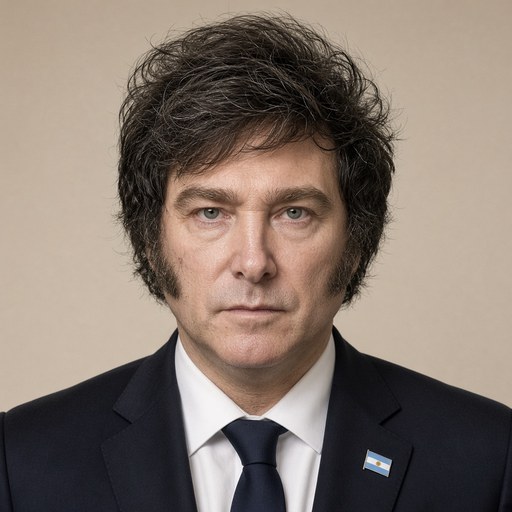
Speech by President Javier Milei at the inauguration of the Lamb Weston factory in Mar del Plata.
 Javier Milei · President of Argentina
- Context
- Milei spoke at the inauguration of Lamb Weston's potato processing plant in Mar del Plata on October 7, 2025, celebrating foreign investment and outlining his free-market economic vision.
- Main themes
- Private investment and job creation, economic freedom and libertarianism, reduction of state intervention, poverty reduction, monetary policy and inflation control, agricultural and food processing industry, value chains and exports, savings and investment incentives, Argentina's economic transformation
- Duration
- ~29 min
- Words
- 3,457
- Sentences
- 145
- Readability
- 55
- Grade
- 11.5
- Syntax
- 3.16
- Vocabulary
- 1.96
Translated from Spanish
The broad sphere of national life a sentence belongs to. Every sentence has an Arena, so it is the denominator the other indices are read against.
Other145 sentences in 24 paragraphs
Hello everyone. There is still time, there is still time. It is a pleasure to be here in Mar del Plata, in the presence of all of you, and even more so to be part of the inauguration of the most modern potato processing plant in Latin America, which will enhance the production of more than 100 local producers. This new factory will generate approximately 3,000 jobs, both direct and indirect, among the plant, the producers, the transporters, and the Port of Mar del Plata from where the products will be exported to the entire region.
Thank you to Mike Smith, thank you to Marc Schroeder, to Romina Broda, and to the entire Lamb Weston team for the invitation and for betting on Argentina to expand. Thank you also to all the employees for the effort they have put into transforming this space into this emblematic plant.
This is the way: private investment in profitable businesses that generate genuine jobs directly and promote activity in other links of the economy, integrating a value chain where these other links generate even more genuine jobs. That is why we celebrate this moment, which, along with so many others of this kind, is a demonstration of the Argentina we are creating, both for ourselves and for future generations.
And that is precisely what I want to talk to you about today: the future that awaits us if we insist on this path we have chosen, which is the path of freedom. This path will not only bear fruit in the agricultural sector and its derivatives but also in the entirety of the Argentine economy. Our path is to free the economy from the shackles imposed by the State; freeing the economy means taking less from citizens through taxes and bureaucracy, so that Argentines can decide for themselves how to make the most of their money instead of politicians deciding for them.
That everyone, every day, can buy, sell, hire, save, invest, and work more and more freely. This encourages both saving and investment. Because if I stop taking something from you that I used to take, you have more capital than before to use as you wish. There is a phrase from a libertarian economist that states that when money is tight, it is because there is too much State. This is interesting because there are many who spend hours and hours reciting and blaming our management for people not making ends meet, when we lifted 12 million Argentines out of poverty, and today there are 6 million Argentines who used to go hungry and now eat. But… I understand that we have made an enormous effort. All Argentines have made an enormous effort. We, from the Executive Branch, have also. And I clarify: the Executive Branch has also made an enormous effort because our salaries have been frozen by my decision since December 2023.
And it is interesting that those who proclaim that people cannot make ends meet are defenders of the present State, and it is interesting because when someone cannot make ends meet, it is definitely because there is too much State. And these people, if they were truly concerned that people cannot make ends meet, would not be proposing more State as a solution, but less State. But, well, as a phrase from Thomas Sowell —which is phenomenal— states: the first law of economics is scarcity, meaning there is not enough for everyone; according to Ricardo's Law of Association, there is room for everyone. But he also says: the first law of politics is to ignore the first law of economics, unless the president is an economist. But, well, that is how we are fighting.
This incentive to save, to invest, as we have just pointed out… when all this context is generated, at first you will probably increase your expenses to cover delayed needs due to politics, such as changing an appliance or painting your house. But once those expenses are covered, you will have a capacity for saving that you did not have before. Logically, given the historical instability of the peso, due to its pathological issuance by politicians, Argentines seek to shelter our savings in dollars, which used to be more stable. I would like to mention that, since the middle of last year, the amount of money has been fixed in Argentina; the monetary base is fixed, and the lags in monetary policy range between… old studies showed between 18 and 24 months. Now there is a study at the University of Córdoba that shows it is 26. This means that by the middle of next year, around August, inflation in Argentina will have disappeared, given that inflation is the most regressive and violent tax created by the political corporation, and by the middle of next year it will be history.
That is why it is also important to keep in mind that if we are working in that line of contraction and monetary control, we must also consider that the dollar has its depreciation. Therefore, the next step is to seek different ways to maintain the value of our dollars, or even for their value to grow over time. And one way to do this is also to give opportunities to our domestic currency. This is called investment, which is nothing more than putting savings at the service of others to generate even higher returns. Here, credit also starts to play an important role because if one wants to invest in a business, one often needs large amounts of money. So, with the capacity to save, one can take out a loan and use months, or even years, of savings in the present, and repay it in the future.
This link between saving and investment, which is fundamentally what allows for capital accumulation and generates economic growth, and that accumulation of capital increases productivity and real wages, crucially depends on property rights. And the truth is that the advance of the State, fundamentally, is a form of expropriation; the extreme case is communism, which is 100% taxes, leaving nothing. Therefore, the direction must be the opposite; that is, if you want there to be growth, if you want there to be saving, if you want there to be investment, you must respect property rights, and for that, you must remove the State from the middle. On one hand, you remove the State from the middle by lowering taxes, and the other is deregulating and removing the corrupt political kiosks that hinder the functioning of the private sector. We are not only saying that we are going to lower taxes and that if we can continue with this management and this handling of the macroeconomy, by 2031, we will return to the private sector 500 billion dollars in taxes that will be lowered.
This is not just a promise in an election year. Last year we lowered taxes by two points, and despite that, we were able to achieve fiscal balance, given the reduction of public spending. That is to say, the adjustment was not paid by the people; it was paid by the elite. Now, when property rights are not respected, the consequence is what has happened in Argentina over the last 100 years: from being a developed country, it became a developing one, and we were on the path to Venezuela. So, returning to what we were saying in terms of saving capacity, credit, and investment, many times one does not know where to invest their savings and decides to lend it to the bank. And for the bank to lend it to whoever it sees fit, fulfilling its role as a bank, right? Something that changed radically from December 23 to now, when, basically, banks were dedicated to taking deposits to lend them to the Central Bank, which generates a quasi-fiscal deficit of 10 points of GDP, which we exterminated in the middle of last year.
That is why the work of macroeconomic stabilization and lowering country risk that we are carrying out is so important, and which has now been halted by political action, which in the last six or seven months has only tried to break macroeconomic balance, which has translated into an increase in Country Risk, an increase in rates, and an economy that expanded by six and a half in the first semester; now it is stagnant due to the obstructive, destructive, and destabilizing attitude from the Congress of the Argentine Nation. Because what does Country Risk fundamentally mean? Country Risk, combined with the American rate, sets a floor on the cost of credit. That is to say, this shrinks credit. The higher the rate, the less credit there will be in the natural construction of saving and investment if you put the risk above the coordination rate.
And if the country risk, if the costs of credit are very high, it means that companies and individuals stop taking credit to expand, and economic growth stagnates. To understand how important it is to lower the cost of credit in our country, it is enough to observe, for example, the number of Argentines who were able to access home ownership for the first time, thanks to mortgage loans during the last year and a half.
At the business level, this decision of how to save and invest works in the same way. Once maximum productive capacity is reached, a company can decide to keep that income cap or reinvest its profits in making more plants and hiring more people. In fact, this is the reason that brings us all here today. So my heartfelt congratulations for continuing to bet on a country that has entered the path to being great again.
This increase in your production and sales capacity generates a benefit for all parties. I often say that entrepreneurs and those who make money are social benefactors because, basically, to be successful as an entrepreneur, you have to serve others with better quality goods at a better price; if you do not do that, you will go bankrupt. So the benefit, far from being something stigmatized —as the entire State party and the political elite do— should actually be a source of pride and celebration that there are successful entrepreneurs because they are people who are improving the lives of their fellow citizens.
One of the most surprising things that happened to me was when I met Elon Musk for the first time. We were meeting with him, and at that moment, when we were talking about the economy, he said to me: “I get up every day thinking about what problem I can solve for people.” I said: “This guy deserves to be the richest businessman in the world.” It is not that he has a product and tries to push it onto people; no, he looks for what problems people have and tries to solve them; it is as if he were the Messi of well-being, a machine for generating value for everyone. So, that is why I have… I say, and then I had the honor of being able to interact more, and the more I interacted, the more I could validate that he is extraordinary. And following this line, when you generate benefits for customers, you also generate them because they access —again— better quality goods at a better price. This also benefits employees because it creates new jobs and improves wages due to increased productivity. And for partners because it increases the value of their company. Saving and investment are the keys to lasting and quality progress; they are the true engines of economic growth and social well-being. It is thanks to saving and investment that Argentines can access home ownership, change their cars, renew old appliances, go on vacation, start and expand businesses. It is thanks to saving and investment that Argentines can truly be architects of their own destiny, and that is why we want Argentina to be able to return to being a country where saving and investment are no longer a bad word.
The responsibility of politics has robbed us Argentines of the fruits of our labor, and this Government is determined to recover it. But to achieve this, there is only one way: to defend tooth and nail the fiscal order, which is the first necessary condition for growth. From there, with the numbers in order, we must carry out the necessary reforms that catalyze our economic growth. In fact, there is a study by Juan Pablo Nicolini that shows that simply putting the fiscal result in order —something we did in one month, after 123 years of fiscal deficit— we achieved it in one month, that would ensure us, in the long term, a growth of 4%. And, in addition, over these 20 months, we have made 9,000 structural reforms, and we are also doing strong work on human capital, which explains about 70 percentage points of economic growth. And, in addition, we are opening up the economy. That is to say, Argentina is in a position to, in 7 to 10 years, reach or exceed the per capita GDP of Spain. In 15 to 20 years, we are in a position to be like Germany. In less than 30 years, we could match the United States. In 40 years, we would become one of the three countries with the highest per capita GDP in the world. Therefore, making Argentina great again is possible, it is feasible, it only requires will. Knowing that we are halfway there. We must keep working. We must keep betting on freedom. We must not give up. And that will put us on the other side of the river, and the path to prosperity will begin to make Argentina great again.
To achieve this, we must materialize this path of economic liberation on different fronts. On the tax front, so that the State takes as little as possible from you and so that you can always know what the State... What is it taking from you? Because you need to know what it takes; you can manage it. On the labor front, to make it easy to create jobs so that more and more companies can hire personnel. On the commercial front, to export more and flood the world with Argentine talent and so that Argentines can access a greater variety of products at better prices here at home.
Basically, countries export in order to import; if not, go look at what a supermarket in Switzerland is like. What do they produce in Switzerland? Financial services, chocolates, watches, pocket knives, and, at one time, a wonderful tennis player; there is tourism. When you enter a supermarket in Switzerland, except for the chocolates, what are the rest of the things? Imported. So, for example... and it is also worth mentioning in this city, where the dear mayor, Guillermo Montenegro, is. There are countries that live off tourism, for example. So, we have a lot, especially in Mar del Plata, and that can also coexist with the productive sector. And today we are also showing a sample of that.
And another thing that is also important is on the criminal front, so that no one can take away the fruits of your labor, or worse yet, your life, and go unpunished. Order is a necessary condition for economic growth. That is to say, without order, there is no economic growth. I often repeat the phrase of Alberto Benegas Lynch (h) about liberalism, which is the unrestricted respect for the project of others, based on the principle of non-aggression, in defense of the right to life, liberty, and property. Well, there is order. And this is very important because, from the national government, we have had a wonderful management, reducing crime to historically low levels, with the management of Doctor Patricia Bullrich. We put a stop to the drug traffickers in Rosario, with the Bandera Plan, thanks to the work and effort that Minister Bullrich decided to promote and which was supported by the governor of the province of Santa Fe, Pullaro. And that commitment to security is so important that today our list for the province of Buenos Aires is headed, today, by someone who knows about security and who successfully did it in the Autonomous City of Buenos Aires: the dear "El Colo" Santilli.
So, drug traffickers and thieves, I warn you that we are going to make it hard for you. Now, then you see the defenders of the guarantees appearing, without saying the guarantors... the abolitionists or the Zaffaroni boys. Then they will say: "Oh, well, but these are people who are going to be left without work." I have heard such things from some journalists... yes, yes, well, of course, it must be terrible for all those who live off the thieves. And yes, but stealing is wrong, so go and work, which is what good people do.
In short, all the other paths have already been tried; how many variants of socialism exist, and they have failed. It was also attempted with gradualism, the correct direction, and the change remained unfinished. We have always been clear that there was no way to make the bitter pill we had to endure due to the fiscal responsibility of decades of politics more palatable. What happens is that growth is always and everywhere a function of accumulated capital, physical and human, and institutional, if you will. And politics has dedicated itself, for years, to consuming it, to combating it to appear to provide well-being, and what it ended up doing — like all the actions that the Government takes — let’s say, if it wants to make a plan for poverty, what does it do? It increases poverty. If it wants to protect people's jobs, it increases unemployment. That is to say, this is very interesting; there is a video by Huerta de Soto, which I recommend, that says: "Every time the Government makes a program for something, the result is the opposite." That is to say, here the key is to get the State out of the way. So, and even so, thanks to the excellent work of our economic team and the Ministry of Human Capital, we managed to ensure that the consequences fall as little as possible on the most vulnerable sectors. We cannot underestimate the magnitude of the catastrophe we avoided, which would have been the worst crisis in our history with hyperinflation, along with social indicators in the red, worse than those of 2001.
We also cannot ignore the failure of the previous model, which was unable to generate a single real job in the last 10 years, while trying to disguise it through hidden subsidies, which constitute a large part of public employment. This has resulted in the country not growing since 2011. But if there is one thing I am sure of, it is that Argentines are always capable of getting back on our feet, like ants that rebuild their anthill a thousand times when it is destroyed. Argentines roll up our sleeves and start from scratch every time irresponsible politics blows us to pieces. This is because, under the weight that politicians have placed on our shoulders for so many years, we have learned to squeeze water from stones to survive.
It is no coincidence that we have named this 2025 as the year of the reconstruction of the Argentine Republic, and 2024 as the year of the defense of life, liberty, and property. The first year of our government was a declaration of principles, the establishment of the north that will guide our actions going forward. Now, in this 2025, we begin to stand Argentina up for the last time. And I say "for the last time" because we have the historic opportunity to adopt the ideas of freedom once and for all, to generate hundreds of thousands of jobs over the next 10 years, for the two million Argentines who left in the last decade to return, and so that no one else is forced to seek elsewhere what their own country is denying them.
All of this, and much more, is possible thanks to the effort of everyone and because we decided to embark on the right path after a century of stumbles. Just as we were great at one time, we will reconnect with our greatness as a nation once we have completed the reform process we began at the end of 2023. I have no doubt that together we will make Argentina great again. May God bless the Argentines, may the strength of heaven accompany you, and long live freedom, damn it. Thank you very much.
The original Spanish. The tags above are read on the English translation's sentences.
Hola a todos. Todavía queda, todavía queda. Es un placer estar aquí, en Mar del Plata, en presencia de todos ustedes, y más todavía si se trata de formar parte de la inauguración de la planta procesadora de papa más moderna en Latinoamérica, la cual potenciará la producción de más de 100 productores locales. Esta nueva fábrica generará aproximadamente 3.000 puestos de trabajos entre los directos y los indirectos, entre la planta, los productores, los transportistas y el Puerto de Mar del Plata desde donde se exportarán los productos a toda la región.
Gracias a Mike Smith, gracias a Marc Schroeder, a Romina Broda y a todo el equipo de Lamb Weston por la invitación y por apostar por la Argentina para expandirse. Gracias también a todos los empleados por el empeño que han puesto en transformar este espacio, en esta planta emblemática.
Este es el camino: la inversión privada en negocios rentables, que generan puestos de trabajo genuinos de forma directa y que promueven la actividad en otros eslabones de la economía, integrando una cadena de valor donde estos otros eslabones generan aún más puestos de trabajo genuinos. Por eso celebramos este momento, que, junto a tantos otros de esta misma índole, son una muestra de la Argentina que estamos creando, tanto para nosotros como para las generaciones venideras.
Y precisamente de eso quiero hablarles hoy: del futuro que nos espera si insistimos en este camino que hemos elegido, que es el camino de la libertad. Este camino, que no rendirá frutos solamente en el sector agropecuario y sus derivados, sino también en el conjunto de la economía argentina. Nuestro camino es el de liberar la economía de los grilletes que le puso el Estado; liberar la economía significa sacarles menos a los ciudadanos vía impuestos y burocracia, para que los argentinos puedan decidir por su propia cuenta cómo aprovechar su dinero en lugar de que los políticos anden decidiendo por ellos.
Que todos, cada día, puedan comprar, vender, contratar, ahorrar, invertir y trabajar más y más libremente. Esto incentiva tanto el ahorro como la inversión. Porque si dejo de sacarte algo que antes te sacaba, contás con más capital que antes para disponer como quieras. Hay una frase de un economista libertario que señala que, cuando la plata no te alcanza, es porque te sobra Estado. Esto es interesante, porque hay muchos que pasan horas y horas recitando y achacándole a nuestra gestión que la gente no llega a fin de mes, cuando nosotros sacamos a 12 millones de argentinos de la pobreza, y hoy hay 6 millones de argentinos que antes no comían y ahora sí comen. Pero… yo entiendo que hemos hecho un esfuerzo enorme. Todos los argentinos hemos hecho un esfuerzo enorme. Nosotros, desde el Poder Ejecutivo, también. Y aclaro: el Poder Ejecutivo, también hicimos un esfuerzo enorme, porque nuestros sueldos están frisados por mi decisión desde diciembre del 2023.
Y es interesante esos que proclaman que no se llega a fin de mes, son defensores del Estado presente, y es interesante porque cuando a alguien no le no le alcanza es, definitivamente, porque sobra Estado. Y esta gente si verdaderamente estuviera preocupado porque la gente no le alcanza, porque no llega a fin de mes, no tendría que estar proponiendo como solución más Estado, sino menos Estado. Pero, bueno, como dice una frase de Thomas Sowell —que es fenomenal— que dice: que la primera ley de la economía es la escasez, es decir, no hay de todo para todos, por la Ley de Asociación de Ricardo hay lugar para todos. Pero también dice: que la primera ley de la política es ignorar la primera ley de la economía, salvo que el presidente sea economista. Pero, bueno, así la estamos peleando.
Este incentivo al ahorro, a la inversión, como venimos de señalar… cuando se genera todo este contexto, al principio probablemente aumentes tus gastos en cubrir necesidades atrasadas por culpa de la política, como por ejemplo cambiar un electrodoméstico o pintar tu casa. Pero, una vez cubiertos esos gastos, vas a tener una capacidad de ahorro que antes no tenías. Lógicamente, dada la inestabilidad histórica del peso, producto de su emisión patológica por parte de los políticos, los argentinos buscamos refugiar nuestros ahorros en dólar, que solía ser más estable. Les comento que, desde mediados del año pasado, la cantidad de dinero está fija en Argentina; la base monetaria está fija, y que los rezagos en la política monetaria oscilan entre… los viejos estudios mostraban entre 18 y 24 meses. Ahora hay un estudio en la Universidad de Córdoba que muestra que son 26. Esto quiere decir que, para mitad del año que viene, hacia agosto, la inflación en la Argentina habrá desaparecido, siendo que la inflación es el impuesto más regresivo y más violento que ha creado la corporación política, y que para mitad del año que viene va a ser historia.
Por eso, también es importante tener en cuenta que, si nosotros estamos trabajando en esa línea de contracción y de control monetario, hay que tener en cuenta que el dólar también tiene su depreciación. Por lo que el paso siguiente es buscar distintas formas de mantener el valor de nuestros dólares, o incluso que su valor crezca en el tiempo. Y esa es una forma de hacerlo: es también darle oportunidades a nuestra moneda doméstica. A esto se le llama inversión, que no es otra cosa que poner los ahorros al servicio de otros para que generen retornos aún más altos. Aquí también empieza a jugar un rol importante el crédito, porque si uno quiere invertir en un negocio, muchas veces necesita de grandes cantidades de dinero. Entonces, con capacidad de ahorro, uno puede tomar un crédito y disponer de meses, o incluso de años, de ahorro en el presente, e ir repagándolo en el futuro.
Este vínculo, entre ahorro e inversión, que es en el fondo el que permite la acumulación de capital y genera el crecimiento económico, y esa acumulación de capital aumenta la productividad y los salarios reales, depende crucialmente de los derechos de propiedad. Y la verdad que el avance del Estado, en el fondo, es una forma de expropiación, el caso extremo es el comunismo, es 100% impuestos, no le queda nada. Por lo tanto, la dirección tiene que ser la opuesta, es decir, si usted quiere que haya crecimiento, si quiere que haya ahorro, si quiere que haya inversión tiene que respetar los derechos de propiedad y para eso tiene que correr al Estado del medio. Por un lado, se corre al Estado del medio bajando impuestos y la otra es desregulando y quitando los kioscos de políticos corruptos que empasta el funcionamiento del sector privado. Nosotros no solo que estamos diciendo que vamos a bajar impuestos y que, si nosotros podemos continuar con esta gestión y este manejo de la macroeconomía, de acá al año 2031, le vamos a devolver al sector privado 500 mil millones de dólares en impuestos que se van a bajar.
Esto no es solamente una promesa en un año electoral. Nosotros el año pasado bajamos dos puntos de impuestos y, a pesar de eso, pudimos alcanzar el equilibrio fiscal, dada la reducción del gasto público. Es decir, el ajuste no lo pagó la gente, lo pagó la casta. Ahora, cuando no se respeta los derechos de propiedad, la consecuencia es lo que ha pasado en Argentina los últimos 100 años: de ser un país desarrollado, se convirtió en uno subdesarrollado e íbamos camino a Venezuela. Entonces, retornando a lo que veníamos diciendo en términos de capacidad de ahorro, crédito e inversión, muchas veces uno, a veces no sabe en que invertir sus ahorros y decide prestárselo al banco. Y para que el banco pueda prestárselo a quien vea conveniente, cumpliendo su trabajo como banco ¿no? Algo que cambió radicalmente desde diciembre 23 a ahora, cuando, básicamente, los bancos se dedicaban a tomar depósitos para prestárselos al Banco Central, que nos genera un déficit cuasifiscal de 10 puntos de PBI, que a mitad del año pasado lo exterminamos.
Por eso, también es tan importante el trabajo de saneamiento macroeconómico y de baja del riesgo país que llevamos adelante y que ahora se vio frenado por la acción de la política, que en los últimos seis, siete meses, lo único que hace es tratar de romper el equilibrio macroeconómico, lo que se ha traducido es en un aumento del Riesgo País, en un aumento de las tasas y en una economía que, en el primer semestre se expandió al seis y medio; ahora está estancada por culpa de la actitud obstruccionista, y destructiva, y destituyente desde el Congreso de la Nación Argentina. Porque ¿qué es lo que significa en el fondo el Riesgo País? El Riesgo País lo que hace —sumado a la tasa americana— es poner un piso al costo del crédito. Es decir, eso lo que hace es achicar el crédito. O sea, cuanto más alta sea la tasa, menos crédito habrá, en la construcción natural de ahorro inversión, si ustedes el riesgo se le pone por encima de la tasa de coordinación.
Y, si el riesgo país, si los costos del crédito son muy altos, significa que las empresas y las personas dejan de tomar crédito por expandirse y el crecimiento económico se estanca. Para tomar cuenta de lo importante que es lograr bajar el costo del crédito en nuestro país, alcanza con observar, por ejemplo, la cantidad de argentinos que pudieron acceder a la vivienda propia por primera vez, gracias a los créditos hipotecarios durante el último año y medio.
A nivel empresarial, esta decisión de cómo ahorrar e invertir funciona de la misma manera. Una vez alcanzada la máxima capacidad productiva, una empresa puede decidir quedarse con ese tope de ingresos o reinvertir sus ganancias en hacer más plantas y contratar más gente. De hecho, este es el motivo que nos convoca hoy aquí a todos. Así es que mis felicitaciones de todo corazón por seguir apostando a un país que entró en el sendero que va a ser grande nuevamente.
Este aumento, de su capacidad de producción y de ventas, genera un beneficio para todas las partes. Yo suelo decir que los empresarios y los que ganan dinero son benefactores sociales porque, básicamente, para ser exitoso como empresario hay que servir al prójimo con bienes de mejor calidad a un mejor precio, si ustedes no hacen eso van a la quiebra. Así es que el beneficio, lejos de ser algo estigmatizable, —como lo hace todo el partido de Estado y la casta política— en realidad, debería ser un motivo de orgullo y de celebración que haya empresarios exitosos porque son personas que le están arreglando la vida a sus semejantes.
Una de las cosas más sorprendentes que me pasó, fue cuando lo conocí, por primera vez, a Elon Musk. Estábamos reunidos con él y, en ese momento, cuando estábamos hablando de economía, él me dijo: “Yo me levanto todos los días pensando en qué problema le puedo arreglar a la gente”. Dije: “Este tipo se merece ser el empresario más rico del mundo”. Es decir, no es que él tiene un producto y se lo trata de encajar a la gente; no, no, busca qué problemas tiene la gente y trata de resolverlos, es decir, es como si fuera el Messi del bienestar, es una máquina de generar valor para todos. O sea, que… por eso, es que yo tengo… digo, y después encima tuve el honor de poder interactuar más y cuanto más interactúe, más pude validar de que es un fuera de serie. Y siguiendo en esta línea, cuando ustedes generan beneficios para los clientes también se generan porque acceden —de vuelta— a bienes de mejor calidad a un mejor precio. También esto beneficia a los empleados porque generan nuevo puesto de trabajo y mejora los salarios por aumento de productividad. Y para los socios porque aumenta el valor de su empresa. El ahorro y la inversión son las claves del progreso duradero y de calidad, son los verdaderos motores de crecimiento económico y el bienestar social. Es gracias al ahorro y la inversión que los argentinos pueden acceder a la vivienda propia, cambiar el auto, renovar los electrodomésticos viejos, irse de vacaciones, comenzar y expandir negocios. Es gracias al ahorro y la inversión que los argentinos podrán ser verdaderamente arquitectos de su propio destino y por eso queremos que Argentina pueda volver a ser un país donde el ahorro y la inversión dejen de ser una mala palabra.
La responsabilidad de la política nos robó a los argentinos el fruto de nuestro esfuerzo, y este Gobierno está empecinado en recuperarlo. Pero, para lograrlo, solo hay un camino: defender con uñas y dientes el orden fiscal, que es la primera condición necesaria para crecer. A partir de allí, con los números en orden, debemos llevar a cabo las reformas necesarias que catalicen nuestro crecimiento económico. De hecho, hay un trabajo de Juan Pablo Nicolini que demuestra que, con solo poner en caja el resultado fiscal —algo que nosotros hicimos en un mes, después de 123 años de déficit fiscal—, nosotros lo logramos en un mes, eso nos aseguraría, en el largo plazo, un crecimiento de 4%. Y, además, nosotros a lo largo de estos 20 meses hicimos 9.000 reformas estructurales, y además estamos haciendo un fuerte trabajo en capital humano, que es algo que explica cerca de 70 puntos porcentuales de crecimiento económico. Y, además, estamos abriendo la economía. Es decir, Argentina está en condiciones de, entre 7 y 10 años, alcanzar o superar el PBI per cápita de España. Entre 15 y 20 años, estamos en condiciones de ser como Alemania. En menos de 30 años podríamos igualar a Estados Unidos. En 40 años nos convertiríamos en uno de los tres países con mayor PBI per cápita del mundo. Por lo tanto, hacer grande a la Argentina nuevamente es posible, es factible, solo requiere de voluntad. Saber que estamos a mitad de camino. Hay que seguir trabajando. Hay que seguir apostando a la libertad. No hay que aflojar. Y eso nos va a poner del otro lado del río, y empezará el camino de la prosperidad para ser grande la Argentina nuevamente.
Para ello, tenemos que materializar este camino de liberación económica en distintos frentes. En el frente tributario, para que el Estado te saque lo menos posible y para que siempre puedas saber que el Estado… ¿Qué es lo que te está sacando? porque hay que saber lo que saca, uno los puede torear. En el frente laboral, que para dar empleo sea sencillo y así haya más y más empresas contratando personal. En el frente comercial, para exportar más e inundar del mundo del talento argentino y para que los argentinos puedan acceder a una mayor variedad de productos a mejor precio aquí en casa.
Básicamente, los países exportan para poder importar, si no vayan, miren lo que es un supermercado en Suiza, ¿Qué producen en Suiza? Servicios financieros, chocolates, relojes, cortaplumas y, en su momento, un maravilloso jugador de tenis, hay turismo. Cuando ustedes entran a un supermercado en Suiza, salvo por los chocolates, el resto de las cosas, ¿Qué son? Importadas. Entonces, por ejemplo… y vale también decirlo en esta ciudad, donde está el queridísimo intendente, Guillermo Montenegro. Hay países que viven del turismo, por ejemplo. Así es que, y nosotros tenemos mucho, y en especial en Mar del Plata, y que eso, además, puede convivir también con el sector productivo. Y hoy estamos dando una muestra de ello también.
Y otra cosa que también es importante es en el frente penal, para que nadie pueda quitarle el fruto de tu trabajo, o peor aún, la vida, y quedar impune. El orden es condición necesaria para el crecimiento económico. Es decir, sin orden no hay crecimiento económico. Yo suelo repetir recurrentemente la frase de Alberto Benegas Lynch (h) sobre el liberalismo, que es el respeto irrestricto del proyecto del prójimo, basado en el principio de no agresión, en defensa del derecho a la vida, la libertad y la propiedad. Bueno, ahí está el orden. Y esto es muy importante, porque desde el Gobierno nacional hemos tenido una gestión maravillosa, bajando la delincuencia de manera a niveles mínimos históricos, con la gestión de la Doctora Patricia Bullrich. Le pusimos un freno a los narcos en Rosario, con el Plan Bandera, gracias a la obra y al trabajo que decidió impulsar la Ministra Bullrich y que fue acompañado por el gobernador de la provincia de Santa Fe, Pullaro. Y ese compromiso con la seguridad es tan importante que hoy nuestra lista de la provincia de Buenos Aires está encabezada, hoy, por alguien que sabe del tema de seguridad, y que lo hizo exitosamente en la Ciudad Autónoma de Buenos Aires: el queridísimo "El Colo" Santilli.
Así que, narcos y chorros les aviso que se las vamos a hacer pasar mal. Ahora, después vieron les aparecen los perisobres que defienden a los garantistas, sin decir a los garantes… a los abolicionistas o a los zaffaronis boys. Entonces van a decir: “ay, bueno, pero es gente que se va a quedar sin trabajo”. Yo escuché decir esas cosas por algunos periodistas... sí, sí, bueno, claro, debe ser tremendo para todos los que viven de los chorros. Y sí, pero robar está mal, así que vayan y que laburen que es lo que hace la gente de bien.
En definitiva, todos los demás caminos ya se intentaron, ya se intentó cuántas variantes de socialismo existe y fracasó. Se intentó, también, con el gradualismo la dirección correcta y el cambio quedó inconcluso. Siempre tuvimos claro que no había manera de hacer más agradable el trago amargo que tuvimos que padecer a causa y la responsabilidad fiscal de décadas de la política. Lo que ocurre es que el crecimiento es siempre y en todo lugar una función del capital acumulado, físico y humano, e institucional, si quieren. Y la política se dedicó, por años, a comérselo, a combatirlo para aparentar bienestar y lo que terminó haciendo —como todas las acciones que hace el Gobierno—, digamos, si quiere hacer un plan con la pobreza, ¿qué hace? Aumenta la pobreza. Si quiere cuidar los empleos de la gente, aumenta el desempleo. Es decir, esto es muy interesante, hay un video de Huerta de Soto, que se lo recomiendo, que dice: “Cada vez que el Gobierno hace un programa para algo, el resultado es lo opuesto”. Es decir, acá la clave es sacar al Estado del medio. Entonces, y, aun así, gracias al excelente trabajo de nuestro equipo económico y del Ministerio de Capital Humano logramos que las consecuencias recaigan lo menos posible sobre los sectores más vulnerables. No podemos subestimar la magnitud de la catástrofe que evitamos, que hubiese sido la peor crisis de nuestra historia con una hiperinflación, sumado indicadores sociales en rojos, peores que los del 2001.
Tampoco podemos ignorar el fracaso del modelo anterior, que fue incapaz de generar un solo puesto de trabajo real en los últimos 10 años, mientras intentó disimularlo mediante los subsidios encubiertos, que constituyen gran parte del empleo público. Lo que generó que el país no crezca más desde el 2011. Pero, si de algo estoy seguro, es que los argentinos siempre somos capaces de ponernos de pie, como las hormigas que reconstruyen una y mil veces su hormiguero cuando es destruido. Los argentinos echamos manos a la obra y comenzamos de cero cada vez que la política irresponsable nos hace volar por los aires. Esto es porque, de tanto peso que cargaron sobre nuestras espaldas los políticos durante tantos años, aprendimos a sacarle agua hasta a las piedras para sobrevivir.
No es casualidad que hayamos bautizado este 2025 como el año de la reconstrucción de la República Argentina, y el 2024 el año de la defensa de la vida, la libertad y la propiedad. El primer año de nuestro gobierno fue una declaración de principios, el establecimiento del norte que guiará nuestras acciones hacia adelante. Ahora, en este 2025, empezamos a poner de pie a la Argentina por última vez. Y digo “por última vez” porque tenemos la oportunidad histórica de adoptar las ideas de la libertad de una vez por todas, para generar cientos de miles de puestos de trabajo de acá a 10 años, para que vuelvan los dos millones de argentinos que se fueron en la última década, y para que ninguno más se vea obligado a buscar en otro lado lo que su propio país le está negando.
Todo esto, y mucho más, es posible gracias al esfuerzo de todos y gracias a que decidimos emprender el camino correcto luego de un siglo de tropiezos. Así como fuimos grandes en algún momento, volveremos a reencontrarnos con nuestra grandeza como nación, una vez que hayamos completado el proceso de reformas que comenzamos a fines del 2023. No tengo dudas de que entre todos haremos la Argentina grande nuevamente. Que Dios bendiga a los argentinos, que la fuerza del cielo los acompañe, y viva la libertad, carajo. Muchas gracias.