




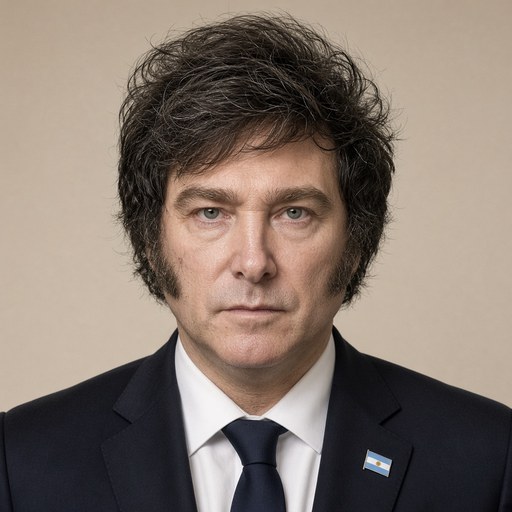
Speech by President Javier Milei at the meeting organized by JP Morgan at the National Museum of Decorative Art in Buenos Aires.
 Javier Milei · President of Argentina
- Context
- Milei addressed JP Morgan investors and Argentine business leaders in Buenos Aires on October 24, 2025, outlining Argentina's economic transformation and liberal reforms.
- Main themes
- Argentina's economic opening, finance and production interdependence, credit as social mobility, property rights, capital accumulation and investment, liberal economic principles, Argentina-US alliance, Argentine political reform
- Duration
- ~36 min
- Words
- 4,309
- Sentences
- 203
- Readability
- 56
- Grade
- 10.7
- Syntax
- 3.03
- Vocabulary
- 2.08
Translated from Spanish
The broad sphere of national life a sentence belongs to. Every sentence has an Arena, so it is the denominator the other indices are read against.
Other203 sentences in 49 paragraphs
I would like to thank the local team at J.P. Morgan for organizing this meeting and all the Argentine entrepreneurs and leaders present here for promoting investments and business relations in our country. Argentina is in a process of returning to the world. After a long night of isolationism and impoverishment, this path is arduous, and for that reason, I also want to thank the support of the government of the United States. The gestures towards Argentina from President Trump and Secretary Bessent only serve to cement the solid alliance of interests and values between our two nations.
As everyone knows, this Sunday there will be elections, legislative elections, and we are in a period of electoral silence. Therefore, I will not make any reference to them during this speech. We must comply with the law because in Argentina, in the new Argentina, those who make the rules must follow them. For that reason, I would like to take this opportunity to put into context where we come from and the moment we find ourselves in as a country.
In Argentina, finance has historically been demonized. Under the pretext of combating capital, there was an attempt to convince the population that finance and production are opposing issues. In real life, where slogans do not dictate people's lives, the opposite happens. Finance is an inseparable part of production since without credit there is no industry, no construction, no agriculture, and no form of productive activity. In fact, what is usually referred to as capital in pure economic theory is much clearer for all those who engage in finance or have businesses; it is what is commonly called an asset. Moreover, if we want to be a bit more precise regarding what we call invested capital, which would be the sum of fixed assets, non-current assets, that is, plus working capital. Therefore, given that real structure, the balance sheet indicates that there is financing, and that financing, whether or not it is in the capital market, consists of financing from equity, that is, net worth, or equity and debt. Therefore, there is no difference; it is nothing more or less than the other side of the balance sheet.
So, moreover, returning to credit, credit is perhaps the best instrument of social mobilization that exists because it is basically the fundamental piece of the machinery of economic growth. That is, economic growth is achieved through capital accumulation, capital accumulation in per capita terms, and that accumulation of capital in per capita terms is achieved by investing, but that investment must be financed, and it is financed with savings, and that intermediation between savings and investment is the responsibility of the financial system, that is, not only banks but also the capital market. Therefore, that separation, let’s say, between the productive and the financial is a mere fiction of the ignorant who do not understand monetary theory. It had to be Milei; otherwise, it wouldn’t be me.
Ultimately, what the defenders of the so-called social justice ignore is that credit is true social justice because it allows us as individuals to access our future savings in the present time and because it does so through voluntary cooperation among fellow citizens without state coercion. That is why respect for property rights is so important in this machinery because if there is no respect for the property rights of the investor, they will not make investments if they cannot capture the return. That is, the fiction of the value of the marginal product of capital, called the return on assets, that is, ROA, let’s say, without property rights does not exist, and savings would not exist either if property rights are not respected. Therefore, another fundamental part is the respect for property rights. That is why we always emphasize, as liberals, the basic rights that can never be touched: the right to life, to liberty, and to property, which, based also on the principle of non-aggression, are ultimately the basis of economic and social progress. That is to say, receiving credit, whether by a person or a company, provides amounts of money that they did not have to invest in something valuable for themselves, whether it be a business, their own home, a machine to work, or an appliance to improve their quality of life. In contrast, the lender sees a reward for postponing their consumption.
Naturally, everything we are explaining has an intertemporal logic, and sometimes we have, on the other side, I don’t want to say monkeys because I don’t want to offend primates, but let’s say, people who don’t even know what the interest rate is. So it’s like telling them it’s a mechanism of intertemporal coordination to shift present consumption to the future and vice versa, or to shift present production to the future, sometimes it gets a bit complicated. Especially for those who think of the economy as if it had a single period. I have to hold back; I’m sorry. If only you knew all the people who come to mind at this moment. Some very small ones too. You know a bit, but well, I will return.
And logically, since there is a reward for lending one’s own savings, behavior is incentivized, and savings grow, instead of consuming everything produced and never growing, as happened hundreds of years ago and as it happened almost uninterruptedly for 25 years in our country. The problem is not that they have embraced some strong version of Keynesianism. The problem is that they do not evolve. That is the problem. Keynesians also understand intertemporality today.
The left opposes credit because, in the first instance, it threatens coercion, which is one of their favorite forms of power. In the second instance, because they do not understand it, nor do they understand the role of a bank that takes the savings of its clients to then lend it to whoever it deems appropriate, benefiting all parties in the process. But the problem is that by condemning and making credit more expensive through taxes and bureaucracy, they only deprive people and companies of capital and the goods and services that capital allows them to access. Consequently, they only destroy the capacity for investment and growth, hindering job creation. In the same way, taking out a loan is a free act, a bet on one’s own future, and a risk that individuals and companies decide to take. That is why it does not surprise anyone that those who do not believe in economic free will are totally opposed to its exercise. Under the guise of protecting people from their own decisions, they end up completely nullifying the capacity to decide and depriving them of a transformative tool. The fear of risk ends up leading directly to stagnation.
After so many decades of Peronism insisting on that poverty rhetoric, we not only inherited an inflation rate of almost 250% annually, which was actually traveling much faster because it was at one and a half daily, the monthly wholesale rate had been 54%, and that, given the dynamics and the monetary imbalance that the country had, could have led to an inflationary disaster that could have ranged between 15,000 and 20,000 percent annually. Moreover, we had the worst indicators in history, whether due to monetary imbalance, let’s say, the money overhang, which was double that of the previous Rodrigazo in 1975, or a Central Bank balance much worse than that of Alfonsín before the hyperinflation of 1989, and also social indicators that were worse than those of 2001. And obviously, in this situation, we also inherited a financial system that hindered the rest of the economy, that is, banks did not operate as banks; they were an appendage of the Central Bank, and the Central Bank was an appendage of the Treasury, and that in the hands of a populist cannot end well. Issuing 13 points of GDP in one year is not something that can end well unless a black swan appears, the first libertarian liberal president appears, and surrounds himself with a giant like Luis Toto Caputo and all his team who have managed to save us from this catastrophe. Look how happy I am with the economic team that I had to change the chancellor and put someone from Toto’s own team.
Moreover, we had a foreign exchange market that, due to so many controls, regulations, and attempts to live with what is ours, had the volume of much smaller countries than ours. Credit levels in relation to GDP comparable to countries that have been at war for decades. A stock market where no new companies had gone public for more than half a decade. Not long ago, Argentina was a country where people bought shoes in installments but had to pay for their house in cash. And all this resulted in an economy whose GDP had been stagnant since 2011, and when we arrived, it was 15% below in per capita terms.
All of this is what we have been resolving since day one of our management and what we summarize when we say that we have organized the macroeconomy. But it is worth clarifying that organizing the macroeconomy does not mean having solved all our problems without being able to prepare better and acquire more tools to solve them. It should also be clear that our job is not to fix the micro. Our job is to have a tidy fiscal policy. In fact, we ensured intertemporal solvency from the first month of management with a zero deficit. This ensures that the debt-to-product ratio does not grow over time. We cleaned up the Central Bank in six months, that is, the broad monetary base has not grown since mid-last year. Therefore, by mid-next year, there will be no more inflation in Argentina. And we have also been lifting regulations from the foreign exchange market to make us resemble a normal country more and more each day.
But there is a wonderful example from a prestigious professor named Juan Carlos de Pablo. He says, look, you have, I don’t know, a pizzeria in, I don’t know, San Nicolás. Now, let’s say you have the same international macro, right?, the same global context; you have the same president, the same governor, the same mayor, and yet, the ten pizzerias do not fare the same. Sometimes clichés are repeated that are really nothing more than mechanisms to introduce corruption in a hidden way, let’s say, behind a nice phrase. If there is one thing we have learned, it is that we should not pick winners. Let’s say, it’s a rule in this. And choosing winners, in essence, fosters corruption. Because when you choose the winner, if you had to choose them, it is because they naturally should not have been. And that, let’s say, in general, politicians do in exchange for favors. And that is corruption. And at the same time, to finance something that the market is not validating, implies at the same time punishing another efficient sector. Thus, not only is efficiency punished in static terms, but also, by hitting incentives, there is a negative effect in dynamic terms.
But returning to the more specific things we discuss, let’s say, for example, the fact of lowering inflation. Lowering inflation implies restoring the price system so that it can send signals to the agents of the economy properly. And so that they can also recover economic calculation and project into the long term, let’s say, where it clearly also implies an idea of interest rate. Because the interest rate is nothing more than the relative price of present goods compared to future goods. And if you introduce instability into the future, whether due to political issues or institutional issues or simply due to the existence of a monetary policy that generates inflation, the consequence is that you will be distorting the markets of present and future goods and therefore it will affect the interest rate, it will affect the allocation of resources, and therefore that will negatively impact the economy, and the economy will grow less, and we will all be worse off.
That is why it is so important, let’s say, to lower inflation because by being able to clean up relative prices, especially between the present and the future, this allows for the restoration of credit to increase investment, both local and foreign, to improve productivity, increase jobs, and improve wages through the increase in the marginal productivity of labor. This is extremely important in relation to infrastructure development, where investments are projected decades into the future, and economic stability is fundamental for more and more works of this nature to be executed. If we add to all this the reforms to reduce the Argentine cost, we are enhancing the process through improved competitiveness, and it is not just a theoretical dissertation, but real application, as some like to say, to belittle all the work we have done so far. We are already seeing the fruits of these two years of macroeconomic order.
We, in fact, in terms of growth, are not only putting an end to inflation so that the price system is not noisy, our fiscal policy aims to pulverize country risk, in which we are deeply confident that starting Monday we will be able to do so calmly and without much noise. But not only that, but also what we are doing in terms of deregulation. That is to say, regulation is nothing more than a violation of property rights. And moreover, when you deregulate, you release increasing returns. That is to say, it allows for a strong increase in productivity, which is nothing more than the story of humanity over the last 250 years.
If we add to that the work we are doing to restore human capital in all its expressions and our policy of opening up to the world, it is clear that every day we are working to make Argentina great again. In terms of investments, we have already approved investments of more than 20 billion dollars, 5 billion dollars are under review, and 32 billion dollars have already been presented and will be reviewed soon. In recent weeks, we had announcements for 55 billion dollars arising from the agreement between YPF and ENI and the Stargate project of Open AI. That is to say, in less than two years of government, we have already had announcements for more than 100 billion dollars, of which at least half are at different stages of execution.
And this is just the beginning. Starting in December, we are confident that with a more reformist Congress than the current one, we will be able to advance the reforms that the country needs to exploit its full potential. Because Argentina, due to bad regulations, has drained all the dynamism from its economy and society. It turned a people eager for progress into a sleepy one, constantly dependent on the favor or anger of the current politician. Politics became more important than the work, effort, and intelligence of each individual. A connection was worth more than an idea. Today what matters is that you have the ideas and the certainty that the State will not bother you, will step aside, and will protect your property rights.
Our laws did nothing but reflect the sectoral privileges that some actors had secured for themselves to the detriment of the whole. Privileges that still today undermine competition, the generation of genuine employment, and the security of citizens.
Our mission is to rectify this true legal madness and thus free the Argentine economy from the shackles it has been subjected to for so many years. That is why, in this national campaign, we present two major axes of reforms for our second term in office. The Zero Tolerance Plan against crime and the Economic Reforms.
The foundation of any economy, of any society, is legal security, and there can never be legal security in a country where crime is romanticized and overlooked, where for political ends the victim and the perpetrator are reversed. Because order is the condition for progress, and there is no order where the law is not respected, since there are no consequences for violating it. The Zero Tolerance Plan against crime seeks to address this social scourge.
This plan has three central components. A profound reform of the Penal Code so that criminals pay seriously, promote the lowering of the age of criminal responsibility, and extend the accusatory system in federal justice throughout the country. The Argentina where good citizens have to be locked behind the bars of their homes because criminals roam free on the streets is over.
The second major axis of reforms that we will seek to pass through Congress consists of economic reforms aimed at generating formal private employment in Argentina again and simplifying and reducing taxes. As you may know, for the past fifteen years, the amount of private or registered employment in our country has not grown. This phenomenon is not only a consequence of the macroeconomic debacle of the country over all these years, but it also relates to obsolete legislation in the area.
That is why Argentina needs a clear, simple, and predictable legal framework in labor matters. A framework that ceases to be an obstacle to hiring and becomes a tool for growth, development, and prosperity. A tool that allows the macro order to quickly translate into better living conditions for Argentines and adds that this is the right path to a better future.
Our labor reform will then consist of:
1. Promoting the negotiation of collective labor agreements so that those who want to update the structures that have been in place for more than 70 years can do so. That is to say, forward flexibility.
2. Reducing bureaucratic hurdles in registration processes so that companies do not need to hire a lawyer or an accountant to motivate a company to generate employment.
3. Putting an end once and for all to the nefarious litigation industry, so that no more labor sharks can drive a small business to bankruptcy and push its workers into unemployment just to collect a lawsuit. I mean, this is decided in the Federal Capital election, right?
There is a candidate who is a partner in this aberration. Obviously, the idea is to grant greater freedoms when it comes to negotiating labor contracts, such as being able to pay 100% of salaries in dollars.
Secondly, we want to carry out a tax reform that has as its goal the simplification and reduction of taxes. We Argentines are fanatics for inventing ridiculous and distorting taxes that complicate more than they collect. Not me, because I consider taxes to be theft.
In fact, we are the only government in Argentine history that in less than 20 months has lowered taxes by two and a half percentage points of GDP. That is indeed a demonstration that I truly hate taxes.
In fact, we come to cut this fanaticism and try to simplify our tax system once and for all.
Thus, we will seek to eliminate about 20 taxes that hinder the Argentine economy without having a revenue impact. Except for those who collect them. I say this because sometimes one wonders why such distorting taxes that collect so little are still there. Yes, it is little at the macro level, at the personal finance level, it is not. I mean, in the end, they are kiosks. But well, you have to be very politically incorrect to say these things.
Well, it doesn't come for free, right? I swear I didn't kill Kennedy; I wasn't even born yet. We will also go for a renewal of the income tax regime that implies a reduction for individuals. Our proposal will expand the conditions for deducting expenses to reduce the personal tax burden and at the same time encourage billing.
The increase in formal transactions in the economy will, in turn, increase the tax base and improve revenue in the medium term. I mean, one of the things we have also managed to prove is the Laffer curve. We lowered taxes, and revenue increased.
I mean, there are many who like the State, and they don't like this kind of result at all. We lowered public spending, and they predicted a great depression, and last year, December 24 compared to December 23, the economy grew by 6.6%. And on top of that, we lowered taxes, and revenue increased. How badly the statists are doing! And I like it. But well, all these things I talk about are fundamental for an economy with the level of informality that ours has. That is why part of the challenge of this reform is to put the incentives in order so that formalizing is more beneficial than evading.
We also want to embark on a path of commercial openness that is so necessary for a country like ours. In this sense, we are already in talks with the United States to further integrate our markets and trade more with each other. Ultimately, well, that also shows where we have aligned, right? I mean, it is clear that I made campaign promises, and the unusual thing is that I fulfilled them all in less than two years.
Because I said I would put public accounts in order; we did it in the first month. That we would clean up the Central Bank; we did it in six months. I also said I would annihilate insecurity. We have ended the blockades that went from 9,000 a year to zero, and we have the lowest crime rates in Argentine history, with the highest record of drug seizures in history. And, moreover, I said I would lower taxes, and I did. I said I would shrink the State, and I shrank it by seven and a half points of GDP.
And not only that, I said that internationally we would align with the United States and Israel. And I did that too. That is to say, a few months ago, we made available the log of measures, and the reality is that we have fulfilled everything we promised in the campaign.
Therefore, it is the first time in history that a politician promises something and also fulfills it before the agreed time. Do you know what this means? That I will continue to make reforms. At the same time, we know that the Congress of the next two years will be much more reformist than the Congress of the last two.
And I do not say this only because La Libertad Avanza will significantly increase its number of seats. I also say it because, except for the usual maladjusted who believe that the economy can be fixed by doing a rain dance, although that is a very sophisticated mechanism compared to what they propose, a good part of the political spectrum agrees with the direction of these reforms. There are many more of us who understand that the era of destroying the future of the country for present political gain is over.
Today there is no more cake to share because the usual maladjusted have eaten it all. Ultimately, today is the time to grow, the time to generate wealth. We trust that there are many actors in the political system who share this view and who are willing to dialogue with us to carry out the reforms that will make this possible.
Days ago —I don't know if it was Toto— made a wonderful example about a highway. The reality is that the lane going towards Cuba or Venezuela is noisy, but it is a minority. It is a noisy minority, but it is a minority. The vast majority wants to go the other way. The vast majority aims for the path of prosperity.
Then, they can have versions: more to the right, more to the left, more to the right that likes to accelerate more. But the important thing is that, looking ahead to the new Congress we will have, that will be much easier. Not only because of how the composition of our political force and our allies will be, which will allow us to defend vetoes easily, but also because the structure that will remain will also allow us to more simply achieve majorities.
Think that when we started, we started with 10% in the Senate and 15% in the Chamber of Deputies. And even with that, we made 10,000 structural reforms. Imagine everything we will do with a much better Congress. Ultimately, our goal is to build in Argentina the capitalist consensus that the country desperately needs to move forward. The consensus that will allow for more work, more investment, and more wealth in all districts of our country and our great Nation.
A consensus that will not only improve the lives of Argentines today but also those of tomorrow, the young people, their children, to whom we owe everything.
But we must always be clear that consensus is only a means, not an end in itself. This is a great difference from the old politics: consensus was an end in itself, enriching politicians and impoverishing good Argentines.
Dialoguing for the sake of dialogue is useless if we do not solve people's lives. To do this, we need to agree and align around the truth.
But we are optimistic because we believe that today, for the first time in decades, we can achieve a consensus around truth and prosperity. A consensus that produces and does not deplete, a consensus that ensures us a better future than the present and much better than the past.
Thank you very much to all. May God bless the Argentines, and may the strength of heaven accompany us. Thank you very much!
The original Spanish. The tags above are read on the English translation's sentences.
Quisiera agradecer al equipo local de J.P. Morgan por realizar este encuentro y a todos los empresarios y referentes argentinos que se encuentran aquí presentes por promover las inversiones y las relaciones empresariales en nuestro país. Argentina se encuentra en un proceso de regreso al mundo. Luego de una larga noche de aislacionismo y empobrecimiento, este camino es arduo y por eso mismo quiero agradecer también el apoyo del gobierno de los Estados Unidos. Los gestos hacia la Argentina del Presidente Trump y el Secretario Bessent no hacen más que cementar la sólida alianza de intereses y valores entre nuestras dos naciones.
Como todos saben este domingo habrá elecciones, elecciones legislativas y nos encontramos en periodo de veda electoral. Por lo tanto, no haré alusión alguna a las mismas durante esta exposición. Hay que cumplir la ley porque en Argentina, en la nueva Argentina, el que las hace las paga. Por eso mismo quisiera aprovechar este espacio para poner en contexto de dónde venimos y en qué momento nos encontramos como país.
En Argentina históricamente se demonizó a las finanzas. Bajo la excusa de combatir al capital se pretendió convencer a la población de que las finanzas y la producción son cuestiones opuestas. En la vida real donde los slogans no dirigen la vida de las personas sucede todo lo contrario. Las finanzas son una parte inseparable de la producción dado que sin crédito no hay industria, no hay construcción, no hay agro y ningún género de actividad productiva. De hecho, lo que se suele denominar capital en la teoría económica pura, para todos los que hacen finanzas o tienen empresas es muchísimo más claro; es lo que usualmente se llama activo. Es más, si se quieren poner un poquito más puntillosos con la cuestión de lo que llamamos el capital invertido que vendría a ser la suma del activo fijo, el activo no corriente, es decir, más el working capital. Por lo tanto, dada esa estructura real, la hoja de balance dice que hay un financiamiento y ese financiamiento esté o no en el mercado de capitales se compone del financiamiento del capital propio, es decir, del patrimonio neto, o sea, el equity y la deuda. Por lo tanto, no hay ninguna diferencia, es no más ni menos que la otra parte de la hoja de balance.
Entonces, es más, de hecho volviendo al crédito, el crédito es quizás el mejor instrumento de movilización social que existe porque básicamente es la pieza fundamental del engranaje del crecimiento económico. O sea, el crecimiento económico se logra por acumulación de capital, acumulación de capital en términos per cápita y esa acumulación del capital en términos per cápita se logra invirtiendo, pero esa inversión tiene que ser financiada y se financia con el ahorro y esa intermediación entre el ahorro y la inversión está a cargo del sistema financiero, es decir, no sólo los bancos sino también el mercado de capitales. Por lo tanto, esa separación, digamos, entre lo productivo y lo financiero es una mera ficción de ignorantes que no saben de teoría monetaria. Tenía que ser Milei, sino no soy yo.
En definitiva, lo que ignoran los defensores de la mal llamada justicia social es que el crédito es la verdadera justicia social, porque nos permite como individuos disponer en tiempo presente de nuestros ahorros futuros y porque además lo hace a través de la cooperación voluntaria entre conciudadanos sin la coacción del Estado. Por eso también es tan importante en este engranaje el respeto de los derechos de propiedad porque si no hay respeto por los derechos de propiedad del inversor no va a hacer inversiones si no puede capturar el retorno. Es decir, la ficción del valor del producto marginal del capital, llámese el retorno sobre los activos, o sea, el ROA, digamos, sin derechos de propiedad no existe y tampoco existiría el ahorro si no se respetan los derechos de propiedad. Por lo tanto, otra parte fundamental es el respeto del derecho de propiedad. Por eso nosotros siempre hacemos hincapié como liberales sobre los derechos básicos que no se pueden tocar nunca: que es el derecho a la vida, a la libertad y a la propiedad que, basados también en el principio de no agresión, son en definitiva la base del progreso económico y social. Es decir, que recibir el crédito, sea una persona o una empresa, dispone de cantidades de dinero con lo que no contaba para invertir en algo valioso para sí mismo, sea un negocio, sea su propia vivienda, sea una máquina para trabajar o sea un electrodoméstico para mejorar su calidad de vida. En contrapartida, quien presta el dinero ve una recompensa por postergar su consumo.
Naturalmente todo lo que estamos explicando tiene una lógica intertemporal y se lo tenemos que a veces, del otro lado, tenemos, no quiero decir simios porque no quiero ofender a los primates, pero digamos, o sea, gente que no sabe ni lo que es la tasa de interés. Entonces es como decirle que es un mecanismo de coordinación intertemporal para pasar el consumo presente al futuro y viceversa, o trasladar la producción del presente al futuro, a veces se hace un poco complicado. En especial a los que piensan en la economía como si tuviera un solo periodo. Me tengo que contener, perdón. Si supieran todas las personas que me pasan por la cabeza en este momento. Algunos muy peticitos también. Ya saben un poco, pero bueno, voy a volver.
Y lógicamente, al existir una recompensa por prestar los ahorros propios, se incentiva la conducta y se hace crecer el ahorro, en lugar de consumir todo lo producido y nunca crecer, como sucedía hace cientos de años y como sucedió casi ininterrumpidamente durante los 25 años en nuestro país. El problema no es que hayan abrazado alguna versión, modelo fuerte del keynesianismo. El problema es que no evolucionan. Ese es el problema. Los keynesianos también entienden la intertemporalidad hoy.
La izquierda se opone al crédito porque, en primera instancia, atenta contra la coacción, que es una forma de su forma de poder favorita. En segunda instancia, porque no lo entienden, ni entienden el rol de un banco quien toma prestado el ahorro de sus clientes para luego prestarlo a quien crea conveniente, beneficiando a todas las partes en el proceso. Pero el problema es que al condenar y encarecer a través de impuestos y burocracia el crédito, no hace más que privar a las personas y empresas de capital y de los bienes y servicios a los que el capital les permite acceder. En consecuencia, no hace más que destruir la capacidad de inversión y crecimiento, frenando la creación de puestos de trabajo. De la misma forma, tomar un crédito es un acto libre, es una apuesta por el propio futuro y un riesgo que las personas y las empresas deciden tomar. Por eso no sorprende a nadie que quienes no creen en el libre albedrío económico se oponen totalmente a su ejercicio. Bajo la apariencia de cuidar a la gente de sus propias decisiones, terminan anulando por completo la capacidad de decidir y privandolos de una herramienta transformadora. El miedo al riesgo termina conduciendo directamente al estancamiento.
Tras tantas décadas de que el peronismo insistiera con esa retórica pobrista, no sólo heredamos una inflación de casi del 250% anual, que en realidad viajaba mucho más rápido porque viajaba al uno y medio diario, la mensual en mayorista había sido 54% y eso, tras la dinámica que tenía y el desequilibrio monetario que tenía el país, podría haber derivado en un desastre inflacionario que podía oscilar entre el 15.000 y el 20.000 por ciento anual. Además, teníamos los peores indicadores de la historia, ya sea por el desequilibrio monetario, digamos, el sobrante monetario, el money overhang, que era el doble que la previa del Rodrigazo en 1975, o un balance del Banco Central mucho peor que el que tenía Alfonsín en la previa de la hiperinflación del 89, y además indicadores sociales que eran peores que los del 2001. Y obviamente que en esta situación también heredamos un sistema financiero y funcional que entorpecía el resto de la economía, es decir, los bancos no trabajaban de banco, eran un apéndice del Banco Central y el Banco Central era un apéndice del Tesoro, y eso en manos de un populista no puede terminar bien. Emitir 13 puntos del PBI en un año no es algo que pueda terminar bien, salvo que aparezca un cisne negro, aparezca el primer presidente liberal libertario y se rodee de un gigante como es Luis Toto Caputo y todo su equipo que han logrado salvarnos de esta catástrofe. Miren lo contento que estoy con el equipo económico que tuve que cambiar el canciller y puse a alguien del propio equipo de Toto.
Además teníamos un mercado cambiario que de tantos cepos, regulaciones e intentos de vivir con lo nuestro, tenía el volumen de países muchísimo más pequeños que el nuestro. Unos niveles de crédito en relación al PBI comparables a países que llevan décadas en guerra. Un mercado bursátil donde no salían a cotizar empresas nuevas hacía más de media década. Sin ir más lejos, Argentina era hace apenas dos años un país donde la gente compraba zapatillas en cuotas pero tenía que pagar la casa al contado. Y todo esto redundaba en una economía cuyo PBI estaba fijo desde el 2011 y cuando llegamos nosotros 15% debajo en términos per cápitas.
Todo esto es lo que estamos resolviendo desde el día cero de nuestra gestión y lo que resumimos cuando decimos que ordenamos la macroeconomía. Pero vale aclarar que ordenar la macroeconomía no es haber solucionado todos nuestros problemas sin poder prepararnos mejor y adquirir más herramientas para resolverlos. Igual también hay que tener claro que nuestro trabajo no es arreglar la micro. Nuestro trabajo es tener una política fiscal prolija. De hecho nosotros aseguramos la solvencia intertemporal desde el primer mes de gestión con el déficit cero. Eso asegura que la relación deuda-producto es no creciente en el tiempo. Saneamos el Banco Central en seis meses, es decir, la base monetaria amplia no creció más, desde mediados del año pasado. Por lo tanto, a mediados del año que viene no habrá más inflación en la Argentina. Y además fuimos liberando regulaciones del mercado cambiario para cada día parecernos más a un país normal.
Pero hay un ejemplo maravilloso que hace un prestigioso profesor que se llama Juan Carlos de Pablo. Dice, mire, usted tiene, no sé, una pizzería en, no sé, en San Nicolás. Ahora, digamos, usted tiene la misma macro internacional, ¿no?, el mismo contexto mundial; tiene el mismo presidente, tiene el mismo gobernador, tiene el mismo intendente, y sin embargo, a las diez pizzerías no les va igual. A veces se repiten frases hechas que en realidad no son más que mecanismos para introducir la corrupción de manera, digamos, oculta, digamos, detrás de una linda frase. Si hay algo que hemos aprendido es que no hay que elegir los ganadores “Don't pick the winners”. Digamos, es una regla en esto. Y elegir los ganadores, en el fondo lo que fomenta es la corrupción. Porque cuando ustedes eligen el ganador, si ustedes lo tuvieron que elegir es porque naturalmente no lo tenía que ser. Y eso, digamos, en general los políticos lo hacen a cambio de favores. Y eso es corrupción. Y al mismo tiempo, para financiar algo que el mercado no está validando, implica al mismo tiempo estar castigando a otro sector eficiente. Con lo cual, no sólo se castiga a la eficiencia en términos estáticos, sino que además, al golpear sobre los incentivos, hay un efecto negativo en términos dinámicos.
Pero volviendo a las cosas más propias de las que discutimos, digamos, por ejemplo, el hecho de bajar la inflación. Bajar la inflación implica recomponer el sistema de precios para que pueda enviar señales a los agentes de la economía debidamente. Y para que también puedan recuperar el cálculo económico y proyectar a largo del tiempo, digamos, donde claramente implica también una idea de tasa de interés. Porque la tasa de interés no es ni más ni menos que el precio relativo de los bienes presentes respecto de los bienes futuros. Y si ustedes le meten inestabilidad al futuro, ya sea o por cuestiones políticas o por cuestiones institucionales o por la mera existencia de una política monetaria que genera inflación, la consecuencia es que ustedes van a estar distorsionando los mercados de bienes presente y futuro y por ende va a afectar la tasa de interés, va a afectar la asignación de los recursos y por ende eso va a impactar negativamente la economía y la economía va a crecer menos y todos vamos a estar peor.
Por eso es tan importante, digamos, bajar la inflación porque al poder dejar limpios los precios relativos, en especial entre el presente y el futuro, esto permite recomponer el crédito para aumentar la inversión, tanto local como externa, para mejorar la productividad, aumentar los puestos de trabajo y mejorar los salarios vía el aumento de la productividad marginal del trabajo. Esto es sumamente importante lo relacionado al desarrollo de infraestructura, donde las inversiones se proyectan décadas a futuro y la estabilidad económica es fundamental para que cada vez más y más obras de esta índole se ejecuten. Si a todo esto le sumamos las reformas para disminuir el costo argentino, estamos potenciando el proceso a través de la mejora de competitividad y no es sólo una disertación teórica, sino la aplicación real, como le gusta decir a algunos, para menospreciar todo nuestro trabajo hecho hasta ahora. Ya estamos viendo los frutos de estos dos años de ordenamiento macroeconómico.
Nosotros, de hecho en materia de crecimiento, no sólo estamos poniendo fin a la inflación para que el sistema de precios no tenga ruido, nuestra política fiscal intenta pulverizar el riesgo país, en lo cual estamos profundamente confiados que a partir del lunes vamos a poder hacerlo de manera tranquila y sin tanto ruido. Pero no sólo eso, sino también lo que hacemos en materia de desregulación. Es decir, la regulación no es ni más ni menos que una vulneración del derecho de propiedad. Y además, cuando ustedes desregulan, liberan rendimientos crecientes. Es decir, permite que se aumente fuertemente la productividad, que no es ni más ni menos que la historia de la humanidad de los últimos 250 años.
Si a eso le sumamos el trabajo que estamos haciendo en recomponer el capital humano en todas sus expresiones y nuestra política de apertura al mundo, está claro que todos los días nosotros estamos trabajando para hacer grande la Argentina nuevamente. En materia de inversiones, de hecho ya aprobamos inversiones por más de 20.000 millones de dólares, 5.000 millones de dólares se encuentran en proceso de revisión, 32.000 millones ya fueron presentados y serán revisados próximamente. En las últimas semanas tuvimos anuncios por 55.000 millones que surgen del acuerdo entre YPF y ENI y el proyecto Stargate de Open AI. Es decir, en menos de dos años de gobierno ya tuvimos anuncios por más de 100.000 millones de dólares, en los cuales al menos la mitad están en distintas etapas de ejecución.
Y esto es sólo el comienzo. A partir de diciembre confiamos en que con un Congreso más reformista que el actual, vamos a poder avanzar en las reformas que el país necesita para poder explotar todo su potencial. Porque la Argentina, a fuerza de malas regulaciones, le sacó todo el dinamismo a su economía y a su sociedad. Convirtió a un pueblo ávido de progreso en un adormecido y pendiente constantemente del favor o enojo del político de turno. La política se volvía más importante que el trabajo, el esfuerzo y la inteligencia de cada uno. Una conexión valía más que una idea. Hoy lo que vale es que tengan las ideas y la certeza de que el Estado no los va a molestar y se va a correr del medio y les va a proteger el derecho de propiedad.
Nuestras leyes no hacían más que reflejar los privilegios sectoriales que algunos actores habían asegurado para sí en detrimento del todo. Privilegios que atentan aún hoy contra la competencia, contra la generación de empleo genuino y contra la seguridad de los ciudadanos.
Nuestra misión es rectificar esta verdadera locura legal y liberar así a la economía argentina de las ataduras a las que fue sometida durante tantos años. Por eso, en esta campaña nacional presentamos dos grandes ejes de reformas para nuestro segundo bienio de mandato. El Plan de Tolerancia Cero contra la delincuencia y las Reformas Económicas.
La base de toda economía, de toda sociedad, es la seguridad jurídica y no puede haber jamás seguridad jurídica en un país en el que la delincuencia se romantiza y se deja pasar, donde por fines políticos se invierte víctima y victimario. Porque el orden es la condición del progreso y no existe orden allí donde no se respeta la ley, ya que no hay consecuencia alguna por violarla. El Plan de Tolerancia Cero contra la delincuencia busca solucionar este flagelo social.
Este plan tiene tres componentes centrales. Una reforma profunda del Código Penal para que los delincuentes paguen en serio, impulsar la baja de edad e inimputabilidad y extender el sistema acusatorio en la justicia federal a todo el país. Se acabó la Argentina donde los ciudadanos de bien tienen que andar encerrados tras las rejas de sus casas porque los delincuentes andan libres por las calles.
El segundo gran eje de reformas que buscaremos pasar por el Congreso consisten en reformas económicas dirigidas a volver a generar empleo privado formal en la Argentina y a simplificar y reducir impuestos. Como seguramente sepan, desde hace quince años que en nuestro país no crece la cantidad de empleo privado o registrado. Este fenómeno no es sólo consecuencia de la debacle macroeconómica del país en todos estos años, sino que tiene que ver con la legislación obsoleta en el área.
Por eso, Argentina necesita un marco jurídico en lo laboral, claro, simple y predecible. Un marco que deje de ser un obstáculo para la contratación, para pasar a ser una herramienta para el crecimiento, el desarrollo y la prosperidad. Una herramienta que permita que el orden macro se traduzca rápidamente en mejores de la vida de los argentinos y les agregue que este es el camino correcto para tener un mejor futuro.
Nuestra reforma laboral entonces consistirá en:
1. Impulsar la negociación de los convenios colectivos de trabajo para que quienes quieran actualizar las estructuras vigentes hace más de 70 años puedan hacerlo. Es decir, flexibilización hacia adelante.
2. Reducir las trabas burocráticas en los procesos registrales para que las empresas no necesiten contratar un abogado o un contador para motivar a una empresa a generar empleo.
3. Terminar de una vez y para siempre con la nefasta industria del juicio, para que nunca más caranchos laboralistas sean capaces de llevar a una pyme a la quiebra y empujar a sus trabajadores al desempleo con tal de cobrar un juicio. Digo, esto se dirime en la elección de Capital Federal, ¿no?
Hay un candidato que es socio de esta aberración. Obviamente que la idea es otorgar mayores libertades a la hora de pactar contratos laborales, como por ejemplo cobrar el 100% de los salarios en dólares.
En segundo lugar, queremos llevar adelante una reforma tributaria que tenga como norte la simplificación y reducción de impuestos. Los argentinos somos fanáticos para inventar impuestos ridículos y distorsivos que complican más de lo que recauda. Yo no, porque yo considero que los impuestos son un robo.
De hecho, somos el único Gobierno en la historia argentina que en menos de 20 meses bajamos los impuestos dos puntos y medios del PBI. Vaya que sí es una muestra de que efectivamente odio a los impuestos.
De hecho, venimos a cortar de cuajo con este fanatismo y tratar de simplificar de una vez por todas nuestro sistema tributario.
Es así que vamos a buscar eliminar cerca de 20 impuestos que entorpecen a la economía argentina sin tener un impacto recaudatorio. Salvo para los que los recaudan. Digo porque algunas veces uno se preguntará por qué impuestos tan distorsivos que recaudan tan poco, están. Sí, es poco a nivel macro, a nivel finanzas personales no. O sea, en el fondo son kioscos. Pero bueno, hay que ser muy políticamente incorrecto para decir estas cosas.
Bueno, no me es gratis, ¿no? Juro que yo no maté a Kennedy, no había nacido todavía. También vamos a ir por una renovación del régimen de ganancias que implica una reducción del mismo para las personas humanas. Nuestra propuesta ampliará las condiciones de ductilidad de gastos para reducir la carga personal del impuesto y a su vez fomentar la facturación.
El incremento de transacciones formales en la economía aumentará, por su parte, la base imponible y mejorará la recaudación en el mediano plazo. Digo, una de las cosas que también hemos logrado, hemos logrado probar la curva de Laffer. Bajamos los impuestos y la recaudación aumentó.
Digo, hay muchos que les gusta el Estado, que este tipo de resultados no les gusta nada. Bajamos el gasto público, nos auguraron una gran depresión y el año pasado, diciembre del 24 contra diciembre del 23, la economía subió 6,6%. Y además encima bajamos impuestos y la recaudación aumentó. ¡Qué mal la están pasando los estatistas! Y me gusta. Pero bueno, todas estas cosas de las que hablo son fundamentales para una economía con el nivel de informalidad de la nuestra. Por eso, parte del desafío de esta reforma es poner los incentivos en regla para que blanquear sea más provechoso que evadir.
También queremos encarar un sendero de apertura comercial tan necesario para un país como el nuestro. En este sentido, ya estamos en conversaciones con los Estados Unidos para integrar más nuestros mercados y comerciar más los unos con los otros. En definitiva, bueno, eso también muestra dónde nos hemos alineado, ¿no? Digo, está claro, digamos, que hice promesas de campaña, digo, y lo inusual es que las cumplí todas en menos de dos años.
Porque dije que iba a poner las cuentas públicas en orden, lo hicimos en el primer mes. Que íbamos a sanear el Banco Central, lo hicimos en seis meses. Dije, además, que iba a aniquilar la inseguridad. Hemos terminado con los piquetes que de 9.000 por año pasaron a cero y tenemos los índices de criminalidad más bajos en la historia argentina, con el mayor récord de incautación de droga en la historia. Y, además, dije que iba a bajar impuestos y los bajé. Dije que iba a achicar el Estado y lo achiqué en siete puntos y medio el PBI.
Y no solo eso, dije que internacionalmente nos íbamos a alinear con Estados Unidos e Israel. Y también lo hice. Es decir, nosotros hace cosa de unos meses pusimos a disposición la bitácora de medidas y la realidad es que de lo que prometimos en campaña hemos cumplido todo.
Por lo tanto, es la primera vez en la historia que un político promete algo y, además, lo cumple antes del tiempo pactado. ¿Saben qué quiere decir esto? Que voy a seguir haciendo reformas. A su vez, sabemos que el Congreso de los próximos dos años será mucho más reformista que el Congreso de estos últimos dos.
Y no lo digo únicamente porque la Libertad Avanza aumentará sensiblemente su cantidad de bancas. Lo digo también porque, salvo por los inadaptados de siempre que creen que la economía se arregla haciendo la danza de la lluvia, aunque ese es un mecanismo muy sofisticado comparado con lo que proponen, buena parte del arco político está de acuerdo con el norte de estas reformas. Somos muchos más los que entendemos que se terminó la era de destruir el futuro del país para tener rédito político presente.
Hoy no queda más torta para repartir, porque los inadaptados de siempre se la comieron toda. En definitiva, hoy es el momento de crecer, el momento de generar riqueza. Confiamos en que hay muchos actores del sistema político que comparten esta mirada y que están dispuestos a dialogar con nosotros para llevar adelante las reformas que harán esto posible.
Días atrás —no sé si fue Toto— hizo un ejemplo maravilloso sobre una autopista. La realidad es que el carril que va hacia el lado de Cuba o de Venezuela son ruidosos, pero son una minoría. Son una minoría ruidosa, pero son una minoría. La gran mayoría quiere ir para el otro lado. La gran mayoría apunta al camino de la prosperidad.
Después, pueden tener versiones: más a la derecha, más a la izquierda, más a la derecha que le gusta acelerar más. Pero lo importante es que, de cara al nuevo Congreso que vamos a tener, eso va a ser mucho más fácil. No solo por cómo va a quedar la composición de lo que tiene que ver con nuestra fuerza política y la de nuestros aliados —que nos va a permitir defender los vetos con facilidad—, sino que además porque la estructura que va a quedar también nos va a permitir de manera más simple conseguir mayorías.
Piensen que cuando arrancamos, arrancamos con el 10% en la Cámara de Senado y con el 15% en la Cámara de Diputados. Y aun con eso hicimos 10.000 reformas estructurales. Imagínense todo lo que vamos a hacer con un Congreso mucho mejor. En definitiva, nuestro objetivo es construir en Argentina el consenso capitalista que el país necesita desesperadamente para salir adelante. El consenso que permitirá que haya más trabajo, más inversión y más riqueza en todos los distritos de nuestro país y de nuestra gran Nación.
Un consenso que no solo le mejorará la vida a los argentinos de hoy, sino también a los de mañana, a los jóvenes, a sus hijos, que son a quienes les debemos todo.
Pero siempre debemos tener en claro que el consenso es solo un medio, no un fin en sí mismo. Esto es una gran diferencia con la vieja política: el consenso era un fin en sí mismo, enriquecía a los políticos y empobrecía a los argentinos de bien.
Dialogar por dialogar no sirve de nada si no le resolvemos la vida a la gente. Para hacerlo, necesitamos estar de acuerdo y alinearnos en torno a la verdad.
Pero somos optimistas, porque creemos que hoy, por primera vez en décadas, podemos conseguir un consenso en torno a la verdad y la prosperidad. Un consenso que produzca y no que deprede, un consenso que nos asegure un futuro mejor que el presente y mucho mejor que el pasado.
Muchísimas gracias a todos. Que Dios bendiga a los argentinos y que la fuerza del cielo nos acompañe. ¡Muchísimas gracias!