




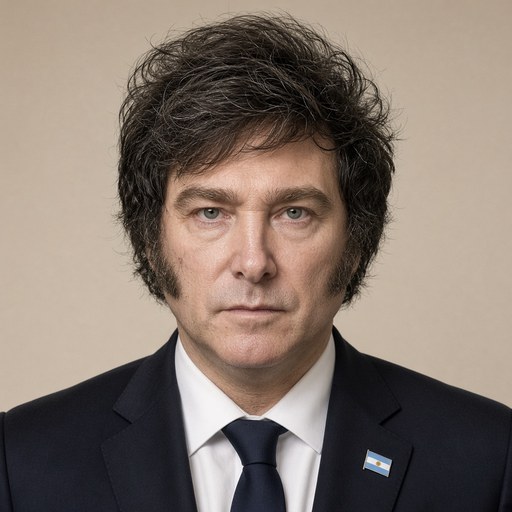
Words of President Javier Milei at Yeshiva University in New York
 Javier Milei · President of Argentina
- Context
- Milei addressed Yeshiva University in New York in March 2026, delivering a lecture on morality as state policy drawing on his Davos speech and upcoming book.
- Main themes
- Morality as state policy, Western ethics and moral foundations, economic freedom, Judeo-Christian values and the Torah, rejection of moral relativism, Pareto optimality and economic efficiency, Zionism and support for Israel, political utilitarianism critique, libertarian philosophy, Argentina's economic reforms
- Duration
- ~73 min
- Words
- 8,792
- Sentences
- 438
- Readability
- 53
- Grade
- 10.7
- Syntax
- 3.00
- Vocabulary
- 2.09
Translated from Spanish
The broad sphere of national life a sentence belongs to. Every sentence has an Arena, so it is the denominator the other indices are read against.
Other438 sentences in 74 paragraphs
Hello everyone. Well, first of all, I would like to thank you for inviting me and for the privilege of being in front of all of you to give this lecture. Today, I will be working with an idea that I originally presented in my speech at Davos recently, and which is basically the title of my upcoming book, which is "Morality as State Policy."
Basically, when designing a state policy, a public policy, and my Ministers can attest to this, based on how we approach our decision-making process... that is to say, our goal in Argentina is to become the freest country in the world. In fact, when we came to power, we were ranked 146th in the economic freedom ranking, and in less than two years, and strictly speaking, according to how the Heritage Foundation calculates it, in reality, in a year and a half we have gained 40 places; today we are 106th and we have made the largest improvement in the history of the index, when one considers the initial conditions – except for countries that were devastated and had to be rebuilt – in that sense, it is the largest improvement in history. And one of the things I always point out to my Ministers is to clearly set the course, the objectives I want to achieve for each portfolio; but always with the restriction that not all viable policies are eligible, because there is a moral restriction and that constitutes our foundation, where life, liberty, and property are respected.
In that sense, we have to, when designing a policy, from our perspectives there is a clear order of merit. For us, first and foremost, are the ethics and morals of the West, which is what has made the West great, which is what has achieved the greatest civilizational feat in the history of humanity. And basically, when we talk about the ethics and morals of the West, it has four pillars: first, the thought and philosophy of the Greeks; second, Roman law; third, the rectitude of the Stoics, that is, to resist evil; in fact, King David himself had… excuse me, his son, I mean, King Solomon, when he takes office, he basically asks for wisdom, courage, temperance, and, obviously, justice. Wisdom to know how to distinguish good from evil; courage to choose good; temperance to stay on the path of good, and justice to act justly.
And finally, we do not believe in moral relativism. Clearly, if you go to… Well, I imagine that many of us here do not eat pork, so one could say that there is moral relativism; or yes, we eat beef and suddenly, in India, no one would think to say that if they have a hunger problem, I would recommend they eat the cows, because it would probably end very badly.
So there is sometimes an idea that moral values are relative. In some things it may be understandable, but there is a set of values that are non-negotiable. That is to say, for us – and that is in the Tablets of the Law – stealing is wrong, killing is wrong, and freedom is enshrined in the First Commandment – according to how it is written in the Torah – when it says: 'I am the creator' - I reproduce it literally and you know why – 'who brought you out of Egypt.' That is to say, freedom is enshrined, life is enshrined, and property is enshrined, and those values are non-negotiable. I don't need to tell you that there is a "do not do," that is, there are things that we are not willing to negotiate, and on those values the civilizational feat of the West has been built. That is to say, there is no moral relativism for everyone. No, there is a set of basic values that cannot be violated and those values are found in the Holy Scriptures.
A second level of analysis… this is a sort of order of merit, that is to say, first are the ethical and moral values; the second category is economic efficiency, and you can look at economic efficiency in a static or dynamic way. In static terms, there is clearly the concept of Pareto Optimality, with which I have been angry for some time, and there is an alternative way to present Pareto Optimality, which is the way Hans-Hermann Hoppe has done it, who despite all the insults he has thrown at me and all the things he has said – probably some of them are true – but aside from that… well, Hoppe is bothered that I am a strong defender of Israel and I, honestly, am proud to be the most Zionist President in the world. This is not going to please Hans-Hermann Hoppe, for sure, but Walter Block will.
That said, as I move forward in the presentation we will be discussing the neoclassical vision and Hoppe's vision, which is, from my point of view, conceptually far superior and saves us many problems. And then there is the dimension of dynamic efficiency. And, finally, the worst of all, the most vile, low, base, and trashy in politics, is political utilitarianism in the Machiavellian sense. And here the most interesting thing is that when you design a just policy, these three elements will be in tune. However, when tension arises between these three elements, it means that the policy is unjust and is not worth carrying out, even if it is politically convenient.
Probably the greatest fraud in the history of humanity is socialism. Suppose you have 5 people: one person has 500 dollars and the other 4 have 0; then the politician comes, steals those 400 dollars, and gives 100 to each of the others, and now everyone has 100 dollars each; that is called social justice. Evidently, if you go to an election after doing that, you will win with 80 percent of the votes. However, that policy – which from the perspective of political utilitarianism is fabulous because it allows you to win an election – allow me to escape the protocol and say what I think, but that policy is crap. And I say this because it is profoundly unjust; it may help you win votes, but it is unjust because it involves treating each of these 5 people unequally before the law. You chose who the winners were and who the losers were for a mere electoral reason.
But not only that, we have a commandment that says: "you shall not steal" and taking money, by force, from a person is theft. That is to say, it may be legal, but it is not legitimate. Yes, I can do it by law, but that does not make it legitimate, it remains unjust. And there is a conflict between what is legal and what is legitimate and, therefore, even if I did it by law, it remains illegitimate and, therefore, it should not surprise us that those countries that have attitudes like this, which also involve violating property rights, the countries that do that sink. They sink because they are violating moral principles. When you go against moral values, it is not free.
That is why the concept of dynamic efficiency from Professor Huerta de Soto is so interesting, because inevitably you will pay the costs of doing these things. So, at some point, you will have to correct.
Argentina had embraced socialist ideas for more than 100 years. We were on our way to becoming Cuba with an intermediate scale in Venezuela. Having been the richest country in the world, they were turning us into a miserable country. Well, having the first liberal-libertarian President – not only of Argentina but of the world – could not happen under normal conditions of pressure and temperature.
In that sense, what I will do throughout this talk, which also has common parts with what was my speech in Davos, is to demonstrate that the capitalist system of free enterprise is just, that it is efficient, and that it is also dynamically efficient. And that one must maintain these values in a stoic manner, because the business for the politician was social justice, and this one should not even do because it is bad due to the dynamic consequence, or because the allocation of resources is inefficient. One should not do it because it is unjust, even if that goes against the political utilitarianism that would allow them to win an election. One must do what is just.
And when you act justly, miracles happen. And that you can make a 30% adjustment in public spending in real terms in a month and still go to an electoral process and win the elections by a landslide, as is our case.
Given this introduction, for decades our thinking has been distorted by presenting us with a false dilemma when designing public policies, where one had to opt for political utilitarianism in pursuit of a supposed common good, which is actually the veneer, the common good. What matters to politicians is winning elections to gain power and to satisfy their most basic issues, which are lust, greed, and ego.
God, I am not going to explain this to you, you should know it better than I do. God taught me this through my rabbi, so you should know it. In fact, seeing so many participants with kippahs, I regretted not bringing one of my kippahs, which even has my name in Hebrew. And what happened, did I miss the joke? No, I only speak in Spanish. Let's not blame the language for my ears not working at 100.
But then this political utilitarianism is carried out to the detriment of respect for individual rights and, consequently, of the ethical and moral values of the West. This is not a mere coincidence, as Professor Jesús Huerta de Soto points out in his work on dynamic efficiency. Efficiency is not compatible with any scheme of equity or justice, but arises solely and exclusively from one of them: justice based on respect for property and the entrepreneurial function.
That is why, what is just cannot be inefficient, nor can what is efficient be unjust, because justice and efficiency are two sides of the same coin.
Without a doubt, the one who anticipated this situation with greater clarity was Murray Newton Rothbard. For him, the maximization of economic utility by a centralized authority is an impossible task. Politicians can never know the desires not only present but especially future, of their population. That is why the only thing that can be done from the State to maximize efficiency is to provide the legal framework for individuals to exchange among themselves, without fear of the violence of their neighbors.
How significant is the phrase "the violence of neighbors." But we are going to win. Only the moral principles underlying the law can serve as a guide to maximize efficiency over time. And it goes without saying that I subscribe to this vision from my role as President of the great Nation of Argentina.
On the contrary, sacrificing ethical and moral values on the altar of efficiency leads to policies that are not only unjust but also lead to collapse, not only on the economic level but also on the social level. This is what has happened, happens, and will always happen with populism under its various guises. We have already seen it unfold to its last consequences in the fascisms and socialism of the 20th century, the socialism of the 21st century, which in the 20th century produced the largest death toll in the history of humanity.
Those policies were the wolf in sheep's clothing, elegantly wrapped to deceive noble souls filled with good intentions, but which inevitably lead to catastrophe. And for this reason, I stand here before you to say that today, more than ever, in the face of the decay and ethical and moral degradation that is afflicting the West, it is necessary to once again promote the ideas of freedom. However, unlike the way it was approached in the past from a utilitarian perspective, today the defense of the capitalist system of free enterprise must be based on its ethical and moral virtue.
As Israel Kirzner points out, today's socialists do not deny the superiority of capitalism in productivity; they question it for being unjust. Therefore, it is not enough for the system to be more productive, since if its foundation were unjust, capitalism would not deserve to be defended. This was a significant difference between the argument made by Mises, which was fully utilitarian, and that his defense of capitalism was because it worked, and that differs substantially from the position of Ayn Rand, the position of Rothbard, and the position of Israel Kirzner.
If the system were unjust, it is not worth defending. We defend the capitalist system of free enterprise essentially because it is a just system. In this way, this presentation will demonstrate that returning to the values of Greek culture, Roman law, the value of the Stoics, and Judeo-Christian values is imperative to escape our dark present and thereby save the West.
In this section, what I am going to do now is prove that the capitalist system of free enterprise is just. This is the core of what I am going to do in this part. Basically, I work with the concepts of natural law, positive law, justice, private property, the principle of non-aggression, and what we define as liberalism.
Much of human conflict arises when natural law and positive law collide. As liberalism conceives it, natural law is the law that derives from human nature, which is prior to conventional laws and institutions and, therefore, is universally just; it is intrinsic to the essence of man and, therefore, unmodifiable and immutable. On the other hand, positive law is what men draft to govern their peoples.
The liberal constitutional system is the only legal system that conceives positive law in order to imitate natural law as closely as possible, and here lies its moral superiority. Other legal systems that either do not start from liberal constitutions, or forget and trample them, or reject natural law, may have law, but that does not mean they will have legitimacy. Natural law contains within it two fundamental and inalienable rights, which are the rights to life and liberty, and man has the right to exercise those attributes in pursuit of his own happiness.
The fundamental right to liberty derives from the acquired right of private property, which was enshrined in John Locke's Principle of Appropriation. Every man is the owner of his own person, of his body, and of his own labor. By applying his labor to the goods that nature offers and that belong to no one, he makes them his own.
Finally, these rights are complemented by the principle of non-aggression, which establishes that no human being has the right to exercise aggression of any kind against another human being, which includes not only physical aggression but also all forms of coercion, compulsion, and/or imposition under the threat of the use of force, that is, by the State. And this, of course, applies to the fact that no one can violate the property rights of another. Hence, we define liberalism according to the definition of Alberto Benegas Lynch Jr., as the unrestricted respect for the life project of others, based on the principle of non-aggression and in defense of the rights to life, liberty, and property.
I say, it is all in the tablets of the law, it could not be clearer. Whose emerging institutions are: private property, free markets free from state intervention, competition understood as free entry and exit, the division of labor, and social cooperation. Naturally, associated with these institutions arises the question of whether they are just.
For this, the obligatory reference is Ulpian, whose basic premise constitutes the foundation of Roman law and is undoubtedly one of the pillars of Western civilization. He also believed that law did not create what is just, but that its purpose was to recognize what is just, order it, and protect it. I quote Ulpian verbatim: "Justice is the constant and perpetual will to render to each his due."
However, Ulpian's statement did not stop there, but he went on to add that the principles of law consist in living honestly, without causing harm to anyone, and giving to each what is his, that is, the principle of non-aggression. In this way, Roman law in its foundation is completely in harmony with liberalism and its institutions; both are just if we understand justice as ensuring natural rights. Therefore, in this section, what we have just proven is that liberalism, free enterprise capitalism, is just, that is, the capitalist free enterprise system is worth defending because it is essentially just.
In this part, I will be addressing the ethics of private property and efficiency. In that speech I gave in Davos, I literally reproduced two paragraphs from Hans Hermann Hoppe, and through the use of logic, he demonstrates that, in turn, based on Locke's principle of original appropriation and the principle of non-aggression, these combined elements lead to an allocation that is efficient. In neoclassical terminology, one would call it Pareto Optimal. However, the way it is designed is fundamental, fundamental. Those who study economics will have learned what the first theorem of welfare economics is, the second theorem of welfare economics; that is, the first theorem of welfare economics states that every competitive equilibrium or under perfect competition is Pareto Optimal, that is, it is efficient. And the second states something truly aberrant, which is that optimality is independent of distribution, which is truly tremendously aberrant, because if that were true, it would be the same to have full private property, that is, full free enterprise capitalism, as to have socialism, even communism, and the result would be independent of property. And empirical evidence says that this is false.
Something that had already been demonstrated by Ludwig von Mises back in the 1920s in his work on socialism, which stated that the problem of the socialist system was that it could not perform economic calculation. And for there to be prices, and to be able to have economic calculation, private property must exist. If I am going to sell this device to him, since it is not mine, I can sell it to him at any price. Or if I had to buy something and the money is stolen, I would not care. That is, if there is no private property, there is no price system. And when there is no price system, the system is adrift. In a socialist system where there are no prices, why would I make roads of crystal or gold? Why wouldn’t I? Because I am so miserable as to make it of asphalt. They look so good if they were made of crystal, or if they were made of gold. I do not make them because I have a notion of value. That is, I have a notion of value and I have a notion of price. And, consequently, I do economic calculation and realize that it would be absurd to make them of crystal or gold.
So, in that sense, when you do not have private property, you do not have prices, therefore, you cannot do economic calculation, and the price system has the function of transmitting signals to the system that also makes agents coordinate in terms of suppliers and demanders, and when supply and demand do not match, it manifests itself in a movement of prices. So, when you do not have private property, that does not work. That is why, when the intervention of the State appears, the price signal begins to be distorted. It is like a kind of noise. Imagine that now, while I am giving the lecture and you are following it through these headphones, noise starts to come in. It is not that you will not understand me because you are not capable of understanding a talk like this, but you do not do it because there is noise. Well, that is what the State does in the economy, it distorts the price signal.
When you reach communism, which is zero private property, the distortion is total and the system collapses.
So, first point, let’s throw the second theorem of welfare economics in the trash because it is nonsense. Well, now I am going to take on the Pareto Optimal. Pareto Optimality, basically, let’s suppose I have an original allocation of resources and I can make an improvement, such that it improves some people or several agents without harming anyone. So, if one were to do this, one would have what is defined as a Pareto improvement. When all these opportunities for Pareto improvements are exhausted, you then find yourself in a Pareto Optimal. But, basically, the idea of Pareto Optimality in some idea also tried to prove or give an environment to the idea of Adam Smith's invisible hand, that each one, guided by his own interest, leads to the general welfare. An idea that, although he strongly expressed in his second book, Adam Smith, which is An Inquiry into the Nature and Causes of the Wealth of Nations, already had its first foundations in his previous book, which was The Theory of Moral Sentiments. But, then, the idea is to show that competitive equilibrium is efficient, or, if you will, a Pareto Optimal. This motivation, after the disasters caused by John Maynard Keynes and the damage he caused to economic theory, economists try to return to their bases and return to the study of equilibrium in the tradition of Léon Walras. Basically, when you study equilibrium, you study whether equilibrium exists, whether it is unique, and whether it is stable. The existence of equilibrium, basically, for it to exist, you have to apply some fixed point theorem. The two most well-known fixed point theorems are Brauer's, which is for point-to-point functions, or if you have point-set applications, they are called correspondences. But a fixed point theorem is nothing more than the generalization of the mean value theorem that many must know because it is studied in calculus. If you have a function that is continuous and goes from negative to positive, you know that there is some point where that function is zero. And you have to ensure that that function is continuous; in case you have a correspondence, it is defined as upper semicontinuous, and that must occur in a set that is convex.
If you look at this, any point that I am going to mark now with my hands exists because this set is convex. So, I take this point and this point, and if I connect them, that point will exist. Now think of the case of a donut. You take one point and take another, and if you want to connect them, the central part is not there. So, you need the functions to be continuous and the sets to be convex. The whole key to the general equilibrium proof that it exists depends on these topological conditions for equilibrium to exist. If, in addition, you want it to be unique, you should work with functions, that is, point-to-point applications. That is, you throw a price and it only responds with one quantity. Therefore, if the excess demand functions, whether demand or supply, are continuous functions, the excess demand functions are continuous. And if that occurs in a set that is convex, therefore, equilibrium exists and is unique. And if, in addition, the direct effects are stronger than the indirect ones, it is clear that the price of tea will hit harder on tea than on coffee, no matter how much they are substitutes. It is obvious that, then, if these direct effects exceed the indirect ones, that will make the matrix in which stability turns gives you a negative definite matrix which implies that it is stable.
Up to that point, no one has much to say because in that parameter equilibrium exists, is unique, is stable. The problem is that when economists become fatally arrogant, look if we have to explain the importance of wearing a kippah, and we start to believe that we are superior beings, now we start to talk about efficiency, about optimality. That is why Hayek's last book is called The Fatal Conceit, because to solve that exercise it is necessary to know the preferences of all individuals, past, present, and future. It is necessary to know the present and future technology, that is, one must guess technological progress. That is, how could it be that Graham Bell was so foolish as to make the landline phone if cell phones now exist? You realize, right? And in addition, they would have to know the endowments. Ask someone 500 years ago if they knew what oil was.
That is, then, to solve that equilibrium you would have to be omniscient, omnipresent, and omnipotent. That is, you would have to be God. And it is clear that we are not. And I will tell you something, and if there is any kind of human being that differs more from that ideal, it is politicians. I will tell you an anecdote. When I started in politics, I always had this very anti-state and anti-politics discourse.
So I remember that at one point a journalist interviewed me and asked me that I, who had so much railed against politics and was now in politics, what I thought of politicians. So I told him: "I was wrong." Then the journalist went out to say: "Ah, of course, you see that he was wrong, he was wrong, so much that he railed, railed, like this, right?, and he showed me like this. I said: "Yes, I was wrong, I fell short."
So when economists got that attack of fatal arrogance, we started wanting to determine what was optimal and what was not. This implies that the demand functions and the supply functions must derive from optimization exercises. So if the demand functions derive from the maximization of utility subject to the budget constraint, and from there the demand functions derive.
And if you then derive the supply functions from the maximization of profit subject to a technological constraint, where in addition to deriving the supply of that good you will derive the demand for inputs, and in the case of consumers, you will derive the demand functions for goods and the supply of factors. As those functions, moreover, are continuous and occur in a set that is convex, now not only does equilibrium exist, is unique, is stable, but it is also optimal. Up to that point, it is already quite arrogant.
But we had to make it worse. And it is the idea of market failures. For a moment, economists became so crazy that, suppose you have a company and you have a model, and the model does not map with reality.
What are you going to do? Look, I’ll tell you, I’ll anticipate it, you are going to throw the model out the window, because if you lose money, they are going to blow the analyst's head off. That is, in real life, if the model does not map with reality, you do not get angry with reality, you make a new model. Economists, when reality does not map with the model, what do we do? We call it a market failure.
That is, the model is not wrong, reality is wrong. And all in pursuit of Pareto Optimality. That is, surely you cannot get the LSD because all the economists took it.
It cannot be more delirious. It is a reflection quite from the late 60s, but I am a man who listens to old music. Moreover, in my liking for music from many years ago, I not only like the Rolling Stones and the Beatles, but I also later got into Reloaded, listened to Elvis, and then ended up listening to opera.
So someone who listens to music, understand that it is a joke typical of a person who listens to music from the 19th century. So, that makes... Market failures are a situation where the equilibrium that you observe does not map with what you define as optimal equilibrium. And that gives the policy maker the attribution to intervene in a market.
Suppose a company appears to compete in the mobile phone market and creates a mobile phone that is much better than the rest of its competitors, which is of better quality and lower price, and all its competitors go bankrupt. There will be no shortage of politicians who will want to regulate them for monopoly, when that man is a hero. However, that situation... What do economists call that market failure? Do they call it? Non-convexities. That is, because the production function shows increasing returns.
Now, then, as a consequence of this, since that does not map with the optimal, because the mathematical structure is not what I defined as optimal, then, as a consequence of this, now I regulate. Now, but if I am going to regulate, I am destroying the right to property. When you look at the history of humanity and see what is called the hockey stick, which is the materialization of increasing returns, where thanks to capitalism in free enterprise, extreme poverty went from 95% to 5% in a world that multiplied its population by 10, how can you tell me that they are bad? That is, the problem is not reality, the problem is economic theory.
And if you regulate monopolies, you kill increasing returns, as they do in Europe, and you know what? You kill economic growth. You over-regulate the economy and kill economic growth. Therefore, that way of working on the problem of efficiency of economists leads to an aberration that kills economic growth. That is, it kills Adam Smith's idea of the pin factory. All because it did not close mathematically for them. That is another story. What is good about what Hans-Hermann Hoppe has done? The good thing about Hans-Hermann Hoppe is that he has derived efficiency, that is, optimality, using the logic of private property and the principle of non-aggression. Therefore, it disconnects us from the problem of topological structure and we do not have to go around calling like idiots that reality is wrong and our model is right. Therefore, I am going to replicate exactly what Hoppe wrote, because I think it is a work of art. Even though Hoppe insults me, it is a work of art. It is like if, I don’t know, Dalí insulted me. But, I say, Dalí's work is wonderful. I am the same. He says, then, we have already proven that the institutions proposed by liberalism that are at the base of capitalism in free enterprise are just. That is, what he says in the previous section. Now is the time to prove that, in addition, capitalism in free enterprise is efficient.
For that, allow me to paraphrase Hans-Hermann Hoppe. Breaking with property relations in favor of the dispossessed is not free. It distorts incentives and, consequently, implies that there will be less original appropriation, more redistribution of what exists, less care for present benefits, and fewer mutually advantageous exchanges. When property is held by the one who develops a good and not by the one who makes its final use, then the incentive is placed on its conservation. In turn, as what the law defends is the physical integrity of property and not its value, then the responsibility for maintaining the value of goods is placed on the owner. Deviating from these principles implies disorganizing incentives.
That is, notice that, by putting on the table, above, Locke's principle of appropriation, that is, that the one who discovers something owns it, right?, and in the principle of non-aggression. That is, and that the owner is the one who originally appropriates it. Imagine if it were appropriated by the one who comes after. Has anyone thought of that exercise? I mean, it is what happens in socialism: someone produces and then someone comes and appropriates it, right? See the aberration that occurs with that. Now think, take it to the extreme. You arrive, you are like Adam, walking through nature. The question is, are there goods that you could appropriate for what? To feed yourself. Now, if you could not appropriate those goods that belong to no one, simply because the Lord made them available to us, what would happen? That you would have to ask permission from future generations to appropriate those goods. And not the next one, but the one that follows and the one that follows and the one that follows. What is the consequence? You could not feed yourself; therefore, you die. That is why, let’s say, socialism always brings death.
And if you take those ideas to the extreme, people die of hunger. If not, look at what happened in Russia when they implemented it. So, the interesting thing about this demonstration is that you reach optimality basically for a logical reason. So now you do not need to talk about market failures or anything like that. That is, suppose the following. I can... Let’s go with the case of externalities.
You have negative externalities, positive externalities. So, when you have a negative externality, as you do not pay the costs, what happens? You produce too much of that externality. And when it is a positive externality, something that we would like to have much more of, you produce sufficiently little. Why? Because you cannot appropriate the benefit. What is the solution of these people? I mean, create a sort of public goods forcibly so that there is more of that good. Now, the point is that policy maker so fatally arrogant who believes that there has to be more, how is he going to finance that good? Because we are still not in paradise. Therefore, someone is going to have to pay for that. And if I have to pay for it, how, with what am I going to pay for it? That is, by collecting taxes. That is, by robbing. Because taxes are theft. No one pays taxes voluntarily. They pay them at gunpoint, they pay them under coercion and against coercion, because if they do not pay them, they go to jail.
So, see how all this of having used topology to derive optimality opened the doors for a group of criminals called politicians to keep putting their hands in our pockets. That is why I say that I am the mole inside the State. That is why I reduced public spending by 30% in one month. There have only been five cases in modern human history like this. Four came from a war. So, something like this had never happened before. Why? Because when you reduce the size of the State, there are fewer taxes and, therefore, they return your freedom.
Having said that, I will now move on to the topic of dynamic efficiency and growth. We argue that the institutions of capitalism in free enterprise, supported by natural rights, Locke's principle of appropriation, and the principle of non-aggression, are not only just, but also efficient, at least in static terms. It is now time to prove that capitalism in free enterprise meets all these same properties in dynamic terms. That is, over time. That is, both in the present and in the future.
Now I am going quite far back. As Professor Jesús Huerta de Soto points out, Xenophon, already 380 years before the Christian era, put in the mouth of Socrates that economics is a knowledge that allows men to increase their wealth and defined private property as the most beneficial for each person's life. After that, Xenophon deals with the concept of efficiency, which he approaches from two perspectives.
On the one hand, from a static view, he points out as efficient the management of available resources aimed at avoiding waste. In addition, the benefit of private property is highlighted by stating that the owner's eye is the best formula for fattening his cattle. That is, only one who has a legitimate right to a good is capable of managing it efficiently. On the other hand, in his second definition of efficiency, Xenophon delves into the dynamic terrain by stating that efficiency implies increasing wealth. That is, it is about increasing the available quantity of goods through entrepreneurial creativity. That is, through trade and speculation. It is not enough to manage well the present goods, but it is necessary to generate more future goods.
This last criterion of efficiency is of fundamental importance for the study of growth in an economy. That is, basically what it says is, what will be dynamically efficient is the legal structure that you design, that is, the institutions that you design to maximize economic growth. Unlike a static model in which only what Robert Lucas Jr. defined as deep parameters is contemplated, that is, preferences, technology, initial resource endowments, in the dynamic sphere both technology and initial endowments can vary and in fact do so continuously.
It is important, when you study general equilibrium, an economy is defined by preferences, it is defined by technology and by endowments. Why am I not including private property or benefits? Because there is a second welfare theorem. Since we do not believe, now we also put property. But see how strong what this vision proposes is, because it says, watch out that technology moves. That is, at some point we will mention Schumpeter and creative destruction. And, in addition, notice that the endowments also change, those we consider endowments. So, it is very important to see how the dimension of property is incorporated and now it is considered that technology is uncertain and also changing endowments. That is, see how the entire analytical structure is moving. The future is uncertain, unpredictable, and volatile. Determining a priori from a central authority what the optimal growth path is in that framework is impossible. Increasing wealth requires that the legitimate owner evaluate for himself the evolution of the factors and take responsibility for his decisions regarding it. Without responsibility resulting from property, no efficiency is possible. That is, distribution and production are not independent factors, but inversely proportional in dynamic terms. To think that a productive system is independent of the distribution of the resources it generates is to think that a productive system is independent of the property rights of its participants. That is, I am hitting hard on the second welfare theorem. As we have seen, only responsibility for the care of one's own can ensure efficiency. And when that responsibility is broken, by denying the producer the fruits of his labor, efficiency of the system is broken sooner or later. When Adam and Eve were expelled from paradise, they were told, you will earn your bread by the sweat of your brow. Not that you will live with the bread earned by the sweat of someone else's brow. Denying this ultimately cost the world the lives of 150 million human beings, while those who managed to survive the terror did so in the most absurd poverty.
So now I will talk about growth and the entrepreneurial function. According to what has been stated and in line with the second line of analysis of Xenophon regarding dynamic efficiency, economic theory has identified four sources of economic progress. First, we have the division of labor. This was exemplified by Adam Smith with the pin factory, that is, increasing returns. Essentially, it is a mechanism by which productivity gains are generated that manifest as increasing returns. Although its limit is defined by the size of the market, the size of it is positively affected by it in a feedback process. This is an idea that at the beginning of the 20th century complemented what Adam Smith had proposed by an economist named Li Yang. It is worth clarifying that this virtuous process is not infinite. This is the demonstration we made in the paper with Demian Reidel, since the limit collides with the resource endowment of an economy. That is, there is a human limit that is that people have 24 hours a day. If I offer you a job, I say, look, you are going to have a job in which over the course of a year I am going to pay you 100 million dollars. Who accepts? Everyone? Well, this job requires that you work 24 hours a day for 365 days a year. How many take it now? I love your optimism, but your body is going to tell you no.
Second, the accumulation of capital, both physical and human. Regarding physical capital, the interaction between savings and investment is crucial, highlighting the fundamental role of the capital market and the financial system in achieving such intermediation. On the human capital side, the focus should not be limited to the educational aspect, but should also consider the development of cognitive abilities. This applies from the moment of human birth, including nutrition and health, which are the basic elements for accessing education and the labor market at the time of adulthood. For liberals, this is supported by a work of Ayn Rand called The Ethics of Emergencies. Third, we have technological progress, which means being able to produce a greater quantity of goods with the same amount of resources, or producing the same using a smaller amount of inputs. Finally, this is the most important of the things I mentioned: we have entrepreneurship, or better defined, the entrepreneurial function, which constitutes, according to Professor Huerta de Soto, the main engine of the economic growth process, since, while the three factors mentioned are important, without entrepreneurs there would be no production and the standard of living would be less than precarious. So, basically, to avoid overwhelming you, I will now move on to what would be dynamic efficiency and institutions, that is, what are the institutions that allow us to achieve dynamic efficiency.
In short, dynamic efficiency, or the economic optimum over time, consists of the ability of an economic system to promote creativity and entrepreneurial coordination. That is, dynamic efficiency depends on those capabilities we humans have to realize the profit opportunities that arise in our environment, acting accordingly to take advantage of them. In turn, this makes it essential to discover and create new ends and means so that market imbalances can be resolved spontaneously. That is why this definition of dynamic efficiency proposed by Huerta de Soto also aligns with Schumpeter's idea of creative destruction and North's adaptive efficiency. It is very important that we keep this in mind, because they are the engine behind the entrepreneurial function. Naturally, given the role of the entrepreneurial function, the institutions under which it develops are of vital importance. In this sense, both Douglas North and Jesús Huerta de Soto see a key function of institutions as reducing uncertainty, thereby reducing volatility and allowing the price system to convey reliable information. Thus, the appropriate institutional framework is one that favors entrepreneurial discovery and spontaneous coordination. Therefore, within this framework, optimal economic policy should aim to identify and remove all artificial barriers that hinder the entrepreneurial process and voluntary exchanges. For example, we have a Ministry of Deregulation, headed by Minister Federico Sturzenegger, and in two years we have eliminated 15,000 regulations. We are the most transformative government, not only in Argentina but in the history of humanity.
However, given the determining influence of institutions on economic progress, this directs our attention to the importance of ethics. Those societies whose institutions adhere to stronger moral values and ethical principles, and therefore favor the free development of the entrepreneurial function, will be more efficient and thus enjoy greater prosperity. If not, just look at how Israel has changed since it began to embrace the ideas of freedom since the 1980s.
Ethics and dynamic efficiency now. Now, Professor Huerta de Soto adds something more. In addition to respecting the right to life, liberty, and property, there are also moral principles that decisively influence dynamic efficiency. The first of these is being owners of the fruit of our time, which is nothing other than the fruit of our effort. This gives rise to values such as discipline, perseverance, responsibility, controlling impulses, maintaining stability, and family commitment, which directly affect a society's ability to sustain processes of creativity and intertemporal coordination.
It is not necessary to be theologians to identify that these values are at the center of our sacred scriptures and of the entire Judeo-Christian tradition in general. That is why you will see me frequently cite the Torah, the Tanakh, and also the Holy Scriptures and the Bible. They are the values that our parents instilled in us and that their parents instilled in them, but which unfortunately are becoming increasingly scarce in schools and homes, where a mentality of chronic dependence on the State has gained ground.
These moral values are culturally necessary for free enterprise capitalism to flourish rather than languish. If they disappear, the system degenerates. If not, look at what is happening in some parts of the planet. But their transmission does not happen on its own. It depends on social institutions such as family, religion, and cultural tradition. On the contrary, envy, ease, opportunism, and resentment sustain the idea of being owners of others' time to use it according to our own will.
If Judeo-Christian values have been an inexhaustible source of progress, the anti-values of the left end up at the other extreme: poverty, misery, underdevelopment, and murder. Having proven that the capitalist free enterprise system is just, that it is efficient in static terms, and that the approach constructed from logic is superior to that used by the neoclassical school, and that it is also dynamically efficient, we have proven that the way to design economic policies guided by Judeo-Christian values is not only just, but also efficient and, as if all this were not enough, it also has political utilitarianism because it benefits the vast majority of the population. In the next part, I have a series of how we have applied these policies over the time we have been in government. I do not want to overwhelm you with all that, but I will probably mention the most emblematic of all the ones we have carried out, which is very popular, which is the chainsaw policy. "Out" is part of the chainsaw. "Out" is basically the fact that we have reduced the number of ministries by half, political positions by 40%, we have laid off 65,000 public employees, and we have canceled a large number of contracts that had no compensation other than political favors and things that benefited no one but the politicians.
When we came to power, Argentina had a fiscal deficit in the Treasury of 5 percentage points of GDP, a deficit in the Central Bank of 10 percentage points of GDP, meaning we had a consolidated fiscal deficit of 15 percentage points of GDP, inflation was running at 1.5% daily, and if that trend had continued, Argentina would have ended up with an inflation rate of 17,000%. In light of Argentine history, where out of the 22 crises it faced throughout the 20th century and the beginning of the 21st century, 22 crises, 20 originated from fiscal imbalance, which could be large or, in other cases, obscenely large. Therefore, the first way to cut monetary issuance was to cut the fiscal deficit, since Argentina did not have access to markets to finance it.
Now, when it came time to decide to cut the fiscal deficit, morality comes into play. That is, the way we made the fiscal adjustment and why we did it has a moral basis. Because if I have a fiscal deficit, one way to address it is by taking on debt. Suppose that in a little while I were to think, or I just came back from strolling through New York, having passed by all the businesses and the most expensive of all, having squandered a lot of money, now the accounts don’t add up and I say now this party is paid for by you. What would you think? Come on, you have to insult me because it is unfair.
But the same applies to taking on debt. Debt is immoral. Why? Because it is future taxes. It is that the party of the present generation is paid for by our children, by our grandchildren, people who do not vote or people who are not even born. Therefore, financing the deficit with debt is immoral. And, in fact, since we came to power, the debt has decreased by 10%. That is, from 500 billion dollars it has gone down to 450 billion dollars. The other alternative was to finance it with monetary issuance. But monetary issuance generates inflation, it degrades the money that people have in their pockets. That is to say, it is the inflation tax. And, therefore, it is also theft because it implies a falsification. And it also implies a deception. They are robbing current dollar holders. Therefore, monetary issuance is theft. Thus, we also considered that it was not possible to issue money to finance the deficit. That is why, starting in the middle of 2024, the amount of money, that is, the monetary base, the one that is originally printed, has remained fixed. Because we have decided to stop defrauding Argentines with the inflation tax.
So, I cannot go into debt, I cannot issue, what would any politician do? They would raise taxes. But taxes are theft. They may be legal, but they are illegitimate. And I was not willing to rob Argentines by raising their taxes. Therefore, the only way to fix it was to take resources away from the resource thief. It was to do justice and return the money to the taxpayers. And, therefore, the adjustment was made entirely on public spending. And the adjustment we made was so large that it not only allowed us to eliminate the fiscal deficit of 5 percentage points of GDP, but also, we were able to lower taxes and return money to Argentines by 2.5 percentage points more. That is, we have returned to Argentines, through fiscal adjustment, tax refunds, and fixing the balance sheet of the Central Bank, 15% of GDP. That is, we are returning to good Argentines 90 billion dollars a year. That is why I thought this was the most emblematic of all. I have a lot more. If you ask me questions and so on, I will answer, but to avoid overwhelming you, I will move on to the final reflections.
Despite popular criticism, free enterprise capitalism does not undermine morality. After all, economic progress through the mechanism of the invisible hand arose from moral sentiments. Another text by Adam Smith focused on ethics. Thanks to the great work of Jesús Huerta de Soto in developing the concept of dynamic efficiency and the practical demonstration that we have humbly made governing Argentina, we are in a position to affirm: "the dilemma between efficiency and justice is false." That is, markets are not only efficient at the productive level, but they are also, precisely, at the level of being just.
And, therefore, public policies must be guided by ethics and respect for individual rights, primarily the right to property, not by political utilitarianism that leads to populist and impoverishing solutions. There will always be an excuse to trample individual rights in pursuit of a supposed common good. It is essential not to listen to that siren song because it leads us to perdition. That is to say, we must remain stoic in the face of the siren song of populists. That is to say, not everything is acceptable to win a vote; everything must be done because it is just. That is why I reiterate, Machiavelli is dead and it is time to bury him. Therefore, in this sense, I want to point out that we do not only defend free enterprise capitalism because it is efficient, but we defend it essentially because it is just. And if we return to embrace the values of the West, that is, Greek philosophy, Roman law, recover the strength of the Stoics, and once again embrace Judeo-Christian values, we will make the West great again. Thank you very much to all.
The original Spanish. The tags above are read on the English translation's sentences.
Hola a todos. Bueno, en primer lugar, deseo dar las gracias por haberme invitado y por tener el privilegio de estar frente a todos ustedes para dar esta conferencia. En el día de hoy voy a estar trabajando con una idea que presenté originalmente en mi discurso de Davos, recientemente, y que básicamente, es el título también de mi próximo libro, que es “La moral, como política de Estado”.
Básicamente, al momento de diseñar una política de Estado, una política pública, y de esto, además, pueden dar fe cada uno de mis Ministros, por cómo enfocamos nuestro proceso decisorio… es decir, nosotros tenemos como objetivo, en Argentina, convertirnos en el país más libre del mundo. De hecho, cuando llegamos al poder estábamos en el puesto 146, del ranking de libertad económica, y en menos de dos años y en estricto rigor, por cómo calculas el Heritage Foundation, en realidad, en un año y medio hemos ganado 40 lugares, hoy somos 106 y hemos hecho le mejora más grande, en la historia del índice, cuando uno considera las condiciones iniciales – salvo países que fueron arrasados y tuvieron que ser reconstruidos- en ese sentido es la mejora más grande de la historia. Y una de las cosas, que siempre señalo a mis Ministros es fijar claramente el rumbo, los objetivos que quiero alcanzar de cada cartera; pero siempre con la restricción de que no todas las políticas viables son elegibles, porque hay una restricción moral y eso constituye nuestra base, donde se respeta la vida, la libertad y la propiedad.
En ese sentido, nosotros tenemos que, al diseñar una política, desde nuestras perspectivas hay un claro orden de mérito. Para nosotros, en primer lugar, están la ética y la moral de Occidente, que es lo que ha hecho grande a Occidente, que es lo que ha logrado la hazaña civilizatoria más grande en la historia de la humanidad. Y, básicamente, cuando hablamos de la ética y la moral de Occidente, tiene cuatro pilares: en primer lugar, el pensamiento y la filosofía de los griegos; en segundo lugar, el derecho romano; tercero, la rectitud de los estoicos, es decir, para resistir el mal; de hecho, el propio Rey David tenía… perdón, su hijo, quiero decir, el rey Salomón, cuando asume, él pide básicamente tener sabiduría, coraje, templanza y, obviamente, justicia. Sabiduría para saber distinguir el bien del mal; coraje para elegir el bien; templanza para sostenerse en el camino del bien, y justicia para actuar de manera justa.
Y, finalmente nosotros no creemos en el relativismo moral. Claramente, si ustedes van a… Bueno, me imagino que muchos de los que estamos acá no comemos cerdo, entonces uno podría decir que hay un relativismo moral; o sí comemos carne de vaca y de repente, en la India a nadie se le ocurriría decir que, si tienen un problema de hambre, les recomendaría comer las vacas, porque terminaría probablemente muy mal.
Entonces hay una idea, a veces, de que los valores morales son relativos. En algunas cosas puede ser entendible, pero hay un conjunto de valores que no son negociables. Es decir, para nosotros- y eso está en las Tablas de la Ley- robar está mal, matar está mal y la libertad está consagrada en el Primer Mandamiento – acorde a cómo está escrito en la Torá – cuando dice: ‘yo soy creador’ - lo reproduzco literal y ustedes saben por qué – ‘el que te sacó de Egipto’. Es decir, se consagra la libertad, se consagra la vida y se consagra la propiedad, y esos valores no son negociables. No hace falta que les cuente a ustedes que hay un no hacer, es decir, hay cosas que nosotros no estamos dispuestos a negociar, y sobre esos valores es que se ha construido la hazaña civilizatoria de Occidente. Es decir, no hay relativismo moral para todos. No, hay un conjunto de valores bases que no pueden ser violentados y esos valores consta en las Sagradas Escrituras.
Un segundo nivel de análisis… esto es una suerte de orden de mérito, es decir, primero están los valores éticos y morales; la segunda categoría es la eficiencia económica, y la eficiencia económica ustedes la pueden mirar de manera estática o de manera dinámica. En términos estáticos está claramente el concepto del Óptimo de Pareto, con el cual vengo enojado, hace tiempo, y hay una forma alternativa de presentar el Óptimo de Pareto, que es el modo en que lo ha hecho Hans-Hermann Hoppe, que a pesar de todo lo que me ha insultado y todas las cosas que me ha dicho- probablemente algunas de ellas sean ciertas- pero al margen de eso… bueno, a Hope le molesta que yo sea un fuerte defensor de Israel y yo, sinceramente, me siento orgulloso de ser el Presidente más sionista del mundo. Esto no le va a gustar a Hans-Hermann Hoppe, seguro, a Walter Block, sí.
Dicho esto, cuando avance en la presentación vamos a estar discutiendo la visión neoclásica y la visión de Hoppe que es, desde mi punto de vista, muy superior conceptualmente y nos evita muchos problemas. Y después está la dimensión de la eficiencia dinámica. Y, por último, lo peor de todo, lo más vil, bajo, rastrero y basura en la política, es el utilitarismo político a lo Maquiavelo. Y acá lo más interesante es que cuando ustedes diseñan una política justa, estos tres elementos van a estar en sintonía. Sin embargo, cuando aparece la tensión entre estos tres elementos significa que la política es injusta y no merece la pena ser llevada a cabo, aun cuando convenga políticamente.
Probablemente el fraude más grande de la historia de la humanidad, sea el socialismo. Supongan que ustedes tienen 5 personas: una persona tiene 500 dólares y los 4 restantes tiene 0; entonces viene el político, les roba esos 400 dólares y les da 100 a cada uno de los restantes, y ahora todos quedan con 100 dólares cada uno; eso se llama justicia social. Evidentemente, si ustedes van a una elección después de hacer eso van a ganar con el 80 por ciento de los votos. Sin embargo, esa política – que desde el punto de vista del utilitarismo político es fabulosa porque les permite ganar una elección- permítanme escapar del protocolo y decir lo que pienso, pero esa política es una mierda. Y digo esto, porque es profundamente injusta; les puede servir para ganar votos, pero es injusta, porque implica tratar desigualmente frente a la ley a cada una de estas 5 personas. Ustedes eligieron quiénes eran los ganadores y quiénes los perdedores por una mera cuestión electoral.
Pero no sólo eso, nosotros tenemos un mandamiento, que dice: “no robarás” y quitarle el dinero, por la fuerza, a una persona es un robo. Es decir, puede ser legal, pero no es legítimo. Sí, lo puedo hacer por ley, pero eso no lo hace legítimo, sigue siendo injusto. Y hay un conflicto entre lo que es legal y lo es legítimo y, por ende, aun cuando lo hiciera por ley sigue siendo ilegítimo y, por ende, no nos debería sorprender que aquellos países, que tengan actitudes como esta que implica, además, violentar el derecho de propiedad, los países que hacen eso, se hunden. Se hunden porque están violentando principios morales. Cuando ustedes van en contra de los valores morales, no es gratis.
Por eso es tan interesante el concepto de eficiencia dinámica del profesor Huerta de Soto, porque inexorablemente ustedes de hacer estas cosas van a pagar los costos. Entonces, en algún momento van a tener que corregir.
Argentina llevaba abrazando ideas socialistas por más de 100 años. Estábamos camino a ser Cuba con una escala intermedia en Venezuela. De haber sido el país más rico del mundo, nos estaban convirtiendo en un país miserable. Bueno, tener el primer Presidente liberal-libertario- no sólo de la Argentina, sino del mundo- no podía ocurrir en condiciones normales de presión y temperatura.
En ese sentido, lo que voy a hacer a lo largo de esta charla, que además tiene partes en común con lo que fue mi discurso en Davos, es justamente demostrar que el sistema capitalista de libre empresa es justo, que es eficiente, y que además es dinámicamente eficiente. Y que uno tiene que mantenerse en estos valores de manera estoica, porque el negocio para el político era la justicia social, y esto uno no lo debería ni siquiera hacer porque es malo por la consecuencia dinámica, o porque es ineficiente la asignación de recursos. No lo tiene que hacer porque es injusto, aun cuando eso vaya en contra del utilitarismo político que le permitiera ganar una elección. Hay que hacer lo que es justo.
Y cuando ustedes obran de manera justa aparecen milagros. Y es que ustedes pueden hacer un ajuste del 30% del gasto público en términos reales en un mes y aun así después ir a un proceso electoral y ganar las elecciones por escándalo, sea nuestro caso.
Dada esta introducción, durante décadas se nos deformó el pensamiento presentándonos un falso dilema al diseñar políticas públicas, donde se debía optar por el utilitarismo político en pos de un supuesto bien común, que en realidad es la pátina, el bien común. Lo que les importa a los políticos es ganar elecciones para tener poder y para satisfacer sus cuestiones más básicas, que es la lujuria, que es la codicia y que es el ego.
Dios no se lo voy a explicar a ustedes, lo tienen que saber mejor que yo. Dios a mí me lo enseñó mi rabino, así que ustedes lo deberían saber. De hecho, de ver tantos participantes con kipá, me arrepentí de no traer uno de mis kipás, que encima tiene mi nombre en hebreo. ¿Y qué pasó, se me escapó el chiste? No, yo solo hablo en español. No le echemos la culpa al idioma de que mis oídos no trabajen al 100.
Pero entonces este utilitarismo político se lleva adelante en detrimento del respeto de los derechos individuales y, en consecuencia, de los valores éticos y morales de Occidente. Esto no es una mera coincidencia, tal como señala el profesor Jesús Huerta de Soto en su trabajo sobre la eficiencia dinámica. La eficiencia no es compatible con cualquier esquema de equidad o justicia, sino que surge única y exclusivamente de uno de ellos: la justicia basada en el respeto por la propiedad y la función empresarial.
Por eso, lo justo no puede ser ineficiente, ni lo eficiente injusto, porque justicia y eficiencia son dos caras de la misma moneda.
Sin lugar a dudas, quien anticipó esta situación con mayor claridad fue Murray Newton Rothbard. Para él, la maximización de la utilidad económica por parte de una autoridad centralizada es una tarea imposible. Los políticos no pueden jamás conocer los deseos no solo presentes, sino sobre todo futuros, de su población. Por eso, lo único que se puede hacer desde el Estado para maximizar la eficiencia es proveer el marco jurídico para que los individuos intercambien entre sí, sin miedo a la violencia de sus vecinos.
Qué significativa está la frase “la violencia de los vecinos”. Pero vamos a ganar. Solo los principios morales que subyacen a la ley pueden servir como guía para maximizar la eficiencia en el tiempo. Y no hace falta aclarar que suscribo a esta visión desde mi rol de Presidente de la gran Nación Argentina.
Por el contrario, sacrificar los valores éticos y morales en el altar de la eficiencia deriva en políticas que no solo son injustas, sino que además conducen al colapso, no solo en el plano económico, sino también en el plano de lo social. Es lo que ocurrió, ocurre y ocurrirá siempre con el populismo bajo sus distintos pelajes. Ya lo vimos desenvolverse hasta sus últimas consecuencias en los fascismos y socialismo del siglo XX, el socialismo del siglo XXI, y que en el siglo XX produjeron un tendal de muertos más grande de la historia de la humanidad.
Esas políticas eran la piel de cordero del lobo socialista, arropado de modo elegante para engañar a almas nobles llenas de buenas intenciones, pero que conducen inevitablemente a la catástrofe. Y por esto mismo me paro aquí ante ustedes para decirles que hoy, más que nunca, frente a la decadencia y degradación ética y moral que atraviesa Occidente, es necesario volver a impulsar las ideas de la libertad. Sin embargo, a diferencia del modo en que se encaró en el pasado desde un enfoque utilitarista, hoy la defensa del sistema capitalista de libre empresa debe estar basada en su virtud ética y moral.
Tal como señala Israel Kirzner, los socialistas de hoy no niegan la superioridad del capitalismo en lo productivo, lo cuestionan por injusto. Por ello, no basta que el sistema sea más productivo, ya que si su base fuera injusta, el capitalismo no merecería ser defendido. Esta era una gran diferencia entre el planteo que hacía Mises, que era plenamente utilitarista, y que su defensa del capitalismo era porque funcionaba, y eso difiere sustancialmente de la posición de Ayn Rand, de la posición de Rothbard y de la posición de Israel Kirzner.
Si el sistema fuera injusto, no vale la pena defenderlo. Nosotros defendemos al sistema capitalista de libre empresa esencialmente porque es un sistema justo. De este modo, esta presentación demostrará que retornar a los valores de la cultura griega, el derecho romano, el valor de los estoicos y los valores judeocristianos es imperativo para salir de nuestro oscuro presente y con ello salvar a Occidente.
En este apartado, ahora lo que voy a hacer es probar que el sistema capitalista de libre empresa es justo. Este es el core de lo que voy a hacer en esta parte. Básicamente trabajo con los conceptos de ley natural, ley positiva, justicia, propiedad privada, principio de no agresión y qué definimos como liberalismo.
Gran parte de los conflictos humanos surgen cuando el derecho natural y el derecho positivo colisionan. Tal como lo concibe el liberalismo, el derecho natural es la ley que se deriva de la naturaleza humana, que es anterior a las leyes convencionales e instituciones y, por lo tanto, es justa en sentido universal; es intrínseca a la esencia del hombre y, por lo tanto, inmodificable e inmutable. Por otra parte, el derecho positivo es el que redactan los hombres para gobernar a sus pueblos.
El sistema constitucional liberal es el único sistema jurídico que concibe el derecho positivo en función de imitar lo mejor posible el derecho natural, y aquí radica su superioridad moral. Otros sistemas jurídicos que o bien no parten de constituciones liberales, o bien los olvidan y atropellan, o rechazan el derecho natural, pueden tener ley, pero eso no significa que tendrán legitimidad. El derecho natural contiene en su seno dos derechos fundamentales e inalienables, que son los derechos a la vida y a la libertad, y el hombre tiene derecho a ejercer esos atributos en busca de su propia felicidad.
El derecho fundamental a la libertad se deriva del derecho adquirido de la propiedad privada, esto fue consagrado en el Principio de Apropiación de John Locke. Todo hombre es dueño de su propia persona, de su cuerpo y de su propio trabajo. Al imprimirle su trabajo a los bienes que ofrece la naturaleza y no pertenecen a nadie, los vuelven suyos.
Finalmente, estos derechos se complementan con el principio de no agresión, el cual establece que ningún ser humano tiene derecho a ejercer agresión de ningún tipo contra otro ser humano, lo cual no solo incluye la agresión física, sino también todo tipo de coacción, coerción y/o imposición bajo amenaza del uso de las fuerzas, es decir del Estado. Y esto, por supuesto, aplica a que nadie puede vulnerar los derechos de propiedad de otro. De ahí que nosotros definimos liberalismo acorde a la definición de Alberto Benegas Lynch hijo, como el respeto irrestricto del proyecto de vida del prójimo, basado en el principio de no agresión y en defensa del derecho a la vida, a la libertad y a la propiedad.
Digo, está todo en las tablas de la ley, más claro es imposible. Cuyas instituciones emergentes son: la propiedad privada, los mercados libres de intervención estatal, la competencia entendida como libre entrada y salida, la división del trabajo y la cooperación social. Naturalmente, asociada a estas instituciones surge la cuestión de si las mismas son justas.
Para ello la referencia obligada es Ulpiano, cuya premisa básica constituye la base del derecho romano y sin dudas es uno de los pilares de la civilización occidental. El también creía que el derecho no creaba lo justo, sino que su fin era reconocer lo justo, ordenarlo y protegerlo. Cito textual a Ulpiano: “La justicia es la constante y persistente voluntad de otorgar a cada cual su derecho”.
Sin embargo, la sentencia de Ulpiano no se quedó ahí, sino que a continuación añadió que los principios del derecho constan en vivir de modo honesto, sin causar daño a nadie y dando a cada cual lo que es suyo, o sea, el principio de no agresión. De esta forma, el derecho romano en su fundamento está totalmente en consonancia con el liberalismo y sus instituciones, ambos son justos, si entendemos por justicia asegurar el derecho natural. Por lo tanto, en esta sección lo que acabamos de probar es que el liberalismo, el capitalismo de libre empresa, es justo, es decir, el sistema capitalista de libre empresa vale la pena ser defendida porque esencialmente es justo.
En esta parte voy a estar abordando la ética de la propiedad privada y la eficiencia. En aquel discurso que di en Davos, reproduje literalmente dos párrafos que son de Hans Hermann Hoppe y que mediante el uso de la lógica él demuestra que, a su vez, apalancados sobre el principio de apropiación originaria de Locke y el principio de no agresión, esos elementos conjugados derivan en una asignación que es eficiente. En la terminología neoclásica uno lo llamaría Óptimo de Pareto. Sin embargo, la forma en la cual es diseñado es fundamental, fundamental. Aquellos que estudien economía habrán aprendido lo que es el primer teorema de la economía del bienestar, el segundo teorema de la economía del bienestar, o sea, el primer teorema de la economía del bienestar dice que todo equilibrio competitivo o bajo competencia perfecta es Óptimo de Pareto, o sea, es eficiente. Y el segundo dice una cosa verdaderamente aberrante y es que la optimalidad es independiente de la distribución, lo cual verdaderamente es tremendamente aberrante, porque si eso fuera cierto sería lo mismo tener propiedad privada a full, o sea, capitalismo de libre empresa a pleno, que tener socialismo, hasta comunismo, y el resultado sería independientemente la propiedad. Y la evidencia empírica dice que eso es falso.
Algo que ya había sido demostrado por Ludwig von Mises allá por la década del 20 en su obra sobre socialismo, y que decía que el problema del sistema socialista era que no podía hacer cálculo económico. Y para que haya precios, y poder tener cálculo económico requiere que exista propiedad privada. Si yo voy a vender este aparato a él, como no es mío, se lo puedo vender a cualquier precio. O si yo tuviera que comprar algo y el dinero es robado, no me importaría. Es decir, si no hay propiedad privada, no hay sistema de precios. Y cuando no hay sistema de precios, el sistema queda a la deriva. En un sistema socialista donde no hay precios, ¿por qué no hago las rutas de cristal o de oro? ¿Por qué no las hago? Porque soy tan miserable de hacerla de asfalto. Si lucen tan bien si fueran de cristal, o si fueran de oro. No las hago porque tengo una idea de valor. Es decir, tengo noción de valor y tengo noción de precio. Y, consecuentemente, hago cálculo económico y me doy cuenta de que sería un disparate hacerlas de cristal o hacerlas de oro.
Entonces, en ese sentido, cuando ustedes no tienen propiedad privada, no tienen precios, por ende, no pueden hacer cálculo económico y el sistema de precios tiene la función de transmitir señales al sistema que además hace que los agentes se coordinen en términos de oferentes y demandantes y cuando la oferta y la demanda no coinciden, se manifiesta en un movimiento de los precios. Entonces, cuando ustedes no tienen propiedad privada, eso no funciona. Por eso, cuando aparece la intervención del Estado, la señal del precio empieza a estar distorsionada. Es como una suerte de ruido. Imagínense que ahora, mientras que yo le estoy dando la conferencia y ustedes la están siguiendo por estos auriculares, empieza a haber ruido. No es que ustedes no me van a entender porque no están aptos para entender una charla de esto, sino que no lo hacen porque hay ruido. Bueno, eso es lo que hace el Estado en la economía, distorsiona la señal de precios.
Cuando llegan al comunismo, que es cero de propiedad privada, la distorsión es total y el sistema se derrumba.
Entonces, primer punto, tiremos a la basura el segundo teorema del bienestar porque es una tontería. Bueno, ahora me la voy a agarrar con el Óptimo de Pareto. El Óptimo de Pareto, básicamente, supongamos que yo tengo una asignación de recursos original y que yo puedo hacer una mejora, tal que mejora alguna gente o varios agentes sin perjudicar a nadie. Entonces, si uno hiciera esto, tendría lo que se define una mejora paretiana. Cuando todas estas oportunidades de mejoras paretianas se agotan, ustedes entonces ahora se encuentran en un Óptimo de Pareto. Pero, básicamente, la idea del óptimo de Pareto en alguna idea también trataba de probar o de dar un entorno a la idea de la mano invisible de Adam Smith, que cada uno, guiado por su propio interés, conduce al bienestar general. Idea que, si bien la plasmó con fuerza en su segundo libro, Adam Smith, que es Investigación sobre la Naturaleza, la Causa, las Riquezas y las Naciones, ya tenía sus primeras bases en su libro anterior que era La Teoría de los Sentimientos Morales. Pero, entonces, la idea es mostrar que el equilibrio competitivo es eficiente, o, si ustedes quieren, un Óptimo de Pareto. Esta motivación, cuando luego de los desastres causados por John Maynard Keynes y el daño que le causó a la teoría económica, los economistas tratan de volver a sus bases y retornan al estudio del equilibrio en la tradición de León Walras. Básicamente, cuando ustedes estudian el equilibrio, se estudia si el equilibrio existe, si es único y si es estable. La existencia del equilibrio, básicamente, para que exista, ustedes tienen que aplicar algún teorema de punto fijo. Los dos teoremas de punto fijo más conocidos son el de Brauer, que es para funciones punto-punto, o si ustedes tienen aplicaciones punto-conjunto, se llaman correspondencia. Pero un teorema de punto fijo no es más que la generalización del teorema del valor medio que muchos deben conocer porque se estudia en cálculo. Si ustedes tienen una función que es continua y pasa de negativo a positivo, ustedes saben que existe algún punto en donde esa función es cero. Y ustedes tienen que asegurarse de que esa función sea continua, en caso de que tengan una correspondencia se define como semicontinua superiormente, y eso se tiene que dar en un conjunto que es convexo.
Si ustedes miran este, cualquier punto que yo voy a marcar ahora con las manos existe porque este conjunto es convexo. Entonces, tomo este punto y este punto, y si los uno, ese punto va a existir. Ahora piensen en el caso de una dona. Toman un punto y toman otro, y si los quieren unir, la parte central no está. Entonces, ustedes necesitan que las funciones sean continuas y que los conjuntos sean convexos. Toda la clave de la demostración de equilibrio general de que existe, dependen de estas condiciones topológicas para que el equilibrio exista. Si, además, ustedes quieren que sea único, deberían trabajar con funciones, es decir, aplicaciones punto a punto. Es decir, ustedes le tiran un precio y contesta únicamente una cantidad. Por lo tanto, si las funciones de exceso de demanda, ya sea las de demanda, ya sea las de oferta, son funciones continuas, las funciones de exceso de demanda son continuas. Y si eso se da en un conjunto que es convexo, por lo tanto, el equilibrio existe y es único. Y si, además, los efectos directos son más fuertes que los indirectos, está claro que el precio del té va a pegar más fuerte en el té que en el café, por más que sean sustitutos. Es obvio que, entonces, además, si estos efectos directos superan los indirectos, eso va a hacer que la matriz en la cual vira la estabilidad, les dé una matriz definida negativa que implica que es estable.
Hasta ahí nadie tiene mucho para decir porque en ese parámetro el equilibrio existe, es único, es estable. El problema es que cuando los economistas nos ponemos fatalmente arrogantes, miren si tenemos para explicar la importancia de llevar la kipá, y nos empezamos a creer que somos seres superiores, ahora nos ponemos a hablar de eficiencia, de optimalidad. Por eso el último libro de Hayek se llama La fatal arrogancia, porque para poder resolver ese ejercicio es necesario conocer las preferencias de todos los individuos, pasados, presentes y futuro. Es necesario conocer la tecnología presente y futura, o sea, hay que adivinar el progreso tecnológico. Es decir, ¿cómo puede ser que Graham Bell haya sido tan tonto de hacer el teléfono fijo si ahora existen los celulares? Se dan cuenta, ¿no? Y además tendrían que conocer las dotaciones. Pregúntenle a alguien hace 500 años si sabía qué era el petróleo.
Es decir, entonces, ustedes para resolver ese equilibrio deberían ser omniscientes, omnipresentes y omnipotentes. Es decir, deberían ser Dios. Y está claro que no lo somos. Y les voy a decir algo, y si hay alguna clase de ser humano que difiere más de ese ideal son los políticos. Les voy a contar una anécdota. Yo, cuando empecé en política, siempre tuve este discurso tan antiestado y antipolítica.
Entonces recuerdo que cuando... En un momento un periodista me hace una nota y me dice que yo, que había tanto despotricado de la política y que ahora estaba en la política, qué pensaba de los políticos. Entonces, yo le dije: “Me equivoqué”. Entonces el periodista salió a decirme: “Ah, claro, ves que se equivocó, se equivocó, tanto que despotricó, despotricó, así, ¿no?, y me enseñaba así. Dije: “Sí, me equivoqué, me quedé corto”.
Entonces cuando a los economistas nos agarró ese ataque de fatal arrogancia empezamos a querer determinar qué era óptimo y qué no. Eso implica que las funciones de demanda y las funciones de oferta deben derivarse de ejercicios de optimización. Entonces si las funciones de demanda derivan de la maximización de la utilidad sujeta a la restricción del presupuesto, y de ahí derivan las funciones de demanda.
Y si ustedes, después derivan las funciones de oferta desde la maximización del beneficio sujeto a una restricción tecnológica, donde además de derivar la oferta de ese bien van a derivar la demanda de insumos, y en el caso de los consumidores van a derivar las funciones de demanda de bienes y la oferta de factores. Como esas funciones, además, son continuas y se dan en un conjunto que es convexo, ahora no sólo que el equilibrio existe, es único, es estable, pero además es óptimo. Hasta ahí, ya es bastante arrogante.
Pero la teníamos que empeorar más. Y es la idea de los fallos de mercado. Por algún momento los economistas nos volvimos tan locos que, supongan que ustedes tienen una empresa y tienen un modelo, y el modelo no mapea con la realidad.
¿Ustedes qué van a hacer? Miren, se los digo yo, ya se los anticipo, van a tirar por los aires el modelo, porque si pierden plata le van a volar la cabeza al analista. Es decir, en la vida real, si el modelo no mapea con la realidad, no se enojan con la realidad, hacen un modelo nuevo. Los economistas, cuando la realidad no mapea con el modelo, ¿qué hacemos? Lo llamamos fallo de mercado.
Es decir, no está mal el modelo, está mal la realidad. Y todo en pos del Óptimo de Pareto. Es decir, seguramente no puedan conseguir el LSD porque se lo tomaron todos los economistas.
No se puede estar más delirante. Es una reflexión bastante de fines de los 60, pero soy un señor que escucha música antigua. Es más, en eso de que me gusta la música de hace muchos años, no solo me gustan los Rolling Stones y los Beatles, sino que, además, después me puse a Reloaded, escuché Elvis y después terminé escuchando ópera.
Así que alguien que escucha música, entiendan que es un chiste propio de una persona que escucha música del siglo XIX. Entonces, eso hace... Los fallos de mercado es una situación donde el equilibrio que ustedes observan no mapea con los que definen como equilibrio óptimo. Y eso les da al policy maker la atribución de intervenir un mercado.
Supongan que aparece una empresa a competir en el mercado de celulares y crea un celular mucho mejor que el resto de sus competidores, que es de mejor calidad y de menor precio, y todos sus competidores van a la quiebra. No va a faltar el político que los va a querer regular por monopolio, siendo que ese hombre es un héroe. Sin embargo, esa situación... ¿Cómo llaman a ese fallo de mercado los economistas? ¿Lo llaman? No convexidades. Es decir, porque la función de producción muestra rendimientos crecientes.
Ahora, entonces, como consecuencia de ello, como entonces ahora eso no mapea con el óptimo, porque la estructura matemática no es la que yo definí como óptima, entonces, como consecuencia de esto, ahora regulo. Ahora, pero si voy a regular, estoy destrozando el derecho de propiedad. Cuando ustedes miran la historia de la humanidad y miran lo que se llama el palo de hockey, que son la materialización de los rendimientos crecientes, donde gracias al capitalismo en libre empresa, la pobreza extrema pasó de 95% a 5% en un mundo que multiplicó por 10 la población, ¿cómo me van a decir que son malos? Es decir, el problema no es la realidad, el problema es la teoría económica.
Y si ustedes regulan los monopolios, matan los rendimientos crecientes, como hacen en Europa, y ¿saben qué? matan el crecimiento económico. Ustedes sobre-regulan la economía y matan el crecimiento económico. Por lo tanto, esa forma de trabajar el problema de la eficiencia de los economistas, deriva en una aberración que mata el crecimiento económico. Es decir, mata la idea de Adam Smith de la fábrica de alfileres. Todo porque no les cerraba matemáticamente. Eso también es otra historia. ¿Qué es lo bueno de lo que ha hecho Hans-Hermann Hoppe? Lo bueno de Hans-Hermann Hoppe es que ha derivado la eficiencia, es decir, la optimalidad, utilizando la lógica de la propiedad privada y el principio de no agresión. Por ende, nos desliga del problema de la estructura topológica y no tenemos que andar llamando como idiotas que la realidad está equivocada y el modelo nuestro tiene razón. Por ende, voy a replicar tal cual lo que escribió Hoppe, porque me parece una obra de arte. Pese a que Hoppe me insulte, pero es una obra de arte. Es como si, no sé, Dalí me insultara. Pero, digo, la obra de Dalí es maravillosa. Estoy igual. Dice, entonces, ya probamos entonces que las instituciones propuestas por el liberalismo que están a la base del capitalismo de libre empresa, son justas. O sea, que es lo que dice en la sección anterior. Ahora es el momento de probar que, además, el capitalismo de libre empresa es eficiente.
Para eso, permítame parafrasear a Hans-Hermann Hoppe. Romper con las relaciones de propiedad en favor de los desposeídos no es gratuito. Trastoca los incentivos y, en consecuencia, implica que habrá menos apropiación originaria, más redistribución de lo existente, menos cuidado por los beneficios presentes y menos intercambios mutuamente ventajosos. Cuando la propiedad la detenta quien desarrolla un bien y no quien hace su último uso, entonces el incentivo está puesto en su conservación. A su vez, como lo que defiende la ley es la integridad física de la propiedad y no el valor de la misma, entonces la responsabilidad del sostén del valor de los bienes está puesta en el propietario. Desviarse de estos principios implica desordenar los incentivos.
Es decir, fíjense que, al ponerse sobre el tapete, arriba, el principio de apropiación de Locke, es decir, que el que descubre algo es dueño de eso, ¿sí?, y en el principio de no agresión. O sea, y que el dueño es el que se lo apropia originariamente. Imagínense que se lo apropiara el que viene después. ¿Alguien pensó ese ejercicio? Digo, es lo que pasa en el socialismo: alguien produce y después viene alguien y se lo apropia, ¿no? Vean la aberración que ocurre con eso. Piensen ahora, llévenlo al extremo. Llegan ustedes, están como Adán, caminan por la naturaleza. La pregunta es, ¿hay bienes que ustedes podrían apropiarse para qué? Para alimentarse. Ahora, si ustedes no se pudieran apropiar de esos bienes que no son de nadie, simplemente porque el Señor los puso a disposición de nosotros, ¿qué pasaría? Que ustedes tuvieran que pedirles permiso a las generaciones futuras para apropiarse de esos bienes. Y no la próxima, sino la que le sigue y la que le sigue y la que le sigue. ¿Cuál es la consecuencia? No podrían alimentarse; por ende, se mueren. Por eso, digamos, siempre el socialismo trae muerte.
Y si llevan esas ideas al extremo, la gente se muere de hambre. Si no, miren lo que pasó en Rusia cuando lo implementaron. Entonces, lo interesante de esta demostración es que ustedes llegan a la optimalidad básicamente por una cuestión lógica. Entonces, ahora no necesitan hablar ni de fallos de mercado ni nada por el estilo. Es decir, supongan lo siguiente. Yo puedo... Vamos con el caso de las externalidades.
Ustedes tienen externalidades negativas, externalidades positivas. Entonces, cuando ustedes tienen una externalidad negativa, como no pagan los costos, ¿entonces qué es lo que pasa? Producen demasiado esa externalidad. Y cuando es una externalidad positiva, algo que nos gustaría que haya de mucho más, producen suficientemente poco. ¿Por qué? Porque no se pueden apropiar del beneficio. ¿Cuál es la solución de esta gente? Digo, crear como una suerte de bienes públicos forzadamente para que haya más de ese bien. Ahora, el punto es ese policy maker tan fatalmente arrogante que cree que tiene que haber más, ¿cómo va a financiar ese bien? Porque, todavía no estamos en el paraíso. Por lo tanto, alguien va a tener que pagar eso. Y si lo tengo que pagar, ¿cómo, con qué lo voy a pagar? Es decir, cobrando impuestos. Es decir, robando. Porque los impuestos son un robo. Nadie paga voluntariamente los impuestos. Los pagan a punta de pistola, los pagan a contra coerción y contra coacción, porque si no los pagan, van presos.
Entonces, vean cómo todo esto de haber utilizado la topología para derivar la optimalidad abrió las puertas para que un conjunto de delincuentes llamado políticos nos vivan metiendo la mano en el bolsillo. Por eso digo que yo soy el topo adentro del Estado. Por eso bajé el gasto público en un mes 30 %. Solamente hay cinco casos en la historia moderna de la humanidad así. Cuatro venían de una guerra. O sea que antes nunca había pasado algo así. ¿Por qué? Porque cuando ustedes reducen el tamaño del Estado, son menos impuestos y, por ende, les devuelven la libertad.
Dicho esto, ahora voy a pasar al tema de la eficiencia dinámica y el crecimiento. Argumentamos que las instituciones del capitalismo de libre empresa, sostenidas por los derechos naturales, el principio de apropiación de Locke y el principio de no agresión, no solo son justas, sino que además son eficientes, al menos en términos estáticos. Es momento ahora de probar que el capitalismo de libre empresa cumple con todas estas mismas propiedades en términos dinámicos. Es decir, a lo largo del tiempo. Es decir, tanto en el presente como en el futuro.
Ahora me estoy yendo bastante atrás. Como señala el profesor Jesús Huerta de Soto, Jenofonte, ya 380 años antes de la era cristiana, ponía en boca de Sócrates que la economía es un saber que permite a los hombres acrecentar la hacienda y definía la propiedad privada como lo más provechoso para la vida de cada cual. Luego de ello, Jenofonte se ocupa del concepto de eficiencia, el cual aborda desde dos perspectivas
Por un lado, desde una visión estática, señala como eficiente a la gestión de los recursos disponibles tendiente a evitar el despilfarro. Además, se resalta el beneficio de la propiedad privada al señalar que el ojo del amo es la mejor fórmula para engordar su ganado. Esto es, solo quien tiene un derecho legítimo a un bien es capaz de administrarlo eficientemente. Por otro lado, Jenofonte en su segunda definición de eficiencia se adentra en el terreno dinámico al señalar que la eficiencia implica incrementar la hacienda. Esto es, se trata de aumentar la cantidad disponible de bienes por la vía de la creatividad empresarial. Esto es, por la vía del comercio y de la especulación. No alcanza con administrar bien los bienes presentes, sino que es necesario generar más bienes futuros.
Este último criterio de eficiencia es de importancia fundamental para el estudio del crecimiento en una economía. Es decir, básicamente lo que dice es, lo que va a ser eficiente dinámicamente es la estructura legal que ustedes diseñen, o sea, las instituciones que ustedes diseñen para que maximice el crecimiento económico. A diferencia de un modelo estático en el que solo se contempla lo que Robert Lucas Jr. definía como los parámetros profundos, esto es, preferencias, tecnología, dotaciones de recursos iniciales, en la esfera dinámica tanto la tecnología como las dotaciones iniciales pueden variar y de hecho lo hacen continuamente.
Es importante, cuando ustedes estudian equilibrio general, una economía se define por las preferencias, se define por la tecnología y por las dotaciones. ¿Por qué no estoy incluyendo la propiedad privada o los beneficios? Porque hay segundo teorema del bienestar. Como nosotros no creemos, ahora ponemos además la propiedad. Pero vean qué fuerte es lo que plantea esta visión, porque dice, ojo que la tecnología se mueve. Es decir, en alguna parte ahora vamos a mencionar a Schumpeter y la destrucción creativa. Y, además, fíjense que además las dotaciones cambian, los que consideramos dotaciones. Entonces, es muy importante ver cómo se incorpora la dimensión de la propiedad y ahora se considera que la tecnología es incierta y además las dotaciones cambiantes. Es decir, vean cómo se les va moviendo toda la estructura analítica. El futuro es incierto, impredecible y volátil. Determinar a priori desde una autoridad central cuál es el sendero óptimo de crecimiento en ese marco es imposible. Incrementar la hacienda requiere que el propietario legítimo evalúe por sí mismo la evolución de los factores y se haga responsable desde sus decisiones al respecto. Sin responsabilidad producto de la propiedad no hay eficiencia posible. O sea que la distribución y la producción no son factores independientes, sino inversamente proporcionales en términos dinámicos. Pensar que un sistema productivo es independiente de la distribución de los recursos que genera es pensar que un sistema productivo es independiente del derecho de propiedad de sus participantes. Es decir, estoy dando duro al segundo teorema del bienestar. Como hemos visto, solo la responsabilidad por el cuidado de lo propio es capaz de asegurar la eficiencia. Y cuando se rompe con esa responsabilidad, al negarle al productor los frutos de su trabajo, se rompe tarde o temprano con la eficiencia del sistema. Cuando Adán y Eva fueron expulsados del paraíso, se les dijo, ganarás el pan con el sudor de tu frente. No que vas a vivir con el pan del sudor ganado de la frente ajena. Haber negado esto le costó al mundo, en última instancia, la vida de 150 millones de seres humanos, al tiempo que aquellos que lograron sobrevivir al terror lo hicieron en la más absurda pobreza.
Entonces ahora voy a hablar del crecimiento y función empresarial. Acorde a lo señalado y en línea con la segunda línea de análisis de Jenofonte respecto a la eficiencia dinámica, la teoría económica ha identificado cuatro fuentes de progreso económico. En primer lugar, tenemos la división del trabajo. Esto fue ejemplificado por Adam Smith con la fábrica de alfileres, o sea, los rendimientos crecientes. En el fondo se trata de un mecanismo por el cual se generan ganancias de productividad que se manifiestan como rendimientos crecientes. Si bien su límite está delimitado por el tamaño del mercado, el tamaño del mismo se ve afectado positivamente por ello en un proceso de retroalimentación. Esta es una idea que a inicio del siglo XX fue complemento de lo que había planteado Adam Smith por un economista que se llamaba Li Yang. Vale la pena aclarar también que este proceso virtuoso no es infinito. Esto es la demostración que hicimos en el paper con Demian Reidel, ya que el límite choca con la dotación de recursos de una economía. Es decir, hay un límite humano que es que las personas disponen de 24 horas por día. Si yo les ofrezco un trabajo, les digo, miren, ustedes van a tener un trabajo en el cual a lo largo de un año les voy a pagar 100 millones de dólares. ¿Quién acepta? ¿Todos? Bueno, este trabajo requiere que trabajen 24 horas por día durante los 365 días del año. ¿Cuántos lo agarran ahora? Me encanta tu optimismo, pero tu cuerpo te va a decir que no.
Segundo, la acumulación de capital, tanto físico como humano. Respecto al capital físico, es crucial la interacción entre ahorro e inversión, poniendo de manifiesto el rol fundamental del mercado de capitales y el sistema financiero para lograr a cabo dicha intermediación. Por el lado del capital humano, el foco no debe limitarse al plano educativo, sino que también debe considerarse el desarrollo de capacidades cognitivas. Esto aplica desde el nacimiento del ser humano, su alimentación y la salud, elementos base para poder acceder a la educación y al mercado de trabajo al momento de la adultez. Eso para los liberales está sustentado en un trabajo de Ayn Rand que se llama la ética de la emergencia. En tercer lugar, tenemos el progreso tecnológico, el cual significa poder producir una mayor cantidad de bienes con la misma cantidad de recursos, o producir lo mismo empleando una menor cantidad de insumos. Finalmente, esto es lo más importante de estas cosas que dije, tenemos el espíritu empresarial, o mejor definido, la función empresarial, la cual constituye, y acorde al profesor Huerta de Soto, constituye el principal motor del proceso de crecimiento económico, ya que, si bien los tres factores señalados son importantes, sin empresarios no habría producción y el nivel de vida sería menos que precario. Entonces, básicamente, para no saturarlos, ahora voy a pasar a lo que sería la eficiencia dinámica y las instituciones, es decir, cuáles son las instituciones que permiten alcanzar la eficiencia dinámica.
En definitiva, la eficiencia dinámica, o sea, el óptimo económico a lo largo del tiempo, consiste en la capacidad de un sistema económico para impulsar la creatividad y la coordinación empresarial. Es decir, la eficiencia dinámica depende de aquellas capacidades que tenemos los humanos para darnos cuenta de las oportunidades de ganancias que surgen en nuestro entorno, actuando en consecuencia para aprovecharnos de las mismas. A su vez, esto hace que se vuelva fundamental la tarea de descubrir y crear nuevos fines y medios para que se resuelvan de forma espontánea los desequilibrios de mercado. Por eso esta definición de eficiencia dinámica que propone Huerta de Soto, combina también con la idea de la destrucción creadora de Schumpeter y la eficiencia adaptativa de North. Esto es muy importante que lo tengamos en cuenta, porque son el motor que está detrás de la función empresarial. Naturalmente, dado el rol de la función empresarial, son de vital importancia las instituciones bajo las cuales se desarrolla. En ese sentido, tanto Douglas North como Jesús Huerta de Soto ven como una función clave de las instituciones reducir la incertidumbre, para así reducir la volatilidad y permitir que el sistema de precios pueda transmitir información fidedigna. De este modo, el marco institucional adecuado es el que favorezca el descubrimiento empresarial y la coordinación espontánea. Por lo que, en este marco, la política económica óptima debería orientarse a identificar y remover todas las trabas artificiales que dificultan el proceso empresarial y los intercambios voluntarios. A modo de ejemplo, nosotros tenemos un Ministerio de Desregulación, a cargo del Ministro Federico Sturzenegger, y en dos años hemos quitado 15 mil regulaciones. Somos el gobierno más transformista, no sólo de la Argentina, sino de la historia de la humanidad.
Sin embargo, dada la influencia determinante de las instituciones en el progreso económico, ello nos dirige la mirada a la importancia de la ética. Aquellas sociedades cuyas instituciones adhieran a valores morales y principios éticos más sólidos y, por tanto, favorezcan el libre desarrollo de la función empresarial, serán más eficientes y con ello disfrutarán de una mayor prosperidad. Si no, miren cómo ha cambiado Israel desde que empezó a abrazar las ideas de la libertad desde los años 80.
Ética y eficiencia dinámica ahora. Ahora bien, el profesor Huerta de Soto nos agrega algo más. Además del respeto al derecho a la vida, la libertad y la propiedad, existen también principios de la moral que influyen decisivamente en la eficiencia dinámica. El primero de ellos es el ser dueños del fruto de nuestro tiempo, que no es otra cosa que el fruto de nuestro esfuerzo. Esto da lugar a valores como la disciplina, la constancia, la responsabilidad, controlar los impulsos, mantener la estabilidad y el compromiso familiar, los cuales inciden directamente en la capacidad de una sociedad para sostener procesos de creatividad y coordinación intertemporal.
No hace falta ser teólogos para identificar que estos valores están en el centro de nuestras sagradas escrituras y de toda la tradición judeocristiana en general. Por eso ustedes me van a ver citar recurrentemente a la Torá, al Tanaj y también a las Sagradas Escrituras y a la Biblia. Son los valores que nos inculcaron nuestros padres y que sus padres les inculcaron a ellos, pero que lamentablemente hoy son cada vez más escasos en las escuelas y los hogares, donde ha ganado terreno una mentalidad de dependencia crónica del Estado.
Estos valores morales son culturalmente necesarios para que el capitalismo de libre empresa florezca en vez de languidecer. Si desaparecen, el sistema se degenera. Si no, miren lo que está pasando en algunas partes del planeta. Pero su transmisión no ocurre sola. Depende de instituciones sociales como la familia, la religión y la tradición cultural. Por el contrario, la envidia, el facilismo, el ventajismo y el resentimiento sustentan la idea de ser dueños del tiempo ajeno para utilizarlo según nuestra propia voluntad.
Si los valores judeocristianos han sido una fuente inagotable de progreso, los antivalores de la izquierda terminan en el otro extremo: pobreza, miseria, subdesarrollo y asesinato. Habiendo probado que el sistema capitalista de libre empresa es justo, que es eficiente en términos estáticos y que además el planteo construido desde la lógica es superior al utilizado por la escuela neoclásica, y que además es dinámicamente eficiente, hemos probado que la forma de diseñar políticas económicas guiadas por los valores judeocristianos no sólo son justa, sino que además son eficiente y además, como si todo esto fuera poco, también tiene utilitarismo político porque favorece a la gran mayoría de la población. En la parte siguiente tengo una serie de cómo nosotros hemos aplicado estas políticas a lo largo de este tiempo que llevamos en el gobierno. Yo no los quiero saturar con todo eso, pero voy a mencionar probablemente la más emblemática de todas las que hemos llevado a cabo, que es muy popular, que es la de la motosierra. “Afuera” es parte de la motosierra. “Afuera” es básicamente el hecho de que nosotros hemos reducido la cantidad de ministerios a la mitad, los cargos políticos en un 40%, hemos echado a 65.000 empleados públicos y hemos dado de baja un gran número de contratos que no tenían ninguna contraprestación más que favores políticos y cosas que no beneficiaban a nadie más que a los políticos.
Nosotros cuando llegamos al gobierno, Argentina tenía un déficit fiscal en el Tesoro de 5 puntos del PBI, un déficit en el Banco Central de 10 puntos del PBI, o sea, teníamos un déficit fiscal consolidado de 15 puntos del PBI, la inflación viajaba al 1,5% diario, y si hubiera mantenido esa tendencia, Argentina hubiera terminado teniendo una inflación del 17.000%. A la luz de la historia argentina, donde de las 22 crisis que tuvo a lo largo del siglo XX e inicio del siglo XXI, 22 crisis, 20 tuvieron origen de desequilibrio fiscal, el cual podía ser grande o, mejor dicho, en otros casos, obscenamente grande. Por lo tanto, la primera forma de cortar la emisión monetaria era cortar con el déficit fiscal, ya que Argentina no tenía acceso a los mercados como para financiarlo.
Ahora, al momento de decidir cortar el déficit fiscal, ahí entra en juego la moral. Es decir, la forma en la cual nosotros hicimos el ajuste fiscal y por qué lo hicimos, tiene una base moral. Porque si yo tengo déficit fiscal, una forma de hacerlo es tomando deuda. Supongan que dentro de un rato a mí se me ocurriera, o recién viniera de estar paseando por Nueva York, haber pasado por todos los negocios y los más caros de todos, haber derrochado un montón de plata, ahora no me dan las cuentas y digo ahora esta fiesta la pagan ustedes. ¿Qué les parecería? Vamos, me tienen que insultar porque es injusto.
Pero lo mismo es tomar deuda. La deuda es inmoral. ¿Por qué? Porque son impuestos futuros. Y es que la fiesta de la generación presente la paguen nuestros hijos, la paguen nuestros nietos, gente que no vota o gente que ni siquiera nació. Por lo tanto, financiar el déficit con deuda es inmoral. Y, de hecho, desde que nosotros llegamos al gobierno, la deuda bajó en un 10%. O sea, de 500 mil millones de dólares pasó a 450 mil millones de dólares. La otra alternativa era financiarlo con emisión monetaria. Pero la emisión monetaria genera inflación, genera degradación del dinero que tienen en los bolsillos. Es decir, es el impuesto inflacionario. Y, por ende, también es un robo porque implica una falsificación. Y implica además un engaño. Le están robando a los tenedores de dólares actuales. Por lo tanto, la emisión monetaria es un robo. Por lo tanto, también consideramos que no se podía emitir dinero para financiar el déficit. Por eso, a partir de la mitad del año 2024, la cantidad de dinero, es decir, la base monetaria, la que se imprime originalmente, ha quedado fija. Porque hemos decidido dejar de estafar a los argentinos con el impuesto inflacionario.
Entonces, no me puedo endeudar, no puedo emitir, ¿Qué haría cualquier político? Subiría los impuestos. Pero los impuestos son un robo. Serán legales, pero son ilegítimos. Y yo no estaba dispuesto a robarle a los argentinos subiéndoles los impuestos. Por lo tanto, la única vía de arreglarlo era quitarle los recursos al ladrón de recursos. Era hacer justicia y devolverles el dinero a los contribuyentes. Y, por ende, el ajuste se hizo todo sobre el gasto público. Y el ajuste que hicimos fue tan grande que no solo nos permitió eliminar el déficit fiscal de 5 puntos del PBI, sino que, además, pudimos bajar impuestos y devolverles el dinero a los argentinos por 2.5 puntos más. Es decir, le hemos devuelto a los argentinos entre el ajuste fiscal, la devolución de impuestos y haber arreglado la hoja de balance del Banco Central, 15% del PBI. Es decir, que le estamos devolviendo a los argentinos de bien 90 mil millones de dólares por año. Por eso me pareció que esta era la más emblemática de todas. Tengo todo un montón más. Si me llegan a hacer preguntas y demás, voy a contestar, pero para no saturarlos paso a las reflexiones finales.
A pesar de las críticas populares, el capitalismo de libre empresa no socava a la moralidad. Después de todo, el progreso económico vía el mecanismo de la mano invisible surgió de los sentimientos morales. Otro texto de Adam Smith abocado a la ética. Gracias al gran trabajo de Jesús Huerta de Soto en el desarrollo del concepto de la eficiencia dinámica y la demostración práctica que humildemente hemos hecho gobernando la Argentina, estamos en condiciones de afirmar: “el dilema entre eficiencia y justicia es falso”. Esto es, los mercados no sólo son eficientes a nivel productivo, sino que además lo son, precisamente, en el nivel de que son justos.
Y, por ende, las políticas públicas deben estar guiadas por la ética y el respeto de los derechos individuales, eminentemente el derecho de la propiedad, no por el utilitarismo político que deriva en soluciones populistas y empobrecedoras. Siempre va a haber excusa para pisotear los derechos individuales en pos de un supuesto bien común. Es fundamental no escuchar ese canto de sirenas porque nos conduce a la perdición. Es decir, mantenernos estoicos frente al canto de sirenas de los populistas. Es decir, no vale todo por ganar un voto, todo tiene que ser hecho porque es justo. Por eso reitero, Maquiavelo ha muerto y es momento de enterrarlo. Por lo tanto, en este sentido, yo quiero señalar que no sólo defendemos entonces el capitalismo de libre empresa porque es eficiente, sino que lo defendemos esencialmente porque es justo. Y si nosotros volvemos a abrazar los valores de Occidente, es decir, la filosofía griega, el derecho romano, recuperamos la fuerza de los estoicos y abrazamos nuevamente los valores judeocristianos, vamos a hacer de nuevo grande a Occidente. Muchísimas gracias a todos.