




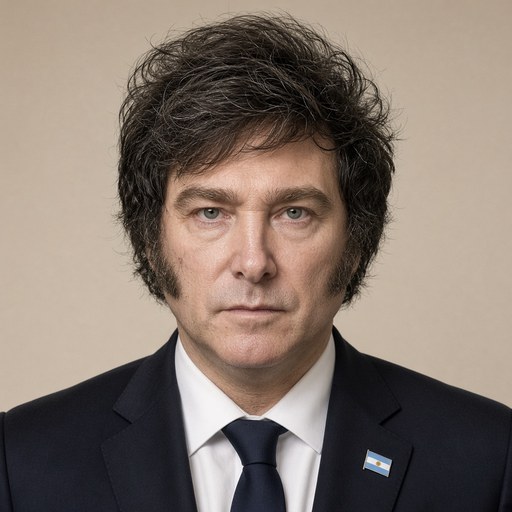
Speech by President Javier Milei at the Madrid Economic Forum 2026, in Spain.
 Javier Milei · President of Argentina
- Context
- Milei addressed the Madrid Economic Forum in Spain in March 2026, closing the event with a speech previewing his forthcoming book on morality as state policy.
- Main themes
- Capitalism and justice, moral foundations of economic policy, critique of socialism, Judeo-Christian and Western values, economic efficiency, Austrian economics, Argentina's economic reform, political utilitarianism, ethics as state policy, fiscal discipline
- Duration
- ~68 min
- Words
- 8,117
- Sentences
- 379
- Readability
- 54
- Grade
- 10.9
- Syntax
- 3.09
- Vocabulary
- 2.11
Translated from Spanish
The broad sphere of national life a sentence belongs to. Every sentence has an Arena, so it is the denominator the other indices are read against.
Other379 sentences in 68 paragraphs
Long live freedom, damn it! Long live freedom, damn it! Long live freedom, damn it! It seems to me that between the bribes and the saunas, they don't like you very much. Besides, with this reception, next year, if they let me, I will hold a concert.
Well, first of all, I want to thank the organizers of the Madrid Economic Forum, not only for inviting me but for giving me the honor of having this opportunity to close the event, which, to be honest, makes me feel at home. So thank you very much.
In today's talk, the idea of what we are going to be discussing, which will actually be the title of my next book, called: "Morality as State Policy." And the central axis has to do with something I read, at the time, in a wonderful book by Israel Kirzner, called: "Capitalism, Creativity, and Distributive Justice." I will mention it in the speech, but I wanted to give you the background on why this format of talk, why the book, and why this approach.
Because one of the wonderful things that Israel Kirzner says in that book is: "Today socialists do not argue that the capitalist system is more efficient, that it is more productive. They do not argue that. They condemn the system because they consider it unjust." And, in that sense, what he says —with very good judgment— is: "If the system were indeed unjust, it is not worth defending." And in that idea, what I am going to prove throughout this talk is that not only is the capitalist system more efficient, but it is also just, and as if that were not enough, it is the only system that brings prosperity to the earth. Therefore, it is key to determine what the foundations are from which we establish that the system is indeed just.
And that has to do with our ethical and moral values. And the reality, and I say this with pride, because it is not only my merit, but the merit of the giants who accompany me in the Government. We do not come to propose a slogan, because everything I say today is supported by facts in Argentina, which we are making great again.
And in that sense, when we have to propose a policy, we do so from three dimensions. First, and non-negotiable in any way, are the ethical and moral values that made the West great. And then the question is, what do we talk about when we talk about the West? The West is Greek philosophy. The West is Roman law. The West is the rectitude of the Stoics. That is why I also like to remember those wishes that King Solomon asked for when he inherited the throne. And what he asks of the creator is wisdom to be able to distinguish good from evil. Courage to choose good. Temperance to stay on the straight path and justice to act justly. And obviously, when one talks about what is just, associated with it are also our values. And whether you like it or not, the values of the West are Judeo-Christian values. In that sense, the reality is that if we fulfilled the Ten Commandments, if we understood what the capital sins are, and the "do not do" of Judaism, I am fully confident that the filthy garbage of socialism would disappear from the face of the earth so that we can all prosper.
At the same time, the second line of analysis, which has always been in dispute with politics, but which for us represents something of secondary importance. Again, the first order of merit belongs to ethics and morality. In second place is where economic efficiency appears. And it is also very interesting, the discussion in static terms, the idea of the invisible hand and optimality, static efficiency. And it is very interesting, and here I will reproduce exactly a proof that Hans-Hermann Hoppe makes in a wonderful book called: "The Ethics of Private Property." Where the way in which that proof is approached is decisive to block socialists of all kinds and stripes when they want to meddle in the market. Naturally, when we enter the realm of dynamics, it goes without saying that I believe I will mention one of our great interplanetary leaders, the fight for freedom, the great professor Jesús Huerta de Soto.
And finally, probably the most rancid, the most miserable, the most despicable. It is political utilitarianism, but... in addition, I say this as a politician. It is a good point, but aside from that. When you... efficiency and political utilitarianism are aligned with ethical and moral values, the result that that policy will have is that it is just, that it is efficient, and it will also yield political returns because you will be doing something that improves the quality of life of human beings.
However, when these three elements come into tension, what it means is that the policy you are analyzing is unjust and therefore that policy must be discarded even if it serves you politically. And I can attest to this because tell me how many politicians in the world know that they enter an election year tightening fiscal policy, tightening monetary policy, and lifting exchange restrictions. We liberals are the only ones who did that.
However, for years our thinking has been distorted by presenting us with a false dilemma when designing public policies where one had to choose between political efficiency versus respect for the ethical and moral values of the West. As Professor Jesús Huerta de Soto points out in his work on dynamic efficiency, from that point of view, efficiency is not compatible with various schemes of equity or justice, but arises solely and exclusively from one of them, which is based on respect for private property and the entrepreneurial function in a context that values the principle of non-aggression. Therefore, the opposition between the dimensions of efficiency and justice is false and erroneous. That is, what is just cannot be inefficient, nor can what is efficient be unjust. And in the perspective of dynamic analysis, justice and efficiency are two sides of the same coin.
Undoubtedly, the one who anticipated this situation with greater clarity was one of our great heroes, Murray Newton Rothbard, by proposing the connection that exists between the dynamic conception, economic efficiency, and the realm of ethics. Rothbard considered it essential to establish the ethical framework that drives dynamic efficiency, given our ignorance of the ends, means, and utility functions that exist in reality; or what, in neoclassical terms, Robert Lucas Jr. called deep parameters. In this sense, that framework is constituted by a set of norms that delimit the right of property and make voluntary exchange possible, in which different individuals always manifest their preferences.
Thus, for Rothbard, to which I subscribe, even from my position as President of the Argentine Nation, only the underlying ethical principles in Western culture can serve as a criterion of efficiency when making decisions regarding public policies. There will be a part of the presentation that you will find more fun. I will present six different policies, and you choose, and I will tell you about them. For that, we will also give a role to chance. We will put a die, and someone will come, will roll the die, and the number that comes up is the policy that I will describe. Let's add a playful part.
Put in crude terms, at the time of designing public policies, it is inadmissible from the point of view of ethics and morality to sacrifice justice on the altar of efficiency. This slogan in favor of values is not only above economic efficiency, but it is also much more above political utilitarianism. Thus, by setting aside ethical and moral values, it leads to policies that are not only unjust but also lead to collapse, not only economically but also socially, to the point that it could end up destroying Western civilization itself.
You already know it, I did it as a visitor. Back in 2024, where the cradle of the woke is, at the Davos forum, I pointed out that the West was in danger. At that same forum, during 2025, I showed that the agendas and policies being promoted by various international organizations and forums were nothing more than a whole set of socialist policies, which you suffer from every day, elegantly wrapped to deceive people with noble souls, full of good intentions, but with the same catastrophic results as always.
That is why we must never forget the words of Thomas Sowell about socialism, to which he recognized a merit, and it is that it sounds very nice. The problem is that it always ends badly, horrifically badly. Believe me, if you were not here, even with all the tremendous regulatory problems that hinder growth in Europe, believe me that if you had the Bank of Spain, not with the European Central Bank, with the unpresentable they have in charge of power, you would have a disaster worse than what Argentina has.
In fact, they are all branches or franchises of the same filthy garbage everywhere, which is 21st-century socialism, but fortunately, thanks to the courage and valor of Donald Trump, it is falling apart. And as my dear great friend, Daniel Lacalle, just said a few minutes ago: it is not far-fetched to dream of a free Cuba. For this reason, and beyond this, today more than ever, in the face of the ethical and moral degradation that the West is going through, as a result of having embraced the new socialist agenda, it is necessary to once again promote the ideas of freedom.
However, unlike the way it was approached in the past, based on a utilitarian approach, today the defense of the capitalist free enterprise system must be based on its ethical and moral virtue. These unpresentable socialists claim to be morally superior. I propose that we go and steal their idea, because the only ones who are ethically and morally just are us.
Thank you. Therefore, and as I had previously indicated, today I will demonstrate that free enterprise capitalism is not only more productive, but that the system is also just. I will also demonstrate that there is no dilemma between political utilitarianism and value-based politics, since if they were in conflict, the facts imply that the foundations of political utilitarianism must be discarded for being unjust. Therefore, this will imply that if we want to get out of our dark present, we must once again draw inspiration, as I said before, from the values of the West: Greek philosophy, Roman law, the rectitude of the Stoics, and Judeo-Christian values. Because in that way, we will be saving the West. Given this introduction, now comes the time to work, which is to prove what I said I would prove.
To prove that the capitalist free enterprise system is just, I will basically work with the concepts of natural law, positive law, justice, private property, the principle of non-aggression, and liberalism. Much of human conflict arises from a failed interpretation between natural law and positive law. Thus, natural law is the law that should govern human beings because it fits their nature and, therefore, is just in a universal sense. It is a common law for all men because it is intrinsic to their essence and, therefore, unmodifiable and immutable. On the other hand, positive law is what men draft to govern their coexistence. Thus, in accordance with natural law, there will be justice. Otherwise, the law will be legal but not legitimate. I say, very simply, if you make a law in which you say you are going to kill a group, look, it may be legal but it is clear that it is illegitimate and that law must be fought against.
Based on that, two natural rights are recognized; the rights to life and to liberty. Man is born alive and free and has the right to preserve those attributes of nature. Furthermore, he has the right that his peers respect him, in order to seek his own happiness, which is the end to which every man tends. In parallel, we have acquired rights. Which are neither natural nor inherent to human beings, but are earned by merit or obtained as gifts. Thus, the fundamental right to liberty derives from the acquired right that is private property. And that is manifested in that we can acquire a good with the fruit of our labor or we can receive a good that is freely given to us or inherited. Not that the State robs it with the damn social justice. There is something that socialist rats should understand, charity is not at gunpoint, and also, as Rothbard said, it is incredible how charitable one can be when the pocket is not theirs but someone else's.
At the same time, the right of property, especially due to its dynamic consequences, is linked to Locke's principle of appropriation, so that now property can derive not only from an arrangement, gift, inheritance, or exchange, but also from the appropriation of excrudition and creation. This issue is not trivial because —as Hayek pointed out— the market is a process of discovery. Finally, these rights are complemented by the principle of non-aggression, which establishes that no human being has the right to exercise aggression of any kind against another human being; which includes not only physical aggression but also all forms of coercion, coercion, or imposition under the threat of the use of force, that is, the action of the State.
That is why we define liberalism according to the definition of the founding father of liberalism in Argentina, Professor Alberto Venegas Lynch (son), who defines liberalism... Applause for the professor. The definition by Professor Alberto Venegas Lynch is very enlightening for when you have to make decisions because notice the height and moral stature that the definition of liberalism has and the clear restrictions it imposes when designing a policy because it says: “Liberalism is the unrestricted respect for the life project of others, based on the principle of non-aggression and in defense of the right to life, liberty, and private property.” From this, a set of institutions derives, which are private property, free markets without state intervention, competition understood as free entry and exit, the division of labor, and social cooperation. Naturally, associated with this social order arises the question of whether it is just. Therefore, to determine if the system is just, the obligatory reference is Ulpian, I mean, that great Roman man, practically the inventor of law. Whose basic premise constitutes the foundation of Roman law and is undoubtedly one of the pillars of Western civilization. And this is important because the definition has two parts, and the first is always mentioned while the important, the most important, second part is omitted. The first part says: “Justice is the constant and persistent will to give each one what is their right.” Obviously, that leaves an open window because this is the intention to give each one what is theirs, what corresponds to them.
However, Ulpian's sentence did not stop there, but he added: “That the principles of law consist in living honestly, without causing harm to anyone, and giving each one what is theirs.” Therefore, note that the definition of liberalism, the concept of liberalism, free enterprise capitalism, satisfies that definition; while socialism, clearly by violating the right to life, liberty, and property, is a filthy garbage that sinks us into misery.
Therefore, we have just proven that free enterprise capitalism is just, and now comes the moment in which we have to prove that it is efficient. Here, I will basically make an introduction to Adam Smith and compare the proof used by the neoclassicals versus the proof of Hans-Hermann Hoppe, where clearly the proof of Hans-Hermann Hoppe, based on Locke's principle of appropriation and the principle of non-aggression through logical means, demonstrates efficiency without having to fall into rigid mathematical structures, which then open the window to what the neoclassicals call market failure; where afterwards socialists take advantage to intervene and put their hands in our pockets, something they love.
Thus, given the emerging institutional framework -- which we have also proven to be just -- now it is time to prove that it is also efficient. The first argument in this regard was made by Adam Smith, who, using the argument of the invisible hand, postulated that each individual pursuing their own interest leads to maximum social welfare. Later, the neoclassicals, guided by an idea of the invisible hand based on Pareto optimality, managed to derive the first axiom of welfare economics. That is, every competitive equilibrium is Pareto optimal. However, this implies embracing a mathematical structure that leaves the doors open to state intervention, under the good intentions of correcting market failures; which, from my point of view, do not exist.
Essentially, the problem with the neoclassicals is that they construct the derivation of optimality using a whole topological structure, and when real life does not map with the model, they make the mistake of saying that this is a market failure. When you, in real life, find that the model does not map with reality, you throw out the model; you do not get angry and kick reality.
That is why the proof developed by Hans-Hermann Hoppe -- despite all the insults and the little he likes me -- based on property rights, in line with Locke's principle of original appropriation, along with the principle of non-aggression, not only proves optimality satisfactorily but also leaves no room for state intervention. Therefore, I will reproduce exactly the words of Hoppe; they are so brilliant that if I touched them, I would ruin them. That is to say, even the definition he uses is efficient, which is the height of efficiency, and it is worth recognizing Professor Hans-Hermann Hoppe for that. He points out that any deviation from this set of rules implies, by definition, a redistribution of property titles, and therefore of income, from the producing and contracting users of goods to the non-producing and non-contracting users. That is, to put it bluntly, from those of us who produce and earn our bread with the sweat of our brow, to the state parasites, who earn their bread with the sweat of others.
Therefore, any deviation in this sense implies that there will be relatively less original appropriation of resources whose scarcity is known. And therefore, there will be less production of new goods, less maintenance of existing goods, and fewer contracts and trades that are mutually beneficial. This, naturally, implies a lower standard of living in relation to the goods and services that change hands. Moreover, the postulate that only the first user -- not the last -- if the first user is the one who discovered it, found it, or inherited it; and the last is the one that politicians usually want to take it from one to give it to another. You can imagine the madness that this implies, right? Imagine that you come into life and have to feed yourself. As you walk, you will find goods, and you discover them; and since they do not belong to others, you appropriate them, consume them, and live with them. Is that clear? Good. What happens if those goods you discover cannot be appropriated by you, and you depended on another user who comes later to authorize you? In essence, that would condemn you to death. Because if you had to ask permission to consume something to feed yourself from the one who comes behind, and the one who comes behind has to do it from the one who comes after, and so on, you would die. And not only would you die, but everyone else would die too. Therefore, that idea of socialism that one produces and another can appropriate will inherently lead to misery.
In short, the postulate that only the first user -- not the last -- acquires the right of property over it ensures that productive efforts will be as high as possible at all times. At the same time, the denial that only the physical integrity of property -- not its value -- must be protected guarantees that every owner will make the greatest productive efforts of value. That is, efforts to promote favorable changes in the value of the property and to prevent or counteract any unfavorable change in its value. Therefore, any deviation from these rules implies a reduction in productive efforts at all times. Basically, the point is: suppose you buy a set of machines to start a business. What will protect the right of property, the principle of non-aggression, are precisely those machines; not the value. Therefore, if you have a successful business, what will define its success is that the market value is equal to or greater than the value at which you bought it; while if it is lower, you will go bankrupt. Value is not protected; property is protected; and this is not minor because imagine what would happen at the moment when candle manufacturers were around and Mr. Edison appeared with the light bulb. That is, what would the socialist do? He would send the inventor of the light bulb to the gallows for bankrupting the poor candle manufacturers; and he would make us all live miserable lives.
Therefore, if the state exists, it must safeguard property, not value; because when it wants to safeguard value, it protects inefficient parasites that foster state corruption against the entire population.
Note that by pivoting on private property and not on demand functions derived from optimization exercises, this allows reaching an optimum without the need to use quasi-esoteric assumptions that later provide support for state intervention. You remember that when you go and study Price Theory or Microeconomics, when market failures appear, which we have already said do not exist, which are the result of a mathematical construction and derive from reality not coinciding with that mathematical structure, the biggest problem with all that is that instead of trying to solve it through voluntary exchanges, the state tries to use it through force. Therefore, supposedly, in the search for that optimum, it ends up sacrificing justice on the altar of efficiency. Therefore, that policy is unjust and its destiny is to end badly.
As if all this were not enough, I have an additional criticism of the second theorem of welfare. This one is more fun. The second theorem of welfare economics, inspired by the work of John Stuart Mill, at a moment of weakness of poor John Stuart, quite a bachelor, already tired of being alone, and wanting to please the widow of a gentleman, who saw a market opportunity because she became a widow... So, poor woman, she was not perfect, she was a socialist. So poor John Stuart tried to please her and derived something that was that efficiency was independent of distribution. That is, that property rights did not matter at all, it would be something like that; and the reality is, if production is independent of distribution, that would mean, for example, that there would be no difference between capitalism and communism. And as much as it hurts the leftists, the wall fell in 1989 and crushed the leftists, not capitalism.
Or have you never seen the aerial photo of North Korea and South Korea? In South Korea, there is light; in North Korea, darkness. Or do you see people in Miami getting on sharks to go to the prison-island of Cuba?
Having said this, we have already proven that the system is just, we have proven that the system is efficient, and now we are going to prove that it is also dynamically efficient; that is, the system that promotes the greatest growth and well-being of individuals. Therefore, having proven that the institutions of free enterprise capitalism, sustained by natural rights, the principle of original appropriation of Locke, and the principle of non-aggression, are not only just but also efficient. At least in static terms, it is now time to prove that free enterprise capitalism fulfills all these same properties in dynamic terms. Xenophon, already 380 years before the Christian era, pointed out that economics is a knowledge that allows men to increase their wealth, while postulating that private property was the most beneficial vehicle for each one's life. That is, this is not something that comes from now; it has a long history. I mean, the fight is eternal. This is interesting because there is a wonderful phrase that says that the cost of freedom is its eternal vigilance. And why is this so? Because on the other side, you have parasites; you have lazy people who I don't know if they hate bathing or working more.
I remember the case of a friend who went on vacation to Cuba, and when he arrives at the beach, a person comes up to him and says: “Can you give me a dollar? Can you give me a dollar? Can you give me a dollar?” And there comes a moment when what does he do? He gives the dollar. And he goes and stands next to another: “Can you give me a dollar?” When the next day comes, the same thing happens. Do you know why? Because that way he ended up earning more money in a day than what he collected in a month, in the socialist wonder. Therefore, the filthy leftists are constantly generating rhetoric and looking for ways to rob and pickpocket others. Why? Because they produce nothing; and the only thing they can produce are words to make the rest feel guilty and put their hands in their pockets. Therefore, I leave you a recommendation, which we tell the Argentine branch of 21st-century socialism, which is Kirchnerism, that is, the kukas: Do not let yourselves be psychologized by the leftists.
However, Xenophon also addresses the concept of efficiency. He approaches it from two perspectives: on one hand, from a static view, he defines efficient management of available resources aimed at avoiding waste; where he also highlights the benefit of private property, pointing out that the owner's eye is the best formula for fattening the cattle. That is, no one respects their own better than oneself. I mean, never leave your pocket near a socialist.
On the other hand, Xenophon, in his second definition of efficiency, delves into the dynamic realm, pointing out that, in turn, efficiency implies increasing wealth. That is, it is about increasing the available quantity of goods through entrepreneurial creativity. That is, through trade or speculation. This latter criterion of efficiency is fundamentally important for the study of economic growth, since unlike a static model, in which only what Robert Lucas Jr. defined as deep parameters is considered—namely, preference, technology, and initial resource endowment—in the dynamic sphere both technology and initial endowments can vary; and in fact, they do so continuously, as a result of entrepreneurial creativity. Moreover, a separate chapter pertains to the institution of private property, which the Austrian School of economics, from Mises, Hayek, Rothbard, Hoppe, to Jesús Huerta de Soto, has demonstrated the impossibility of socialism; and therefore, undermining the ghostly idea of John Stuart Mill that postulates independence between production and distribution.
And it should be noted that an academic deafness that led to socialism cost the world the lives of 150 million human beings; while those who managed to survive the terror did so in absurd misery.
Now entering the part about growth and the entrepreneurial function, in line with what has been stated and in accordance with Xenophon's second definition of analysis, economic theory has identified four sources of economic progress: first, we have the idea of the division of labor, which was brilliantly exemplified by Adam Smith in that idea of the pin factory, where the division of labor generates increases in productivity; and that those limits are given by the size of the market. It is also very important that we internalize this, because not only do socialists characterize themselves by what Hazlitt called the hatred of the machine, or that they also call themselves Luddites, who are the ones that have a phobia of technological progress and scare us with a bunch of utopias. When you understand that the limit of the division of labor, that is, increasing returns, is limited by the size of the market; and that the size of the market, ultimately, is limited by initial endowments, among others, 24 hours a day, you will be clear that those dystopian scenarios make no sense. Therefore, do not allow interventionists to transfer their fears to us and ruin our lives: keep moving forward, keep progressing, keep generating technological progress for a better humanity.
Secondly, we have the accumulation of physical capital, where the interaction between savings, investment, and the role of capital markets is clear. On the other hand, we have human capital, where the focus should not be limited to the educational plane, but should also consider the development of cognitive abilities from the birth of the human being, their nutrition, and health; fundamental elements to access education and the labor market. In any other political context, this would sound like simple rhetoric trying to sweeten your ears; however, we, in honor of Gary Becker, have a Ministry of Human Capital, whose fundamental base is Childhood and Family.
Where, moreover, we dedicate ourselves to caring for health, so that those children can reach education and then be able to integrate dignifiedly into the labor market. It is clear that it is a solution that is not entirely libertarian, but when you arrive in a country on the brink of hyperinflation and with 57% of the population in poverty, Ayn Rand's ethics of emergency states that you must look after human life. And that is what we are doing from Human Capital.
However, unlike other assistance mechanisms, which socialists and fascists like so much—who are also socialists, but discovered that the communist utopia did not work—instead of giving fish to people and enslaving them, we are teaching them to fish, so that at some point they can have a fish factory.
Then, we have technological progress, which means being able to produce a greater quantity of goods with the same amount of resources; or produce the same using a smaller amount of inputs.
Finally—and this is something that interests me greatly, because you can have increasing returns from the division of labor, you can have physical capital, human capital, you can have technological progress… but without entrepreneurial creativity, production would be zero: if you do not have entrepreneurs, you will be poor.
However, for this dynamic efficiency to make sense, you will need institutions. In this regard, what is truly important is to expand the production possibility frontier to the maximum. Thus, dynamic efficiency can be seen as the capacity of an economy to promote creativity and entrepreneurial coordination in such a way that it maximizes economic growth. In turn, the criterion of dynamic efficiency is inextricably linked to that of the entrepreneurial function, which is the typically human capacity to realize the profit opportunities that arise in the environment, and to act accordingly to take advantage of them; making it fundamental to discover and create new ends and means, driving spontaneous coordination aimed at resolving market imbalances. On the other hand, this definition of dynamic efficiency proposed by Huerta de Soto adequately and coherently combines the idea of creative destruction from Schumpeter with the efficiency of North. Naturally, given the role of the entrepreneurial function, the institutions under which they develop are of vital importance. In this sense, both Douglass North and Jesús Huerta de Soto see as a key function of institutions the reduction of uncertainty. By the way, when we went to the presidential elections of 2023, the Country Risk was around 3,000 basis points—regardless of the fact that we were on the way to hyperinflation and a generalized default, both commercial and debt-related. And in that context, today we have managed to lower the Country Risk to levels of 500 basis points. And if, in addition, instead of taking the Country Risk in the bonds that exceed what would be our first mandate… If people want there will be another… But, if you take our last placements until 2027, today the Country Risk in Argentina, under a liberal-libertarian government, has dropped to 200 basis points. We are indeed working to eliminate uncertainty!
Moreover, as Roy Cordato points out, the appropriate institutional framework is one that favors entrepreneurial discovery and coordination. Therefore, in this framework, economic policy should be aimed at identifying and removing all artificial barriers that hinder the entrepreneurial process and voluntary exchanges. Again, it might sound like nice words, like nice slogans; but we, from the Ministry of Deregulation led by ‘El Coloso’ Federico Sturzenegger, have removed 15,000 regulations in two years. 15,000 structural reforms. Yes, it can be done!
So, in this sense, given the determining influence of institutions on economic progress, this directs our gaze towards the importance of ethics. Since those societies that adhere to stronger ethical values and principles in support of institutions will be dynamically more efficient, and with that, will enjoy a higher level of prosperity. Thus, in line with the theory of the entrepreneurial function and the concept of dynamic efficiency, every human being possesses an innate creative capacity that allows them to appreciate and discover the profit opportunities that arise in their environment, acting accordingly to take advantage of them. In this way, entrepreneurship is the typically human capacity to create and discover new means and ends. According to this conception, resources are never given; rather, both means and ends are continuously devised and conceived ex novo by entrepreneurs, always eager to achieve new objectives that they discover have greater value. As you can see, I am a declared disciple of the giant Jesús Huerta de Soto, and I will not deny it.
And the reality is that the best way to foster coordination and entrepreneurial creation is based on being able to appropriate the fruits of one's labor, grounded in natural rights, respecting the right to freedom, the right to life, the right to property, without aggressing against others. When you comply with natural rights, the principle of appropriation of Locke and the principle of non-aggression, which is fundamentally nothing more or less than what underlies Judeo-Christian values, you will have a society that is dynamically efficient and, therefore, prosperous. That is why the West has witnessed the greatest civilizational achievement in the history of humanity.
That said, we have reached the interactive part of the presentation. Basically, I will give you six options to choose from. One is: how is this analytical framework used? For example, to design a fiscal adjustment.
The second case is: how is the Central Bank's cleanup carried out? The management of debt to avoid hyperinflation. I want to take a second, because the great titan who has carried out this task, along with the President of the Central Bank, is my former Secretary of Finance and now Chancellor, the giant Pablo Quirno, please stand up. That man, along with Bausili, prevented hyperinflation. The third analytical element is the exit from the currency controls. The fourth is deregulation. Five, opening up. And six, the fight against inflation. These are all policies that we have carried out, and I will leave it, as I cannot be asking everyone, I cannot be making you shout, because it may be that I have a bias that I want to talk about. But let's leave it there. I brought a die. Can you pass me the die, please? The gentleman who brought me the die is my protocol chief. We call him Messi, because trying to keep me in protocol is a titanic task. They say that one day they saw Darío working and Cyclops passed by and said, “No, let me pass by.” My mythology is too interesting, let's say. Does anyone want to come and roll the die? Whoever wants to come, come on. Go ahead, come up however you can. Yes, of course. Of course, and whatever comes up. And yes, I say. How could it not? Yes, how many dice? Yes, I said it. How could it not? I said: fiscal adjustment, Central Bank cleanup, debt and inflation, exit from currency controls, deregulation, opening up, and the fight against inflation. How could it not? Five. Five. It goes to show that spontaneous order works and that life is capricious. I swear the die is not loaded, because we just rolled opening up. For at least a couple of weeks, we have been discussing opening up in Argentina. And that implies having to face the entire Argentine corporate structure: from businessmen, rent-seekers, envelope journalists, and corrupt politicians. So, I have no doubt: the more socialism, the more corruption you have. First, I will go for the obvious, for the data that spills out to anyone's eyes, so that you clearly understand that what is being defended in Argentina, under the guise of national industry and cheap nationalism, is nothing more than the possibility that corrupt businessmen have to continue hunting in the zoo.
Argentina, according to its income level, should have an openness coefficient, that is, exports plus imports in terms of GDP, of 93%. Argentina has an openness coefficient of 28%. That is, when you take that relative distance, Argentina is the most closed country in the world. Therefore, all those complaints about indiscriminate opening are lies. Furthermore, there is another index, one that the World Bank compiles, which considers 179 countries. Argentina is in 178th place. That is, there is no such thing as indiscriminate opening, as industricide, and all those lies that the media want to install, given the fuel that rent-seeking businessmen provide.
And one of the great debates that arose in Argentina was about a tire company called FATE, whose owner is a man named Manuel… no, Javier Madanes Quintanilla. I say, that's how they know him. Let's say, let him go and defend his shame around the world… Basically, you see, a tire costs 100 dollars. In Argentina, you had to pay 400 dollars. That is, you had to pay four times more.
And besides, this gentleman has an aluminum company called Aluard. And every time he negotiated protection, whether for aluminum or for tires, he did so by extorting governments for over 20 years, threatening to lay off 920 workers. You can imagine that we have not been a government that has escaped receiving that pressure. But you can imagine what our response was, because the day before the labor modernization law was to be discussed, this rent-seeking extortionist laid off the 920 people, families, to create a disaster on the street the day we wanted to pass the labor modernization law. Because clearly, we did not accept. So, this is interesting.
I will begin to analyze the policy in the opposite order of merit to the one I mentioned. You remember that I spoke of ethics and morals, that is, what is just. I spoke of economic efficiency and I spoke of political utilitarianism.
If I were to open the economy, now tires would not cost 400 dollars, they would cost 100 dollars. Consequently, 48 million human beings would benefit and Mr. Madanes Quintanilla would be harmed, and the 920 workers and families of Fate would be harmed. If you give that to a politician, they do political calculations and say here there are 48 million, here a thousand, therefore they choose that solution.
However, that is not a reason for you to justify that policy in itself. Because, if you think about populism, let’s say, it’s like there are 5 people: 4 have nothing, one has 500. So, the one who has 500 is robbed of 400, let’s suppose that the corrupt hands of politicians are not involved, and gives 100 to each of those who had nothing, and now all 5 have 100. Let’s say, there are 4 winning, 1 losing, the politician would love that. However, why is that questionable? Because it is unjust. Because it is theft. Because it is unequal treatment under the law. So, let’s continue with the analysis. Furthermore, it is inefficient, because it would punish the producer and, therefore, in dynamic terms, production would collapse. Therefore, it is also not efficient.
So, we have already seen that this policy of opening is true that it benefits 48 million and only harms 1,000, but that is not a reason to endorse it, because we have to determine, the second stage is whether it is efficient. And the reality is that opening is also efficient, because it is true that the day you open the economy and can buy tires for 100 dollars, this company that was making them for 400 will go bankrupt. However, that means that the person who was paying 400 now pays 100 and has 300 left to spend in the rest of the economy, on activities that are more productive. Therefore, there will be a reassignment of work from less productive sectors to more productive ones. Therefore, you will have higher wages, you will have lower prices, thus you will have more present consumption, more future consumption, and therefore more well-being.
That is to say, the policy of opening also passes the efficiency test. Moreover, it favors the most vulnerable sectors, because, while those who could travel to Uruguay or Chile to bring back tires at market price, those who had to pay for the more expensive tires were the ones who had the least. Therefore, it was regressive. And that increased the chance that they would be the ones who would die on the road for using old tires. Therefore, that policy also promoted the death of the most vulnerable and punished the most vulnerable. So, the question is: how can it be that, if politicians love to harvest votes and opening would have generated more votes gained than votes lost, why don’t they do it? If it is so efficient, why don’t they do it? Because it is called corruption. Opening also eliminates corruption.
Because when the bureaucrat raises the wall so that they cannot compete, they also realize that they can negotiate with the businessman to maintain that restriction. Don’t come crying to me that they already existed, because if not, let’s remove all of them at once, let’s see what they think. So, and don’t come telling me that they don’t have time, because it is clear that for more than 10 years I have been in the media saying what needs to be done, how to do it, and I am doing it. Therefore, if you went to the races and bet on the wrong horse, I’m very sorry, but you also want to bet and when you err you want all Argentines to pay for your mistakes for betting on corrupt governments. Or the argument of the infant industry. The infant industry in Argentina is 80 years old. I think it is quite grown up.
Therefore, those who wave the idea of national industry, who wave cheap nationalism, who wave the defense of employment, I tell you that this policy we apply generates higher wages, more jobs, lower prices, greater present consumption, greater future consumption, and less corruption.
However, even if all this happened, we have to prove that what we are doing is just, because we already said that, no matter how efficient it is, no matter how utilitarianly positive it is, politically we have to prove that it is just. And the question is very simple. Is anyone against freedom? Is anyone in favor of stealing? Therefore, let me tell you that this policy is also just. Because when a barrier is built for you not to be able to trade, you are not being allowed to have the freedom to reap the fruits of your labor. Therefore, your freedom is being curtailed. And since they do it with the coercive apparatus of the State to charge you something four times more expensive, it is also theft. Therefore, our policy is not only utilitarian because it favors the vast majority of Argentines, it is not only efficient, but we also defend this policy because it is just.
(Off microphone) Long live! Therefore, we are in a position… we have already seen that the capitalist system of free enterprise is just, efficient, and is the one that generates the greatest prosperity given dynamic efficiency. Moreover, I have demonstrated with facts what is being done. Still, Argentina is a very special country because you go and expose the corrupt web and corrupt journalists come out to defend the corrupt.
(Off microphone) Exactly. That is one of them. But this is interesting because, for example, another businessman I question is Mr. Paolo Rocca. It is interesting because while the Kirchners insulted him, they ended up paying four thousand dollars per ton of steel tube when today they are worth one thousand four hundred. They did do that, we did not. Therefore, I am enduring all the media slaughter, which responds to those business tycoons, for fighting for the well-being of Argentines. That is to say, those who do not negotiate with corruption are attacked and persecuted by the very corporatist corrupt of the system. Be they business tycoons, corrupt journalists, and thieving politicians.
Therefore, as a final reflection, I will say: that despite popular criticism, free enterprise capitalism does not undermine moral values. After all, economic progress opened the mechanism of the invisible hand, arose from the moral sentiments of Adam Smith, and modernity owes its existence to the bourgeois virtues of McCloskey. In turn, thanks to the great work of Jesús Huerta de Soto in the development of the concept of dynamic efficiency and its implementation in Argentina, whether libertarians like it or not, this allows us to be sure that the dilemma between efficiency and justice is false. That is, markets are not only superior in terms of productivity, but they are also just, and therefore public policies must be guided by ethics and not political utilitarianism, whether economic or political, because they always lead to populist and impoverishing solutions. Therefore, I reaffirm what I said in Davos this year regarding Machiavelli. Machiavelli is dead, therefore, it is time to bury him.
Moreover, given the deep link between morality and free markets, the latter make us better people, that is, thanks to dynamic and efficient markets we can, at the same time, progress economically, defend private property, maintain peace, achieve social harmony, and strengthen those social virtues that are indispensable for a prosperous society.
Finally, I want to give you a reflection… let’s say, I will skip because I prefer… (Off microphone) Thank you! What I want to point out is that for some strange reason, the West has begun to turn its back on the ideas of freedom, and that is why in my presentation in Davos, in 2024, I stated that the West is in danger, as a result of having embraced increasing doses of socialism in its most hypocritical version, which is “Wokism.” I believe you know it and know the dynamics of the path of servitude that makes them increasingly violent.
In turn, at that forum, as I said before, in 2025 I explained the mental parasites that the left has sown in humanity. However, and I said it in Davos and I repeat it now, 2026 is the year in which I bring you good news. The world has begun to awaken. The best proof of that is what is happening in America with the resurgence of the ideas of freedom. Therefore, America will be the beacon of light that will reignite all of the West and, with that, will pay its civilizational debt with our show of gratitude towards its foundations in Greek philosophy, in Roman law, in the rectitude of the Stoics, and in Judeo-Christian values. We have a better future ahead of us, but that better future exists only if we return to the roots of the West, only by returning to the ideas of freedom.
May God bless you all, may the forces of heaven accompany us. Long live freedom, damn it! Long live freedom, damn it! Long live freedom, damn it! Thank you very much!
The original Spanish. The tags above are read on the English translation's sentences.
¡Viva la libertad, carajo! ¡Viva la libertad, carajo! ¡Viva la libertad, carajo! Me parece que entre las coimas y los saunas no los quiere mucho. Aparte, con esta recepción, el año que viene, si me dejan, hago un recital.
Bueno, en primer lugar, deseo dar las gracias a los organizadores del Madrid Economic Forum, no solo por invitarme, sino por permitirme el honor de tener esta posibilidad de cerrar el evento, que además, la verdad es que me hacen sentir como en casa. Así es que muchísimas gracias.
En la charla de hoy, la idea de lo que vamos a estar discutiendo, que de hecho va a ser el título de mi próximo libro, que se llama: “La moral como política de Estado”. Y el eje central tiene que ver con algo que leí, en su momento, en un libro maravilloso de Israel Kirzner, que se llama: “Capitalismo, creatividad y justicia distributiva”. Lo voy a mencionar en el discurso, pero quería darles la previa del motivo de por qué este formato de charla, por qué el libro y por qué este enfoque.
Porque una de las cosas maravillosas que dice Israel Kirzner, en ese libro, dice: “Hoy los socialistas no discuten que el sistema capitalista es más eficiente, que es más productivo. No discuten eso. Lo condenan al sistema porque consideran que es injusto.” Y, en ese sentido, lo que dice —con muy buen criterio— Israel Kirzner es: “Si efectivamente el sistema fuera injusto, no merece la pena ser defendido”. Y en esa idea, lo que voy a probar a lo largo de esta charla, es que no sólo que el sistema capitalista es más eficiente, sino que es además justo y como si esto fuera poco, es el único sistema que trae prosperidad a la tierra. Por lo tanto, es clave sobre cuáles son las bases a partir de las cuales determinamos que el sistema efectivamente es justo.
Y eso tiene que ver con nuestros valores éticos y morales. Y la realidad, y lo digo con orgullo, porque no es sólo mérito mío, sino que es mérito de los gigantes que me acompañan en el Gobierno. Nosotros no venimos a plantear un slogan, porque todo lo que digo hoy lo estoy soportando con hechos en la Argentina, que la estamos haciendo grande nuevamente.
Y en ese sentido, cuando nosotros tenemos que plantearnos una política, lo hacemos desde tres dimensiones. Primero, y no negociable de ninguna manera, están los valores éticos y morales que hicieron grande a Occidente. Y entonces la pregunta es, ¿de qué hablamos cuando hablamos de Occidente? Occidente es la filosofía griega. Occidente es el derecho romano. Occidente es la rectitud de los estoicos. Por eso también me gusta recordar aquellos deseos que le pidió el Rey Salomón cuando hereda el trono. Y lo que pide al creador es sabiduría para poder distinguir el bien del mal. Coraje para elegir el bien. Templanza para mantenerse en el camino recto y justicia para actuar de manera justa. Y obviamente, cuando uno habla de lo justo, asociado a ello también están lo que son nuestros valores. Y les guste o no, los valores de Occidente son los valores judeocristianos. En ese sentido, la realidad es que si cumpliéramos con los diez mandamientos, si entendiéramos cuáles son los pecados capitales, y el no hacer del judaísmo, tengo plena seguridad que la basura inmunda del socialismo saldría de la faz de la tierra para que todos podamos prosperar.
A su vez, la segunda línea de análisis, y es la que siempre estuvo en disputa con la política, pero que para nosotros representa algo de segundo orden. De vuelta, el primer orden de mérito lo tiene la ética y la moral. En el segundo lugar es donde aparece la eficiencia económica. Y ahí también es muy interesante la discusión en términos estáticos, la idea de la mano invisible y de la optimalidad, la eficiencia estática. Y es muy interesante, y yo aquí voy a reproducir tal cual una prueba que hace Hans-Hermann Hoppe, en un libro maravilloso, que se llama: “La ética de la propiedad privada”. Donde la forma en la cual se encara esa prueba es determinante para bloquearle a los socialistas de todo tipo y pelaje cuando quieren meter la mano adentro del mercado. Naturalmente, cuando entremos en el terreno de la dinámica, demás está decir que creo que voy a mencionar a uno de nuestros grandes líderes interplanetarios, la lucha por la libertad, el gran profesor Jesús Huerta de Soto.
Y por último, probablemente lo más rancio, lo más miserable, lo más despreciable. Es el utilitarismo político, pero… además, lo digo como político. Es un buen punto, pero al margen de eso. Cuando ustedes… la eficiencia y el utilitarismo político están alineados con los valores éticos y morales, el resultado que esa política va a tener es que es justa, que es eficiente y además va a rendir rédito político porque ustedes van a estar haciendo algo que mejora la calidad de vida de los seres humanos.
Sin embargo, cuando estos tres elementos entran en tensión, lo que significa es que esa política que ustedes están analizando es injusta y por ende dicha política tiene que ser descartada aún cuando le sirva políticamente. Y eso sí puedo dar cuenta porque díganme cuántos políticos en el mundo conocen que entren en un año electoral apretando la política fiscal, apretando la política monetaria y liberando las restricciones cambiarias. Eso lo hicimos sólo los liberales.
Sin embargo, durante años se nos deformó el pensamiento presentándonos un falso dilema al diseñar políticas públicas donde se debía optar entre la eficiencia política en contraposición al respeto de los valores éticos y morales de Occidente. Tal como señala el profesor Jesús Huerta de Soto, en su trabajo sobre eficiencia dinámica, desde dicho punto de vista, la eficiencia no es compatible con diversos esquemas de equidad o justicia, sino que surge única y exclusivamente de uno de ellos, el cual se basa en el respeto de la propiedad privada y la función empresarial en un contexto que vale el principio de no agresión. Por eso, la oposición entre las dimensiones de eficiencia y justicia es falsa y errónea. Esto es, lo justo no puede ser ineficiente, ni lo eficiente injusto. Y es que en la perspectiva del análisis dinámico, justicia y eficiencia son dos caras de la misma moneda.
Sin lugar a dudas, quien anticipó esta situación con mayor claridad fue uno de nuestros grandes héroes, Murray Newton Rothbard, al plantear la conexión que existe entre la concepción dinámica, la eficiencia económica y el ámbito de la ética. Rothbard consideraba imprescindible establecer previamente el marco ético que impulse la eficiencia dinámica, dado el desconocimiento que tenemos de los fines, medios, funciones de utilidad que existen en la realidad; o lo que, en términos neoclásicos, Robert Lucas Jr. llamaba parámetros profundos. En este sentido, dicho marco está constituido por un conjunto de normas que delimitan el derecho de propiedad y hacen posible el intercambio voluntario, en el que los diferentes individuos siempre dejan de manifiesto cuáles son sus preferencias.
Así, para Rothbard, a lo cual adscribo, aún desde mi posición de Presidente de la Nación Argentina, sólo los principios éticos subyacentes en la cultura occidental pueden servir como criterio de eficiencia a la hora de tomar decisiones en materia de políticas públicas. Va a haber una parte de la presentación que les va a resultar más divertida. Les voy a presentar seis políticas distintas, y ustedes eligen, y yo se las cuento. Para eso también vamos a darle un rol al azar. Vamos a poner un dado, y alguien va a venir, va a tirar el dado y el número que salga es la política que yo voy a describir. Vamos a ponerle una parte lúdica.
Puesto en términos crudos, al momento de diseñarse las políticas públicas, resulta inadmisible desde el punto de vista de la ética y la moral sacrificar la justicia en el altar de la eficiencia. Esta consigna en favor de los valores no solo está por encima de la eficiencia económica, sino que aún lo está, mucho más, por encima del utilitarismo político. Así, al dejar de lado los valores éticos y morales, ello deriva en políticas que no son solamente injustas, sino que además llevan al colapso, no solo en lo económico, sino también en el plano de lo social, a punto tal que podría terminar acabando con la propia civilización occidental.
Ustedes ya lo saben, ya lo hice de visitante. Allá en el año 2024, donde está la cuna de los woke, en el foro de Davos, señalé que Occidente estaba en peligro. A su vez, en ese mismo foro, durante el 2025, mostré que las agendas y políticas que se venían impulsando desde los distintos organismos y foros internacionales no eran ni más ni menos que todo un conjunto de políticas socialistas, las cuales ustedes padecen todos los días, arropadas de modo elegante para engañar a personas de almas nobles, llenas de buenas intenciones, pero con los mismos resultados catastróficos de siempre.
Por eso, nunca debemos olvidar las palabras de Thomas Sowell sobre el socialismo, al cual le reconocía un mérito, y es que suena muy lindo. El problema es que siempre termina mal, horrorosamente mal. Créanme que si ustedes no estuvieran, aún con todos los problemas de montañas regulatorias tremendas que imposibilitan el crecimiento en Europa, créanme que si tuvieran Banco Central de España, no con Banco Central Europeo, con el impresentable que tienen a cargo del poder, tendrían un desastre peor que el que tiene Argentina.
De hecho, son todas sucursales o franquicias de la misma basura inmunda en todos lados, que es el socialismo del siglo XXI, pero que afortunadamente, gracias al coraje y el valor de Donald Trump, se está cayendo a pedazos. Y como dijo recién mi querido gran amigo, hace minutos, Daniel Lacalle: no está lejos soñar con una Cuba libre. Por esto, y más allá de esto, hoy más que nunca, frente a la degradación ética y moral que atraviesa Occidente, fruto de haber abrazado la nueva agenda socialista, es necesario volver a impulsar las ideas de la libertad.
Sin embargo, a diferencia del modo en que se encaró en el pasado, basado en un enfoque utilitarista, hoy la defensa del sistema capitalista de libre empresa debe estar basado en su virtud ética y moral. Estos impresentables de los socialistas se arrogan ser superiores moralmente. Propongo que vayamos y les robemos la idea, porque los únicos que somos ética y moralmente justos somos nosotros.
Gracias. Por lo tanto, y tal como les había adelantado, hoy demostraré que el capitalismo de libre empresa no sólo es más productivo, sino que además el sistema es justo. A su vez, les demostraré que no existe dilema entre el utilitarismo político y la política basada en valores, ya que si las mismas estuvieran en conflicto, hechos implican que las bases del utilitarismo político deben descartarse por ser injustas. Por lo tanto, esto implicará que si queremos salir de nuestro oscuro presente, debemos volver a inspirarnos, como dije antes, en los valores de Occidente: la filosofía griega, el derecho romano, la rectitud de los estoicos y los valores judeo cristianos. Porque, de esa manera, estaremos salvando Occidente. Dada esta introducción, ahora llega el momento de trabajar, que es probar lo que dije que iba a probar.
Para probar que el sistema capitalista de libre empresa es justo, básicamente voy a trabajar con lo que es el concepto de ley natural, ley positiva, justicia, propiedad privada, principio de no agresión y liberalismo. Gran parte de los conflictos humanos surgen de una fallida interpretación entre el derecho natural y el derecho positivo. Así, el derecho natural es la ley que debe regir al ser humano porque se adecúa a su naturaleza y, por lo tanto, es justa en sentido universal. Es una ley común para todos los hombres porque es intrínseca a su esencia y, por lo tanto, inmodificable e inmutable. Por otra parte, el derecho positivo es el que redactan los hombres para regir su convivencia. De este modo, en coincidencia con la ley natural habrá justicia. En su defecto, la ley será legal pero no será legítima. Digo, muy simple, si ustedes hacen una ley en la cual dicen que van a matar a un grupo, miren, puede ser legal pero está claro que es ilegítima y esa ley debe ser combatida.
En función de eso se reconocen dos derechos naturales; los derechos a la vida y a la libertad. El hombre nace vivo y nace libre y tiene derecho a conservar esos atributos de la naturaleza. Además, tiene derecho que a sus semejantes se lo respete, en orden de buscar su propia felicidad que es el fin al que tiende todo hombre. En paralelo tenemos los derechos adquiridos. Los cuales no son naturales ni tampoco son inherentes al ser humano, sino que los mismos son ganados por merecimiento u obtenido por regalos. De este modo, el derecho fundamental a la libertad se deriva del derecho adquirido que es la propiedad privada. Y eso se manifiesta en que podamos adquirir un bien con el fruto de nuestro trabajo o podemos recibir un bien que libremente nos donen o nos hereden. No que los robe el Estado con la maldita justicia social. Hay algo que deberían entender las ratas socialistas, la caridad no es a punta de pistola, y además como decía Rothbard es increíble toda lo caritativo que se puede ser cuando el bolsillo no es el suyo sino es el bolsillo ajeno.
A su vez el derecho de propiedad, en especial por sus consecuencias dinámicas, se vincula con el principio de apropiación del locke, por lo que ahora la propiedad no sólo puede derivar de una ordenación, regalo, herencia o intercambio, sino que se suma la apropiación del excrudimiento y de una creación. Este tema no es una cuestión trivial porque —tal como señalaba Hayek— el mercado es un proceso de descubrimiento. Finalmente, estos derechos se complementan con el principio de no agresión, el cual establece que ningún ser humano tiene derecho a ejercer agresión de ningún tipo contra otro ser humano; lo cual no sólo incluye la agresión física, sino también todo tipo de coacción, coerción o imposición bajo amenaza del uso de la fuerza, es decir, el accionar del Estado.
De ahí que definimos liberalismo acorde a la definición del prócer del liberalismo en la Argentina que es el profesor Alberto Venegas Lynch (hijo), y que define al liberalismo… Aplausos para el profesor. La definición del profesor Alberto Venegas Lynch es muy iluminadora para cuando ustedes tienen que tomar decisiones porque fíjense la altura y la estatura moral que tiene la definición del liberalismo y las restricciones bien claras que impone al momento de diseñar una política porque dice: “El liberalismo es el respeto irrestricto del proyecto de vida del prójimo, basado en el principio de no agresión y en defensa del derecho a la vida, a la libertad y a la propiedad privada”. Donde de eso se derivan un conjunto de instituciones que son la propiedad privada, los mercados libres de intervención estatal, la competencia entendida como libre entrada y salida, la división del trabajo y la cooperación social. Naturalmente, asociado a este ordenamiento social surge la cuestión de si el mismo es justo. Por ende, para determinar si el sistema es justo la referencia obligada es Ulpiano, digo, aquel gran hombre romano, inventor del derecho prácticamente. Cuya premisa básica constituye la base del derecho romano y sin dudas es uno de los pilares de la civilización Occidental. Y esto es importante porque la definición tiene dos partes y siempre se menciona la primera y se omite la importante, la más importante, que es la segunda. La primera parte dice: “La justicia es la constante y persistente voluntad de otorgar a cada cual, cuál es su derecho”. Obviamente, eso deja una ventana abierta, porque esto es la intención de dar a cada uno lo suyo, lo que le corresponde.
Sin embargo, la sentencia de Ulpiano no se quedó ahí, sino que a continuación añadió: “Que los principios del derecho constan en vivir de modo honesto, sin causar daño a nadie y dando a cada cual lo que es suyo”. Por lo tanto, noten que la definición de liberalismo, el concepto del liberalismo, el capitalismo de libre empresa, satisface esa definición; mientras que el socialismo claramente al violentar el derecho a la vida, a la libertad y a la propiedad es una basura inmunda que nos hunde en la miseria.
Por lo tanto, acabamos de probar que el capitalismo de libre empresa es justo y ahora viene el momento en el cual tenemos que probar que es eficiente. Acá básicamente voy a hacer una intro de Adam Smith y voy a comparar la prueba que utilizan los neoclásicos versus la prueba de Hans-Hermann Hoppe, donde claramente la prueba de Hans-Hermann Hoppe basándose en el principio de apropiación de Locke, y en el principio de no agresión por la vía lógica, demuestra la eficiencia sin tener que caer en rígidas estructuras matemáticas, que después abren la ventana a lo que los neoclásicos llaman falla de mercado; donde después los socialistas aprovechan para intervenir y meternos las manos en el bolsillo, algo que les encanta.
Así, dado el entramado institucional emergente --el cual además hemos probado que el mismo es justo-- ahora es momento probar que, además, es eficiente. El primer planteo al respecto fue realizado por Adam Smith, quien utilizando el argumento de la mano invisible postulaba que cada individuo persiguiendo su propio interés llevaba al máximo bienestar social. Más tarde, los neoclásicos, guiados por una idea de la mano invisible basada en el óptimo de Pareto, lograron derivar el primer axioma de la economía del bienestar. Esto es, todo equilibrio competitivo es óptimo de Pareto. Sin embargo, esto implica abrazar una estructura matemática que deja abierta las puertas a la intervención estatal, bajo las buenas intenciones de corregir los fallos de mercado; los cuales, desde mi punto de vista, no existen.
Esencialmente, el problema de los neoclásicos es que construyen la derivación de la optimalidad utilizando toda una estructura topológica, y que cuando la vida real no mapea con el modelo cometen el error de decir que eso es un fallo de mercado. Cuando ustedes, en la vida real, el modelo no mapea con la realidad, tiran el modelo; no se enojan y revientan a patadas la realidad.
Por eso, la prueba que ha desarrollado Hans-Hermann Hoppe --a pesar de todo lo que me insulta y lo poco que me quiere--, basado en los derechos de propiedad, en línea con el principio de apropiación originaria de Locke, junto al principio de no agresión, no solo resulta satisfactoria en probar la optimalidad, sino que además no deja lugar a la intervención del Estado. Por eso, voy a reproducir tal cual las palabras de Hoppe; son tan brillantes que, si las tocara, las arruinaría. Es decir, hasta es eficiente la definición que utiliza, lo cual es el paroxismo de la eficiencia, y que vale la pena reconocerle el profesor Hans-Hermann Hoppe. Señala que cualquier desviación de este conjunto de reglas implica, por definición, una redistribución de títulos de propiedad, y por lo tanto de los ingresos, desde los usuarios productores y contratantes de bienes hacia los no usuarios productores y no contratantes. Es decir, hablando mal y pronto, desde los que producimos y nos ganamos el pan con el sudor de la frente, y los parásitos del Estado, que se ganan el pan con el sudor de la frente ajena.
Por lo tanto, cualquier desviación en tal sentido implica que habrá relativamente menos apropiación originaria de recursos cuya escasez sea conocida. Y por ende, habrá menos producción de nuevos bienes, menos mantenimiento de los bienes existentes, y menos contratos y comercios que sean mutuamente beneficiosos. Esto, naturalmente, implica un menor estándar de vida en relación con los bienes y servicios que pasan de mano en mano. Además, el postulado de que solo el primer usuario --no el último--, si el primer usuario es el que lo descubrió, el que lo encontró o el que lo heredó; y el último es el que suelen los políticos querer sacárselo a uno para dárselo a otro. Ustedes se imaginan la locura que eso implica, ¿no? Imagínense que ustedes llegan a la vida y tienen que alimentarse. Conforme ustedes van caminando, se van a ir encontrando bienes, y que ustedes los descubren; y como no son de otros, se lo apropian, con eso consumen y con eso viven. ¿Está claro eso? Bien ¿Qué pasa si esos bienes que descubren no se los pueden apropiar, y dependieran de que otro usuario que viene posterior se lo tenga que autorizar? En el fondo, eso los condenaría a la muerte. Porque si ustedes le tuvieran que pedir permiso para consumir algo para alimentarse al que viene atrás, y el que viene atrás se lo tiene que hacer al que viene después, y así sucesivamente, ustedes se van a morir. Y no solo se van a morir ustedes, si no que se van a morir todos los demás. Por lo tanto, esa idea del socialismo de que uno lo produce y otro se lo puede apropiar, inherentemente va a derivar en miseria.
En definitiva, el postulado de que solo el primer usuario --no el último-- adquiere el derecho de propiedad sobre el mismo nos asegura que los esfuerzos productivos serán tan altos como sea posible en todo momento. A su vez, la negación de que solo la integridad física de la propiedad --no el valor de la misma-- debe ser protegido, garantiza que todo propietario llevará a cabo los mayores esfuerzos productivos de valor. Esto es, esfuerzos para promover cambios favorables en el valor de la propiedad y para prevenir o contrarrestar cualquier cambio no favorable en el valor de la misma. Por lo tanto, cualquier desviación de estas reglas implica una reducción de los esfuerzos productivos en todo momento. Básicamente, el punto es: supongan ustedes que compran un conjunto de máquinas para hacer un negocio. Lo que va a proteger el derecho de propiedad, el principio de no agresión, son justamente esos fierros; no el valor. Por lo tanto, si ustedes tienen un negocio exitoso, lo que va a definir que sea exitoso es que el valor de mercado sea igual o mayor que el valor al que ustedes lo compraron; mientras que si es menor van a ir a la quiebra. No se protege el valor, se protege la propiedad; y esto no es menor, porque imaginen qué pasaría en el momento en el que estaban los fabricantes de velas y apareció el señor Edison con la lamparita. Es decir ¿Qué es lo que haría el socialista? Mandaría a la horca al inventor de la lamparita por mandar a la quiebra a los pobres fabricantes de vela; y haría que todos tuviéramos una vida miserable.
Por lo tanto, en caso de que exista el Estado, debe resguardar la propiedad, no el valor; porque cuando quiere resguardar el valor cuida ineficientes parásitos que fomentan la corrupción del Estado en contra de toda la población.
Nótese que al pivotear sobre la propiedad privada y no sobre funciones de demanda derivada de ejercicio optimización, esto permite alcanzar un óptimo sin la necesidad de utilizar supuestos cuasi esotéricos que luego brinden sustento a la intervención estatal. Ustedes recuerden que cuando van y estudian Teoría de los precios o Microeconomía, cuando aparecen los fallos de mercado, que ya dijimos que no existen, que son fruto de una construcción matemática y derivan de que la realidad no coincida con esa estructura matemática, el problema más grande de todo eso es que en lugar de tratar de solucionarlo por la vía de los intercambios voluntarios, el Estado los intenta utilizar por la vía de la fuerza. Por lo tanto, supuestamente, en la búsqueda de ese óptimo, termina sacrificando la justicia en el altar de la eficiencia. Por lo tanto esa política es injusta y su destino es que termine mal.
Como si todo esto fuera poco, tengo una crítica adicional al segundo teorema del bienestar. Esta es más divertida. El segundo teorema de la economía del bienestar, inspirado en la obra de John Stuart Mill, en un momento de debilidad del pobre John Stuart, bastante solterón, ya cansado de estar solo, y frente a querer quedar bien con la viuda de un señor, que vió una oportunidad de mercado, porque quedó viuda… Entonces, pobre mujer, no era perfecta, era socialista. Entonces el pobre John Stuart trató de quedar bien con ella y derivó algo que era que la eficiencia era independiente de la distribución. Es decir, que el derecho de propiedad no importaba nada, vendría a ser algo así; y la realidad, si la producción es independiente de la distribución, eso significaría, por ejemplo, que no habría diferencia entre capitalismo y comunismo. Y mal que les duela a los zurdos el muro se cayó en el año 89 y aplastó a los zurdos, y no al capitalismo.
¿O acaso nunca vieron la foto aérea de Corea del Norte y Corea del sur? En Corea del Sur hay luz; en Corea del Norte, oscuridad. ¿O acaso ustedes ven gente en Miami subiéndose a tiburones para irse a la isla-cárcel de Cuba?
Dicho esto, ya hemos probado que el sistema es justo, hemos probado que el sistema es eficiente y ahora vamos a probar que, además, es dinámicamente eficiente; que es aquel sistema que promueve el mayor crecimiento y bienestar de los individuos. Por eso, habiendo probado que las instituciones del capitalismo de libre empresa, sostenida por los derechos naturales, el principio de apropiación originaria de Locke, y el principio no agresión, no solo que son justas, sino que además son eficientes. Al menos en términos estáticos, es momento ahora de probar que el capitalismo de libre empresa cumple todas estas mismas propiedades en términos dinámicos. Jenofonte, ya 380 años antes de la era cristiana, señalaba que la economía es un saber que permite a los hombres acrecentar la hacienda, mientras postulaba que la propiedad privada resultaba el vehículo más provechoso para la vida de cada cual. Es decir, no es que esto viene de ahora, viene de larga data. O sea, la pelea es eterna. Esto es interesante, porque hay una frase maravillosa que dice que el costo de la libertad es su eterna vigilancia. ¿Y por qué esto es así? Porque del otro lado ustedes tienen parásitos; ustedes tienen vagos que yo no sé si odian más bañarse o trabajar.
Yo recuerdo el caso de un amigo que se fue de vacaciones a Cuba, y cuando llega a la playa viene una persona y le dice: ¿Me das un dólar? ¿Me das un dólar? ¿Me das un dólar? Y llega un momento en que ¿Qué hace? Le da el dólar. Y va y se pone al lado de otro ¿Me das un dólar? Cuando llega el otro día, pasa lo mismo. ¿Saben por qué? Porque de esa manera terminaba ganando más plata en un día que lo que juntaba en un mes, en la maravilla socialista. Por lo tanto, los zurdos roñosos están todo el tiempo generando retóricas y viendo cómo robarle y comerle el bolsillo a otros. ¿Por qué? Porque ellos no producen nada; y lo único que pueden producir son palabras para que el resto se sientan culposos, y meterle la mano en el bolsillo. Por lo tanto, les dejo una recomendación, que nosotros le decimos a la filial argentina del socialismo del siglo XXI, que es el kirchnerismo, o sea, los kukas: No se dejen psicopatear por los zurdos.
Sin embargo, Jenofonte se ocupa del concepto de eficiencia también. El cual aborda desde dos perspectivas: por un lado, desde una visión estática, define como eficiente a la gestión de los recursos disponibles tendiente a evitar el despilfarro; donde además se resalta el beneficio de la propiedad privada, al señalar que el ojo del amo es la mejor fórmula para engordar el ganado. Es decir, nadie respeta la propia mejor que uno mismo. Digo, nunca dejen su bolsillo cerca de un socialista.
Por otro lado, Jenofonte, en su segunda definición de eficiencia, se adentra en el terreno dinámico, señalando que, a su vez, la eficiencia implica incrementar la hacienda. Esto es, se trata de aumentar la cantidad disponible de bienes por la vía de la creatividad empresarial. Esto es, por la vía del comercio o de la especulación. Este último criterio de eficiencia es de importancia fundamental para el estudio del crecimiento de una economía, ya que a diferencia de un modelo estático, en el que solo se contempla lo que Robert Lucas Jr. definía como los parámetros profundos --esto es, preferencia, tecnología y dotación de recursos iniciales-- en la esfera dinámica tanto la tecnología como las dotaciones iniciales pueden variar; y de hecho lo hacen continuamente, como resultado de la creatividad empresarial. Es más, un capítulo aparte obedece a la institución de la propiedad privada y que pivotea sobre ella la Escuela austríaca de economía, desde Mises, Hayek, Rothbard, Hoppe, hasta Jesús Huerta de Soto, ha demostrado la imposibilidad del socialismo; y por ende, echando por tierra la fantasmagórica idea de John Stuart Mill que postula la independencia entre la producción y la distribución.
Y dicho sea de paso, una sordera académica que derivó en el socialismo y que le costó al mundo la vida de 150 millones de seres humanos; al tiempo que aquellos que lograron sobrevivir al terror lo hicieron en una absurda miseria.
Entrando ahora a la parte del crecimiento y la función empresarial, acorde a lo señalado y en línea con la segunda definición del análisis de Jenofonte, la teoría económica ha identificado cuatro fuentes de progreso económico: en primer lugar, tenemos la idea de la división del trabajo, lo cual fue ejemplificado brillantemente por Adam Smith en esa idea de la fábrica de alfileres, donde la división del trabajo genera incrementos de productividad; y que esos límites de eso están dados por el tamaño del mercado. Esto también es muy importante que lo internalicemos, porque no solo que los socialistas se caracterizan por lo que Hazlitt llamaba el odio a la máquina, o que también se llaman luditas, que son los tipos que le tienen fobia al progreso tecnológico y que nos asustan con un montón de utopías. Cuando ustedes entienden que el límite de la división del trabajo, es decir, los rendimientos crecientes, están limitados por el tamaño del mercado; y que el tamaño de mercado, en última instancia, está limitado por las dotaciones iniciales, entre otras, 24 horas por día, van a tener claro que esos escenarios distópicos no tienen sentido. Por lo tanto, no permitan que los intervencionistas nos trasladen sus miedos y nos arruinen nuestra vida: sigan adelante, sigan progresando, sigan generando progreso tecnológico por una humanidad mejor.
En segundo lugar, tenemos la acumulación de capital físico, donde es clara la interacción entre ahorro, inversión y el rol que ocupan los mercados de capitales. Por otro lado, tenemos el capital humano, donde el foco no debe limitarse al plano educativo, sino que también debe considerarse el desarrollo de capacidades cognitivas desde el nacimiento del ser humano, su alimentación y la salud; elementos fundamentales para poder acceder a la educación y al mercado de trabajo. En cualquier otro político, esto sonaría como simple retórica que trataría de estar endulzándole los oídos; sin embargo, nosotros, en honor a Gary Becker, tenemos un Ministerio de Capital Humano, cuya base fundamental es Niñez y Familia.
Donde, además, nos dedicamos a cuidar de la salud, para que esos niños puedan llegar a educarse y después poder integrarse dignamente al mercado de trabajo. Está claro que es una solución que no es del todo libertaria, pero cuando ustedes llegan a un país al borde de una hiperinflación y con 57% de pobres, la ética de la emergencia de Ayn Rand dice que ustedes deben velar por la vida humana. Y eso es lo que estamos haciendo desde el Capital Humano.
Sin embargo, a diferencia de los otros mecanismos de asistencia, que tanto le gustan a socialistas y fascistas --que son también socialistas, pero que descubrieron que la utopía comunista no funcionaba--, en lugar de estar regalándole el pescado a la gente y esclavizarlo, nosotros le estamos enseñando a pescar, para que en algún momento tengan una fábrica de pescados.
Luego, tenemos el progreso tecnológico, el cual significa poder producir una mayor cantidad de bienes con la misma cantidad de recursos; o producir lo mismo empleando una menor cantidad de insumos.
Finalmente --y esto es algo que a mí me interesa de sobremanera, porque ustedes pueden tener los rendimientos crecientes por división del trabajo, pueden tener capital físico, capital humano, pueden tener progreso tecnológico… pero sin creatividad empresarial, la producción sería cero: si ustedes no tienen empresarios, van a ser pobres.
Sin embargo, para que esta eficiencia dinámica pueda tomar sentido, ustedes van a necesitar de instituciones. En función de esto, lo verdaderamente importante es expandir al máximo la frontera de posibilidades de la producción. Así, la eficiencia dinámica puede verse como la capacidad de una economía para impulsar la creatividad y la coordinación empresarial de modo tal que maximice el crecimiento económico. A su vez, el criterio de eficiencia dinámica está indisolublemente unido al de función empresarial, siendo esta la capacidad típicamente humana para darse cuenta de las oportunidades de ganancia que surgen en el entorno, y actuando en consecuencia para aprovecharse de las mismas; haciendo que se vuelva fundamental la tarea de descubrir y crear nuevos fines y medios, impulsando una coordinación espontánea destinada a resolver los desequilibrios de mercado. Por otra parte, esta definición de eficiencia dinámica que propone Huerta de Soto combina adecuadamente y de modo coherente la idea de destrucción creativa de Schumpeter, con la eficiencia de North. Naturalmente, dado el rol de la función empresarial, es de vital importancia las instituciones bajo las cuales se desarrollan las mismas. En este sentido, tanto Douglass North como Jesús Huerta de Soto ven como una función clave de las instituciones la de reducir la incertidumbre. Dicho sea de paso, cuando nosotros fuimos a las elecciones presidenciales del 2023, el Riesgo País estaba en torno a los 3.000 puntos básicos --al margen que estábamos camino a una hiperinflación y a un default generalizado, comercial y de deuda--. Y en ese contexto, hoy hemos logrado bajar el Riesgo País a niveles de 500 puntos básicos. Y si además, en lugar de tomar el Riesgo País en los bonos que exceden más allá de lo que sería nuestro primer mandato… Si la gente quiere habrá otro… Pero, si ustedes toman nuestras últimas colocaciones al 2027, hoy el Riesgo País en Argentina, de la mano de un gobierno liberal-libertario, ha bajado a 200 puntos básicos. ¡Vaya que estamos trabajando para eliminar la incertidumbre!
Además, como señala Roy Cordato, el marco institucional adecuado es el que favorezca el descubrimiento empresarial y la coordinación. Por lo que, en este marco, la política económica debería orientarse a identificar y remover todas las trabas artificiales que dificultan el proceso empresarial y los intercambios voluntarios. De vuelta, podría sonar a lindas palabras, a lindos eslogan; pero nosotros, desde el Ministerio de Desregulación que maneja ‘El Coloso’ Federico Sturzenegger, en dos años hemos quitado 15.000 regulaciones. 15.000 reformas estructurales. ¡Vaya que sí se puede!
Entonces, en este sentido, dada la influencia determinante de las instituciones en el progreso económico, ello nos dirige la mirada hacia la importancia de la ética. Ya que aquellas sociedades que adhieran a valores y principios éticos más sólidos en el respaldo en las instituciones, serán dinámicamente más eficientes, y con eso disfrutarán de un mayor nivel de prosperidad. Así, en línea con la teoría de la función empresarial y el concepto de eficiencia dinámica, todo ser humano posee una innata capacidad creativa que le permite apreciar y descubrir las oportunidades de ganancias que surgen en su entorno, actuando en consecuencia para aprovechar de las mismas. De este modo, la empresarialidad es la capacidad típicamente humana para crear y descubrir nuevos medios y fines. De acuerdo a esta concepción, los recursos nunca están dados; sino que tanto los medios como los fines son continuamente ideados y concebidos ex novo por los empresarios, siempre deseosos de alcanzar nuevos objetivos que ellos descubren que tienen mayor valor. Como verán, soy un declarado discípulo del gigante Jesús Huerta de Soto, y no lo voy a negar.
Y la realidad es que la mejor forma de fomentar la coordinación y la creación empresarial se basa en poder apropiarse del fruto de su trabajo, en el fondo de los derechos naturales, de respetar el derecho a la libertad, el derecho a la vida, el derecho de propiedad, sin agredir a terceros. Cuando ustedes cumplen con los derechos naturales, el principio de apropiación de Locke y el principio de no agresión, que en el fondo no es más ni menos que lo que está subyacente en los valores judeocristianos, ustedes van a tener una sociedad que es dinámicamente eficiente y, por ende, prospera. Por eso Occidente ha sido testigo de la mayor hazaña civilizatoria de la historia de la humanidad.
Dicho esto, hemos llegado a la parte interactiva de la presentación. Básicamente, yo les voy a dar seis opciones para que se pueda elegir. Una es: ¿cómo se utiliza este marco analítico? Por ejemplo, para diseñar un ajuste fiscal.
El segundo caso es: ¿cómo se lleva a cabo el saneamiento del Banco Central? El manejo de la deuda para evitar una hiperinflación. Quiero, digamos, tomarme un segundo, porque el gran titán que ha llevado a cabo esta tarea, junto con el Presidente del Banco Central, es quien fuera mi secretario de Finanzas y hoy Canciller, el gigante de Pablo Quirno, por favor, de pie. Ese señor, junto a Bausili, evitaron la hiperinflación. El tercer elemento analítico es la salida del cepo. El cuarto es la desregulación. Cinco, la apertura. Y seis, la lucha contra la inflación. Son todas políticas que nosotros hemos llevado a cabo y que lo voy a dejar, como no le puedo estar preguntando a todos, no puedo estar haciéndolos gritar, porque puede ser que yo tenga un sesgo del cual quiero hablar. Pero mejor dejémoslo ahí. Traje un dado. ¿Me alcanzan el dado, por favor? El señor que me trajo el dado es mi jefe de protocolo. Le decimos Messi, porque tratar de mantenerme en el protocolo a mí es una tarea titánica. Dicen que un día lo vieron a Darío al trabajar y pasó Cíclope y dijo: “No, dejá, yo paso de largo”. Es demasiado interesante, digamos, mi mitología. ¿Alguien quiere venir a tirar el dado? Que pase el que quiera. Dale, dale, vení. Subí como puedas. Sí, claro. Claro, y lo que salga. Y sí, digo. ¿Cómo que no? ¿Si, cuántos dados? Sí que lo dije. ¿Cómo que no? Dije: ajuste fiscal, saneamiento del Banco Central, deuda e inflación, salida del cepo, desregulación, apertura y lucha contra la inflación. ¿Cómo no? Cinco. Cinco. Vaya que el orden espontáneo trabaja y que la vida es caprichosa. Juro que el dado no está cargado, porque nos acaba de tocar apertura. Hace por lo menos un par de semanas que en Argentina venimos discutiendo sobre la apertura. Y eso implica tener que enfrentar a toda la estructura corporativa argentina: desde empresarios, prebendarios, periodistas ensobrados y políticos corruptos. Entonces, no tengo duda: cuanto más socialismo, más corrupción tenés. En primer lugar voy a ir sobre lo evidente, sobre los datos, que derraman los ojos a cualquiera, para que tomen claro que lo que se está defendiendo en Argentina, bajo la pátina de la industria nacional y el nacionalismo berreta de pacotilla, no es ni más ni menos la posibilidad que tienen los empresarios corruptos para seguir cazando en el zoológico.
Argentina, acorde a su nivel de ingreso, debería tener un coeficiente de apertura, es decir, exportaciones más importaciones en términos del PBI, del 93%. Argentina tiene un coeficiente de apertura del 28%. Es decir, que cuando toman esa distancia relativa, Argentina es el país más cerrado del mundo. Por lo tanto, todas esas quejas de apertura indiscriminada son mentiras. A su vez, hay otro índice, uno que elabora el Banco Mundial, que considera 179 países. Argentina está en el lugar 178. Es decir, que no hay tal cosa como apertura indiscriminada, como industricidio y como todas esas mentiras que quieren instalar desde los medios de comunicación, dado el combustible que le ponen los empresarios prebendarios.
Y uno de los grandes debates que surgió, en Argentina, fue acerca de una empresa de neumáticos que se llama FATE y cuyo dueño es un señor que se llama Manuel…, no, Javier Madanes Quintanilla. Digo, así lo conocen. Digamos así, que vaya y defienda su vergüenza por todo el mundo… Básicamente, ustedes, un neumático cuesta 100 dólares. En Argentina, había que pagar 400 dólares. Es decir, había que pagarlo cuatro veces más caro.
Y además, este señor tiene una empresa de aluminio que se llama Aluard. Y cada vez que negociaba una protección, ya sea para el aluminio, o ya sea para los neumáticos, lo hacía extorsionando gobiernos desde hace más de 20 años, con que iba a tirar 920 trabajadores a la calle. Se imaginan que nosotros no hemos sido un gobierno que haya escapado a recibir esa presión. Pero se imaginarán cuál habrá sido nuestra respuesta, porque el día anterior a tratarse la ley de modernización laboral, este extorsionador prebendario tiró a la calle las 920 personas, familias, para generarnos un desastre en la calle el día que queríamos sacar la ley de modernización laboral. Porque claramente, no aceptamos. Entonces, esto es interesante.
Voy a empezar a analizar la política en el orden de mérito opuesto al que señalé. Ustedes recuerdan que yo hablé ética y moral, o sea, lo que es justo. Hablé de eficiencia económica y hablé de utilitarismo político.
SI yo abriera la economía, ahora los neumáticos no costarían 400 dólares, costarían 100 dólares. Consecuentemente, se beneficiarian 48 millones de seres humanos y se perjudicaría el señor Madanes Quintanilla y se perjudicaría los 920 trabajadores y familias de Fate. Si ustedes eso se lo dan a un político, hace calculo político y dice acá hay 48 millones, acá mil, por ende elige esa solución.
Sin embargo, eso no es un motivo para que ustedes justifiquen esa política en sí. Porque, si ustedes piensan en el populismo, digamos, es como que hay 5 personas: 4 no tienen nada, uno tiene 500. Entonces, al que tiene 500 le roban 400, supongamos que no están las porosas manos de los políticos, y le da 100 a cada uno de los que no tenían nada y ahora quedan los 5 con 100. Digamos, hay 4 ganando, 1 perdiendo, al político eso le encantaría. Sin embargo, ¿por qué es cuestionable eso? Porque es injusto. Porque es un robo. Porque es un trato desigual ante la ley. Entonces, sigamos en el análisis. Además, es ineficiente, porque castigaría al que produce y, por ende, en términos dinámicos, la producción se derrumbaría. Por lo tanto, tampoco es eficiente.
Entonces, ya vimos que esta política de abrir es cierto que beneficia a 48 millones y solamente perjudica a 1.000, pero eso no es motivo para avalarla, porque tenemos que determinar, la segunda etapa es si es eficiente. Y la realidad es que la apertura también es eficiente, porque es cierto que el día que ustedes abran la economía y puedan comprar los neumáticos a 100 dólares, esta empresa que lo hacía a 400 va a ir a la quiebra. Sin embargo, eso implica que la persona que estaba pagando 400 ahora paga 100 y le quedan 300 disponibles para gastar en el resto de la economía, en actividades que son más productivas. Por lo tanto, va a haber reasignación de trabajo de sectores menos productivos a más productivos. Por lo tanto, van a tener mayores salarios, van a tener precio más bajo, por ende van a tener más consumo presente, más consumo futuro, por ende más bienestar.
Es decir, que la política de apertura también supera el test de la eficiencia. Es más, favorece a los sectores más vulnerables, porque, mientras que aquellos que podían viajar hacia Uruguay o hacia Chile para traerse los neumáticos a precio de mercado, los que tenían que pagar los neumáticos más caros eran los que menos tenían. Por lo tanto, era regresivo. Y eso incrementaba la chance de que fueran ellos los que se mataran en la ruta por usar neumáticos viejos. Por lo tanto, esa política promovía además la muerte de los más vulnerables y castigaba a los más vulnerables. Entonces, la pregunta es: ¿cómo puede ser que, si a los políticos les encanta cosechar votos y abrir le hubiera generado más votos ganados que votos perdidos, por qué no lo hacen? Si es tan eficiente, ¿por qué no lo hacen? Porque se llama corrupción. La apertura también elimina la corrupción.
Porque cuando el burócrata levanta la pared para que no pueda competir, además, se da cuenta que puede negociar con el empresario para mantener esa restricción. No me vengan a llorar con que ya existían, porque si no, saquemos todas de golpe, a ver qué opinan. Entonces, y tampoco me vengan a decir que no tienen tiempo, porque está claro que desde hace más de 10 años estoy en los medios de comunicación diciendo qué hay que hacer, cómo se hace, y lo estoy haciendo. Por lo tanto, si fuiste a las carreras y apostaste el caballo equivocado, lo siento mucho, pero además querés apostar y cuando errás querés que todos los argentinos paguemos tus errores por apostar a gobiernos corruptos. O el argumento de la industria infante. La industria infante en Argentina tiene 80 años. Me parece que ya está bastante grande.
Por lo tanto, aquellos que se enarbolan en la idea de la industria nacional, que se enarbolan en el nacionalismo barato, que se enarbolan en la defensa del empleo, les cuento que esta política que aplicamos nosotros genera mayores salarios, mayores puestos de trabajo, menores precios, mayor consumo presente, mayor consumo futuro y menos corrupción.
Sin embargo, aun cuando pasara todo esto, tenemos que probar que lo que estamos haciendo es justo, porque ya dijimos que, por más que sea eficiente, por más que sea utilitaristamente positivo, en lo político hay que probar que es justo. Y la pregunta es muy simple. ¿Alguien está en contra de la libertad? ¿Alguien está a favor de robar? Por lo tanto, déjenme decirles que esta política además es justa. Porque cuando a ustedes le construyen una barrera para no poder comercializar, no les están permitiendo tener la libertad de hacer fruto de su trabajo. Por lo tanto, le están cercenando la libertad. Y como además lo hacen con el aparato coactivo del Estado para cobrarle algo cuatro veces más caro, además es un robo. Por lo tanto, nuestra política no solo es utilitarista porque favorece a la gran mayoría de los argentinos, no solo es eficiente, sino que además defendemos esta política porque es justa.
(Fuera de micrófono) ¡Viva! Por lo tanto, estamos en condiciones…, ya vimos que el sistema capitalista de libre empresa es justo, eficiente y es el que genera la mayor prosperidad dada la eficiencia dinámica. Además, le he demostrado con hechos lo que se está haciendo. Igual Argentina es un país muy especial porque ustedes van y dejan en evidencia el entramado corrupto y salen los periodistas corruptos a defender corruptos.
(Fuera de micrófono) Exactamente. Ese es uno de ellos. Pero es interesante esto porque, por ejemplo, otro empresario al que yo cuestiono es al señor Paolo Rocca. Es interesante porque mientras que los Kirchner lo insultaban, después terminaban pagando la tonelada de tubo de acero cuatro mil dólares cuando hoy valen mil cuatrocientos. Ellos sí hacían eso, nosotros no lo hicimos. Por ende, me estoy bancando toda la carnicería mediática, que responden a esos empresaurios, por luchar por el bienestar de los argentinos. Es decir, aquel que no negocia con la corrupción es atacado y perseguido por los propios corruptos corporativistas del sistema. Ya sea empresaurios, periodistas y políticos ladrones.
Por lo tanto, a modo de reflexiones finales, voy a decir: que a pesar de las críticas populares el capitalismo de libre empresa no socava los valores morales. Después de todo, el progreso económico abría el mecanismo de la mano invisible, surgió de los sentimientos morales de Adam Smith y la era moderna, debe su existencia, a las virtudes burguesas de McCloskey. A su vez, gracias al gran trabajo de Jesús Huerta de Soto en el desarrollo del concepto de eficiencia dinámica y la puesta en práctica en Argentina, les guste o no les guste a los libertarados, esto nos permite estar seguros que el dilema entre eficiencia y justicia es falso. Esto es, los mercados no solo son superiores desde lo productivo, sino que también son justos y que por ende la políticas públicas deben estar guiadas por la ética y no el utilitarismo político, ya sea económico o político porque siempre derivan en soluciones populistas y empobrecedoras. Por lo tanto, reafirmo lo que he dicho en Davos este año con respecto a Maquiavelo. Maquiavelo ha muerto, por lo tanto, es momento de enterrarlo.
Es más, dado el vínculo profundo entre la moral y los mercados libres, estos últimos nos hacen mejores personas, o sea, que gracias a los mercados dinámicamente y eficiente podemos, al mismo tiempo, progresar económicamente, defender la propiedad privada, mantener la paz, alcanzar la armonía social y fortalecer que aquellas virtudes sociales que son indispensables para una sociedad próspera.
Por último, quiero darles una reflexión… digamos, voy a pasar porque prefiero… (Fuera de micrófono) ¡Gracias! lo que quiero señalar es que hace tiempo Occidente, por alguna extraña razón, comenzó a darle la espalda a las ideas de la libertad y es por ello que en fue en mi exposición en Davos, en 2024, había afirmado que Occidente está en peligro, fruto de haber abrazado dosis creciente de socialismo en su versión más hipócrita que es el “Wokismo”. Creo que la conocen y conocen la dinámica de camino de servidumbre que los pone cada vez más violentos.
A su vez, en aquel foro, como dije antes, en el 2025 expliqué los parásitos mentales que sembró la izquierda en la humanidad. Sin embargo, y lo dije en Davos y lo repito ahora, 2026 es el año en el que les traigo buenas noticias. El mundo ha comenzado a despertar. La mejor prueba de eso es lo que está pasando en América con el renacer de las ideas de la libertad. Por lo tanto, América será el faro de luz que vuelva a encender a todo Occidente y, con eso, pagará su deuda civilizatoria con nuestra muestra de gratitud hacia sus bases en la filosofía griega, en el derecho romano, en la rectitud de los estoicos y los valores judeocristianos. Tenemos por delante un futuro mejor, pero ese mejor futuro existe solo si volvemos a las raíces de Occidente, solo volviendo a las ideas de la libertad.
Que Dios los bendiga a todos, que las fuerzas del cielo nos acompañen. ¡Viva la libertad, carajo! ¡Viva la libertad, carajo! ¡Viva la libertad, carajo! ¡Muchas gracias!