




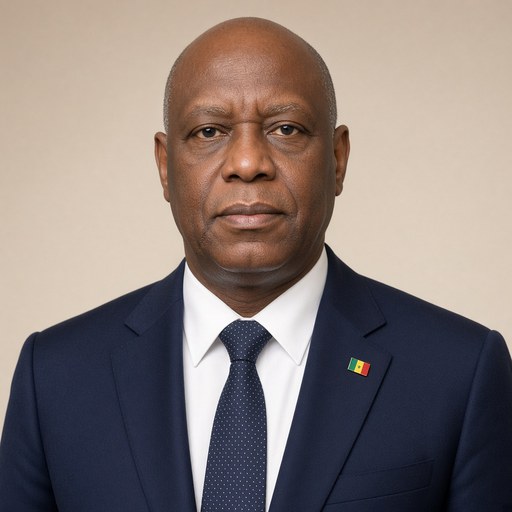
Address by H.E. President Macky Sall on the Occasion of the Presentation of His Book Africa, leading from the heart.
 Macky Sall · President of Senegal
- Context
- Sall addressed a gathering of international dignitaries at the presentation of his book 'Africa, Leading from the Heart' in September 2025.
- Main themes
- African development and potential, pan-Africanism, colonial legacy and independence, united African voice, natural resources and economic opportunity, Africa's youth and resilience, global partnerships, public leadership and governance, energy access, international justice and equity, book launch and personal vision
- Duration
- ~11 min
- Words
- 1,286
- Sentences
- 71
- Readability
- 48
- Grade
- 11.0
- Syntax
- 2.76
- Vocabulary
- 2.28
The broad sphere of national life a sentence belongs to. Every sentence has an Arena, so it is the denominator the other indices are read against.
Other71 sentences in 4 paragraphs
Excellencies:
Dear Ban Ki-moon, former Secretary-General of the United Nations, Dear sister Ameenah Gurib-Fakin, former President of Mauritius, Dear friend Charles Michel, former President of the European Council, Dear brother Yusuf Tuggar, Nigeria’s Minister of Foreign Affairs, Dear brother Moussa Faki Mahamat, Special Envoy for the 4P (the Pact for Prosperity, People and the Planet), former Chairperson of the African Union Commission, My dear wife Marème and family, Ladies and gentlemen, distinguished guests, All protocols observed,
Thank you all for graciously accepting my invitation. I am deeply grateful to each of you for taking the time to be here. Africa stands at the crossroads. The world is at the crossroads. Thank you for being here today, to stand with Africa. With this new book, I share my vision directly from the heart. I know all of you who believe in Africa. You also lead from the heart. Because when we do, we move forward for the people of Africa. The potential of our continent is incomparable. And if we do lead from the heart, Africa’s bright future becomes unstoppable.
I would first like to place Africa at Heart in its historical context to help explain its purpose and its global resonance. I belong to a generation of Africans born after independence, at the end of a long and painful cycle of colonial domination. Our generation was nourished by the struggle of our illustrious pioneers, whom Amadou Hampâté Bâ called “the Eldest Sons of the 20th Century in Africa.” Their fight for Africa’s independence and for the recognition of its rightful place in the community of nations left a lasting impression on us and inspired us. It was this intellectual, political, and trade union ferment that prepared me for, and led me into, politics. That is the raison d’être of my book. Africa at Heart is essentially focused on the challenges of the continent and the means to address them in a rapidly changing global context. It is neither a complaint nor a lament, but the story of an African citizen about Africa a plea for a rejuvenated and more united Africa; an Africa free from the prejudices and injustices of a world order that slows its march toward development. I do not claim to speak on behalf of Africa. I mainly wanted to share active militancy and the experience of a public life spanning several years in the service of Senegal and Africa. This is the purpose of the 23 chapters I present in the book. They cover issues that I often addressed during my tenure as President of Senegal and in my mandates on behalf of Africa, notably as Chair of the NEPAD Heads of State and Government Orientation Committee (New Partnership for Africa’s Development) and as Chairperson of the African Union. Clearly, these issues remain relevant. They concern us as citizens, public and private leaders, intellectuals, young and old alike. They especially call for advocacy and action. That is what motivated me to publish Africa at Heart. In it, I speak of public action that positively impacts the daily lives of our people. I recall the radiant smile of a child in Tomboronkoto, in southeastern Senegal, who discovered electricity for the first time in 2021 when I came to connect his village to the national power grid as part of an economic tour. I speak of a panafricanism of action, for an Africa that must remain standing and resolute, despite the weight of history and the injustices of the present. I speak of an Africa that must assert itself as a conscious actor of its potential, open to all horizons, for co-constructed, fair, and equitable partnerships. We know the usual narratives about Africa Africa of conflicts, poverty, and disease; Africa divided, exploited, and marginalized on the international stage. We cannot deny this Africa of problems. But there is also an Africa of solutions, which refuses the fatality of underdevelopment. Africa of solutions is its vibrant and creative youth, who undertake and succeed; it is its millions of men and women who wake up early, go to bed late, and work hard to feed, educate, and care for their families; it is its businesspeople who invest, innovate, create wealth, and generate jobs. Africa of solutions is a continent rich in natural resources: 30 million km², nearly 60% of the world’s untapped arable land, 15% of global forest resources, and 30% of the world’s mineral reserves, including critical minerals essential to the energy transition. Even better, our continent is not only a land of natural resources. It is also a crucible of ideas, cultures, and vibrant energies. Its women and men embody hope, resilience, creativity, and innovation. Africa is young, vibrant, and plural. It is a continent in motion, looking to the future. Whether in peace, security, sustainable development, or social justice, Africa is at the center of major global issues. For this place to be fully recognized, we must speak with a united and more ambitious voice. Africa must not be seen as a problem to solve, but as a solution under construction an Africa that is the actor of its own destiny, refusing to be at the periphery of the world. To achieve this, there is no room for resignation. We must now, more than ever, be and remain in the time of action. Africa must be a strategic actor, a driver of global transformation, a credible partner in the quest for a better future for itself and for the world. But this Africa of solutions will only flourish and prosper if we succeed in correcting the imbalances of an eighty-year-old world order, which takes into account neither the needs nor the interests of our continent. My deep conviction is that, regardless of their efforts, our countries cannot develop without reforming global political, economic, and financial governance. In this global governance, Africa cannot remain on the sidelines of decisions taken elsewhere and in its name. Through this book, I reaffirm my commitment to think about Africa in the world and the world with Africa. Above all, I want to call for collective mobilization: that of public and private decision-makers, civil society, intellectuals, and especially youth, to build a new awareness, based on a shared, inclusive, and sustainable vision of our common destiny. When I talk about global governance, I am not calling for a revolution, but I am calling for a necessary evolution of the decision-making bodies of the United Nations, the IMF, and the World Bank. We must welcome Africa’s admission to the G20 and the granting of a third seat to the continent on the IMF Board of Directors. But many concerns still remain. I think of the biased ratings by rating agencies, which considerably increase the cost of access to credit for our countries. I think of the unbearable burden of Africa’s debt for decades, with no prospect of a comprehensive and lasting solution. I think of the obstacles to a just and equitable energy transition, which would allow Africa to contribute to the fight against global warming without compromising its development efforts. These are some of the issues I addressed in this book. I know they are all complex and weighty. Nevertheless, I remain optimistic. I believe in the emergence of a united, peaceful, and stable Africa, confident in itself and in its youth. That is why this book is also a message to Africa and its youth. To all the young people of Africa, I say: believe in yourselves! The future belongs to you! Educate yourselves. Dare to undertake, to fulfill yourselves and to contribute to writing the future of our continent. The Africa of tomorrow will be what you make of it. Thank you for your kind attention.