




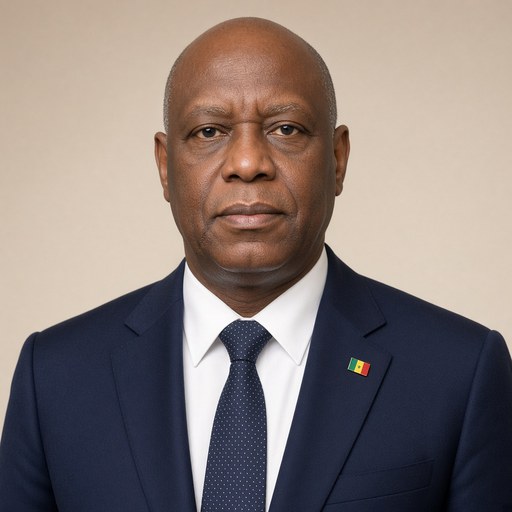
Speech by H.E. President Macky Sall at the Crans Montana Forum on International Cooperation in Maritime Security
 Macky Sall · President of Senegal
- Context
- Sall addressed the Crans Montana Forum on International Cooperation in Maritime Security in April 2025, speaking on global maritime threats and African maritime governance.
- Main themes
- Maritime security and safety, international cooperation, African maritime governance, piracy and illicit trafficking, freedom of navigation, port infrastructure and development, landlocked countries' sea access, African Charter on Maritime Security, Senegal-Morocco relations, transnational threats, global trade and maritime transport, human dimension of ports
- Duration
- ~7 min
- Words
- 827
- Sentences
- 32
- Readability
- 30
- Grade
- 15.4
- Syntax
- 3.35
- Vocabulary
- 2.38
The broad sphere of national life a sentence belongs to. Every sentence has an Arena, so it is the denominator the other indices are read against.
Other32 sentences in 24 paragraphs
Ladies and Gentlemen, Dear friends,
Before anything else, I would like to extend my fraternal greetings to His Majesty King Mohammed VI, may God assist him, and renew my best wishes for his good health, long life, and continued success in carrying out his eminent responsibilities in the service of the friendly and brotherly Moroccan people.
Senegal and Morocco share a strong centuries-old friendship, built on common values, a convergence of views on all matters of strategic interest, and intense cooperation in various sectors, including maritime affairs.
I had the opportunity to visit the Port of Tanger Med in November 2019. I still have fond memories of a world-class logistics hub a symbol and showcase of an ambitious Africa determined to claim its rightful place on major global maritime routes.
In the same spirit, I am pleased to take part, for the first time, in this Crans Montana Forum meeting. This is a commitment I am fulfilling to Ambassador Jean-Paul Carteron , who has been kindly inviting me to every edition of the Forum for over two decades.
Ambassador, thank you for your kind invitation and for your persistence.
In a world plagued by wars and multiple tensions, the issue of maritime safety and security is undoubtedly a key component of the broader global security challenge.
Maritime routes continue to face serious threats: armed conflicts, piracy, illicit trafficking of all kinds, geostrategic rivalries, and more.
The consequences of these threats are damaging in several ways: ships are forced to abandon their usual routes and make long detours to avoid insecure zones, leading to significant additional costs. This results in higher prices for consumers, environmental harm from increased carbon emissions due to longer distances, and deep disruptions to trade.
Yet maritime transport accounts for more than 80% of global trade, making ports not only unique levers for commerce and development but also frontlines in defending our economic and human security.
Therefore, while the sea represents an open gateway to the world and vast opportunities, we must ensure this openness does not become a security vulnerability.
Securing our maritime coastlines means protecting our people, resources, ecosystems, and critical infrastructure; it also means safeguarding the freedom of navigation and jointly combating transnational threats.
These major challenges require enhanced collaboration between countries through information sharing, pooling of naval capabilities, and coordination between defense and security forces and port services.
That is why we must continue to invest not only in maritime infrastructure, but also in security and safety, personnel training, digital resilience, and protection of port stakeholders — the essential sentinels of international trade.
Let us not forget that ports are also places of humanity and crossroads of encounters. Every day, millions of men and women — seafarers, dockers, traders, logisticians, and transporters — from diverse backgrounds, meet, exchange, and work together there.
Indeed, amidst the hustle of loading and unloading, the paperwork and procedures, and the vital shipyard operations, there is an irreducible human element that brings ports to life and gives them rhythm and soul.
I would also like to recall that the topic uniting us here is being addressed at the continental level, through the African Charter on Maritime Security and Safety , adopted by the African Union Extraordinary Summit in October 2016 in Lomé.
This regional legal instrument embodies the commitment of African countries to make their maritime zones areas of peace, security, and sustainable development.
It specifically aims to promote the fight against piracy, illegal fishing, illicit trafficking, and pollution, through strengthened cooperation in information sharing, respect for international law, and integration of maritime issues into security and development policies. I believe that a country like Morocco, known for its leadership in these areas, can certainly help better promote this Charter in coordination with the African Union Commission.
Furthermore, I wish to draw the Forum’s attention to the importance of fully considering the situation of landlocked countries , in line with relevant provisions of the United Nations Convention on the Law of the Sea — rightly called the “Constitution of the Seas” due to its universal purpose of making maritime spaces places of cooperation in a spirit of good neighborliness, ensuring these countries’ legitimate right to free and secure access to the sea.
Indeed, the Montego Bay Convention reminds us that the sea is not just a matter for coastal countries. It also concerns landlocked nations whose access to maritime corridors is vital for inclusion, trade, and economic development.
Ladies and Gentlemen, dear friends,
In terms of trade for development, it is undoubtedly through the sea that Africa will gain greater prominence in global exchanges.
And it is through modern ports that fully meet security and safety requirements that we will succeed in making our countries indispensable links in the global maritime logistics chain. I am confident that, through your combined expertise, you will make a significant contribution to this legitimate ambition. I strongly encourage you in this endeavor and thank you for your kind attention.