




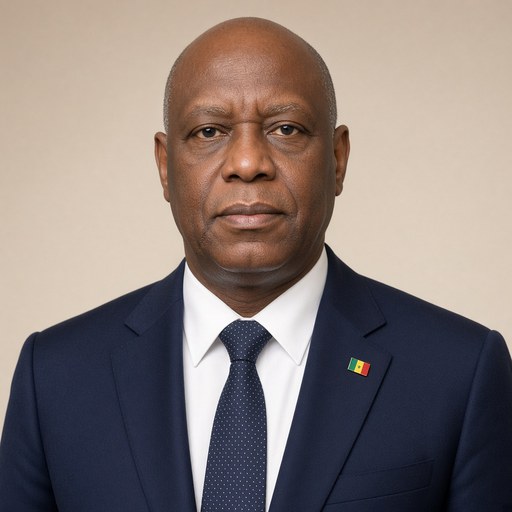
Statement by H.E. Macky Sall at the Panel “Multilateralism in Crisis: Rethinking Global Cooperation” – Baku Forum 2026
 Macky Sall · President of Senegal
- Context
- Sall addressed the Baku Forum 2026 panel on multilateralism in crisis on March 13, 2026, calling for renewed global cooperation frameworks.
- Main themes
- Multilateralism reform, global cooperation, peace and security, development cooperation, reducing inequalities, UN reform, climate and global challenges, dialogue and diplomacy, investment over aid, women and youth empowerment, geopolitical tensions
- Duration
- ~5 min
- Words
- 551
- Sentences
- 32
- Readability
- 22
- Grade
- 14.5
- Syntax
- 2.76
- Vocabulary
- 2.41
The broad sphere of national life a sentence belongs to. Every sentence has an Arena, so it is the denominator the other indices are read against.
Other32 sentences in 25 paragraphs
Ladies and Gentlemen, Dear Friends,
First, allow me to thank our friend Rovshan Mudarov for his kind invitation. I would also like to congratulate the authorities of Azerbaijan for the inclusive spirit of the Baku Forum, and for the theme of this year’s edition, whose relevance speaks for itself in light of the current state of the world.
Conflicts and geopolitical tensions persist. Economic vulnerabilities are deepening. Global challenges especially those related to climate, health, and technology are becoming increasingly complex.
Confidence in collective action is eroding, and the effectiveness of the multilateral system is increasingly being questioned.
Yet despite these difficulties, I firmly believe that multilateralism remains the best framework for addressing challenges that go beyond the capacities of individual nation-states.
The current crisis only makes one thing clearer: we need more dialogue, not less. We need dialogue to find common solutions to our shared problems within the framework of a renewed and pragmatic multilateralism.
In my view, responding to the crisis of multilateralism and rethinking global cooperation requires three major priorities.
First, we must promote an integrated approach to peace, security, and development.
There can be no lasting peace without inclusive development. And development cannot be sustainable in a context of conflict and instability.
Strengthening the foundations of peace therefore requires better crisis prevention, more efficient peace operations, and stronger coordination between the United Nations and regional organizations and mechanisms.
At the same time, development cooperation itself needs to evolve.
Public development aid remains valuable as an instrument of solidarity, particularly in sectors such as education and health. But aid is limited in scale and often slow in its procedures, while development requires massive and urgent investment.
For this reason, we need a shift in paradigm one that places greater emphasis on partnerships based on investment and trade, in order to foster shared growth and shared prosperity.
Second, we must revitalize multilateralism.
This is essential if we want to restore confidence in the system through a diplomacy based on dialogue, listening, and compromise.
Dialogue, listening, and compromise can only flourish within a renewed and inclusive multilateral framework, capable of reconciling different perspectives, bridging distant positions, and promoting negotiated solutions.
This is why reforming the multilateral system especially the United Nations is so important in order to strengthen its operational effectiveness.
This reform should aim to rationalize field operations, avoid duplication, and modernize working methods, including through greater use of technological tools to optimize the use of financial resources.
Third, and finally, we must place people back at the center of multilateralism.
Reducing inequalities, empowering women, and investing in youth must remain central priorities of the international agenda, because women and young people together represent more than half of humanity.
In conclusion, rethinking global cooperation in a time of crisis for multilateralism reminds me of the attitude of a good doctor when facing a patient with a fever.
A good doctor knows that breaking the thermometer will not make the fever disappear. The real task is to treat the illness that causes the fever.
Likewise, the solution to the crisis of the multilateral system is not fragmentation.
The real solution is to revitalize multilateralism to preserve its unity, strengthen its credibility and moral authority, improve its effectiveness, and adapt its mechanisms to the realities of today and tomorrow.
Thank you.