




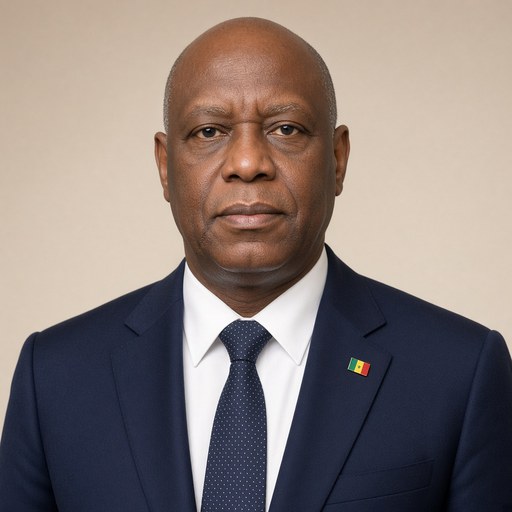
GLOBAL SOLUTIONS SUMMIT 2025: Speech by H.E. President Macky Sall, Africa in Contemporary Multilateralism
 Macky Sall · President of Senegal
- Context
- Sall addressed the Global Solutions Summit 2025 on May 6, presenting Africa's perspective on contemporary multilateralism and the continent's key challenges.
- Main themes
- Multilateralism reform, Africa's role in global governance, peace and security in Africa, counterterrorism in the Sahel, economic development and fair global order, climate change and energy transition, just energy transition partnerships, African Continental Free Trade Area, international cooperation reimagined, climate finance for Africa, credit ratings and investment risk, African Peace and Security Architecture
- Duration
- ~9 min
- Words
- 1,102
- Sentences
- 51
- Readability
- 27
- Grade
- 14.9
- Syntax
- 3.08
- Vocabulary
- 2.32
The broad sphere of national life a sentence belongs to. Every sentence has an Arena, so it is the denominator the other indices are read against.
Other51 sentences in 44 paragraphs
Ladies and Gentlemen, Dear Friends,
First of all, I would like to thank our friend Christian Kastrop for his kind invitation and for the warm welcome I have received.
I congratulate Global Solutions for organizing this Summit. In a world plagued by tensions and uncertainties, it is both timely and vital to create spaces for dialogue to jointly reflect on possible ways out of the crisis.
In the face of urgent challenges, the course of history has once again become uncertain. The multilateral system, born from the ashes of war to promote peace, shared progress, and solidarity among nations, is now showing its limits. It is struggling to provide coordinated responses to contemporary challenges.
Indeed, multilateral institutions appear frozen, while conflicts both old and new persist, each more devastating than the last; terrorist threats remain; COPs continue to take place (29 in total), yet climate change worsens; and the world is experiencing a major trade war, even as it was still recovering from the post-COVID economic crisis.
In this context of deep crises and transformations, Africa continues to face several challenges. I will limit myself here to four major ones.
First challenge: peace, security, and stability.
In addition to ongoing conflict situations, terrorism is becoming endemic on the continent, especially in the Sahel.
For years, Africa has consistently warned that traditional peacekeeping operations are not suited for counterterrorism, due to inadequate mandates and resources. The premature termination of some operations, in anger and misunderstanding, is evidence of this.
This is why we have always advocated for more robust mandates and better-calibrated means to fight terrorism within the framework of the African Peace and Security Architecture, with logistical and financial support from the United Nations and partner countries.
This is the price we must pay to defeat terrorism, or at least to significantly reduce its capacity to act.
It is in our shared interest because the persistence of terrorism in Africa constitutes a global threat, which falls under the responsibility of the Security Council the guarantor of the collective security system.
Second challenge: economic development.
With its 30 million square kilometers, demographic weight, and wealth in mineral, water, energy, and land resources (60% of the world’s uncultivated arable land), Africa has the necessary potential to support its development efforts and contribute to global growth.
This requires sound public policies, but also a more just and equitable global economic order.
Development dynamics are hindered when taxes are not paid where wealth is created due to abusive tax exemptions, and when credit ratings are skewed by increasingly challenged criteria and methodologies. In Africa, the perceived investment risk is often higher than the actual risk, which raises borrowing costs due to particularly high insurance premiums.
In my view, it is time to rebuild international cooperation on reimagined paradigms, including:
I believe that today’s Africa needs fair rules and equitable partnerships more than limited and inefficient official development assistance.
For example, just for infrastructure, the African Development Bank estimates Africa’s needs at between 130 and 170 billion dollars per year.
While we must acknowledge and value the achievements made within traditional partnerships, Africa will continue to open up to new partnerships without exclusivity or exclusion—to diversify its prospects for economic and social development.
All of this, along with the progressive establishment of the African Continental Free Trade Area, will contribute to a new doctrine of cooperation based on shared values, joint solutions, and mutually beneficial interests, free from ideological or socio-cultural conditionalities.
Third challenge: the energy transition in the context of climate change.
According to the principle of common but differentiated responsibilities, Africa is fully committed to the fight against climate change.
Across the continent, low-carbon and climate-resilient projects are emerging.
But the continent that pollutes the least cannot be forced to choose between development and environmental protection, or to go into debt to bear alone the cost of adaptation.
It is therefore urgent to mobilize the necessary financial resources for climate action, particularly within the framework of Just Energy Transition Partnerships.
Furthermore, for fairness and justice, we must avoid unilateral decisions such as the one taken at COP26 in Glasgow banning foreign financing of fossil energy sources even those with low emissions, like gas while some industrialized countries continue to use far more polluting energies like coal.
Let me recall that the African Union, the African Development Bank, and the Global Center on Adaptation launched the Africa Adaptation Acceleration Program (AAAP) in 2021.
This ambitious initiative aims to mobilize 25 billion dollars to strengthen Africa’s climate resilience in key sectors, including agriculture, infrastructure, youth and entrepreneurship, and finance and governance.
As Chair of the Global Center on Adaptation Oversight Board, I call on bilateral and multilateral partners to support the second phase of the AAAP initiative for the 2026–2030 period.
Fourth and final challenge: reforming global governance.
The ideal behind multilateralism is to promote collaborative, inclusive, and solidarity-based relationships between countries of unequal strength.
In this spirit, it is fair to acknowledge the services rendered by the United Nations and Bretton Woods systems to their member states.
But 80 years after its creation, post-war multilateralism is becoming obsolete, as it no longer meets the realities and needs of its time.
For more than three-quarters of member states, this is a source of inequality that feeds frustration and challenges to the system.
The gradual expansion of the BRICS in the Global South illustrates the discomfort of a system at risk of fragmentation if not reformed.
We should not move toward a world of competing or even antagonistic multipolarities. Wisdom calls for a rethinking of global political, economic, and financial governance to make it more representative of today’s world.
The G20 has shown the way by admitting the African Union as a full member an initiative led by Senegal during its chairmanship of the African Union.
The granting of a third seat to Africa on the IMF Executive Board is also a step in the right direction.
It is important that other institutions, like the UN Security Council and the World Bank, follow these examples to help create a more inclusive, legitimate, and effective multilateral system.
Ladies and Gentlemen, dear friends,
In a world shaken by so many upheavals, we must not give up hope not a passive hope, but an active one; a hope rooted in courageous dialogue, the strength of cooperation, and faith in our shared humanity.
In the face of global challenges, only a new, clear-eyed and humanistic awakening will allow us to heal divisions, ease anger and tensions, and promote solidarity-based cooperation founded on our common values and respect for our differences.
Thank you.