




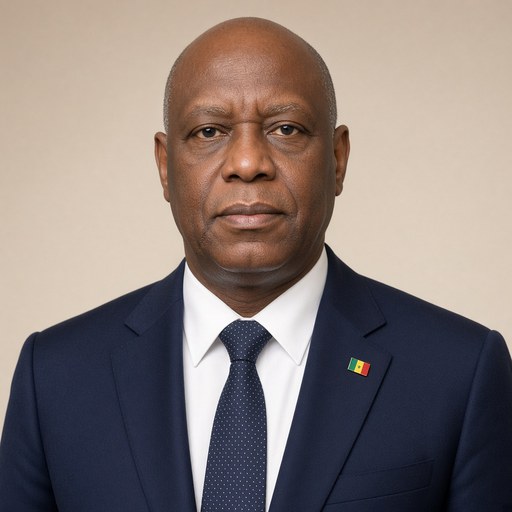
Opening ceremony of the 6th World Forum on the Social Solidarity Economy
 Macky Sall · President of Senegal
- Context
- Sall addressed the 6th World Forum on the Social Solidarity Economy on May 4, 2023, held for the first time on African soil in Dakar, Senegal.
- Main themes
- Social and solidarity economy, sustainable development, poverty and social marginalization, youth and women empowerment, informal to collective economy transition, decentralized cooperation, local governments and municipalities, African development, UN resolution on SSE, entrepreneurship and access to credit, international solidarity, SDGs financing
- Duration
- ~10 min
- Words
- 1,224
- Sentences
- 49
- Readability
- 27
- Grade
- 15.3
- Syntax
- 3.20
- Vocabulary
- 2.31
Translated from French
The broad sphere of national life a sentence belongs to. Every sentence has an Arena, so it is the denominator the other indices are read against.
Other49 sentences in 48 paragraphs
Mr. Prime Minister,
Ladies and gentlemen Ministers,
Mr. Mayor of Bordeaux, President of the Global Forum on Social Economy,
Mr. Mayor of the city of Dakar,
Ladies and gentlemen Mayors who are members of the Global Forum on Social Economy,
Ladies and gentlemen Presidents and Directors of Global Networks of Social and Solidarity Economy,
Ladies and gentlemen members of the Diplomatic Corps,
Ladies and gentlemen local and territorial elected officials,
Dear guests,
On behalf of Senegal, I would like to greet our hosts and thank them for graciously accepting our invitation to participate in this 6th edition of the Global Forum on Social and Solidarity Economy, which is being held for the first time on African soil.
I wish a warm welcome to all of you and a pleasant stay among us. I am delighted, for many reasons, to preside over this ceremony.
First, as a former Mayor, I understand the crucial role of social and solidarity economy as a tool in the fight against poverty and social marginalization.
Secondly, from this grassroots experience, I believe in the collaboration between the State and its subdivisions: cities, municipalities, local authorities, and other local governments, to strengthen the productive capacities of vulnerable social groups, particularly youth and women.
Finally, I am convinced of the usefulness of decentralized cooperation as a means of exchanging experiences on best practices, and as a mechanism of solidarity beyond national borders.
That is why, a few years ago, I, along with Mr. Khalifa Ababacar Sall, then Mayor of Dakar, promoted to the African Union the Pan-African Organization of United Cities and Local Governments of Africa (CGLUA).
It is in the same continuity that I supported the request of Ms. Soham WARDINI, at the time Mayor of the city of Dakar, to host this 6th edition of the Global Forum on Social and Solidarity Economy.
Ladies and gentlemen,
The social and solidarity economy, which refers to enterprises organized in the form of cooperatives, mutuals, associations, or foundations, whose functioning and activities are based on a principle of solidarity and social utility, is a reality at the heart of society.
Here in Senegal, the social and solidarity economy has long been practiced, with the so-called tontine system, where members come together by affinity to contribute and take turns recovering their investment.
It is therefore encouraging that the United Nations General Assembly adopted, on April 18, its very first resolution on the promotion of social and solidarity economy in the service of sustainable development.
The resolution particularly encourages multilateral, international, and regional financial institutions, as well as development banks, to participate in the efforts of member states to achieve the Sustainable Development Goals, through existing and new financial instruments and mechanisms, suitable for all stages of development.
I am particularly pleased about this because this text aligns with the advocacy I have consistently made during my term at the head of the African Union, for:
This means that in a context of exacerbated crisis, the solidarity economy must also be applied at the international level to enable states to have additional resources to support their internal efforts.
As the world continues to suffer the cumulative consequences of the pandemic and the invasion of Ukraine, I invite your Forum to draw the attention of partner countries and institutions to the particular situation of developing countries whose structurally weak economies are undoubtedly the most destabilized by the crisis.
In the face of unprecedented challenges, innovative and solidarity-based responses are needed for a fairer and more inclusive world.
By placing your meeting under the theme of the transition from informal economies to collective and sustainable economies for our territories, you have chosen to address current issues, including, among others:
This dialogue seems essential to me, because clearly the State cannot do everything alone; but without it, its subdivisions, namely cities, municipalities, and other local authorities and governments, would not be able to do anything.
Hence the necessity to establish and maintain a constructive dialogue in mobilizing means of action for the benefit of target populations.
On the other hand, I note with interest the priority you have given to youth and women through the pre-Forum dedicated to them.
This is an excellent initiative.
Indeed, in all countries, albeit to varying degrees, youth and women remain among the most vulnerable social groups, particularly in terms of empowerment, access to employment and other income-generating activities, wage treatment, and access to credit.
That is why, regarding Senegal, I established in 2018 the Delegation for Women and Youth Entrepreneurship (DER/FJ) to assist in their economic integration by providing loans, including nano credits, under soft conditions, as well as through support and advice.
The DER/FJ is part of our vision of a solidarity-based development founded on social justice and territorial equity, of which other instruments include the Emergency Community Development Program (PUDC), the Emergency Modernization Program for Border Axes and Territories (PUMA), Family Security Scholarships, and Universal Health Coverage.
Ladies and gentlemen,
As I review the sub-themes of your Forum, I also realize that sustainable development, through the promotion of the green economy, is at the heart of your agenda.
This makes sense since climate change now poses an existential threat to planet Earth, our common habitat.
At the same time, it makes sense to take into account the common but differentiated responsibility of countries in the face of the climate peril.
What I mean is that while we must all work towards achieving sustainable development through low-carbon economic policies, it is just and equitable to recognize the differences.
The least polluting countries, which suffer the most from the effects of climate change, and which are the furthest behind in the industrialization process, cannot bear the same responsibilities as industrialized countries whose production patterns, since the industrial revolution at the end of the 18th century, have progressively plunged the planet into the current state of climate emergency.
This is the essence of the demand from developing countries for a just and equitable energy transition, allowing them to have access to basic energy to improve their economic competitiveness and achieve universal access to electricity.
For example, I would like to remind you that more than 600 million Africans still live without electricity.
This indicates, ladies and gentlemen, that the issues you will address here, each as impactful as the other, show that beyond the social and solidarity economy, your Forum raises essential questions that call us to solidarity.
All of us, together, countries of the North and the South, state and local authorities, private sector, opinion leaders, and citizens, must remain mobilized to contribute to the search for concerted and effective solutions.
I hope that your meetings will allow us to lay another milestone in this direction, for a better world, because it is fairer and more solidary.
I congratulate Ms. Minister of Microfinance and Social and Solidarity Economy, Victorine Ndèye, and all her teams for the efforts dedicated to the preparation of the Forum.
I also want to thank and congratulate the Mayor of the city of Dakar, Mr. Barthélemy Dias, as well as the Network of actors and local authorities of the Social and Solidarity Economy for their contribution to the organization of the meeting.
I now declare the 6th edition of the Global Forum on Social and Solidarity Economy open, and wish you great success in your work.
Thank you.
The original French. The tags above are read on the English translation's sentences.
Monsieur le Premier Ministre ,
Mesdames, Messieurs les Ministres,
Monsieur le Maire de Bordeaux, Président du Forum mondial de l’économie sociale,
Monsieur le Maire de la ville Dakar,
Mesdames, Messieurs les Maires membres du Forum mondial de l’économie sociale,
Mesdames, Messieurs les Présidents et Directeurs des Réseaux mondiaux de l’économie sociale et solidaire,
Mesdames, Messieurs les membres du Corps diplomatique,
Mesdames, Messieurs les élus locaux et territoriaux,
Chers invités,
Au nom du Sénégal, je voudrais saluer nos hôtes et les remercier d’avoir bien voulu répondre à notre invitation en prenant part à cette 6 e édition du Forum mondial de l’économie sociale et solidaire, qui se tient pour la première fois en terre africaine.
A toutes et à tous je souhaite la bienvenue et un agréable séjour parmi nous. Je me réjouis, à plus d’un titre, de présider cette cérémonie.
D’abord, en tant qu’ancien Maire, je mesure le rôle crucial de l’économie sociale et solidaire comme instrument de lutte contre la pauvreté et la marginalisation sociale.
Ensuite , de par cette expérience à la base, je crois à la collaboration entre l’Etat et ses démembrements : villes, communes, collectivités territoriales et autres gouvernements locaux, pour le renforcement des capacités productives des couches sociales vulnérables, en particulier les jeunes et les femmes.
Enfin, je suis convaincu de l’utilité de la coopération décentralisée comme moyen d’échange d’expérience sur les meilleures pratiques, et comme mécanisme de solidarité au-delà des frontières nationales.
Voilà pourquoi j’avais porté il y a quelques années, avec Monsieur Khalifa Ababacar Sall , alors Maire de Dakar, la promotion auprès de l’Union Africaine de l’Organisation panafricaine des Cités et Gouvernements locaux unis d’Afrique (CGLUA).
C’est dans la même continuité que j’avais appuyé la requête de Mme Soham WARDINI , à l’époque Maire de la ville de Dakar, pour accueillir chez nous cette 6 e édition du Forum mondial de l’économie sociale et solidaire.
Mesdames, Messieurs,
L’économie sociale et solidaire, qui désigne les entreprises organisées sous forme de coopératives, mutuelles, associations, ou fondations, dont le fonctionnement et les activités reposent sur un principe de solidarité et d’utilité sociale, est une réalité au cœur de la société.
Ici au Sénégal, l’économie solidaire et sociale se pratique de longue date, avec la formule dite tontine, dont les membres se retrouvent par affinité, pour cotiser et récupérer leur mise à tour de rôle.
Il est donc heureux que l’Assemblée générale des Nations Unies, ait adopté, le 18 avril dernier, sa toute première résolution sur la promotion de l’économie sociale et solidaire au service du développement durable.
La résolution encourage notamment les institutions financières multilatérales, internationales et régionales, ainsi que les banques de développement, à participer aux efforts des Etats membres pour réaliser les Objectifs du développement durable, au moyen d’instruments et de mécanismes financiers, existants et nouveaux, adaptés à tous les stades du développement.
Je m’en réjouis particulièrement parce que ce texte va dans le sens du plaidoyer que j’ai constamment fait durant mon mandat à la tête de l’Union Africaine, pour :
C’est dire que dans un contexte de crise exacerbée, l’économie solidaire doit également s’appliquer à l’échelle internationale pour permettre aux Etats de disposer de ressources additionnelles en appui à leurs efforts internes.
Alors que le monde continue de subir de plein fouet les conséquences cumulées de la pandémie et de l’invasion de l’Ukraine, j’invite votre Forum à attirer l’attention des pays et Institutions partenaires sur la situation particulière des pays en développement dont les économies, structurellement faibles, sont assurément les plus déstabilisées par la crise.
Face à des défis inédits, il faut des réponses innovantes et solidaires pour un monde plus juste et plus inclusif.
En plaçant votre rencontre sous le thème de la transition des économies informelles vers des économies collectives et durables pour nos territoires , vous avez voulu aborder des sujets d’actualité, dont, entre autres :
Ce dialogue me parait indispensable, parce qu’à l’évidence l’ Etat ne peut tout faire à lui seul ; mais sans lui, ses démembrements que sont les villes, communes et autres collectivités et gouvernements locaux ne pourraient rien faire.
D’où la nécessité d’instaurer et maintenir un dialogue constructif dans la mobilisation des moyens d’action au bénéfice des populations cibles.
D’autre part, je note avec intérêt la priorité que vous avez accordée aux jeunes et aux femmes à travers le pré Forum qui leur a été dédié.
C’est une excellente initiative.
En effet, dans tous les pays, certes à des degrés divers, les jeunes et les femmes restent parmi les couches sociales les plus vulnérables, notamment en matière d’autonomisation, d’accès à l’emploi et autres activités génératrices de revenus, de traitement salarial, et d’accès au crédit.
C’est pourquoi, s’agissant du Sénégal, j’ai mis en place en 2018 la Délégation à l’Entreprenariat des Femmes et des Jeunes (DER/FJ) pour aider à leur insertion économique par l’octroi de prêts, y compris des nano crédits, à des conditions douces, mais également par l’encadrement et le conseil.
La DER/FJ s’inscrit dans notre vision d’un développement solidaire fondé sur la justice sociale et l’équité territoriale, dont les autres instruments sont le Programme d’Urgence de Développement communautaire (PUDC), le Programme d’Urgence de Modernisation des Axes et Territoires frontaliers (PUMA), les Bourses de Sécurité familiale et la Couverture Maladie Universelle.
Mesdames, Messieurs,
En parcourant les sous-thèmes de votre Forum, je me rends également compte que le développement durable, à travers la promotion de l’économie verte, est au cœur de votre agenda.
Cela a du sens puisque le réchauffement climatique constitue désormais une menace existentielle pour la planète terre, notre habitat commun.
En même temps, il y a du sens à tenir compte de la responsabilité commune mais différenciée des pays face au péril climatique.
J’entends par là que si nous devons tous œuvrer à la réalisation du développement durable par des politiques économiques sobres en carbone, il est juste et équitable de faire la part des choses.
Les pays les moins pollueurs, qui subissent le plus les effets du réchauffement climatiques, et qui sont les plus en retard sur le processus d’industrialisation, ne peuvent pas porter les mêmes responsabilités que les pays industrialisés dont les schémas de production, depuis la révolution industrielle à la fin du 18 e siècle, ont progressivement plongé la planète dans l’état d’urgence climatique actuel.
C’est tout le sens de la revendication des pays en développement pour une transition énergétique juste et équitable, leur permettant de disposer d’une énergie de base pour améliorer leur compétitivité économique et réaliser l’accès universel à l’électricité.
A titre d’exemple, je rappelle que plus de 600 millions d’africains vivent encore sans électricité.
C’est dire, mesdames, messieurs, que les problématiques que vous aborderez ici, aussi percutantes les unes que les autres, montrent qu’au-delà de l’économie solidaire et sociale, votre Forum pose des questions essentielles qui nous interpellent solidairement.
Tous, ensemble, pays du Nord et du Sud, autorités étatiques et locales, secteur privé, leaders d’opinion et citoyens, nous devons rester mobilisés pour contribuer à la recherche de solutions concertées et efficaces.
J’espère que vos assises nous permettront de poser un jalon de plus dans ce sens, pour un monde meilleur, parce que plus juste et plus solidaire.
Je félicite Madame le Ministre de la Microfinance et de l’Économie sociale et solidaire, Victorine Ndèye et l’ensemble de ses équipes pour les efforts consacrés à la préparation du Forum.
Je tiens également à remercier et féliciter le Maire de la ville de Dakar, Monsieur Barthélemy Dias , ainsi que le Réseau des acteurs et collectivités territoriales de l’Économie sociale et solidaire pour leur contribution à l’organisation de la rencontre.
Je déclare maintenant ouverte la 6 ème édition du Forum mondial de l’économie sociale et solidaire, et souhaite plein succès à vos travaux.
Je vous remercie .