




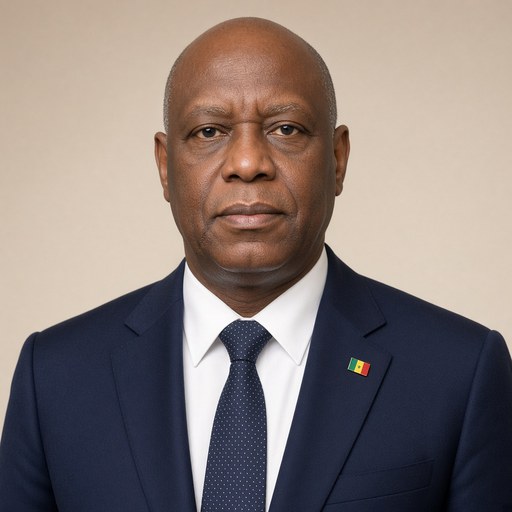
Universal Peace Federation Summit, Session I: Climate Change, Environmental Crisis, and the Future of the Earth, Speech by H.E. President Macky Sall
 Macky Sall · President of Senegal
- Context
- Sall addressed the Universal Peace Federation Summit's climate session on April 12, 2025, calling for climate justice and adequate financing for Africa.
- Main themes
- Climate change and Africa, climate justice and equity, Just Energy Transition Partnerships (JETPs), Africa Adaptation Acceleration Program (AAAP), climate finance and debt burden, Great Green Wall initiative, renewable energy transition, desertification and land restoration, greenhouse gas emissions responsibility, international climate commitments, food security, global solidarity
- Duration
- ~5 min
- Words
- 618
- Sentences
- 31
- Readability
- 42
- Grade
- 12.2
- Syntax
- 2.86
- Vocabulary
- 2.34
The broad sphere of national life a sentence belongs to. Every sentence has an Arena, so it is the denominator the other indices are read against.
Other31 sentences in 22 paragraphs
Dear colleagues,
Dear friends,
Ladies and gentlemen,
This session of our summit is dedicated to the great challenge of our time: climate change and the future of our planet.
There is no need to reiterate here the intensification of extreme climate events that threaten our ecosystems and endanger the lives of millions of people around the world.
These disruptions have become a daily reality across all continents. I will limit myself here to the case of Africa.
Although it is responsible for less than 4% of global greenhouse gas emissions, Africa remains the most exposed continent to the effects of climate change.
Faced with this injustice, African countries are striving to implement sustainable solutions through green projects, particularly in the areas of transportation and energy.
However, due to insufficient access to the funding promised under international commitments, these projects are most often financed by the countries themselves, at the cost of growing debt.
Thus, our countries, which contribute the least to the climate crisis, are forced to bear the cost of its consequences alone. This is a double penalty, a double injustice.
In the energy sector, the implementation of Just Energy Transition Partnerships (JETPs) in Africa represents an opportunity for an innovative and fair energy transition, through a gradual shift from fossil fuels to renewable energy, while taking into account local economic and social realities. Indeed, we must ensure that JETPs do not sacrifice jobs or development needs.
To be credible and effective, JETPs must prioritize concessional financing, encourage technology transfers, strengthen local capacities, and ensure inclusive governance. It is under these conditions that they can truly drive a just and sustainable energy transition in Africa.
At the regional level, the innovative Great Green Wall initiative, launched in 2005 by 11 countries in the Sahel-Saharan zone, aims to halt desertification through reforestation, restoration of degraded land, the development of agro-sylvo-pastoral activities, and the improvement of food security.
This initiative has now gained international recognition, notably through the One Planet Summit. Major funding pledges have been made, which is commendable. But what will make the difference is the rapid and effective disbursement of these resources for concrete actions, as close to communities as possible.
The challenge of adapting to climate change remains critical for Africa, with droughts, floods, and heatwaves continuing to impact the living conditions of millions of people.
I would like to pay tribute to Mr. Ban Ki-moon, former Secretary-General of the United Nations, for the remarkable work he accomplished as Chair of the Board of the Global Center on Adaptation, a position I am honored to now hold.
In partnership with the African Union and the African Development Bank, the Global Center on Adaptation launched in 2021 the Africa Adaptation Acceleration Program (AAAP). It is the most ambitious initiative of its kind. It aims to mobilize $25 billion to strengthen Africa’s climate resilience in four key areas: agriculture, infrastructure, youth and entrepreneurship, and finance and governance.
I issue an urgent call to all bilateral and multilateral partners to support the second phase of the AAAP initiative for the 2026–2030 period.
The fight against global warming must be a collective battle. Africa, the continent that pollutes the least, wants to contribute to the global effort to reduce greenhouse gas emissions; but it must not be forced to choose between development and environmental protection, nor should it fall into debt for bearing the cost of adaptation alone.
In return for its efforts, it is urgent to mobilize the necessary funds to finance climate action.
It is together, in a spirit of solidarity and partnership that meets the scale and urgency of the challenge, that we will be able to build a sustainable future for the planet.
Thank you.