




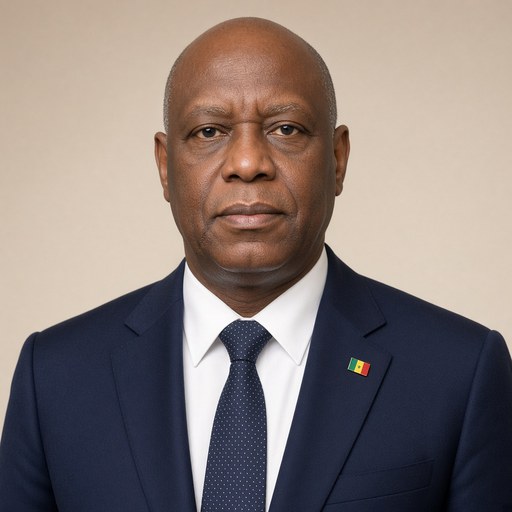
Universal Peace Federation Summit, Theme: Contemporary Challenges to the World Order: Establishing a New Era of Peace and Prosperity
 Macky Sall · President of Senegal
- Context
- Sall addressed the Universal Peace Federation Summit on April 11, 2025, speaking on contemporary challenges to the world order including peace, governance reform, and climate change.
- Main themes
- Global peace and conflict prevention, multilateralism reform, UN Security Council reform, global governance equity, Africa's representation in international institutions, climate change, international financial system reform, credit rating agencies and developing countries, African Debt Relief Initiative, poverty and inequality, BRICS Plus and Global South, dialogue and tolerance
- Duration
- ~5 min
- Words
- 600
- Sentences
- 31
- Readability
- 31
- Grade
- 13.5
- Syntax
- 3.13
- Vocabulary
- 2.27
The broad sphere of national life a sentence belongs to. Every sentence has an Arena, so it is the denominator the other indices are read against.
Other31 sentences in 17 paragraphs
Dear colleagues, Honorable Mother Moon, Dr. Charles Yang, President of the Universal Peace Federation, Ladies and Gentlemen,
First of all, I would like to thank you, Honorable Mother Moon and Dr. Charles Yang, for your kind invitation and warm welcome. It is a pleasure to take part in this summit of the Universal Peace Federation, the second one I have attended after hosting the first African Summit of the UPF in Dakar in January 2018. I also have fond memories of the Sunhak Peace Prize that your organization graciously awarded me in 2020.
That prize reflects our shared commitment to building a better world a peaceful, more just, and more united one.
But it must be said that the global context is worrying. Deadly conflicts, terrorism, and violent extremism persist. Climate change is worsening. Amid an unprecedented social and economic crisis, poverty is increasing and inequalities are deepening. We are experiencing major geopolitical upheavals whose consequences remain unpredictable.
Despite these numerous and complex challenges, we must keep faith in peace and in a better future for all.
Peace, as we know, is not just the absence of war. It is also built through dialogue, tolerance and mutual respect, justice, and solidarity.
To establish lasting global peace, there is no better approach than conflict prevention and inclusive management whether for latent or open conflicts.
As for me, I have always believed that in the face of global security threats, the Security Council as the guarantor of collective security under the United Nations Charter must play a more decisive role. This requires stronger mandates where needed, enhanced means of action, and greater support for regional mechanisms, particularly in Africa.
Another major challenge of our time is revitalizing multilateralism for a fairer and more equitable global governance system. International institutions created in the post-war context must evolve to better reflect 21st-century realities. That is why we advocate for reform of the Security Council and for fairer representation in international economic and financial institutions.
In this spirit, Africa’s admission as a member of the G20 following Senegal’s advocacy during its chairmanship of the African Union and the granting of a third seat for the continent on the IMF Board are two major steps forward in global governance.
The reform of the multilateral system is not only desirable; it is imperative to preserve its legitimacy and prevent its weakening, or even fragmentation, in the face of the rise of alternative frameworks, as seen with the growth of the BRICS Plus and the Global South.
Furthermore, there is an urgent need to reform international financial system mechanisms, including credit rating methods. Rating agencies should rely on more objective and transparent criteria, to more accurately reflect the economic realities of developing countries. Many studies have indeed shown that rating agencies tend to overstate risk perceptions in these countries, which leads to excessively high borrowing costs, limits investment capacity, and unfairly increases debt burdens.
This is why, under the leadership of President Olusegun Obasanjo, a group of former African Heads of State and Government, including myself, recently launched the African Debt Relief Initiative.
Another major challenge is the climate issue, which demands urgent, united, and ambitious mobilization for inclusive, fair, and sustainable solutions. We will have an opportunity to return to this subject during tomorrow’s session.
In conclusion, I would like to express the willingness of my Foundation to work with all those of good will.
Together, let us strive to ease tensions, protect our planet, reduce the persistent inequalities between North and South, and restore full meaning to multilateralism. I wish our summit every success.
Thank you.