




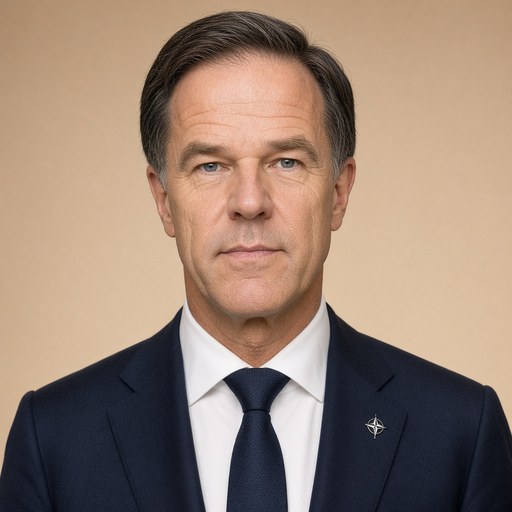
Speech by Prime Minister Mark Rutte at the memorial service for former Prime Minister and Minister of State Wim Kok in Amsterdam.
 Mark Rutte · Prime Minister of the Netherlands
- Context
- Rutte delivered a eulogy at the memorial service for former Prime Minister Wim Kok in Amsterdam on 25 October 2018.
- Main themes
- Tribute to Wim Kok, statesmanship and leadership, personal character and authenticity, Dutch political history, Wassenaar Agreement, Purple coalition, Srebrenica, social solidarity and responsibility, international recognition, family and legacy, navigating political crises
- Duration
- ~7 min
- Words
- 811
- Sentences
- 59
- Readability
- 63
- Grade
- 7.9
- Syntax
- 2.72
- Vocabulary
- 2.29
Translated from Dutch
The broad sphere of national life a sentence belongs to. Every sentence has an Arena, so it is the denominator the other indices are read against.
Other59 sentences in 28 paragraphs
Dear Rita,
Dear children and grandchildren of Wim,
Family and friends,
Ladies and gentlemen,
Everything that has been said and written in the last week proves: Wim Kok touched many people and profoundly influenced the Netherlands.
I personally think back warmly to our conversations in the Torentje, which of course never revolved around trivial matters. Wim would come by once a year, and we would always discuss the state of politics.
The first time, I was a bit nervous. There I was, suddenly talking to that great man, whom I looked up to immensely as a twenty-something and thirty-something. That feeling has always lingered a bit. Wim had that natural authority and almost paternal presence. But he was also someone with whom you could easily speak in confidence. These are cherished memories, and for which I remain grateful: he truly wanted to help.
It is difficult to characterize Wim Kok in just a few words. But perhaps this is the common thread: everything about him was real. No embellishments, vanity, or hidden agendas – that was Wim Kok.
A child of the reconstruction, a driven advocate for the common man, the prime minister of everyone – that was Wim Kok. And above all: a down-to-earth mind with a warm and socially engaged heart – that was Wim Kok.
The Netherlands changed before his eyes and under his hands. He grew up in a segmented and industrial society, where sandwiches were still happily made.
Later, he became the prime minister of a very diverse and prosperous country, where solidarity, equal opportunities, and individual freedom went hand in hand. And responsibility, because that was always part of it for Wim. It is a word that he embodied in person.
The famous Wassenaar Agreement was a turning point for the Netherlands and for him. Because there, the two souls in his breast were both expressed: the union man from the barricades and the administrative connector and man of sensible compromise that he would be as prime minister.
His greatest strength as prime minister was that he could see things very broadly and that he had patience. He himself called his way of working 'starting from the back': thinking about where you want to end up and then reasoning back in small steps. The carpenter's son governed the country with a carpenter's eye.
And yes, he could sometimes be impatient and demanding of those around him. But he was first and foremost strict with himself – it could always be better, always simpler, workdays always longer. That is why the people in his immediate surroundings were happy to go the extra mile for him.
What I admire in him is his navigational skill and leadership at decisive moments. In the WAO crisis. In the lead-up to the royal wedding. And of course, immediately after the murder of Pim Fortuyn.
As the smoke plumes rose from the Pleingarage, Wim spoke from the heart: 'For God's sake, let us keep our calm.' And then he did what he always did: bringing people together, listening, talking, and creating space for everyone. It is moments like these that demonstrate statesmanship.
It is completely logical that so much talent and administrative strength also received international praise and recognition. 'What we only talk about, Wim Kok has been putting into practice in the Netherlands for years,' said
Tony Blair
and
Bill Clinton
.
And even Nelson Mandela recognized in him a kindred spirit. Wim was, of course, far too down-to-earth for any kind of idolization, but Mandela was his hero. Unforgettable is that touching moment when they walked hand in hand through the crowd over the Binnenhof to the House of Representatives.
Of course, so much responsibility over such a long period comes with disappointments and shadow sides. The end of Purple and the biting criticism of those days was such a difficult-to-grasp disappointment. But the darkest shadow for him as a person and prime minister was the Srebrenica drama, 'the open wound that never heals,' as he called it. There was deep emotion until the very end, which immediately showed on his face as soon as the subject was brought up.
Dear Rita, children and grandchildren,
Once your husband, father, and grandfather said in an interview: 'What I notice is that people often leave an indelible impression even after their death. You live on in the thoughts and lives of others.' It cannot be otherwise; he must have primarily thought of you, of his family, which was so incredibly important to him.
I hope that in all the beautiful and lasting memories, there is a beginning of comfort for you. Know that Wim also lives on in the warm memory of everyone who had the privilege of knowing him and in the collective memory of the Netherlands, as the statesman he was.
We miss him.
We remain grateful to him.
The original Dutch. The tags above are read on the English translation's sentences.
Beste Rita,
Beste kinderen en kleinkinderen van Wim,
Familie en vrienden,
Dames en heren,
Alles wat in de laatste week is gezegd en geschreven bewijst: Wim Kok heeft veel mensen geraakt en Nederland vergaand beïnvloed.
Zelf denk ik met warmte terug aan onze gesprekken in het Torentje, die natuurlijk nooit over koetjes en kalfjes gingen. Wim kwam zo eens per jaar langs en dan namen we eigenlijk altijd de stand van de politiek door.
De 1e keer kneep ik hem wel. Daar zat ik ineens te praten met die grote mijnheer, waar ik als 20'er en 30'er huizenhoog tegenop keek. Dat gevoel is altijd wel een beetje gebleven. Wim had nu eenmaal dat natuurlijke gezag en bijna vaderlijke overwicht. Maar hij was ook iemand met wie je gemakkelijk in vertrouwen sprak. Het zijn dierbare herinneringen en waar ik hem dankbaar voor blijf: hij wilde echt helpen.
Het is lastig Wim Kok met een paar woorden te typeren. Maar misschien is dit de rode draad: alles aan hem was écht. Geen opsmuk, ijdeltuiterij, of dubbele agenda’s – dat was Wim Kok.
Kind van de wederopbouw, gedreven voorvechter van de gewone man, premier van iedereen – dat was Wim Kok. En vooral: een nuchter verstand met een warm en sociaal bewogen hart – dat was Wim Kok.
Nederland veranderde onder zijn ogen en onder zijn handen. Hij groeide op in een verzuilde en industriële samenleving, waarin boterhammen nog met tevredenheid werden belegd.
Later werd hij premier van een heel divers en welvarend land, waarin solidariteit, gelijke kansen en individuele vrijheid hand in hand gingen. En verantwoordelijkheid, want dat hoorde er voor Wim altijd bij. Het is een woord dat hij ons in persoon heeft voorgeleefd.
Het beroemde Akkoord van Wassenaar is voor Nederland en voor hem een scharnierpunt geweest. Want daar kwamen de 2 zielen in zijn borst beide tot uiting: de vakbondsman van de barricaden en de bestuurlijke verbinder en man van het verstandige compromis die hij als premier zou zijn.
Zijn grootste kracht als premier was dat hij zaken heel breed kon overzien en dat hij geduld had. Zelf noemde hij zijn manier van werken 'achteraan beginnen': bedenken waar je uit wilt komen en dan in kleine stapjes terug redeneren. De timmermanszoon bestuurde het land met een timmermansoog.
En ja, hij kon soms ongeduldig en veeleisend zijn voor zijn omgeving. Maar hij was allereerst streng voor zich zichzelf – het kon altijd beter, altijd eenvoudiger, werkdagen altijd langer. Daarom zetten de mensen in zijn directe omgeving graag een stap extra voor hem.
Wat ik in hem bewonder, is zijn stuurmanskunst en leiderschap op de bepalende momenten. In de WAO-crisis. In de aanloop naar het kroonprinselijk huwelijk. En natuurlijk direct na de moord op Pim Fortuyn.
Terwijl de rookpluimen uit de Pleingarage omhoog kringelden, sprak Wim uit het hart: 'Laten we in godsnaam onze kalmte bewaren.' En vervolgens deed hij wat hij altijd deed: mensen bij elkaar brengen, luisteren, praten en ruimte scheppen voor iedereen. Het zijn momenten als deze waarop staatsmanschap zich bewijst.
Het is volkomen logisch dat zoveel talent en bestuurskracht ook internationaal lof en waardering kreeg. 'Waar wij slechts over praten, dat brengt Wim Kok in Nederland al jaren in de praktijk,' zeiden
Tony Blair
en
Bill Clinton
.
En ook Nelson Mandela, herkende in hem een gelijkgestemde geest. Wim was natuurlijk veel te nuchter voor dweperij, maar Mandela was zijn held. Onvergetelijk is dat ontroerende moment dat zij samen hand in hand door de menigte over het Binnenhof naar het Kamergebouw lopen.
Natuurlijk gaat zoveel verantwoordelijkheid over zo’n lange periode gepaard met teleurstellingen en schaduwzijdes. Het einde van Paars en de bijtende kritiek van die dagen was zo’n moeilijk te vatten teleurstelling. Maar de donkerste schaduw was voor hem als mens en premier het drama Srebrenica, 'de open wond die nooit dichtgaat', zoals hij dat zelf noemde. Daar zat tot op het laatst diepe emotie, die zich meteen op zijn gezicht aftekende zodra het onderwerp ter sprake kwam.
Beste Rita, kinderen en kleinkinderen,
Ooit zei jullie man, vader en opa in een interview: 'Wat ik merk is dat mensen ook na hun dood vaak nog een onuitwisbare indruk achterlaten. Je leeft door in de gedachten en levens van anderen.' Het kan niet anders, of hij dacht daarbij allereerst aan jullie, aan zijn gezin dat dat zo ongelooflijk belangrijk voor hem was.
Ik hoop dat in alle mooie en blijvende herinneringen voor jullie een begin van troost schuilgaat. Weet dat Wim ook doorleeft in de warme herinnering van iedereen die het voorrecht had hem te kennen en in het collectieve geheugen van Nederland, als de staatsman die hij was.
We missen hem.
Wij blijven hem dankbaar.