




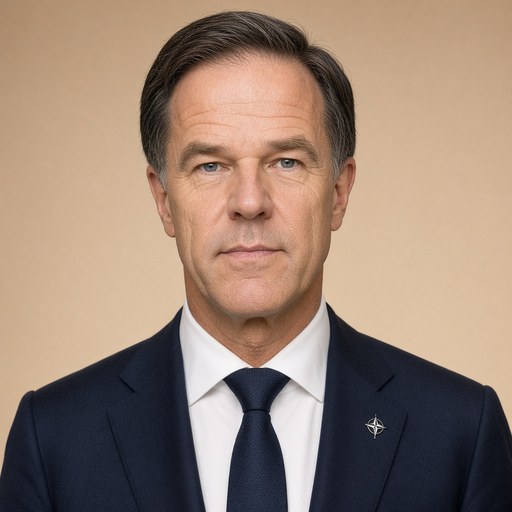
Speech by Prime Minister Mark Rutte at the National Holocaust Commemoration
 Mark Rutte · Prime Minister of the Netherlands
- Context
- Rutte addressed the National Holocaust Commemoration in the Netherlands on 28 January 2024, marking 79 years since the liberation of Auschwitz.
- Main themes
- Holocaust remembrance, antisemitism, October 7 Hamas attack, Jewish victims, intergenerational memory, hatred and dehumanization, Dutch Jewish community, vigilance against hate, peace and tolerance, legacy of survivors
- Duration
- ~5 min
- Words
- 574
- Sentences
- 56
- Readability
- 62
- Grade
- 7.1
- Syntax
- 2.32
- Vocabulary
- 2.26
The broad sphere of national life a sentence belongs to. Every sentence has an Arena, so it is the denominator the other indices are read against.
Other56 sentences in 54 paragraphs
In a moving television interview in 1985, 40 years after the liberation, the elderly writer and Holocaust survivor Abel Herzberg, speaking tentatively in a brittle, fragile voice, said:
You can’t understand it if you weren’t there. And if you were there, you can’t understand it either. You just can’t understand it.
So, in the final years of his eventful life, even Abel Herzberg – a man better able than most to put the hell of the camps into words – was forced to conclude: ‘I don’t understand it.’
The intense, unceasing hatred.
The injustice.
The dehumanisation.
The violence and sadism.
The industrial scale of it all.
The relentless, murderous drive to destroy an entire people.
To wipe them off the face of the earth.
It’s something that cannot be understood.
The reality is…
It was present then.
And it is present still.
You know what I’m referring to.
At this year’s commemoration of the Holocaust, 79 years after the liberation of Auschwitz, we cannot ignore what happened on 7 October 2023.
A day on which the Jewish people were confronted yet again with a deliberate and orchestrated act of mass murder.
A day on which kidnapping, rape and mutilation were used as the most despicable of weapons – a way to sow fear and terror.
A day followed quickly by a wave of antisemitic reactions that left schools and synagogues around the world, including the Netherlands, in need of protection.
The same old sense of feeling unsafe.
The same old sense of being threatened.
The same old sense of having to look over your shoulder.
Open antisemitism, once again.
As if ‘Auschwitz never again’ has become just a hollow phrase.
Everything inside us screams: this cannot stand.
It must not stand.
We can’t allow it.
We won’t allow it.
As we gather here, in this emotionally charged place on this solemn occasion, I want to make something clear.
Tomorrow and every day after that, I will carry on talking about the war in Gaza.
We need an open and critical debate, including a debate about and with Israel.
But not today.
Not on the day that we commemorate the six million victims of the Holocaust.
And not in this place, amid the fragile shards of the Auschwitz Monument.
Today we reflect on the terrible fate suffered by more than 100,000 Dutch Jews and over 200 Dutch Roma and Sinti, who were murdered because of who they were.
Today we honour their legacy.
And the best way we can do so is by speaking out.
Against hate and exclusion.
Against threats of violence.
And against antisemitism.
By staying vigilant.
And by serving the cause of peace, humanity and tolerance in all that we do.
Ladies and gentlemen, in the Jewish community the passing on of traditions is a key cultural practice.
Le‘dor va’dor – from generation to generation.
As the time approaches when the last Holocaust survivors are no longer among us, this is now a duty for us all, Jews and non-Jews alike.
We must continue to remember, because of the past and because of the present.
And I add this morning: we must continue to pass on knowledge about the Holocaust to young people.
From generation to generation.
We do not commemorate so that we will understand it one day.
That is impossible.
We remember as an expression of our everlasting sorrow.
As a mark of honour.
And as a warning.
Thank you.