




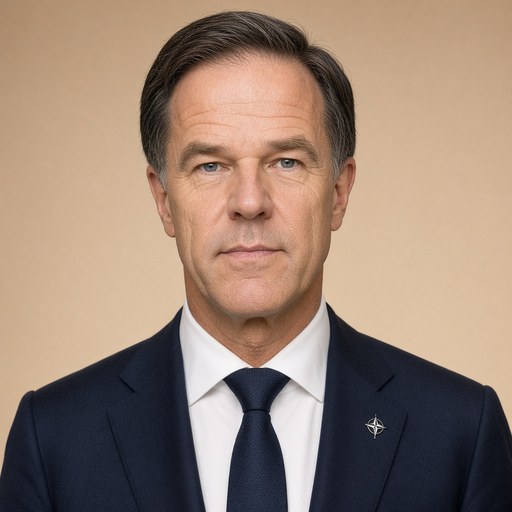
Speech by the Prime Minister at the commemoration of Dries van Agt in the Senate.
 Mark Rutte · Prime Minister of the Netherlands
- Context
- Rutte addressed the Dutch Senate on 26 February 2024 to commemorate former Prime Minister Dries van Agt following his death alongside his wife Eugenie.
- Main themes
- Commemoration of Dries van Agt, political legacy, sense of justice and conscience, progressive vs. conservative identity, Palestinian cause, personal tributes, relationship with Eugenie van Agt, joint euthanasia death, Dutch political history, Rutte's personal memories
- Duration
- ~6 min
- Words
- 739
- Sentences
- 47
- Readability
- 60
- Grade
- 8.5
- Syntax
- 2.87
- Vocabulary
- 2.35
Translated from Dutch
The broad sphere of national life a sentence belongs to. Every sentence has an Arena, so it is the denominator the other indices are read against.
Other47 sentences in 24 paragraphs
Mr. Chairman,
Dries van Agt was a uniquely individual man throughout his life. A man who remained true to himself under all circumstances and in every role, and never sought the gray middle ground.
Van Agt derived his life motto from the Apostle Paul: ‘Test everything; hold fast what is good.’ It is fitting that he loved traditions and decorum. It may also be fitting that he had a baroque roundabout way of speaking, which was so characteristic of him.
But as a person, Dries van Agt was certainly not conventional.
Rather the opposite. Colorful, charming, disruptive – those are words that suit him well.
His main opponent, Joop den Uyl, referred to him at his farewell from national politics in 1982 – I quote – ‘(...) a man who often provoked resistance, but rarely hostility.’ That was a keen observation. And there is also appreciation in that – despite their differing personalities and all the differences of opinion that were so characteristic of the complex relationship between these two political giants.
It is a pity, Den Uyl wrote further – and I quote again – ‘(...) that I never went cycling with him, regardless of whether we would have stopped at the first inn.’ That is warmth – despite everything.
The image is that Dries van Agt was parachuted into national politics in 1971 as a progressive lawyer from Nijmegen, coming out of nowhere to become Minister of Justice. That he soon revealed himself to be an arch-conservative, advocating for an ‘ethical revival,’ as he called it. And that in his life after politics he became progressive again.
That image may not be untrue, but in my view, it is too limited.
Dries van Agt was never one-dimensional, either progressive or conservative. He did not fit into a box.
What is true: justice was, for him as a thoroughbred lawyer, a core concept, and he acted on his conscience. Just as when he, as a young Minister of Justice, proposed granting clemency to the ‘Three from Breda.’
As in the case surrounding the Bloemenhove abortion clinic. And as in his later life, as a passionate advocate for the Palestinian cause.
His conscience and his sense of justice drove him – made him combative. Those seeking a common thread in his public life will find it there.
For me personally, Dries van Agt was the first prime minister I truly experienced consciously. As a child, I understood his well-crafted and profound sentences only partially, and words like ‘deksels,’ ‘sapristi,’ and ‘amice’ were completely foreign to me.
But with Van Agt, you immediately got the feeling that politics meant something. You felt how it could crackle, especially in the triangle with Hans Wiegel and Joop den Uyl – and I found that fascinating.
I think back with a big smile to all the meetings I was fortunate to have in later years with my great-great-grandfather in office, as I often called him – to his great delight. A conversation with Dries van Agt was always enjoyable, never boring, and there was always something to laugh about. Even when the conversation was sharp, which was often the case. I will miss that.
Mr. Chairman, I believe many, like me, were deeply moved by the news that Dries van Agt and his inseparable wife Eugenie decided to make the journey to their final destination together after more than 65 years of marriage. Hand in hand – greater love is hardly imaginable. Van Agt himself testified to that often enough.
Without Eugenie, whom he always referred to as ‘my girl,’ he felt like half a person, and her sober judgment weighed heavily for him. Or as Van Agt's biographers once described it: Eugenie had access to his heart. We also remember her today with deep respect.
Mr. Chairman,
One of the many winged expressions of Dries van Agt was:
In the light of the hereafter, everything we do is small.
I dare to engage in discussion with him one more time today, for this relativizing statement may be true for most of us, but not for someone who has meant so much to so many people for 93 years.
That considerable legacy of a rich and well-spent life remains with us, along with many beautiful memories. The Netherlands is grateful to him.
I wish the children, grandchildren, and other survivors of Dries and Eugenie van Agt much strength in processing this great loss.
The original Dutch. The tags above are read on the English translation's sentences.
Mijnheer de voorzitter,
Dries van Agt was zijn leven lang een totaal eigensoortig mens. Een man die onder alle omstandigheden en in elke functie zichzelf bleef en nooit het grijze midden zocht.
Zijn levensmotto ontleende Van Agt aan de apostel Paulus: ‘Onderzoekt alles, maar behoudt het goede.’ Daarbij past dat hij hield van tradities en decorum. Daarbij past misschien ook de barokke ronde taal, die zo karakteristiek voor hem was.
Maar als persoon was Dries van Agt zeker niet conventioneel.
Eerder het tegendeel. Kleurrijk, charmant, ontregelend – dat zijn woorden die wel bij hem passen.
Zijn belangrijkste opponent, Joop den Uyl, noemde hem bij zijn afscheid van de landspolitiek in 1982– ik citeer – ‘(..) een man die wel vaak weerstand opriep, maar zelden vijandschap.’ Dat was raak getroffen. En er klinkt ook waardering in door – ondanks hun uiteenlopende persoonlijkheden en alle verschillen van mening, die zo kenmerkend waren voor de complexe relatie tussen deze twee politieke grootheden.
Het is jammer, schreef Den Uyl verder – en ik citeer opnieuw – , ‘(…) dat ik nooit met hem ben wezen fietsen, daargelaten of we bij de 1e herberg zouden zijn afgestapt.’ Dat is warmte – ondanks alles.
De beeldvorming wil dat Dries van Agt in 1971 als progressieve Nijmeegse jurist vanuit het niets de landspolitiek in werd geparachuteerd om minister van Justitie te worden. Dat hij zich al snel ontpopte als een oerconservatief, die pleitte voor een ‘ethisch reveil,’ zoals hij dat zelf noemde. En die in zijn leven na de politiek opnieuw progressief werd.
Dat beeld is misschien niet onwaar, maar in mijn ogen wel te beperkt.
Dries van Agt was nooit eendimensionaal progressief of conservatief. Hij paste niet in een hokje.
Wat wel waar is: rechtvaardigheid was voor hem als volbloedjurist een kernbegrip en hij acteerde op zijn geweten. Zoals toen hij, als jong minister van Justitie, voorstelde gratie te verlenen aan de ‘Drie van Breda’.
Zoals in de kwestie rond de abortuskliniek Bloemenhove. En zoals in zijn latere leven, als hartstochtelijk pleitbezorger voor de Palestijnse zaak.
Zijn geweten en zijn gevoel voor rechtvaardigheid dreven hem – maakten hem strijdbaar. Wie zoekt naar een rode draad in zijn publieke leven komt daar bij uit.
Voor mij persoonlijk was Dries van Agt de eerste premier die ik echt bewust meemaakte. Als kind begreep ik zijn doorwrochte en gedragen volzinnen natuurlijk maar half en woorden als ‘deksels’, ‘
sapristi’
en ‘
amice
’ waren mij totaal vreemd.
Maar je kreeg bij Van Agt wel meteen het gevoel dat politiek ergens over ging. Je voelde hoe het kon zinderen, zeker in de driehoek met Hans Wiegel en Joop den Uyl – en dat vond ik fascinerend.
Ik denk met een grote glimlach terug aan alle ontmoetingen die ik in later jaren mocht hebben met mijn betovergrootvader in het ambt, zoals ik hem vaak noemde – tot zijn grote plezier. Een gesprek met Dries van Agt was altijd genoeglijk, nooit saai en er viel ook steevast wat te lachen. Ook als het gesprek scherp was en dat was vaak genoeg het geval. Ik ga dat missen.
Voorzitter, ik denk dat velen met mij diep ontroerd waren door het bericht dat Dries van Agt en zijn onafscheidelijke echtgenote Eugenie na een huwelijk van meer dan 65 jaar besloten ook de reis naar hun laatste bestemming samen te maken. Hand in hand - groter liefde is nauwelijks denkbaar. Daarvan heeft Van Agt zelf vaak genoeg getuigd.
Zonder Eugenie, die hij steevast ‘mijn meisje’ noemde, voelde hij zich een half mens en haar nuchtere oordeel telde zwaar voor hem. Of zoals Van Agts biografen het ooit omschreven: Eugenie had toegang tot zijn hart. Ook haar herdenken wij vandaag met diep respect.
Mijnheer de voorzitter,
1 van de vele gevleugelde uitdrukkingen van Dries van Agt luidde:
In het licht van het hiernamaals is alles wat wij doen gering.
Ik waag het vandaag nog 1 keer met hem in discussie te gaan, want deze relativerende uitspraak mag waar zijn voor de meesten van ons, maar niet voor iemand die 93 jaar lang zoveel heeft betekend voor zoveel mensen.
Die niet geringe nagedachtenis aan een rijk en welbesteed leven blijft bij ons, samen met tal van mooie herinneringen. Nederland is hem dankbaar.
Ik wens de kinderen, kleinkinderen en andere nabestaanden van Dries en Eugenie van Agt veel sterkte toe bij de verwerking van dit grote verlies.