




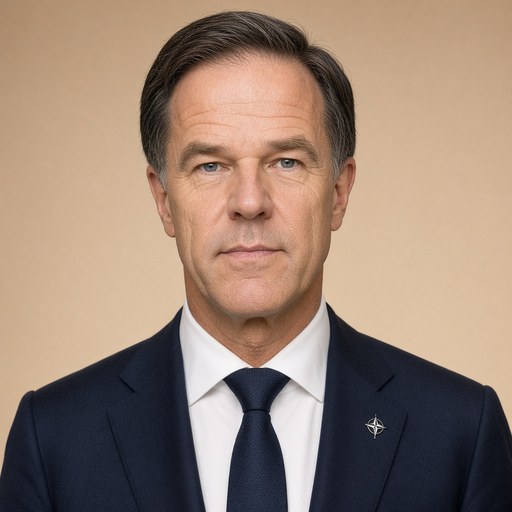
Speech by the Prime Minister at the commemoration of Dries van Agt in the House of Representatives.
 Mark Rutte · Prime Minister of the Netherlands
- Context
- Rutte addressed the Dutch House of Representatives on February 26, 2024, to commemorate former Prime Minister Dries van Agt following his death.
- Main themes
- Commemoration of Dries van Agt, political legacy and character, CDA leadership, moral conscience and principle, homo ludens concept, relationship with Joop den Uyl, love and partnership with Eugenie, Dutch parliamentary history, Catholic identity, political complexity and duality
- Duration
- ~6 min
- Words
- 734
- Sentences
- 49
- Readability
- 72
- Grade
- 7.0
- Syntax
- 2.71
- Vocabulary
- 2.30
Translated from Dutch
The broad sphere of national life a sentence belongs to. Every sentence has an Arena, so it is the denominator the other indices are read against.
Other49 sentences in 28 paragraphs
Mr. Chairman,
A few years before the Second World War, Johan Huizinga published his Homo ludens – the playing man. In it, he elaborates on the idea that the ludic, the 'play element', is essential to human civilization.
That concept of homo ludens fits no one better than the man we commemorate today. For Dries van Agt, life was a game. But it was a game that had to be played with great seriousness and dedication.
He had both sides within him. On one hand, the playful and light-hearted, the relativizing quip, the laughter on his side.
Growing up in the 1930s in Brabant, he once described it as 'walking in the sun' and his birthplace Geldrop as 'the ear shell of the Lord'.
Those are certainly not the words of a melancholic person.
And yet Dries van Agt could struggle greatly with himself and his surroundings.
He called that 'heavy-laden' himself. Especially in contentious issues, such as around the Three of Breda, the Bloemenhove abortion clinic, or later the Palestinian issue, it was his legal and moral conscience that drove him. Then he could be unyielding and principled.
Thus, Van Agt once openly doubted for 6 weeks whether he should resign as Minister of Justice after he had retreated in the Bloemenhove issue. In the letter to Parliament he wrote about this, heart and mind fought for precedence. And that is not the behavior of someone who simply whistles through life.
In cycling terms, Dries van Agt during his time in The Hague was the man of the lonely escape, who could not do without the warmth of the peloton.
A soloist with a huge need to be 'liked', as he put it himself.
A journalist once called Van Agt a 'political cryptogram' – elusive to political opponents and allies alike. In the polarized relations of that time, he played that role with flair. Thus, he became, as the English so beautifully say, the man you love to hate or hate to love.
But Dries van Agt was also, with all his special qualities, the right person to become the first leader of the CDA.
I think because he embodied the southern Catholic way of life with his entire being, while at the same time he was the personification of a moral attitude that appealed to other blood groups.
Dries van Agt connected in person.
Add to that his great social talents, his love for the stage, and the likability he had – especially outside The Hague – and it is clear that Van Agt, as the first leader of the CDA, was the right man in the right place.
His complex relationship with Joop den Uyl has been fodder for enthusiasts of our parliamentary history for many years. People could hardly be more different than these two political giants.
Den Uyl, the hard worker, for whom life consisted of politics. And Van Agt, the sensitive person, for whom the pleasures of life outside politics were indispensable.
They were clashing characters who complemented each other very well at times, such as during the train hijackings and school hostage situation in Drenthe.
At that time, it was precisely Dries van Agt who was most in control of his emotions.
One person completed Dries van Agt throughout his life, his great love Eugenie, with whom he was married for more than 65 years. He often said: without her, he was nothing, helpless. Until death, they chose 'together'. Hand in hand.
It reminded me of those famous lines from Vondel's Gysbrecht:
'Where was truer loyalty / than between man and woman / ever found in the world?' So much love is deeply moving.
Mr. Chairman, in the year 2000, Van Agt was asked in an interview whether he looked forward to the final judgment with confidence. He said then, and I quote:
Will I go to heaven? Well, I have a chance. I have done a number of good things, and a number of less good things. But the balance... I can manage a 6 plus.
It was the homo ludens Dries van Agt in a nutshell: playful, relativizing, humorous – but with a serious undertone.
I am sure that the Netherlands owes him much more than a 6 plus.
We commemorate Dries and Eugenie van Agt with deep respect and wish their children, grandchildren, and other survivors much strength in coping with this great loss.
The original Dutch. The tags above are read on the English translation's sentences.
Mijnheer de voorzitter,
Enkele jaren voor de Tweede Wereldoorlog publiceerde Johan Huizinga zijn Homo ludens – de spelende mens. Daarin werkt hij de gedachte uit dat het ludieke, het ‘spelelement’, wezenlijk is voor de menselijke beschaving.
Dat begrip homo ludens past bij niemand beter dan bij de man die wij vandaag herdenken. Want voor Dries van Agt was het leven een spel. Maar wel een spel dat met grote ernst en toewijding gespeeld diende te worden.
Hij had beide kanten in zich. Aan de ene kant het speelse en lichtvoetige, de relativerende kwinkslag, de lachers op zijn hand.
Opgroeien in de jaren ‘30 in Brabant omschreef hij ooit als 'wandelen in de zon' en zijn geboortedorp Geldrop als 'de oorschelp van de Heer'.
Dat zijn niet bepaald de woorden van een zwaarmoedig mens.
En toch kon Dries van Agt geweldig worstelen met zichzelf en zijn omgeving.
'Zwaartillend' noemde hij dat zelf. Zeker bij hoogoplopende kwesties, zoals rond de Drie van Breda, de abortuskliniek Bloemenhove, of later de Palestijnse kwestie was het zijn juridische en morele geweten dat hem dreef. Dan kon hij onverzettelijk en principieel zijn.
Zo heeft Van Agt ooit 6 weken lang openlijk getwijfeld of hij niet moest opstappen als minister van Justitie, nadat hij bakzeil had gehaald in de kwestie Bloemenhove. In de Kamerbrief die hij hierover schreef, streden hart en verstand om voorrang. En dat is dan weer niet het gedrag van iemand die alleen maar fluitend door het leven gaat.
In wielertermen gesproken was Dries van Agt in zijn Haagse tijd de man van de eenzame ontsnapping, die niet kon zonder de warmte van het peloton.
Een solist met een enorme behoefte aan ‘aardig gevonden worden’, zoals hij dat zelf zei.
Een journalist noemde Van Agt ooit een ‘politiek cryptogram’ – ongrijpbaar voor politieke opponenten én medestanders. In de gepolariseerde verhoudingen van toen speelde hij die rol met verve. Zo werd hij, zoals de Engelsen dat zo mooi zeggen,
the man you love to hate or hate to love
.
Maar Dries van Agt was ook, met al zijn bijzondere kwaliteiten, de aangewezen persoon om eerste lijsttrekker te worden van het CDA.
Ik denk omdat hij met zijn hele manier van ‘zijn’ het zuidelijke katholieke levensgevoel ademde, terwijl hij tegelijkertijd de verpersoonlijking was van een morele levenshouding die andere bloedgroepen aansprak.
Dries van Agt verbond in persoon.
Tel daarbij op zijn grote sociale talenten, zijn liefde voor het podium en de gunfactor die hij – zeker buiten Den Haag – overvloedig had, en het is duidelijk dat Van Agt als 1e voorman van het CDA de juiste man was op de juiste plaats.
Zijn complexe relatie met Joop den Uyl is al jarenlang voer voor liefhebbers van onze parlementaire geschiedenis. Veel verschillender dan deze 2 politieke grootheden kunnen mensen bijna niet zijn.
Den Uyl, de noeste werker, voor wie het leven bestond uit politiek. En Van Agt, de gevoelsmens, voor wie de aangenaamheden van het leven buiten de politiek juist onmisbaar waren.
Het waren botsende karakters die elkaar op momenten toch heel goed aanvulden, zoals tijdens de treinkapingen en schoolgijzeling in Drenthe.
Toen was het juist Dries van Agt die zijn emoties het meest de baas was.
Eén persoon maakte Dries van Agt zijn leven lang compleet, zijn grote liefde Eugenie, met wie hij meer dan 65 jaar getrouwd was. Hij heeft het vaak gezegd: zonder haar was hij niets, hulpeloos. Tot in de dood kozen zij voor ‘samen’. Hand in hand.
Het deed mij denken aan die beroemde dichtregels uit Vondels Gysbrecht:
‘Waar werd oprechter trouw / dan tussen man en vrouw / ter wereld ooit gevonden?’ Zoveel liefde is diep ontroerend.
Mijnheer de voorzitter, in het jaar 2000 werd Van Agt in een interview gevraagd of hij het eindoordeel met vertrouwen tegemoetzag. Hij zei toen, en ik citeer:
Of ik in de hemel kom? Nou, ik heb wel een kans. Ik heb wel een aantal goeie dingen gedaan, en een aantal minder goeie dingen. Maar het saldo ... Een 6 plus haal ik wel.
Het was de homo ludens Dries van Agt ten voeten uit: speels, relativerend, humoristisch – maar met een serieuze ondertoon.
Ik weet zeker dat Nederland hem veel méér dank verschuldigd is dan voor een 6 plus.
Wij herdenken Dries en Eugenie van Agt met diep respect en wensen hun kinderen, kleinkinderen en andere nabestaanden veel sterkte toe met de verwerking van dit grote verlies.