




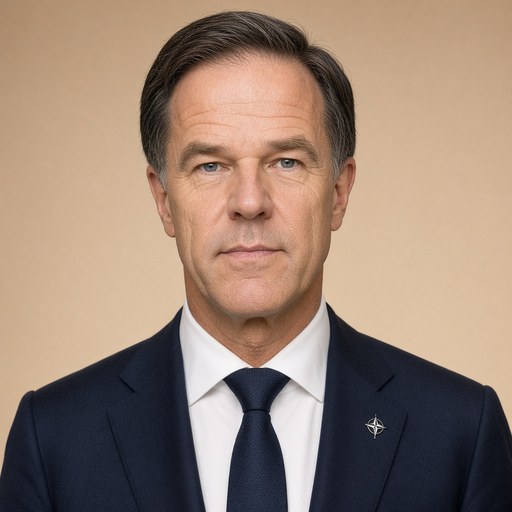
Toespraak minister-president bij herdenking opstand kamp Sobibór in Polen
 Mark Rutte · Prime Minister of the Netherlands
- Context
- Rutte addressed a commemoration marking the 80th anniversary of the Sobibor prisoner uprising at the redesigned memorial site in Poland on 12 October 2023.
- Main themes
- Holocaust remembrance, Sobibor extermination camp, Dutch Jewish victims, uprising of October 1943, antisemitism and racism, memory and testimony, Jules Schelvis legacy, courage and resistance, obligation to future generations, contemporary parallels with Ukraine and Hamas attack, freedom and human dignity
- Duration
- ~7 min
- Words
- 819
- Sentences
- 85
- Readability
- 66
- Grade
- 6.6
- Syntax
- 2.40
- Vocabulary
- 2.40
The broad sphere of national life a sentence belongs to. Every sentence has an Arena, so it is the denominator the other indices are read against.
Other85 sentences in 49 paragraphs
Ladies and gentlemen,
Today’s commemoration takes place against a tragic and alarming background. It’s been less than a week since the unprecedented terrorist attack on Israel by Hamas.
Today our hearts go out to all the innocent victims and their loved ones. We are with them in spirit, in this quiet place of remembrance.
Ladies and gentlemen,
The unforgettable
Jules Schelvis
was 1 of only 18 Dutch people who survived Sobibor extermination camp.
When he was 92, 3 years before he passed away, he said in an interview, ‘I have set myself a task: I will keep telling until I no longer can.’
Jules Schelvis
spent most of his long and remarkable life working to uncover the gruesome history of this place. A mission made all the more vital by the fact that the Nazis burned all traces of their appalling crimes here after the uprising of October 1943. They wanted to conceal the horrors of Sobibor forever.
And for the first few decades after the war, it seemed they had succeeded. For a long time, the hell of Sobibor received little attention. Too little attention.
That’s why it was so significant that, from the 1970s on,
Jules Schelvis
spent his life researching, describing and documenting the unspeakable events that unfolded here. He painted a graphic picture, and showed it to the world.
Others followed his example, honouring the legacy of the countless thousands of women, men and children murdered here in cold blood. Murdered because of who they were.
Today, we give them a voice.
Today, we tell their stories.
Today, we keep their memory alive.
It is now our task to keep telling their story. And it’s our solemn duty to pass that task on to the next generation.
1/3 of all Dutch Holocaust victims died at Sobibor – more than 34,000 Jewish women, men and children.
Only at Auschwitz were there more.
Sobibor is an ink-black chapter in the Dutch history of the Second World War. That’s why it has long been a point of honour for the Dutch government to ensure the creation of a proper memorial. A place where the victims’ relatives can visit. To grieve, to commemorate and – perhaps – to find comfort.
But also a place where the story of Sobibor is kept alive for generations to come. As a warning. History requires that of us – no, it demands that of us.
And so, I’m pleased that this redesigned place of remembrance has now been completed. I’d like to thank our partners from Poland, Slovakia and Israel for all their hard work.
Together, we will make sure we can keep telling this story. Yes, because of the past. But also because of the here and now.
Anti-Semitism has not gone away. Racism and exclusion have not gone away.
We need only look a short way east to see how moral bankruptcy and a hunger for power can lead to the most terrible deeds. These evils have not gone away. And we must continue to resist them.
80 years ago, a group of Sobibor prisoners rose up against the most brutal and ruthless regime imaginable. Among them were 2 brave Dutch women who survived the uprising:
Ursula Stern
and
Selma Engel-Wijnberg
.
You might wonder how they found the strength, after everything they’d been through. Ripped away from their everyday lives. From their loved ones.
Forced to endure days in a cattle train. Kicked, beaten and humiliated when they arrived at the death camp. More vulnerable than ever.
And we ask ourselves: where did they find the courage? After such cruel, inhuman treatment, how much strength did it take to rise up against the killers of Sobibor?
We can barely imagine. Perhaps the only explanation is that the desire for freedom and the will to survive are deeply ingrained in the human psyche.
We’re seeing that again now – in a very different time and context – in the people of Ukraine, who are fighting for freedom and against oppression. And isn’t that the essence of remembrance? The intrinsic connection between past and present?
Today we honour all those who rose up in 1943, and all those who were murdered at Sobibor. In the words of Jewish tradition: ‘May their memory be a blessing.’ May they never be forgotten, as their killers intended.
By being here today, we are sending a clear message. We will not allow evil to triumph.
And by coming together here, speaking the names of the victims and telling their stories, we remind ourselves how important it is to be vigilant. Today, in the here and now.
To stand up against anti-Semitism and other forms of exclusion. To stand up against the oppression of 1 group by another. To stand up for freedom, compassion and humanity. To follow the example set by
Jules Schelvis
,
Ursula Stern
and
Selma Engel-Wijnberg
.
We must keep telling.
Thank you.