




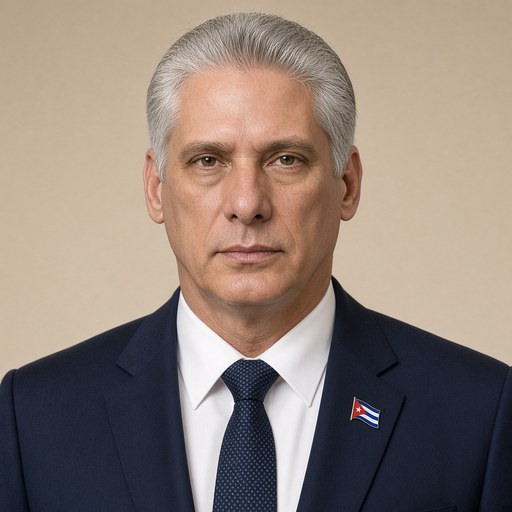
Message from Miguel Díaz-Canel Bermúdez, President of the Republic of Cuba, at the II International Conference on Unilateral Coercive Measures. Geneva, April 9, 2026.
 Miguel Díaz-Canel · President of Cuba
- Context
- Díaz-Canel addressed the II International Conference on Unilateral Coercive Measures in Geneva on April 9, 2026, denouncing the US blockade's humanitarian impact on Cuba.
- Main themes
- US blockade against Cuba, unilateral coercive measures, human rights violations, energy crisis and fuel shortages, collective punishment, multilateralism and international law, self-determination, humanitarian impact, international solidarity, legally binding instrument against coercive measures, sovereignty of developing nations
- Duration
- ~7 min
- Words
- 800
- Sentences
- 33
- Readability
- 29
- Grade
- 15.3
- Syntax
- 2.92
- Vocabulary
- 2.41
Translated from Spanish
The broad sphere of national life a sentence belongs to. Every sentence has an Arena, so it is the denominator the other indices are read against.
Other33 sentences in 22 paragraphs
Dear Volker Türk, United Nations High Commissioner for Human Rights:
Dear Alena Douhan, Special Rapporteur on the negative impact of unilateral coercive measures on human rights:
Distinguished participants in this important Conference:
A few days ago, the arrival of a Russian oil tanker in a Cuban port made headlines around the world. Hundreds of media outlets followed the route of the tanker with unusual interest. The energy blockade against Cuba had lasted more than three months, that is, the threat of applying coercive measures to any country that, in the exercise of its sovereign prerogatives, exports fuel to Cuba.
In the face of the criminal intent to suffocate our economy, the 100,000 tons of fuel from the ship Anatoly Kolodkin became an absolutely extraordinary event, which the Cuban people celebrated in every possible way.
Why? When does such a common act among sovereign nations turn into such an extraordinary event? The answer is very simple: when an entire people is punished, deprived of resources and essential means for their sustenance, with the criminal intent of causing their economy to collapse.
Cuba is a victim of prolonged collective punishment that aims to bring its people to their knees through hunger, disease, and severe shortages of basic supplies. This suffocation policy adds to 65 years of the most severe and prolonged economic, commercial, and financial war ever waged against any country, which has been codified through a meticulous and perverse system of unilateral coercive measures, designed to provoke a social explosion and violate the constitutional order legitimately established by Cubans in the exercise of our right to self-determination.
By preventing the arrival of fuel to Cuba, the government of the United States flagrantly, deliberately, and unjustifiably violates the human rights of an entire people, as well as the freedom of trade of third countries.
In Cuba, prolonged daily power outages, shortages of water and liquefied gas are making domestic chores a burden.
More than 96,000 Cubans, including 11,000 children, are waiting for surgeries due to the lack of electricity and despite the efforts of health institutions to find solutions. More than 16,000 patients who need radiotherapy and 2,888 who depend on hemodialysis are affected by the paralysis of services that require energy stability.
Schools and universities have had to readjust their study programs and resort to semi-presential modalities to ensure the continuity of the educational process. Public and private transportation is practically paralyzed due to lack of fuel. The business system and food production have been severely impacted and incapacitated to guarantee basic supplies.
Beyond these figures, it is impossible to account for the physical and psychological exhaustion, the daily shortages, the postponement of dreams, and the media war to which a noble, resilient, and supportive people like ours is subjected, solely out of malice.
What country can live and develop under this pressure? What right does the world's leading economic power have to commit such abuse against a small developing country?
Will the United Nations allow sovereign states to be aggrieved in International Law and attempt to return to times of vassalage, barbarism, colonization, and slavery?
From international institutions, we must do much more to denounce and confront the unilateral coercive measures that are imposed and reinforced, not only against Cuba but also against numerous developing countries.
This International Conference is an opportunity to highlight their impact and make proposals oriented towards action. From Cuba, we promote the creation of a Working Group of the Human Rights Council, composed of several experts, to provide broader and more specialized attention to this issue.
We also advocate for the adoption of a legally binding international instrument that demands the immediate lifting of these measures and accountability for those responsible.
Despite the adverse current context, Cuba trusts and bets on multilateralism and diplomacy as the only effective tools for maintaining peace, civilized coexistence, and sustainable development.
From this small nation that resists with dignity the harassment of the blockade in all its aggressive variants, I deeply appreciate the expressions of international solidarity and support that we have received in these difficult times.
I thank High Commissioner Volker Turk, the mandate holders, and other international experts for their firm opposition to the blockade against Cuba and the systematic denunciation of its illegality and the incalculable impact on the human rights of Cubans.
I assure you that the Cuban people will not forget those who, in the face of abuse and blackmail, stood on the side of justice and raised their hands and voices, without fear, to defend this heroic people's right to live and to choose their destiny sovereignly.
Likewise, I assure you that the Cuban people will defend, against the voracious appetite of the empire that attacks us, every inch of our homeland. The determination of Cubans to defend our absolute sovereignty is total.
The original Spanish. The tags above are read on the English translation's sentences.
Estimado Volker Türk, alto comisionado de las Naciones Unidas para los Derechos Humanos:
Estimada Alena Douhan, relatora especial sobre el impacto negativo de las medidas coercitivas unilaterales en los derechos humanos:
Distinguidos participantes en esta importante Conferencia:
Hace pocos días, la llegada de un buque petrolero ruso a puerto cubano fue titular noticioso en todo el mundo. Cientos de medios siguieron la ruta del tanquero con inusual interés. Cumplía más de tres meses el bloqueo energético a Cuba, es decir, la amenaza de aplicar medidas coercitivas a cualquier país que, en uso de sus prerrogativas soberanas, exporte combustible a Cuba.
Frente al criminal propósito de asfixiar nuestra economía, las 100 mil toneladas de combustible del barco Anatoly Kolodkin se convirtieron en un hecho absolutamente extraordinario, que el pueblo cubano celebró de todas las maneras posibles.
¿Por qué?¿Cuándo un acto tan común entre naciones soberanas se transforma en un suceso tan extraordinario? La respuesta es muy sencilla: cuando se castiga a todo un pueblo, privándolo de recursos y medios esenciales para su sostenimiento, con el criminal propósito de hacer estallar su economía.
Cuba es víctima de un castigo colectivo prolongado que pretende arrodillar a su pueblo por hambre, enfermedades y duras carencias de insumos básicos. Esta política de asfixia se suma a 65 años de la guerra económica, comercial y financiera más severa y prolongada aplicada contra país alguno, que ha sido codificada a través de un minucioso y perverso sistema de medidas coercitivas unilaterales, diseñado para provocar un estallido social y violentar el orden constitucional legítimamente establecido por los cubanos en ejercicio de nuestro derecho a la libre determinación.
Al impedir la llegada de combustible a Cuba, el gobierno de Estados Unidos viola de manera flagrante, deliberada e injustificada los derechos humanos de todo un pueblo, así como la libertad de comercio de terceros países.
En Cuba, se están viviendo prolongados cortes diarios de electricidad, desabastecimiento de agua y gas licuado, lo que convierte en un agobio la realización de las labores domésticas.
Más de 96 mil cubanos, incluidos 11 mil niños, se encuentran a la espera de cirugías, debido a la falta de electricidad y a pesar del esfuerzo de las instituciones de salud en función de encontrar soluciones. Más de 16 mil pacientes que necesitan radioterapia y 2 mil 888 que dependen de hemodiálisis están afectados por la paralización de servicios que requieren estabilidad energética.
Los centros escolares y universitarios han tenido que reajustar sus programas de estudios y acudir a modalidades semipresenciales para garantizar la continuidad del proceso docente educativo. EI transporte público y privado se encuentra prácticamente paralizado por falta de combustible. El sistema empresarial y la producción de alimentos han sido duramente impactados e incapacitados para garantizar insumos básicos.
Más allá de estas cifras, es imposible contabilizar el agotamiento físico y psicológico, las carencias diarias, la posposición de los sueños y la guerra mediática a la que se somete, solo por maldad, a un pueblo noble, resiliente y solidario como el nuestro.
¿Qué país puede vivir y desarrollarse bajo esta presión? Qué derecho tiene la principal potencia económica mundial de cometer semejante abuso contra un pequeño país en desarrollo?
Permitirán las Naciones Unidas los Estados soberanos que se agravie el Derecho Internacional y se intente regresar a épocas de vasallaje, barbarie colonización y esclavitud?
Desde las instituciones internacionales debemos hacer mucho más para denunciar y enfrentar las medidas coercitivas unilaterales que se imponen y refuerzan, no solo contra Cuba, sino también contra numerosos países en desarrollo.
Esta Conferencia Internacional es una oportunidad para visibilizar su impacto y realizar propuestas orientadas a la acción. Desde Cuba, impulsamos la creación de un Grupo de Trabajo del Consejo de Derechos Humanos, conformado por varios expertos, que brinde una atención más amplia y especializada a este tema.
Abogamos igualmente, por la adopción de un instrumento internacional jurídicamente vinculante, que demande el levantamiento inmediato de estas medidas y la rendición de cuentas de los responsables.
A pesar del adverso contexto actual, Cuba confía y apuesta por el multilateralismo y la diplomacia, como las únicas herramientas eficaces para el mantenimiento de la paz, la convivencia civilizada y el desarrollo sostenible.
Desde esta pequeña nación que resiste con dignidad el acoso del bloqueo en todas sus agresivas variantes, agradezco profundamente las muestras de solidaridad internacional y apoyo que hemos recibido en estas horas difíciles.
Agradezco al Alto Comisionado Volker Turk, a los titulares de mandatos entre otros expertos internacionales, por su firme oposición al bloqueo contra Cuba y la denuncia sistemática de su ilegalidad y del impacto incalculable en los derechos humanos de las cubanas y los cubanos.
Les aseguro que el pueblo cubano no olvidará a los que, frente al atropello y el chantaje, se colocaron del lado de la justicia y alzaron sus manos y voces, sin miedo, para defender el derecho de este heroico pueblo a vivir y a elegir soberanamente su destino.
Del mismo modo, les aseguro que el pueblo cubano defenderá, frente al apetito voraz del imperio que nos agrede, cada palmo del suelo patrio. La determinación de cubanas y cubanos para defender nuestra absoluta soberanía, es total.