




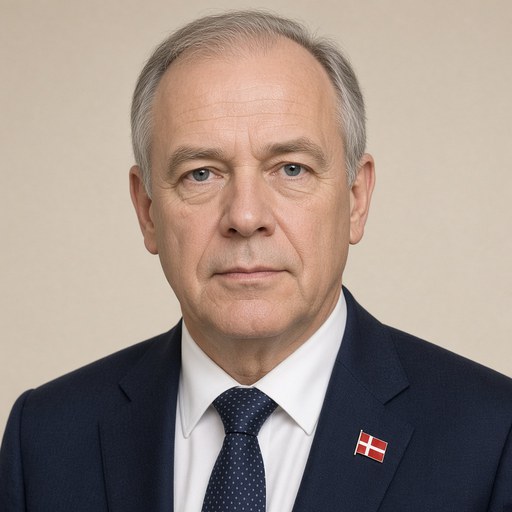
Reply to inquiry F 24 by Frank Aaen (The Red-Green Alliance): "What can the Prime Minister inform about the fulfillment of the election promises from March 1998?"
 Poul Nyrup Rasmussen · Prime Minister of Denmark
- Context
- Rasmussen replied to a Folketing inquiry by Frank Aaen in February 1999, defending his government's record on election promises made in March 1998.
- Main themes
- Election promise fulfillment, political opposition attacks, personal attacks vs. substantive debate, government coalition agreements, distribution policy, economic policy, Venstre party criticism, political integrity, parliamentary debate conduct
- Duration
- ~15 min
- Words
- 1,739
- Sentences
- 116
- Readability
- 63
- Grade
- 7.5
- Syntax
- 2.70
- Vocabulary
- 1.94
Translated from Danish
The broad sphere of national life a sentence belongs to. Every sentence has an Arena, so it is the denominator the other indices are read against.
Other116 sentences in 33 paragraphs
The political spokesperson for the CD, Mr. Peter Duetoft, said in his speech: 'It cannot be an independent purpose to dig deep trenches here in the Folketing. We must think carefully. We must wisely consider what methods we actually bring into play in the political debate?' I completely agree with that. I have said so from the beginning. I am glad that it is being emphasized.
The government has set itself a number of goals. We have not abandoned them, but we naturally also take into account the conditions under which those goals must be achieved. If a government does not take into account the changed conditions, we will actually find ourselves in a situation that can diminish our opportunities to reach the goals we have set.
* * *
The debate has changed character several times today from teasing and personal attacks to also becoming political. That the Enhedslisten is upset that the government has made an agreement on the finance bill for 1999 is, in itself, very understandable. That Venstre is upset that Venstre lost the election and that the government made an agreement on the Pentecost package with the left, is also, in itself, very understandable.
In general, it is very understandable that there are some who are sad about this today. Just as long as they do not become even sadder that the rest of us are not so sad about it. For example, when I listen to Ms. Ulla Tørnæs' speech - she sounds very, very sad. I have both cheated, deceived, and broken promises. I think Ms. Ulla Tørnæs is increasingly beginning to resemble her predecessor in the job as Venstre's political spokesperson. The predecessor is now the chairman: One would not want to get their hands dirty, so one would rather send their lieutenants into the field. Then one uses one of the political weapons that is the most dangerous to use: The constant suspicion.
I know it is not new. I know it started on election night. When the election was decided, it was said: 'Voter deception!'. I must say that the party Venstre cannot be accused of a lack of consistency. Venstre's new invention has now become a label that is to be stuck on, preferably on my person. A constant suspicion, a new personal attack about untrustworthiness. I see a straight line from something that was once called wool in the mouth, to tripwires, to fumbling, to a lack of leadership, to the bicycle helmet, to Rushdie, and who knows what else.
Now it is something completely different that has been chosen, but the consequence is the same. The method is the same. The goal is the same. Frankly, why not just say outright what it is really about. It is, after all, tangible.
Venstre disagrees with the line the government stands for. That is fair enough.
Venstre does not share the government's distribution policy stance. That is fair enough.
Venstre does not agree with the government's green line. That is fair enough.
Venstre does not agree with the government's housing policy. That is fair enough.
Venstre does not think that when society for a moment must slow its pace to avoid going off the rails, we should distribute the task that must be borne properly, in solidarity in both the public and private sectors. They do not agree with that, and that is fair enough.
The problem is just that they do not say it openly and directly. I prefer a real political contest, a real political discussion. There we stand, and there they stand. That is our position, that is their position. That is real. But this mudslinging, which has a completely different purpose, I do not think is fair. Instead, let us discuss openly with open helmets, as CD has done today, as the government parties have done, as other parties have done.
* * *
That some disagree with the government. That is fair.
That Enhedslisten disagrees with our economic policy. That is also fair, but do not mix it up with personal attacks. I do not think it is beautiful to look at, and I do not really believe it is particularly respected. For there have always been discussions here in the Folketing about who the government should make agreements with. Should it be to the right side or should it be to the left side of the chamber. And when we made agreements to the right side, those on the left were upset, and if we made agreements to the left side, those on the right were upset. That has always been the case.
Let us discuss our parties' positions and the government's strategy on a political basis. And let us get out of this with the personal race and personal attacks. I do not think that leads anywhere.
* * *
You can find statements and you can find goals that the government has set and that have not yet been achieved. That applies to all of us. But I now allow myself here in my reply to state that the Denmark we have today is a better Denmark than the one we took over the responsibility for leading six years ago. And I also think I am allowed to state that very significant parts of the government platform we presented after the election have been implemented. Documentation for that has been distributed. I will not go into details.
That is quite impressive. We are only a quarter of the way through the entire election period. And if we measure how much has been implemented in relation to the government platform, we are far above a quarter.
I say this at the risk of being scolded for that we are on our way into a reform pause. But the truth is that we have implemented far more than a quarter of our total government platform, even though we are not more than a quarter of the way through a normal election period.
* * *
May I say: We know that some of the goals we have set have not yet been achieved, but there is nothing new in that, as Mr. Peter Duetoft so excellently emphasized. It would really be a failure, I feel, if a government under the leadership of the Social Democrats and the Radicals did not take into account the need to correct the course of the great Danish ship if there was an obstacle in front of us. And we know there is.
We know that the financial crisis in Latin America, in Asia, and in Russia affects us. We also know that the economic growth in Europe affects us. That has always been the case. When there was an oil crisis in the 1970s, the government had to adjust, realign, and so it will be in the future. When the composition of the population changes, then a government must take that into account. When there are more and more elderly people and fewer younger people, we must adjust our policies accordingly. The wrong thing would be not to adjust one's policies accordingly. That would really be to fail everything we stand for.
When globalization comes at us at full speed and technology does too, we must invest in further education, adult education, and the upskilling of our employees, as well as senior policies, so we are sure there are hands to carry welfare.
One area where there is still much to be done is, for example, the education sector. We would have been a little better off if our educational capacity in a number of areas had been greater when we took over the government responsibility in 1993.
May I mention one example: The mentally ill. I would have very much liked to see us increase the training rate for psychiatric specialties. We have not been able to do that strongly enough. We hope over time that we can do it. But there is much to be done here. Something has happened, but there is much to be done.
Another example is our entire health sector and hospital sector. There is still much to be done, but a lot has happened. We have allocated more resources than in the years before, and improvements have occurred. Take the heart area where we have reduced waiting times. Take the treatment numbers where there has been a very significant increase in the overall effort for the hospitals. Take the life-threatening diseases that we have collectively addressed. I believe that is the kind of sensible cooperation that I think we should be characterized by here in the Folketing. And finally: Let us focus on the positive, forward-looking cooperation.
* * *
And when I therefore hear Venstre calling for cooperation, I must say. Yes, but it requires quite a bit of self-control that one has had to listen to all the dirt that has been thrown up here from up here. But we cooperate. We are robust people, and we are ready to continue to cooperate both with the left side of the chamber and with the right side, so we can move forward in the right direction.
I was pleased with Mr. Holger K. Nielsen's emphasis that now we must see to move forward and look ahead. I completely agree. If I can interpret SF's message in that SF also believes that we must of course adjust our economic policy when the conditions around us change; that SF also believes that when the population of society here in the country changes, it also has its consequences; then there will be no lack of willingness to cooperate from the government's side, neither in relation to SF nor in relation to others. Mr. Holger K., it has never been the government's style to keep responsible parties outside, and willing to take on responsibility, and it will not be in the future either.
I hope that this spring we will start negotiating a defense agreement. We will make a very strong effort for that, and we will of course seek the cooperation partners that we know from experience are ready to take on responsibility in this area.
I will conclude once again by saying: I hope that the debate today has not dug trenches for real, but that we can move forward with our political work. It is on our political work and our ability to cooperate that we should be judged.
The original Danish. The tags above are read on the English translation's sentences.
Den politiske ordfører for CD, hr. Peter Duetoft, sagde i sit indlæg: 'Det kan ikke være et selvstændigt formål at grave dybe kløfter her i Folketinget. Vi må tænke os godt om. Vi må overveje klogt, hvad det egentlig er for metoder, vi bringer i brug i den politiske debat?' Det er jeg ganske enig i. Det har jeg sagt fra starten. Jeg er glad for, at det bliver understreget.
Regeringen har sat sig en række mål. Dem har vi ikke opgivet, men vi tager naturligvis også hensyn til de vilkår, hvorunder de mål skal nås. Hvis en regering ikke tager hensyn til de forandrede vilkår, så kommer vi i virkeligheden i en situation, der kan forringe vore muligheder for at nå de mål, vi har sat os.
* * *
Debatten har skiftet karakter nogle gange i dag fra drilleri og personangreb til også at blive politisk. At Enhedslisten er sur over, at regeringen har lavet forlig om finansloven for 1999, det er i og for sig meget forståeligt. At Venstre er sur over, at Venstre tabte valget, og at regeringen lavede forlig om pinsepakken med venstrefløjen, det er i og for sig også meget forståeligt.
I det hele taget er det meget forståeligt, at der er nogle, der er kede af det her i dag. Bare de så ikke bliver yderligere kede af, at vi andre ikke er så kede af det. Når jeg f.eks. lytter til fru Ulla Tørnæs' indlæg - hun lyder meget, meget ked af det. Jeg har både snydt, og jeg har bedraget, og jeg begået løftebrud. Jeg synes, fru Ulla Tørnæs mere og mere begynder at ligne sin forgænger i jobbet som Venstres politiske ordfører. Forgængeren er nu formand: Man skulle nødig snavse hænderne til, så sender man hellere sine løjtnanter på banen. Så bruger man et af de politiske våben, der er allerfarligst at bruge: Den konstante mistænkeliggørelse.
Jeg ved godt, det ikke er nyt. Jeg ved godt, det startede på valgaftenen. Da valget var afgjort, så lød det: 'Vælgerbedrag!'. Jeg skal ellers love for, at partiet Venstre kan man ikke anklage for mangel på konsekvens. Venstres nye opfindelse er nu blevet til en mærkat, der skal klistres op, helst på min person. En stadig mistænkeliggørelse, et nyt personangreb om utroværdighed. Jeg ser en lige linje fra noget, der engang blev kaldt uld i mund, til snubletråde, til fumleri, til mangel på lederskab, til cykelhjelmen, til Rushdie, og hvad ved jeg.
Nu er det så noget helt andet, man har valgt, men konsekvensen er jo den samme. Metoden er den samme. Målet er det samme. Ærlig talt, hvorfor siger man ikke ligeud, hvad det reelt handler om. Det er dog til at tage og føle på.
Venstre er uenig i den linje, regeringen står for. Det er fair nok.
Venstre deler ikke regeringens fordelingspolitiske holdning. Det er fair nok.
Venstre er ikke enig i regeringens grønne linje. Det er fair nok.
Venstre er ikke enig i regeringens boligpolitik. Det fair nok.
Venstre synes ikke, at når samfundet et øjeblik skal dæmpe sit tempo for ikke at løbe af sporet, så skal vi fordele den opgave, der skal bæres, ordentligt, solidarisk i såvel den offentlige som den private sektor. Det er man ikke enig i, og det er fair nok.
Problemet er blot, at man ikke siger det åbent og direkte. Jeg foretrækker en reel politisk dyst, en reel politisk diskussion. Dér står vi, og dér står de. Det er vores standpunkt, det er deres standpunkt. Det er reelt. Men den her mudderkastning, som har et helt andet formål, det synes jeg ikke er fair. Lad os i stedet diskutere åbent med åbentstående hjelm, som CD har gjort det i dag, som regeringspartierne har gjort det, som andre partier har gjort det.
* * *
At nogen er uenige med regeringen. Det er fair.
At Enhedslisten er uenig med vores økonomiske politik. Det er også fair, men lad være med at blande det sammen med personangreb. Jeg synes ikke, det er smukt at se på, og jeg tror egentlig ikke, det er særlig respekteret. For der har jo altid været diskussioner her i Folketinget, om hvem regeringen skal indgå forlig med. Skal det være til højre side eller skal det være til venstre side i salen. Og når vi indgik forlig til højre side, så var dem til venstre kede af det, og indgik vi forlig til venstre side, så var dem til højre ked af det. Sådan har det altid været.
Lad os diskutere vore partiers holdninger og regeringens strategi på et politisk grundlag. Og lad os komme ud af det her med personræset og personangrebene. Det tror jeg ikke fører nogen som helst steder hen.
* * *
Man kan finde udtalelser og man kan finde målsætninger, som regeringen har sat sig, og som ikke er nået endnu. Det gælder os alle sammen. Men jeg tillader mig nu alligevel her i min replik at konstatere, at det Danmark, vi har i dag, er et bedre Danmark end det, vi overtog ansvaret for ledelsen af for seks år siden. Og jeg synes også, jeg har lov til at konstatere, at meget betydelige dele af det regeringsgrundlag, vi lagde frem efter valget, er gennemført. Der er omdelt en dokumentation derfor. Jeg skal ikke gå i detaljer.
Det er da ganske flot. Vi er jo ikke mere end en fjerdedel henne i den samlede valgperiode. Og hvis vi måler, hvor meget, der er gennemført i forhold til regeringsgrundlaget, så er vi langt over en fjerdedel.
Jeg siger det med risiko for at blive skældt ud for, at vi er på vej ind i en reformpause. Men sandheden er jo, at vi har gennemført langt over en fjerdedel af vort samlede regeringsgrundlag, selv om vi ikke er mere end en fjerdedel henne i en normal valgperiode.
* * *
Må jeg sige: Vi ved godt, at nogle af de mål, vi har sat os, ikke er nået endnu, men det er der heller ikke noget nyt i, som hr. Peter Duetoft jo så udmærket understregede det. Det ville virkelig være at svigte, føler jeg, hvis en regering under Socialdemokratiets og de radikales ledelse ikke tog højde for at korrigere kursen for det store danske skib, hvis der var en forhindring foran os. Og det ved vi jo, der er.
Vi ved da godt, at den finansielle krise i Latinamerika, i Asien og i Rusland påvirker os. Vi ved da også godt, at den økonomiske vækst i Europa påvirker os. Sådan har det jo altid været. Da der var oliekrise i 1970'erne, måtte regeringen selvfølgelig justere, rette ind, og sådan vil det også være fremover. Når befolkningens sammensætning ændrer sig, jamen så må en regering da tage højde herfor. Når der kommer stadig flere ældre, og stadig færre yngre, så må vi da indrette vores politik derefter. Det forkerte ville være ikke at indrette sin politik derefter. Det ville virkelig være at svigte alt det, vi står for.
Når globaliseringen kommer ind over os med fuld fart og teknologien ligeså, så skal vi da satse på efteruddannelse, voksenuddannelse, dygtiggørelse af vore medarbejdere, seniorpolitik ligeså, så vi er sikre på, der er hænder til at bære velfærden.
Et område, hvor der stadig er meget at gøre, det er eksempelvis uddannelsesområdet. Vi havde været lidt bedre stillet, hvis vores uddannelseskapacitet på en række områder havde været større, da vi overtog regeringsansvaret i 1993.
Må jeg nævne et eksempel: De sindslidende. Jeg havde frygtelig gerne set, at vi kunne forøge uddannelsestakten for psykiatriske specialer. Det har vi ikke kunnet tilstrækkelig stærkt. Vi håber over nogen tid, at vi kan gøre det. Men der er meget at gøre her. Der er sket noget, men der er meget at gøre.
Et andet eksempel er hele vores sundhedsområde og sygehusområde. Der er stadig meget at gøre, men der er dog sket en hel del. Vi har tilført flere ressourcer end i årene før, og der er sket forbedringer. Tag hjerteområdet hvor vi har fået nedbragt ventetiderne. Tag behandlingsantallene hvor der har været en meget betydelig stigning i den samlede indsats for sygehusene. Tag de livstruende sygdomme, som vi jo i fællesskab har løftet. Jeg mener, det er den form for fornuftigt samarbejde, jeg synes, vi skal kendetegnes ved herinde i Folketinget. Og til allersidst: Lad os koncentrere os om det positive, fremadrettede samarbejde.
* * *
Og når jeg derfor hører Venstre opfordre til samarbejde, så må jeg sige. Jo, men det kræver ret stor selvkontrol, at man i dag har skullet høre på al det smuds, der er blevet kastet herop på heroppefra. Men vi samarbejder. Vi er robuste folk, og vi er parate til fremover at samarbejde både med venstre side af salen og med højre side, så vi kan nå videre i den rigtige retning.
Jeg var glad for hr. Holger K. Nielsens fremhævelse af, at nu må vi se at komme videre og se fremad. Jeg er ganske enig. Hvis jeg kan opfatte SF's melding derhen, at SF også mener, at vi selvfølgeligt må indrette vores økonomiske politik, når forholdene omkring os ændrer sig; at SF også mener, at når samfundets befolkning her i landet ændrer sig, så har det også sine konsekvenser; så vil det ikke mangle på samarbejdsvilje fra regeringens side, hverken i forhold til SF eller i forhold til andre. Hr. Holger K., det har aldrig været regeringens stil at holde partier uden for, som er ansvarlige, og parate til at påtage sig et ansvar, og det vil det heller ikke være fremover.
Jeg håber, at vi her i foråret skal i gang med at forhandle forsvarsforlig. Det vil vi gøre en meget stærk anstrengelse for, og der vil vi selvsagt søge de samarbejdsparter, som vi ved erfaringsmæssigt, på dette område, er parat til at påtage sig et ansvar.
Jeg skal slutte endnu engang med at sige: Jeg håber, at debatten i dag ikke har gravet grøfter for alvor, men at vi kan komme videre med vores politiske arbejde. Det er på vores politiske arbejde og evne til at samarbejde, vi skal bedømmes.