




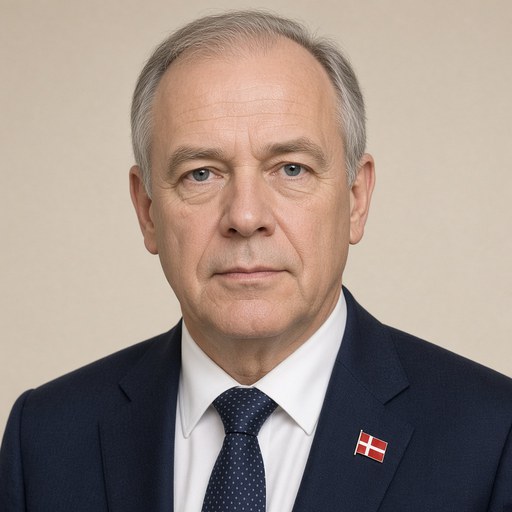
Prime Minister Poul Nyrup Rasmussen's New Year's Speech 1998/1999
 Poul Nyrup Rasmussen · Prime Minister of Denmark
- Context
- Rasmussen addressed the Danish nation on New Year's Eve 1998/1999, reflecting on the past year's challenges and outlining priorities for welfare and social solidarity.
- Main themes
- Danish welfare society, early retirement reform, economic responsibility, social solidarity, labor market challenges, aging workforce, community values, political leadership, inequality and social policy, welfare sustainability
- Duration
- ~18 min
- Words
- 2,124
- Sentences
- 159
- Readability
- 60
- Grade
- 7.1
- Syntax
- 2.60
- Vocabulary
- 1.84
Translated from Danish
The broad sphere of national life a sentence belongs to. Every sentence has an Arena, so it is the denominator the other indices are read against.
Other159 sentences in 82 paragraphs
Good evening!
For most people, the New Year is a natural opportunity to take stock - and look ahead. How did the year that has passed go? What expectations do we have for the year we are entering?
In the last 24 hours, we have all surely looked back on 1998: What went well, what did not go so well - and what can I do better in the coming year?
For me, 1998 showed that we need an in-depth debate on how we ensure the Danish welfare society.
And for me, 1998 showed that many may have taken progress and welfare for granted. Perhaps we have, in our haste, spent too little time discussing that welfare also has a price - and that only we ourselves can pay it.
Perhaps we have forgotten what we deep down know - that welfare is not something that automatically comes in the mail. It requires that there is order in the economy, that those who can make an effort. That we do not all only think of ourselves, but also of our neighbor - and not least of those who are not so fortunate as to be able to take care of themselves.
* * *
The welfare society is something we must constantly work to preserve - and it requires that some decisions are made. And those decisions will not make everyone happy - far from it. Although in the long run, it is still best for our entire society.
But proper political leadership is to do what is necessary - even when what is necessary means that some must give up something so that others - the weakest - can have a better life.
This can lead to criticism. But as a government - and not least as Prime Minister - one must be prepared to bear the brunt if the decision is necessary for the whole. That was the decision regarding early retirement.
The criticism has been harsh. It has been uncomfortable - but I have learned from it.
First and foremost, I have learned that even the best reform is not good enough if it is poorly explained. And that the best explanation is not good enough if one has themselves given rise to disappointed expectations.
* * *
It had become necessary to change the old early retirement scheme. Otherwise, it simply could not survive.
Many thousands more than originally intended have gone on early retirement. This means that expenses have become much larger. And it also means that there are fewer people to finance our welfare.
For early retirement is also not something that just comes in the mail. The vast majority of the expenses for early retirement are paid by all those who go to work, earn their wages, and pay their taxes. And the money we spend on early retirement, we cannot use elsewhere, where there may be greater need.
Another problem is that we are going to have many more people over 60 years old and many fewer younger people. If we all go on early retirement at 60, we will simply lack labor.
We must retain all those who thrive in their jobs - not least the well-educated - for as long as possible in the labor market.
* * *
Until recently, it was the case that companies preferred to hire a 25-year-old - and preferably with 30 years of experience. Youth was everything. Now the reality is different.
We need the older workers - with their experience and maturity.
The most forward-thinking companies are already working to create positions that do not exist today - not just positions for the fully combat-ready. But also jobs for the vulnerable, the insecure - those who are not used to a booming labor market, but who can certainly contribute.
It is towards them that companies must show their social responsibility.
* * *
We want a Denmark where some may have a lot, but no one has too little! That is our path!
There is also another path.
We know from other countries that new divides and inequalities can quickly take root. If we accept a healthcare system where not everyone has equal access regardless of their wallet. If we accept a social policy where a helping hand is not available to all who need it. Then what we understand by the Danish welfare society will fall apart.
We do not want that path. And when I put it so sharply, it is because I ask myself if there is something we have forgotten?
If in our eagerness to secure ourselves we have forgotten the others - if in the midst of the strong economic progress that most of us have experienced - we have come to think too little of the community? And too little of our responsibility towards each other?
* * *
Wasn't that what we saw when there was a conflict in the labor market not so many months ago?
Then there were queues in supermarkets, at the grocer's, and everywhere else. We were all equally guilty. Suddenly everyone had to buy yeast! And gasoline - in buckets.
In reality, there was enough for all of us. It just required that those at the front of the line remembered that there also had to be something for those at the back.
* * *
We want a good community: real opportunities for all of us. Job opportunities for everyone who can. Education - and new chances if things have gone wrong.
These are the goals that our entire policy is about.
And every time those goals are in danger, the government takes action. We adjust our course. We intervene before disaster brings everything to a halt.
That is why we implemented the Pentecost Package - because we could see warning signs that the economy was at risk of overheating, and that the temperature needed to be lowered. Just like if the engine in a car approaches the boiling point - we do not continue as if nothing has happened!
That is why we intervened against private consumption and the skyrocketing property prices. If we had not reacted, we would have been on our way to the economic crises that we have long since left behind.
* * *
In 1999, we will also need to make important political decisions.
It seems to be going quite well.
Many thrive in the fast, modern, efficient society. Many find it fun.
But there are some who cannot keep up. There are some who fall by the wayside, who are excluded.
We must remember those people who have fallen off - those who live a twilight existence on the sidelines.
There are the mentally ill living a miserable life.
There are people who live in deep loneliness.
There are parents who cannot manage to take care of their children.
There are still tens of thousands who, with a cold and cynical expression, are labeled with the worst of all designations: losers. We need to get those people out of the statistics and into the Danish community.
We need to constantly work on how we can break what experts call the social inheritance - the fact that parents' misfortune automatically passes on to their children.
I know that it is harder than anything else. I know that it will take decades. But we will be known for how we take care of the weakest.
* * *
We have worked hard to correct Denmark's economy. We are now reaping the benefits of this policy.
It has succeeded in giving far more people the freedom that comes from being able to use their skills, make an effort, earn their own money, and determine their own lives.
High employment is also a prerequisite for us to get order in society's economy. Fewer need money from the common pot. More can contribute. We can afford both welfare - and to pay off our debt. And to continue our work to improve the environment.
* * *
Many can share the credit for the results achieved so far. The Danes have made a great effort. Companies have shown impressive ability to innovate, the Parliament has had the courage to make necessary decisions in a timely manner.
There should be no doubt that if necessary, the government will at all times recognize its responsibility and intervene.
We will never, ever return to the situation where the Danish society's economy approached the abyss as in the 1970s. And we will not return to a situation where the Potato Cure brought the country to a standstill - as in the 1980s. Because then it takes 7 years before we get back on our feet.
* * *
The financial crisis that has shaken Russia, Asia, and Latin America has so far only brushed against us. On the other hand, we are well-prepared if it comes - thanks to our consistent economic policy. We can take a hit or two.
But we also need to think long-term about our position in relation to the new currency cooperation in Europe.
As of today, 11 of our partner countries have definitively decided to embark on a course that means that up to 300 million people will have a common currency, the Euro. This is now a fact. It cannot be changed.
We have a choice between two options:
One option is to continue to stay outside and maintain the special agreement that was made in 1998 with the Euro countries.
The other option is that we at some point join the Euro. It is a big decision to give up a national currency system. Conversely, the disadvantages of staying outside can become so great that it harms business development and employment.
My personal opinion is: I believe it is best for Denmark, for employment, and for our welfare society that we at some point join the Euro.
But let us now take the necessary time for a thorough debate. In the population, in our parties, in the Parliament. The choice is our own. It goes without saying that Danish accession to the Euro can only happen after a referendum. It is up to us to decide.
* * *
With our yes to the Amsterdam Treaty last year, we said yes to a treaty that largely contains our values.
Now the European cooperation is not just about markets and money. Now it is also about the environment and employment, equality, and consumer interests.
I have not forgotten what was said during the referendum in Denmark - we will continue to respect those Danes who took a different stance.
We want a broader Europe, a Europe at peace with itself and its surroundings. Therefore, we need to include more countries. That is the most important European task in 1999. Where we can celebrate the 150th anniversary of the Danish Constitution.
Think about how privileged we are with our democracy and our constitution. And think about how much the new free countries have to do - think of all that the new democracies now have to build up, all that they have to go through. That is also why it is so important that we, in the name of democracy, support the expansion.
And that is also why it is important that we all participate in the vote for the European Parliament in June.
* * *
We talk a lot about the economy in Danish politics. And I can understand that people sometimes get tired of hearing about it. But the foundation for our welfare, our security, and freedom is that there is order in the economy. Otherwise, we lose what is our true goal with everything we do in politics - to ensure the fundamental social and human values that hold us together.
Before we wish each other a Happy New Year, I would like to say:
Most of us feel that we will be judged by what we do - what we create in our daily lives, at work, for each other. This also applies in politics. It also applies to the government and to myself. We must be judged by the results of the policies we pursue.
The development we have had in Danish society over the past 6 years has not come by itself. It has come because we wanted it. We have come far by our own efforts - through hard work. This applies to all of us in society.
Part of that hard work is making necessary decisions. We in the government will continue our work in 1999 and ensure that Denmark stays on course. Let us together give our welfare society the best possible start in the 21st century.
Happy New Year!
The original Danish. The tags above are read on the English translation's sentences.
Godaften!
For de fleste mennesker er nytåret en naturlig anledning til at gøre status - og se fremad. Hvordan forløb det år, der er gået. Hvilke forventninger har vi til det år, vi går ind i?
Indenfor det seneste døgn har vi sikkert alle set tilbage på 1998: Hvad gik godt, hvad gik ikke så godt - og hvad kan jeg gøre bedre i året, der kommer.
For mig viste 1998, at vi har brug for en indgående debat om, hvordan vi sikrer det danske velfærdssamfund.
Og for mig viste 1998, at mange måske har taget fremgangen og velfærden for givet. Måske har vi i skyndingen brugt for lidt tid til at diskutere, at velfærden også har en pris - og at der kun er os selv til at betale den.
Måske har vi glemt, hvad vi inderst inde godt ved - at velfærd ikke er noget, der automatisk kommer med posten. Det kræver, at der er orden i økonomien, at den, der kan, yder en indsats. At vi ikke alle kun tænker på os selv, men også på naboen - og ikke mindst på dem, der ikke er så heldige, at de kan klare sig selv.
* * *
Velfærdssamfundet er noget, vi bestandigt må arbejde for at bevare - og det kræver, at der bliver truffet nogle beslutninger. Og de beslutninger vil ikke gøre alle glade - så langt fra. Selvom det på længere sigt alligevel er bedst for hele vort samfund.
Men ordentlig politisk ledelse er at gøre det nødvendige - også når det nødvendige betyder, at nogle må afgive noget for at andre - de svageste - kan få et bedre liv.
Det kan give kritik. Men det må man som regering - og ikke mindst som statsminister - være parat til at lægge ryg til, hvis beslutningen er nødvendig for helheden. Det var beslutningen om efterlønnen.
Kritikken har været hård. Den har været ubehagelig - men jeg har lært af den.
Først og fremmest har jeg lært, at selv den bedste reform ikke er god nok, hvis den er dårligt forklaret. Og at den bedste forklaring ikke er god nok, hvis man selv har kunnet givet anledning til skuffede forventninger.
* * *
Det var blevet nødvendigt at ændre den gamle efterlønsordning. Ellers kunne den simpelthen ikke overleve.
Mange tusinder flere end oprindeligt tænkt er gået på efterløn. Det betyder, at udgifterne er blevet meget større. Og det betyder også, at der bliver færre mennesker til at finansiere vores velfærd.
For efterlønnen er heller ikke noget, der bare kommer med posten. Langt den største del af udgifterne til efterløn betales jo af alle dem, der går på arbejde, tjener deres løn og betaler deres skat. Og de penge vi bruger på efterløn, kan vi jo ikke bruge andre steder, hvor der måske er større behov.
Et andet problem er, at vi bliver mange flere over 60 år og mange færre yngre. Hvis vi alle sammen går på efterløn som 60-årige, kommer vi simpelthen til at mangle arbejdskraft.
Vi skal fastholde alle dem, der trives med deres job - ikke mindst de veluddannede - så længe som muligt på arbejdsmarkedet.
* * *
Indtil for nylig var det sådan, at virksomhederne helst ville have en 25-årig - og gerne med 30 års erfaring. Ungdom var alt. Nu er virkeligheden en anden.
Vi har brug for de ældre – med deres erfaring og deres modenhed.
De mest fremsynede virksomheder er allerede i gang med at skabe stillinger, der ikke findes i dag – ikke blot stillinger til de fuldt kampdygtige. Men også jobs til de sårbare, de usikre – dem, der ikke er forvænt med, at der er medgang på arbejdsmarkedet, men som sagtens kan bidrage.
Det er overfor dem, virksomhederne skal vise deres sociale ansvar.
* * *
Vi ønsker et Danmark, hvor nogen muligvis har meget, men ingen for lidt! Det er vores vej!
Der er også en anden vej.
Vi ved fra andre lande, at nye kløfter og uligheder hurtigt kan få fodfæste. Accepterer vi et sundhedsvæsen, hvor alle ikke har lige adgang uafhængigt af pengepungen. Accepterer vi en socialpolitik, hvor en hjælpende hånd ikke er tilgængelig for alle, som trænger. Så falder dét, vi forstår ved det danske velfærdssamfund, fra hinanden.
Den vej vil vi ikke. Og når jeg stiller det så skarpt op, er det fordi, jeg spørger mig selv, om der er noget, vi har glemt?
Om vi i vores iver efter at sikre os selv har glemt de andre - om vi midt i den stærke økonomiske fremgang de fleste af os har haft - er kommet til at tænke for lidt på fællesskabet? Og for lidt på vores ansvar overfor hinanden?
* * *
Var det ikke dét, vi så, da der for ikke så mange måneder siden var konflikt på arbejdsmarkedet?
Så blev der kø i supermarkederne, hos købmanden og alle de andre steder. Vi var såmænd lige gode om det. Pludselig skulle alle købe gær! Og benzin - i baljer.
I virkeligheden var der jo nok til os alle sammen. Det krævede blot, at de forreste i køen huskede, at der også skulle være noget til de bagerste.
* * *
Vi ønsker et godt fællesskab: reelle muligheder for os alle sammen. Jobmuligheder til alle, der kan. Uddannelse - og nye chancer, hvis det er gået galt.
Det er de mål, hele vores politik handler om.
Og hver gang de mål kommer i fare, så tager regeringen fat. Så retter vi kursen ind. Så griber vi ind, før ulykken sætter alt i stå.
Derfor gennemførte vi Pinsepakken - fordi vi kunne se faresignaler om, at økonomien var i risiko for at brænde sammen, og at temperaturen måtte sænkes. Præcis som hvis motoren i bilen nærmer sig kogepunktet - så fortsætter vi jo ikke, som om ingenting er hændt!
Derfor greb vi ind mod det private forbrug og ejendomsprisernes himmelflugt. Hvis vi ikke havde reageret, ville vi igen have været på vej mod de økonomiske kriser, vi for længst har lagt bag os.
* * *
Også i 1999 får vi brug for at træffe vigtige politiske beslutninger.
Det går tilsyneladende ret godt.
Mange trives i det hurtige, moderne, effektive samfund. Mange synes, det er sjovt.
Men der er nogle, som ikke kan hænge på. Der er nogle, der falder af i svinget, bliver udstødt.
Vi skal huske de mennesker, der er faldet fra – dem, der lever et tusmørkeliv på sidelinien.
Der er psykisk syge med et kummerligt liv.
Der er mennesker, som lever i dyb ensomhed.
Der er forældre, der ikke magter at passe på deres børn.
Der er stadig titusinder, der med et koldt og kynisk udtryk får den værste af alle betegnelser hæftet på sig: tabere. De mennesker skal vi have ud af statistikkerne og ind i det danske fællesskab.
Vi har brug for hele tiden at arbejde med, hvordan vi kan bryde dét, eksperterne kalder den sociale arv – det, at forældrenes ulykke automatisk går i arv til børnene.
Jeg ved, at det er sværere end noget andet. Jeg ved, at det vil tage årtier. Men vi vil kendes på, hvordan vi tager os af de svageste.
* * *
Vi har arbejdet hårdt for at rette Danmarks økonomi op. Vi høster nu fordelene af denne politik
Det er lykkedes at give langt flere mennesker den frihed, der ligger i at kunne bruge sine kundskaber, gøre en indsats, tjene sine egne penge og bestemme over sin egen tilværelse.
Høj beskæftigelse er også forudsætningen for, at vi kan få orden i samfundets økonomi. Færre skal have penge fra den fælles kasse. Flere kan bidrage. Vi får både råd til velfærden – og til at komme af med vores gæld. Og til at fortsætte vort arbejde med at forbedre miljøet.
* * *
Der er mange, der kan dele æren for de resultater, der er nået indtil nu. Danskerne har gjort en stor indsats. Virksomhederne har vist imponerende evne til at forny sig, Folketinget har haft modet til at træffe nødvendige beslutninger i rette tid.
Der skal ikke herske tvivl om, at hvis det bliver nødvendigt, så vil regeringen til enhver tid kende sit ansvar og gribe ind.
Vi vil aldrig, aldrig tilbage til den situation hvor det danske samfunds økonomi nærmede sig afgrunden som i 70’erne. Og vi vil heller ikke tilbage til en situation, hvor Kartoffelkuren satte landet helt i stå - som i 80’erne. For så går der 7 år, inden vi kommer på fode igen.
* * *
Den finanskrise, som har rystet Rusland, Asien og Latinamerika har foreløbig kun strejfet os. Til gengæld står vi godt rustet, hvis den kommer - takket være vores konsekvente økonomiske politik. Vi kan tage et skrub eller to.
Men vi har også brug for at tænke langsigtet over vores placering i forhold til det nye valutasamarbejde i Europa.
Fra i dag har 11 af vore samarbejdslande definitivt besluttet at slå ind på en kurs, som betyder, at op imod 300 millioner mennesker vil få en fælles mønt, Euro’en. Det er nu en kendsgerning. Det kan der ikke laves om på.
Vi har et valg mellem to muligheder:
Den ene mulighed er fortsat at stå udenfor og fastholde den særaftale, som blev indgået i 1998 med Euro-landene.
Den anden mulighed er, at vi på et tidspunkt tilslutter os Euro’en. Det er en stor beslutning at opgive et nationalt møntsystem. Omvendt kan ulemperne ved at stå uden for blive så store, at det skader erhvervsudvikling og beskæftigelse.
Min personlige holdning er: Jeg tror, det er bedst for Danmark, for beskæftigelsen og for vort velfærdssamfund, at vi på et tidspunkt tilslutter os Euro’en.
Men lad os nu tage den fornødne tid til en grundig debat. I befolkningen, i vore partier, i Folketinget. Valget er vores eget. Det siger sig selv, at dansk tilslutning til Euro’en kun kan ske efter en folkeafstemning. Det er os selv, der bestemmer.
* * *
Med vort ja til Amsterdamtraktaten sidste år sagde vi ja til en traktat, som i høj grad indeholder vore værdier.
Nu handler det europæiske samarbejde ikke kun om markeder og penge. Nu handler det også om miljø og beskæftigelse, ligestilling og forbrugernes interesser.
Jeg har ikke glemt, hvad der blev sagt under folkeafstemningen i Danmark - vi vil fortsat respektere de danskere, der tog et andet standpunkt.
Vi ønsker et bredere Europa, et Europa i fred med sig selv og sine omgivelser. Derfor skal vi have flere lande med. Det er den vigtigste europæiske opgave i 1999. Hvor vi selv kan fejre 150 året for Danmarks Riges Grundlov.
Tænk, hvor er vi priviligerede med vores demokrati og vores grundlov. Og tænk, hvor har de nye frie lande meget de skal gøre - tænk på alt det, de nye demokratier nu skal bygge op, alt det de skal igennem. Også derfor er det så vigtigt, at vi i demokratiets navn støtter udvidelsen.
Og også derfor er det vigtigt, at vi allesammen deltager i afstemningen til Europa-parlamentet i juni.
* * *
Vi taler meget om økonomi i dansk politik. Og jeg kan godt forstå, at folk ind i mellem bliver trætte af at høre på det. Men grundlaget for vores velfærd, vores tryghed og frihed er jo, at der er orden i økonomien. Ellers mister vi det, der er vores egentlige mål med alt det, vi gør i politik - at sikre de grundlæggende sociale og menneskelige værdier, som holder os sammen.
Inden vi ønsker hinanden godt nytår vil jeg gerne sige:
De fleste af os har det vel sådan, at vi vil bedømmes på det, vi gør - det vi skaber i dagligdagen, på arbejdet, for hinanden. Det gælder også i politik. Det gælder også regeringen og jeg selv. Vi skal bedømmes på resultaterne af den førte politik.
Den udvikling, vi har haft i det danske samfund gennem 6 år, er ikke kommet af sig selv. Den er kommet fordi vi ville det. Vi er nået langt ved egne kræfter - gennem hårdt arbejde. Det gælder os alle i samfundet.
En del af det hårde arbejde er at træffe nødvendige beslutninger. Vi vil i regeringen i 1999 fortsætte vort arbejde og sikre, at Danmark holdes på sporet. Lad os i fællesskab give vort velfærdssamfund den bedst mulige start i det 21. århundrede.
Godt nytår!
***
Se nytårstalen
hér