




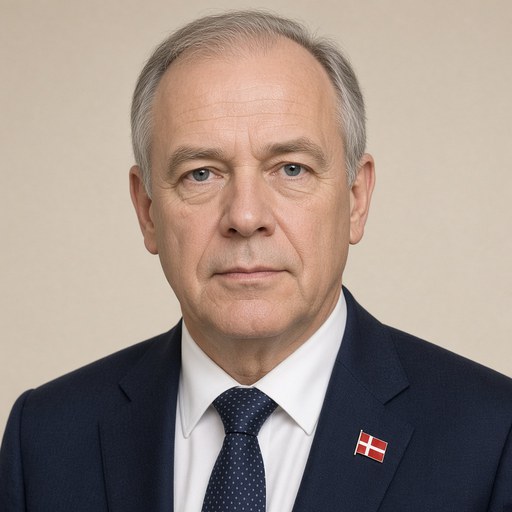
Speech at the Council for European Policy (EMU Meeting), Tuesday, April 20, 1999.
 Poul Nyrup Rasmussen · Prime Minister of Denmark
- Context
- Rasmussen addressed the Council for European Policy in Denmark on April 20, 1999, arguing for Danish membership in the Eurozone on economic and political grounds.
- Main themes
- Euro membership for Denmark, economic and political integration, social security and competitiveness, common currency and internal market, welfare principles and human rights, European identity and vision, Eastern enlargement, global trade and WTO negotiations, employment strategy, environmental policy, social dumping prevention, referendum timing
- Duration
- ~22 min
- Words
- 2,654
- Sentences
- 150
- Readability
- 48
- Grade
- 10.0
- Syntax
- 2.85
- Vocabulary
- 2.07
Translated from Danish
The broad sphere of national life a sentence belongs to. Every sentence has an Arena, so it is the denominator the other indices are read against.
Other150 sentences in 59 paragraphs
'The Euro and Denmark - a perspective and more than just economics'
I hope that today we will have a lively debate - perhaps even a vigorous debate about the Euro.
Thank you to the Council for European Policy for taking up the call to kickstart the European debate. I believe we all feel obligated by that.
Now I hope that the debate will focus more on the content
- rather than on when there should be a referendum. There is certainly much that can be said wisely and strategically about the timing - when - I have no doubt about that. But let us instead have a debate about attitudes and perspectives for Denmark and the Euro.
* * *
Just a few years ago, many believed it was not possible: 11 countries united in an economic community with a common currency and common monetary policy. We are not very keen on mentioning the words 'to make history' these days, because today's agenda may change to a new one tomorrow.
But it is indeed a historic event. We are talking about some of the countries that Denmark is closest to: Germany, France, Benelux, and Finland, which have now entered into a new economic cooperation. We are talking about a region that Danes frequently travel to. We are talking about an economic interdependence that is quite crucial for us. Our trade with the Euro area alone accounts for nearly half of our total foreign trade.
I have not hidden my own viewpoint regarding Denmark's connection to the Euro: I believe we should be a member. I believe it is best for Denmark and the future of our welfare society.
As I mentioned earlier, we will return later to the timing of when the Danes should take a stance on the issue. For it is, after all, solely the Danish population that decides that matter through a referendum!
* * *
My justification for saying yes does not need to be identical to the justifications of other parties or other individuals. I say this because the motivations that lead to a conclusion can be very different and tied to various European visions.
My vision of Europe does not necessarily have to be the same as others' vision of Europe. For my part, the vision of a Europe - a new Europe, a new cooperation in a completely new framework - is an area where high social security goes hand in hand with high competitiveness.
I believe we have shown in Denmark that social security and competitive strength are not opposites, but in fact prerequisites for each other. Lifelong education and opportunities for all. That is part of being able to cope in the future's global competition.
Let me clarify: In the Euro area, we are not only talking about a currency - the Euro, which competes with the dollar. We are talking about more than that. We are talking about a currency that is common for the internal market. But not just a currency for the internal market; it is also a currency for a market for which we politicians have made certain decisions. We have set some minimum requirements that give the market a human face. We demand minimum conditions regarding the environment. We demand minimum conditions in the area of working conditions. And demands for consumer information, etc. We are gradually developing a completely new employment strategy.
But it is more than that. It is also an area where member states commit to certain fundamental welfare principles. And it is finally an area where there is agreement and respect for human rights, and agreement on how to respect minorities in our populations.
As has been made clear, it is a quite special area. In market and political terms. I would like to start by emphasizing this very strongly, for to me, the Euro debate is not only an economic, technical debate, but very much a political debate.
I actually feel that with the Amsterdam Treaty and the Euro cooperation, we have been given some good instruments at our disposal. We must use these instruments to create stability, security within a group of countries, and thus a very large population group - freed from speculative pressure. We must use the instrument to develop our environmental policy and outright reject social dumping or short-term policies that create unemployment.
The European region is a very special region on the blue planet. It obliges us to move forward. One could say that with the agreement on Agenda 2000 - the next 5-6 years of the European budget - we have removed certain skeptics' last justifications for slowing down in relation to the expansion towards Eastern and Central Europe. And one could actually also say that with the Euro area, we have gained a new additional tool to ensure a sensible expansion process.
But we can and should go even further. I actually believe that we must now begin to shape a pioneering region that can leave its mark on the rest of the blue planet - both in relation to the third world, in relation to Latin America, Africa, Asia, the USA, Canada, and Japan.
I believe that in the upcoming WTO negotiations, we should make our mark more clearly and strongly. And I believe that the dream some of us had as young people is no longer so distant. It is in sight and within reach. We can begin from the European region's side to set demands on world trade in a different way than before. Demands for compliance with certain fundamental labor rights, demands for certain ILO standards, demands for a ban on child labor. Of course, taking into account how quickly developing countries can meet these demands - demands that things should be done properly for all people in all countries on this planet.
I noticed that the President of the United States in his recent address to the nation touched on some of the same elements. Therefore, it is not just theory, but actually within reach. For the first time in many years - perhaps for the first time ever.
With these strong positive perspectives, I would like to elaborate on the reasoning behind why we cooperate on a stable currency, the Euro. The answer is simple: Because the Euro is important for our economic welfare.
Since World War II, Denmark, as a smaller country, has always been tied to a larger currency: After World War II, Denmark participated in the Bretton Woods system. It lasted until August 1971, when the Americans suspended the dollar. In September 1971, the so-called Smithsonian Agreement was reached. The agreement meant that other currencies could fluctuate +/- 2 1⁄4 % in relation to the dollar. This meant that the European currencies could fluctuate by up to +/- 4 1⁄2 %.
Then came the Basel Agreement of April 10, 1972, where it was decided to limit the fluctuations of the EEC currencies against each other to +/- 2 1⁄4 %. We joined the agreement along with the other applicant countries; Norway, the United Kingdom, and Ireland, and the system for the European currencies became known as 'the snake in the tunnel'.
In March 1973, the Bretton Woods system in the form it had taken with the Smithsonian Agreement was finally abandoned. 'The snake cooperation' continued in Europe for several more years.
The EMS system replaced 'the snake cooperation' from March 13, 1974, until the introduction of the Euro on January 1 of this year. The EMS system has been the framework for European currency cooperation. But we remember the real collapse of the EMS system a couple of years ago and the motivations and background for that.
* * *
On one hand, one could say that the European currency cooperation has clearly proven its durability and its value. In my opinion, that is beyond discussion. On the other hand, the very collapse of the EMS cooperation has also shown that it was still vulnerable when pressure was applied. Therefore, I believe it was well-founded to start considering what else could be done to strengthen its defense capability against speculative pressure and in relation to the region's demands and needs for currency stability.
The challenge is primarily to do something about unemployment and low growth - without jeopardizing what has already been achieved.
The answer is largely changes and structural policy, which each individual country naturally makes decisions about: The labor market and an offensive macroeconomic policy. For the latter, of course, also coordinated in the way that is well-known in European cooperation.
The European Central Bank lowered interest rates by half a percentage point on April 8 with the aim of contributing to stimulating growth and employment.
* * *
For me, this historical process is proof that the way forward is to pull together by coordinating our economic policy. I have no doubt that cooperation of this nature is far better than a situation where we work against each other and thereby risk exporting unemployment to one another.
We have indeed worked against each other before. History has several examples of that. If we are to find the innermost, real reason for why we have high unemployment in the European region, actually 18 million unemployed, we find the explanation. It is not that we have European cooperation, but that we have lacked a European cooperation that is sufficiently strong in this area.
I am especially thinking of the oil crises in 1974 and 1979, where it was quite obvious that we did not have an offensive response in Europe to the price increases by the oil sheikhs, which hit our societies so massively. There was no doctrine developed in European cooperation. I remember it so clearly. We lacked a common response that could protect employment.
The problem was that when an external shock occurred, as the two oil crises represented, we found ourselves in a situation where all the Western European countries had deficits in their balance of payments. Each individual country reacted and felt pressured to implement significant internal cuts, with the result that each individual country actually pressured its neighbor to also make significant cuts.
The result was not long in coming. We drove each other down into a downward spiral of unemployment creation instead of developing an intelligent response to the shock we faced from the oil-producing countries. History repeated itself in 1979. If we look at the unemployment curve for Europe, we can see the clear trace.
For Denmark, it is actually only now, after 6 years of massive effort, that we have succeeded in bringing unemployment down to the lowest in Europe - and the lowest unemployment in 20 years.
That is the lesson from the last 20 years: I have no doubt that the path we are trying to pursue now - outwardly - is about building resilience in the area against external shocks. Inwardly, it is the prerequisite for stabilizing our cooperation on our employment goals. Therefore, we must hold on to the close cooperation in the EU, which applies to the Euro countries, and it applies to Denmark.
* * *
And now to my views on a fixed krone exchange rate and fixing currencies - is it an advantage, or is it not an advantage? How significant is it for us to have the freedom that comes from being able to devalue or revalue?
I would like to say that the fixed krone exchange rate is an unyielding cornerstone of the government's economic policy. The goal is to ensure low interest rates, low inflation, and stable currency conditions. It helps consumers, it helps savings, it helps employment. One should not be mistaken: High inflation is not beneficial for low-income earners; on the contrary. A fixed krone exchange rate with the resulting effects helps investments and sales and thereby also growth and employment.
A so-called active exchange rate policy may sometimes seem tempting to some, but all experience shows that the result is negative for small countries if things get going. Especially for small countries with a large foreign trade. I will not mention country names from recent times, but just say that one of our closest neighbors has had some quite painful experiences! But now we are building bridges - in more than one sense. And my Dutch colleague will likely confirm that after the devaluation of the Dutch guilder in the early 80s, it took almost 10 years before the Dutch interest rate was as low as before.
* * *
The figures for Denmark's economic development undoubtedly show that the fixed exchange rate policy has served us well. And that we have always sought the binding international currency cooperation. Hence our agreement on ERM 2.
With ERM 2, we respect the formulation from the national compromise of 1993. The national compromise 'Denmark in Europe' states: 'Denmark must, even when other EU countries possibly move to phase 3, participate in a close currency cooperation in the EU'.
The government has maintained the fundamental principles of Danish exchange rate policy with ERM 2: The fixed exchange rate policy and the binding international cooperation. In fact, I have not met many who seriously wished that we would break with our exchange rate policy principles, which now have more than 40 years of history. I consider the stability that is part of this cooperation to be something completely fundamental for Denmark.
* * *
But are there not some downsides to the Euro?
It is, of course, a very big decision to give up one's national currency. It is a very consequential decision, which is not easy to revert once the decision has been made. One can also think a lot about the pace of the integration process that is associated with the Amsterdam Treaty, about our de facto position in relation to the cooperation. I will not go into that right now.
One can certainly also think about what price formation situation, what fiscal effect will arise from our neighboring country - Germany - possibly having the same currency as Denmark: prices will be measured in the same currency unit, so that any citizen, German, Danish, or third-country citizen within the EU area, can compare directly.
There is also no doubt that some of the cooperation related to the Amsterdam Treaty will gain momentum with Euro membership. There will likely, as I hinted earlier, also be some effects on the scope and nature of the fiscal policy instruments we can use, either to counteract an economic downturn or to achieve an economic upturn.
* * *
The question of interest rates in relation to Euro countries, when we are not members of the Euro, has been discussed extensively. All else being equal, there is no doubt that not being a member of the Euro area for a period will mean that we will have to pay a premium interest rate. Its size and scope will also be determined by a number of other developments.
I would also like to mention that Denmark, as an attractive investment country for foreign investors, cannot overlook the fact that it matters whether we are a member of the Euro or not. How significant that impact is, no one can say, but it does matter. We feel it, that’s just how it is. There is no reason to hide that.
* * *
There are many angles one can take in the discussion. It is good that we are now engaged in this debate. Let us, for heaven's sake, get started discussing the substance. It is important that we make every effort to ensure that the population - every single person who will eventually have to take a stance - at least has had real access to familiarize themselves with what membership of the Euro means. And what it means to be outside of it.
I would like to contribute to that today.
The original Danish. The tags above are read on the English translation's sentences.
'Euro’en og Danmark - et perspektiv og mere end økonomi'
Jeg håber, at vi i dag vil få en livlig debat - måske også en spændstig debat om Euro’en.
Tak til Rådet for Europæisk Politik for, at de har grebet opfordringen til at få gang i Europa-debatten. Det tror jeg, vi alle sammen føler os forpligtet af.
Nu håber jeg, at debatten i højere grad vil samle sig om
indholdet
- fremfor om
hvornår
der skal være en folkeafstemning. Det med tidspunkt - hvornår - kan der siges en hel masse klogt og strategisk om, det er jeg slet ikke i tvivl om. Men lad os nu i stedet få en debat om holdninger og perspektiver for Danmark og Euro’en.
* * *
For blot få år siden troede mange, at det ikke var muligt: 11 lande samlet i et økonomisk fællesskab med fælles valuta og fælles pengepolitik. Vi er ikke meget for at nævne ordene 'at skrive historie' nu om stunder, fordi dagsordenen i dag kan være forandret til en ny i morgen.
Men det er faktisk en historisk begivenhed. Vi taler om nogle af de lande, som Danmark er tættest på: Tyskland, Frankrig, Benelux og Finland, som nu har indgået et nyt økonomisk samarbejde. Vi taler om et område, som danskerne hyppigt rejser til. Vi taler om, at vi økonomisk har en gensidig afhængighed, som er ganske afgørende for os. Alene vores handel med Euro-området udgør knap halvdelen af vores samlede udenrigshandel.
Jeg har ikke lagt skjul på, hvad mit eget synspunkt er, når det gælder Danmarks tilknytning til Euro’en: Jeg mener, vi skal være medlem. Jeg mener, det er bedst for Danmark og vort velfærdssamfunds fremtid.
Som jeg sagde før, så kommer vi senere tilbage til tidspunktet for, hvornår danskerne skal tage stilling til spørgsmålet. For det er vel at mærke alene den danske befolkning, der afgør den sag ved en folkeafstemning!
* * *
Min begrundelse for at sige ja behøver på ingen måde at være identisk med andre partiers begrundelser eller andre personers begrundelser. Det siger jeg, fordi de bevæggrunde, der fører frem til en konklusion kan være vidt forskellige og være knyttet til forskellige europæiske visioner.
Min Europa-vision behøver ikke nødvendigvis at være den samme som andres Europa-vision. For mit vedkommende gælder, at visionen om et Europa - et nyt Europa, et nyt samarbejde i en helt ny ramme - er et område, hvor høj social tryghed går hånd i hånd med høj konkurrencedygtighed.
Jeg synes, at vi selv har vist i Danmark, at social tryghed og konkurrencestyrke ikke er modsætninger, men i virkeligheden hinandens forudsætninger. Livslang uddannelse og muligheder for alle. Det hører med til at kunne klare sig i fremtidens globale konkurrence.
Lad mig præcisere: På Euro-området taler vi ikke alene om en valuta - Euro’en, der konkurrerer med dollar’en. Vi taler om mere end det. Vi taler om en valuta, der er fælles for det indre marked. Men ikke bare en valuta for det indre marked, det er også en valuta for et marked, vi politikere har truffet nogle beslutninger for. Vi har lagt nogle mindstekrav ind, som giver markedet et menneskeligt ansigt. Vi stiller krav om mindstebetingelser vedrørende miljø. Vi stiller krav om mindstebetingelser på arbejdsmiljøområdet. Og krav om forbrugeroplysning o.s.v. Vi udvikler gradvist en helt ny beskæftigelsesstrategi.
Men, det er mere end det. Det er også et område, hvor medlemslandene bekender sig til visse grundlæggende velfærdsprincipper. Og det er endelig et område, hvor der hersker enighed og respekt for menneskerettighederne, og enighed om, hvordan man skal respektere minoriteter i vore befolkninger.
Som det er fremgået, er det et ganske særligt område. I markedsmæssig og politisk henseende. Det vil jeg gerne starte med at understrege meget kraftigt, for dermed er Euro-debatten for mig ikke alene en økonomisk, teknisk debat, men i meget høj grad en politisk debat.
Jeg føler faktisk, at vi med Amsterdam-traktaten og Euro-samarbejdet har fået nogle gode instrumenter til rådighed for os. Vi skal bruge instrumenterne til at skabe stabilitet, tryghed indenfor en gruppe af lande og dermed en meget stor befolkningsgruppe - frigjort for spekulationspres. Vi skal bruge instrumentet til at udvikle vores miljøpolitik og blankt afvise sociale dumpninger eller kortsigtet politik, der skaber arbejdsløshed.
Den europæiske region er en helt særlig region på den blå klode. Det forpligter os til at gå videre. Man kan sige, at vi med enigheden om Agenda 2000 - de næste 5-6 års Europa-budget - har fjernet visse skeptikeres sidste begrundelser for at gå ned i tempo i forhold til udvidelsen mod Øst- og Centraleuropa. Og man kan faktisk også sige, at vi med Euro-området har fået et nyt ekstra værktøj til at sikre en fornuftig udvidelsesproces.
Men, vi kan og bør gå videre endnu. Jeg mener faktisk, at vi nu må begynde at forme en foregangsregion, der kan sætte sit præg på resten af den blå klode - både i forhold til den tredje verden, i forhold til Latinamerika, Afrika, Asien, USA, Canada og Japan.
Jeg mener, at vi i de kommende WTO-forhandlinger bør markere os tydeligere og stærkere. Og jeg mener, at den drøm, nogle af os havde som unge, ikke længere er så fjern. Den er i sigte og inden for rækkevidde. Vi kan begynde fra den europæiske regions side at stille krav til verdenshandelen på en anden måde end før. Krav om overholdelse af visse grundlæggende faglige rettigheder, krav om visse ILO-standarder, krav om forbud mod børnearbejde. Naturligvis under hensyntagen til, hvor hurtigt u-landene kan leve op til disse krav - krav om at ting skal gå ordentligt til for alle mennesker i alle lande på denne klode.
Jeg lagde mærke til, at USA’s præsident i sin tale til nationen for ikke så lang tid siden var inde på nogle af de samme elementer. Derfor er det ikke kun teori, men faktisk inden for rækkevidde. For første gang i mange år - måske for første gang nogensinde.
Med disse stærke positive perspektiver vil jeg gerne uddybe ræsonnementerne om, hvorfor vi samarbejder om en stabil valuta, Euro’en. Svaret er enkelt: Fordi Euro’en er vigtig for vores økonomiske velfærd.
Siden 2. Verdenskrig har Danmark, som et mindre land, altid været knyttet til en større valuta: Efter 2. Verdenskrig deltog Danmark i Bretton Woods systemet. Det varede indtil august 1971, hvor amerikanerne suspenderede dollar’en. I september 1971 blev den såkaldte Smithsonian aftale indgået. Aftalen indebar, at andre valutaer kunne svinge +/- 2 1⁄4 % i forhold til dollar’en. Det indebar, at de europæiske valutaer kunne svinge med op til +/- 41⁄2 %. -
Så kom Basel-aftalen af 10. april 1972, hvor det blev besluttet at begrænse EF-valutaernes udsving over for hinanden til +/- 2 1⁄4 %. Vi tilsluttede os aftalen sammen med de øvrige ansøgerlande; Norge, Storbritannien og Irland og systemet for de europæiske valutaer blev kendt som 'slangen i tunnelen'.
I marts 1973 blev Bretton Woods systemet i den form, det havde fået med Smithsonian-aftalen, så endeligt opgivet. 'Slangesamarbejdet' fortsatte i Europa i endnu en årrække.
EMS-systemet afløste 'Slangesamarbejdet' fra den 13. marts 1974 og frem til Euro’ens indførelse fra 1. januar i år. EMS-systemet har været rammen om det europæiske valutasamarbejde. Men vi husker EMS-systemets reelle sammenbrud for et par år siden og bevæggrunden og baggrunden herfor.
* * *
På den ene side kan man sige, at det europæiske valuta-samarbejde klart har bevist sin holdbarhed og sin værdi. Det er efter min opfattelse uden for diskussion. På den anden side har selve sammenbruddet af EMS-samarbejdet også vist, at det alligevel var sårbart, når der blev sat tryk på. Derfor mener jeg, at det var velbegrundet at gå i gang med at overveje, hvad man i øvrigt kunne gøre for at styrke sin forsvarsevne i forhold til spekulationspres og i forhold til regionens krav og behov for valutastabilitet.
Udfordringen er først og fremmest at få gjort noget ved ledigheden og den lave vækst - uden at sætte det, man allerede har opnået, over styr.
Svaret er i høj grad forandringer og strukturpolitik, som hvert enkelt land naturligvis suverænt træffer beslutninger om: Arbejdsmarkedet og en offensiv makroøkonomisk politik. For sidstnævntes vedkommende selvfølgelig også koordineret på den måde, som er velkendt i det europæiske samarbejde.
Den Europæiske Centralbank sænkede den 8. april renten med et 1⁄2 procentpoint med det formål at bidrage til at stimulere vækst og beskæftigelse.
* * *
For mig er dette historiske forløb et bevis på, at vejen frem er at trække på samme hammel ved at samordne vores økonomiske politik. Jeg er slet ikke i tvivl om, at et samarbejde af denne karakter er langt bedre end en situation, hvor vi arbejder mod hinanden og hermed risikerer at eksportere arbejdsløsheden til hinanden.
Vi har jo arbejdet
mod
hinanden før. Det har historien flere eksempler på. Hvis vi skal finde den inderste, reelle begrundelse for, hvorfor vi har den høje arbejdsløshed i den europæiske region, faktisk 18 millioner arbejdsløse, så finder vi forklaringen. Den er ikke, at vi har et europæisk samarbejde, men at vi har
manglet
et europæisk samarbejde, der er tilstrækkeligt stærkt på dette felt.
Jeg tænker især på oliekriserne i 1974 og i 1979, hvor det var helt åbenlyst, at vi reelt ikke i Europa havde et offensivt modsvar til oliesheikernes prisforhøjelser, som ramte vore samfund så massivt. Der var ikke udviklet en doktrin i det europæiske samarbejde. Jeg husker det så tydeligt. Vi manglede et fælles modsvar, der kunne beskytte beskæftigelsen.
Problemet var, at når der kom et ydre chok, som de to oliekriser var udtryk for, befandt vi os i en situation, vor alle de vesteuropæiske lande fik underskud på deres betalingsbalancer. Hvert enkelt land reagerede og følte sig presset til at gennemføre interne betydelige nedskæringer med det resultat, at hvert enkelt land i virkeligheden pressede nabolandet til, at de så også måtte foretage betydelige nedskæringer.
Resultatet lod ikke vente på sig. Vi skruede hinanden ned i en nedadgående arbejdsløshedsskabende spiral i stedet for et udvikle et intelligent modsvar til det chok, vi mødte fra de olieproducerende lande. Historien gentog sig i 1979. Hvis vi ser på arbejdsløshedskurven for Europa, kan vi se det tydelige spor.
For Danmarks vedkommende er det i virkeligheden først nu efter 6 års massiv indsats lykkedes os, at få arbejdsløsheden ned til det laveste i Europa - og den laveste ledighed i 20 år.
Det er vel læren efter de seneste 20 år: Jeg nærer slet ingen tvivl om, at det spor vi prøver at forfølge nu - udadtil - handler om at opbygge robusthed i området over for ydre chokvirkninger. Indadtil er det forudsætningen for at stabilisere vort samarbejde om vore beskæftigelsesmål. Derfor skal vi holde fast i det tætte samarbejde i EU, det gælder Euro-landene, og det gælder Danmark.
* * *
Og nu til mine synspunkter omkring fast kronekurs og fastlåsning af valutaer - er det en fordel, eller er det ikke en fordel? Hvor betydningsfuldt er det for os at have den frihedsgrad, der følger af at kunne devaluere eller revaluere?
Jeg vil gerne sige, at den faste kronekurs er en ufravigelig hjørnesten i regeringens økonomiske politik. Målet er at sikre lave renter, lav inflation og stabile valutaforhold. Det hjælper forbrugerne, det hjælper opsparingen, det hjælper beskæftigelsen. Man skal ikke tage fejl: En høj inflation er ikke til fordel for lavindkomster, tværtimod. En fast kronekurs med deraf følgende effekter hjælper investeringer og afsætning og derigennem også vækst og beskæftigelse.
En såkaldt aktiv valutakurspolitik kan indimellem virke fristende for nogen, men al erfaring viser, at resultatet er negativt for små lande, hvis der først kommer gang i sagerne. Især for små lande med en stor udenrigshandel. Jeg skal ikke nævne landenavne fra nyere tid, men blot sige, at en af vore nærmeste naboer har gjort nogle temmelig smertelige erfaringer! Men nu bygger vi bro - i mere end en forstand. Og min hollandske kollega vil nok bekræfte, at efter devalueringen af den hollandske gylden i starten af 80’erne, tog det næsten 10 år inden den hollandske rente på ny var så lav som tidligere.
* * *
Tallene for Danmarks økonomiske udvikling viser uden for enhver tvivl, at fastkurspolitiken har tjent os godt. Og at vi altid har søgt det forpligtende, internationale valutasamarbejde. Derfor også vores aftale om ERM 2.
Med ERM 2 respekterer vi formuleringen fra det nationale kompromis fra 1993. Det nationale kompromis 'Danmark i Europa' siger: 'Danmark må, også når andre EU-lande evt. går over til 3. fase, deltage i et nært valutasamarbejde i EF'.
Regeringen har med ERM2 fastholdt de grundlæggende principper for dansk valutakurspolitik: Fastkurspolitikken og det forpligtende internationale samarbejde. Faktisk har jeg ikke mødt ret mange, der for alvor har ønsket, at vi brød med vores valutapolitiske grundsætninger, som nu efterhånden har mere end 40 år på bagen. Jeg anser den stabilitet, der er en del af dette samarbejde, som noget fuldstændigt fundamentalt for Danmark.
* * *
Men er der ikke nogle minusser ved Euro ́en?
Det er naturligvis en meget stor beslutning at opgive sin nationale møntfod. Det er en meget konsekvent beslutning, som ikke er sådan at vende tilbage til, når beslutningen en gang er truffet. Man kan også gøre sig mange tanker om tempoet i den integrationsproces, som knytter sig til Amsterdam-traktaten, om vores de facto placering i forhold til samarbejdet. Det skal jeg ikke gå ind i lige nu.
Man kan bestemt også gøre sig tanker om, hvilken prisdannelsessituation, hvilken finanspolitisk effekt, der vil komme af, at vores naboland - Tyskland - i givet fald vil have den samme valuta som Danmark: priserne bliver målt i samme valutaenhed, således at enhver borger, tysk, som dansk, som tredielandsborger inden for EU-området, kan sammenligne direkte.
Der er heller ikke tvivl om, at noget af det samarbejde, der knytter sig til Amsterdam-traktaten vil få mere fart på i Euro-medlemsskabet. Der vil formentlig, som jeg antydede før, også være nogle effekter på omfanget og karakteren af de finanspolitiske instrumenter vi kan bruge, enten for at modvirke et konjunkturnedslag eller opnå en konjunkturopgang.
* * *
Spørgsmålet om renteniveauerne i forhold til Euro-landene, når vi ikke er medlemmer af Euro’en, er blevet diskuteret meget. Alt andet lige er der ikke tvivl om, at det ikke at være medlem af Euro-området over en periode vil betyde, at vi kommer til at betale en merrente. Dens størrelse og dens omfang vil også være bestemt af en række andre udviklinger.
Jeg vil også nævne, at Danmark som attraktivt investeringsland for udenlandske investorer selvsagt ikke kan se bort fra, at det har betydning, hvorvidt vi er medlem af Euro’en eller ej. Hvor stor en betydning kan ingen sige, men det har betydning. Vi mærker det, sådan er det bare. Det er der såmænd ikke nogen grund til at lægge skjul på.
* * *
Der er mange vinkler, man kan lægge i diskussionen. Det er godt, at vi nu er i gang med denne debat. Lad os for alt i verden komme i gang med at diskutere substansen. Det er vigtigt, at vi gør os alle anstrengelser for, at befolkningen - hver eneste person, der til sin tid skal tage stilling - i hvert fald har haft reel adgang til at gøre sig bekendt med, hvad medlemskab af Euro’en betyder. Og hvad det betyder at være uden for.
Det ville jeg hermed gerne give mit bidrag til i dag.