




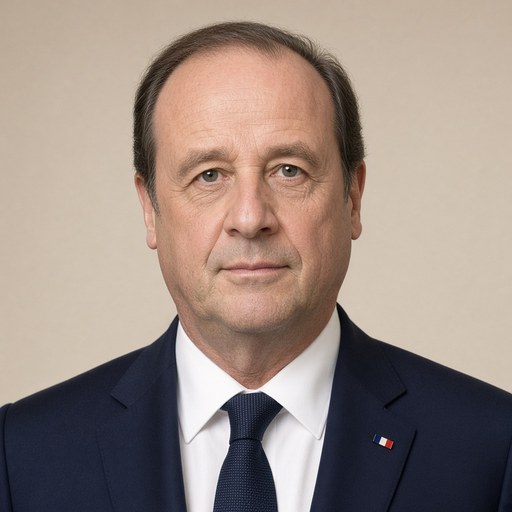
Press conference by Mr. François Hollande, President of the Republic, on the preparation of a growth pact and on the future of Greece within the Eurozone, in Brussels on May 25, 2012.
 François Hollande · President of France
- Context
- Hollande addressed a press conference in Brussels on May 25, 2012, following his first European Council meeting focused on a growth pact and Greece's eurozone membership.
- Main themes
- Growth pact, eurozone stability, eurobonds, budgetary discipline, European Investment Bank recapitalization, structural funds, financial transaction tax, Greece's future in the eurozone, project bonds, energy transition, bank recapitalization, European solidarity mechanism
- Duration
- ~43 min
- Words
- 5,151
- Sentences
- 215
- Readability
- 52
- Grade
- 11.7
- Syntax
- 2.99
- Vocabulary
- 2.08
Translated from French
This is an interview, press conference or exchange with other speakers. It is split into sentences and counted in the corpus, but its sentences are not tagged on the twelve indices.
215 sentences in 60 paragraphs
THE PRESIDENT - Ladies and gentlemen, good evening or rather good night. I participated for the first time in a European Council, which was informal in the sense that it was only aimed at preparing the meeting that will take place at the end of June and which should, if the work is done in this direction, prepare a growth pact that could be an additional dimension to what has been built so far. I reminded this Council of what my conception of growth is. It is not about opposing it to budgetary discipline. Budgetary discipline can allow for the recovery of growth, and growth can facilitate budgetary consolidation.
I also provided a conception of growth that should be comprehensive. There are structural reforms that each of the member countries can undertake to improve their competitiveness. There is what Europe can do, what it is already doing to promote the single market and thus allow for more exchanges between member countries. But there is not enough incentive for investment that could allow European countries to regain higher growth rates. This is all the more damaging as today, European growth is zero for the year 2012, or even in slight recession for the eurozone, and the forecasts for 2013 are relatively pessimistic since the growth rate for the entire Union would barely be 1%. So the challenge is indeed to inject energy back into the engine of growth. Regarding the proposals, there are some that can already reach consensus today, and that is already not so bad, on what we call "project bonds," on the recapitalization of the European Investment Bank, on the mobilization of structural funds, currently unused, on the orientation of the European budget.
But I proposed that we go even further, particularly in that European projects should be more targeted on new technologies, on energy transition, on industrial projects, and notably through the globalization of the EIB. I also wished for the perspective of eurobonds to be included, which would be the additional step of integration. As soon as there is a willingness to pool budgetary policies, there is a monetary policy conducted by the Central Bank, it is legitimate that there are new instruments, and eurobonds can fit into this perspective of integration. I also reaffirmed France's commitment to the financial transaction tax. Not because the tax itself would be a factor of growth; it is rare that a tax creates growth by itself, but because the revenues derived from the financial transaction tax could be allocated to a fund that could itself be useful for investment.
Finally, I insisted on the use that could be made of the European solidarity mechanism, which is not yet fully established since the ratifications that were planned for July 1 have not occurred, but in any case, the European Financial Stability Fund could already play this role, so that this mechanism could be useful for the recapitalization of banks in connection with the European Central Bank.
So it was an exchange of views. Not all member countries necessarily share my conception, I must admit, but there are a number of them that expressed themselves in the same direction, others were able to put forward ideas on the best way to take investment spending into account in the calculation of the Stability Pact.
What I wanted is for there to be new instruments that could be proposed, eurobonds, taxes on financial transactions, European solidarity mechanism to recapitalize banks. Nevertheless, I look at what has already been proposed consensually and that the President of the European Council summarized in a document. So, it is a first step that was necessary, but we are not yet at the end of June and there will still be work to be done to convince.
On Greece, a text was adopted to remind the willingness of the member countries of the Union, not just the eurozone, that Greece remains in the eurozone, while respecting its commitments, and while already highlighting the effort that the eurozone has made to support Greece, it was indicated that there would be a mobilization of structural funds to support the growth effort of the Greeks and thus give confidence to Greek voters regarding what may happen after June 17.
That is the essence of what I wanted to tell you; if it lasted so long, it is because all the countries represented at the European Council speak, and sometimes at length. So do not think that there were debates that could have seized one participant or another. No, it was very calm but very long. So I can answer your questions despite the late hour.
QUESTION -- Did you feel that a majority emerged during these discussions on, for example, the theme of eurobonds?
THE PRESIDENT -- There was no accounting that precise. I understood that some countries were totally opposed, others considered it in the very long term, and others could think that it could be closer. But if your question was to ask whether I was alone in defending eurobonds? No, I was not alone.
QUESTION -- I follow up on the question, what was Germany's position, since it is Germany that counts in this debate, since it will have the most to lose, so did Germany tell you of its total, absolute, and definitive opposition to the creation of eurobonds? On Greece, you have rightly pointed out that Greece must meet its commitments. Let’s imagine that universal suffrage, which can reserve surprises, brings to power a government that will not meet its commitments since it has announced that it will not. What do we do? Have you considered any hypotheses and possibly prepared for a bankruptcy, a departure of Greece from the eurozone?
THE PRESIDENT -- First question, it is not for me to speak on behalf of Germany. But what I retain is that Ms. MERKEL does not see eurobonds as a factor of growth but as a distant perspective of integration. If I want to be fair and do not want to interpret the German position in a way that would be favorable or unfavorable to me, I try to understand. I have a different conception; eurobonds are not simply a point of culmination at the end of an integration process, they can be an opportunity to mutualize not past debt but future debt to allow states that today borrow at interest rates of 6% to access the market more easily and, moreover, to use eurobonds for investment projects or those that would be directly carried out by the Union. This would justify modifying the treaties. I agree. I make a distinction with "project bonds" which now seem to be widely accepted but which are more guarantees than new loans, more public-private partnerships than an initiative taken by the Union.
So I still see that, in this discussion, there are first clarifications, progress, and also ongoing debates.
On Greece, first, I am not informed of any simulation by I don’t know what group or subgroup of what a departure of Greece from the eurozone could provoke. I am not saying that there is no place where this should be worked on, perhaps there must be, each country can also conduct its studies. In any case, as far as France is concerned, I am not informed of this type of simulation work and we are not directly conducting this type of hypothesis for France. Why? Because I prioritize keeping Greece in the eurozone, which was indeed the position expressed this evening. What would happen if the new government resulting from the Greek elections refused the memorandum and did not respect the obligations that Greece must currently undertake? I think, and without necessarily sharing this point of view, but I think that the attitude of the eurozone would be to demand strict compliance with commitments. But while waiting and hoping for another situation, I advocate that beyond what the Greeks must apply, that is to say the memorandum, and beyond what the eurozone has already done for Greece, structural funds should be quickly mobilized so that Greece's growth can be encouraged in a very short time, so that the Greeks can have confidence in the solidarity of the eurozone and that they can say that they have obligations to respect but also prospects for a return to growth and an improvement in their living conditions.
QUESTION -- To ensure that the debate on eurobonds does not remain too hermetic to the general public, could you tell us how you defend the idea of a growth pact, what is the interest, in your opinion, of having eurobonds, and is it a new effort of solidarity that should be made towards the most indebted countries, and would it imply a transfer of sovereignty?
THE PRESIDENT -- There are several questions. So that we can speak to the broadest public, Europe, without modifying any treaty, can already use the European Investment Bank. So the first idea is to increase the capital of the European Investment Bank, and thanks to this contribution, this bank will be able to lend more widely to companies to carry out a number of investment projects.
So everyone can understand that without going so far as to issue bonds, the use of the European Investment Bank can already serve to finance a number of projects.
The second idea that adds to the first is "project bonds," which is also an innovation, that is to say, projects that arise from a private initiative, companies raise loans, and the Union provides its guarantee through an appropriate mechanism. There are therefore possibilities for additional investments.
Then the last idea, eurobonds as such have several conceptions; either it is to mutualize past debts, which is not acceptable, we are not going to borrow to cover the debt that has already been incurred in a number of countries, that is not at all my conception. The second conception is to say that eurobonds can serve for new loans of a number of states, this would be desired by those who borrow at very high interest rates, what we call the "spreads," compared to Germany which now borrows at 0%, Spain borrows at 6%. So eurobonds would be a factor of mutualization allowing these countries to borrow at a lower cost and thus also allowing them to move faster in budgetary adjustment and to carry out a number of investments.
Then there is a third conception that would imply, as I said, a modification of the treaties that goes in the direction of integration, since there is a common budgetary policy, we can also imagine a policy of investments that could be undertaken, and at that moment eurobonds become an instrument for Europe, an additional resource.
In this regard, the financial transaction tax can also have a link with eurobonds since it can allow for the repayment of the interest on the loans contracted. But the financial transaction tax is also an idea that allows for raising resources, finally collecting revenues that can then be used to replenish the budget and finance the operations that Europeans can decide for themselves with the control of Parliament.
QUESTION -- Still on these eurobonds, you decided with Ms. MERKEL not to immediately revisit the question of renegotiating the treaty to first discuss the issue of growth tools. Are the two linked, can we imagine that in your mind the idea of inscribing these eurobonds as a perspective is a prerequisite to the idea of reopening negotiations on the treaty?
THE PRESIDENT -- At this stage, to allow for the broadest discussion, we have not mentioned any legal instrument, so ideas are exchanged, and it is at the end of our deliberations at the European Council at the end of June that any potential treaty modifications can be proposed, but at this stage, there has been no discussion on existing treaties that would need to be modified or new treaties that would need to be negotiated.
QUESTION -- Do you wish for that?
THE PRESIDENT -- I will see at the end what can be effectively put in a legal form of a treaty.
QUESTION -- On the train that brought you here to Brussels, you said that you would not present yourself as the savior of Europe, surely referring to your predecessor, and we also sensed that you found that Europe might be moving too slowly to resolve this crisis. However, earlier in this same press conference, you humorously pointed out that the discussions had been lengthy because the 27 had spoken at great length. My question is a bit personal; this is your first summit. Do you ultimately find that the European functioning is in line with current events, for example, which are very pressing regarding Greece and Spain? Should Europeans change their mode of operation?
THE PRESIDENT -- First, regarding the past, this is the 24th summit since October 2008. That does not mean that nothing has been done during the other 23, and mechanisms have been invented, developed, and expanded. Decisions have been made, and that indicates that there is a slowness in the process, but it is undoubtedly linked to the decision-making mode. Work has been done, and today what must count is to give a new dimension, particularly in terms of growth. Then, regarding the mechanisms themselves, I do not want to lecture because I am newly elected, but when we meet with 27, all 27 speak, because when 22 have spoken, why would 5 remain silent? They must account to their public opinion, and they speak for extremely variable durations; some can express their thoughts in a few minutes, while others, who knows why, take part of the night. So it is also about respecting sovereignties; each country matters and must be heard. Perhaps later, when I have attended several European Councils, I will suggest other methods, but for now, I do not want to lecture, so I adapted and was rather brief in my intervention. So that is not where I can be criticized, but I was clear.
QUESTION -- This morning, Prime Minister Mr. AYRAULT, who was on RTL, when asked whether the growth was not meeting expectations and whether the commitment to bring the deficit down to 3% next year could be upheld, he replied, "That is what we wish." Between wishing and a commitment, there is a difference. To restore trust with France's partners, have you been led to clarify France's commitment to its 3% target for next year?
THE PRESIDENT -- No, I said that as far as I am concerned, I want to achieve the objectives that were set, which I myself stated during the campaign, to reach 3% by the end of 2013. Then, what we will learn about the state of accounts will require us to wait until the end of June for the first president of the Court of Auditors to give us his report. We will see; I think everything will depend on the growth rate for the year 2013. That is why the discussion this evening, and especially that at the end of June, is not a theoretical discussion because while the growth for 2012 is already given, the OECD has confirmed it to be around 0.6; we know we will be between 0.5 and 0.7. No surprises. On the other hand, the issue is whether in 2013 we are at 1.3 or 1.7? If we are at 1.7, it is easier to reach 3%.
So all my national policy or my European commitments, my desire to bring growth at the European level, and even in the discussions we can have at the G8, which was done at Camp David and soon at the G20, is to ensure that growth returns faster than expected.
QUESTION -- Yesterday, for the first time, we saw that in China the exchange rate between the euro and the yuan fell to 1 euro equals 8, and two years ago it was 1 euro equals 12. So many Chinese have as their first reflex, "We need to come to Europe to shop." So you see that the crisis in Europe, the European debt crisis, can also lead to a devaluation of the euro and rather favor trade and exports in Europe. What is your assessment of this situation? What could it change in trade relations between Europe and China?
THE PRESIDENT -- I appreciate your presentation of the yuan's revaluation, as if it were a Chinese intention. No, it is the product of a situation we know in the eurozone that causes the euro to decrease in value against the dollar and the yuan. There are not only disadvantages to this situation, but I do not believe that European competitiveness will be found simply through exchange rate adjustments. Efforts in investment and productive recovery will also be necessary.
The European Commission will soon release, I am told, figures on the competitiveness of the different member countries of the European Union, and without knowing these figures, I know what has happened over the past 5 years, if not 10 years, which is that there has been a degradation of the competitiveness of the French economy, notably a deterioration of its trade balance. Therefore, we need to make investment efforts, and we cannot simply base our improvement in the trade balance on the implicit revaluation of the yuan. This will not prevent the Chinese from coming in large numbers, I hope, to spend their holidays in France.
QUESTION -- What chances do you give to the summit at the end of June to achieve a convergence of views between France and Germany, particularly on the issue of eurobonds?
THE PRESIDENT -- For now, from Germany, there is the idea that eurobonds, if I want to give the most optimistic version, can only be a point of culmination, while we consider that it should be a starting point. That is to say what the respective positions are today. But it is true that there is a difference, and it has been noted by the President of the European Council. This is not new. I respect Ms. MERKEL's point of view when she says that eurobonds are not a growth instrument as such. But it is an instrument that can allow growth under certain conditions. So we will have this debate that will continue. It could not be resolved here; in fact, no one imagined that it would be, and therefore there was no, if that is what you were expecting, conflicts or confrontations. Everyone expressed their point of view, and there are countries that have expressed their opposition to eurobonds much more firmly than Ms. MERKEL, dismissing any hypothesis of eurobonds. You have others who are in favor of eurobonds and who are not in favor of the financial transaction tax, for example, Great Britain. And then there are countries against everything; I will not name them, but you can find them; they are against eurobonds, against the financial tax, against increasing the capital of the EIB, against increasing the European budget. That exists.
Then there are also countries that may be in favor of eurobonds, in favor of the financial transaction tax, and in favor of the recapitalization of the EIB. So there is a European Council that will continue to work and undoubtedly seek a compromise; we must always seek compromise. But we are not there yet. What was necessary was to put ideas on the table and clearly state who was for and who was against, so that subsequently the President of the European Council and the President of the European Commission could work to bring the points of view closer.
QUESTION -- If the Germans persist in their resistance, can you imagine or consider launching a eurobond project with fewer countries, perhaps without the Germans, and doing this project with certain countries rather than the entire Union? Second question, how do you envision that the European Central Bank could do more for growth?
THE PRESIDENT -- First, I do not place myself in the hypothesis that we should do without Germany or Germany without France. We are seeking positions that can be shared; that is the idea. If more than a month before a European Council that will make decisions, I were already in the perspective that there would be no decision and that there would be a separation, I would not respect the idea I have of what European construction is. So I will work to ensure that it is possible to find solutions that allow growth to truly be a dimension of European action. I spoke of a Growth Pact; the term has been taken up, including by the President of the European Central Bank, and I believe it is now established.
Regarding the European Central Bank, its President was present at our discussions. What I took from it is that he had already allowed for a massive intervention so that banks could find liquidity and that he was looking at the situation without us having to debate the central bank; we did not debate the central bank this evening.
Opinions were expressed; I defended my position, which I recalled, of a recapitalization of banks through the European solidarity mechanism in connection with the Central Bank.
QUESTION -- I would like to return to the question of Greece. You said regarding simulations that we do not conduct this type of hypothesis because I prioritize keeping Greece in the eurozone. But it takes two for that; the Greeks can very well vote against keeping their country in the eurozone. There can be events that happen, "bank runs," a succession of events that put us in a fait accompli. By refusing to place yourself in this situation, do you not risk making a mistake? After all, governing is about anticipating. Do you not risk being reproached for making a mistake that could have serious consequences?
THE PRESIDENT -- Anticipating what? Greece's exit from the eurozone and its consequences? But already, if we were to engage in this reflection, I am not saying that there are no studies; there has been information indicating that there were a number of simulations that could exist. But if I were to publicly speak about the hypothesis of Greece's exit, that would mean we would have already sent a signal. A signal to the Greeks and a signal to the markets. So I prefer, because I have a responsibility, to address the Greeks by saying: "France and indeed Europe want you to remain in the eurozone, that you respect the commitments that have been made, but that we make gestures to show you that we are committed to helping you regain hope." It is in the interest of the Greeks, it is in the interest of the eurozone, and even in the interest of the global economy. At the G8, the American President was interested in the situation of the eurozone, not simply out of solidarity with the Greeks, but because he knew well that if there were, as you say, a "bank run," it would have consequences for Europe and also for American growth. That is why I do not place myself in that scenario.
QUESTION -- You had a bilateral meeting with the Polish Prime Minister. I would like to ask you if, in the 2014-2020 European Union budget, you see sources of growth, sources of investment, especially in structural funds, or will you continue the policy of your predecessor? Second question, are you going to Ukraine for the football championships?
THE PRESIDENT -- Regarding the meeting I had with the Polish Prime Minister, it was quite pleasant. We talked about the Weimar Triangle because it is a common desire of Ms. MERKEL, the Polish authorities, and myself to have these meetings in that framework and also to have a bilateral relationship with Poland, let’s say better than before.
On the budgetary perspective, you are right; there is a debate about it; it took place this evening and will return at the end of June. There are those who are in favor of a larger European budget, those who want less European spending, considering that the less there is in the European budget, the less participation from the states, and there are those who, within the framework of the European budget, want to allocate a larger share to structural funds and a smaller share to the common agricultural policy. From this point of view, I have a consistent position, which is to maintain a high level for the common agricultural policy while also having structural funds.
As for Ukraine, this question was raised in the bilateral meeting; I love football, but what is happening in Ukraine is a problem.
QUESTION -- At the heart of the crisis is the link between banking risk and sovereign risk, and to address this issue, there are discussions at the level of central banks about the possibility of a European banking union. Mr. MONTI in the United States mentioned the possibility of creating a European deposit guarantee fund to prevent contagion in the event of a banking crisis in Spain or Greece. What do you think about that?
THE PRESIDENT -- That is also my position. That is to say, Mr. MONTI and I defended this proposal in the informal Council. I said it myself, I wish for the integration of financial supervision mechanisms and deposit guarantees and crisis resolution. So that is a point we will return to. The more we coordinate, we centralize, the better the response will be on supervision, on crisis resolution, and especially on deposit guarantees. Moreover, on many points, we found common ground with Mr. MONTI this evening.
QUESTION -- This afternoon in Paris, you mentioned alongside these important financial issues a democratic challenge, against the backdrop of the rise of populist movements in Europe, and we could add against the backdrop of increased distrust among European citizens regarding European construction at this time. Did you discuss this tonight, and what did your counterparts say?
THE PRESIDENT - Yes, I emphasize the dual challenge; there is an economic challenge to allow growth to return more quickly, to accelerate the recovery of accounts and improve the level of employment. That is the economic challenge that everyone understands. But there is a democratic challenge, meaning that we today have a double populism that is emerging or consolidating. A populism in Northern Europe, from citizens who no longer want to give, and a populism in Southern Europe from other countries that are frustrated to be forced to endure austerity plans, and we see in local elections or national elections these movements emerging, taking very different names; they can also be movements that are not extremist but reflect a rejection of the functioning of Europe as it is today. When I say functioning, it is not about decision-making modes, it is not about how we speak in European Councils, it is rather about the policies that are being implemented because some, I heard it tonight, believe they have already given a lot. These are the countries of Northern Europe, in relation to the countries of Southern Europe, and in the countries of Southern Europe, there is great concern that, despite all the austerity efforts, they still find themselves with very high interest rates.
I just received the President of the Spanish government. He is not of the same political sensitivity as mine. He mentioned everything that has been decided since the elections in Spain for structural reforms, all the adjustments that have been made, all the cuts in purchasing power that have been accepted. The general strikes he has endured. And despite that, he said, he still has interest rates at 6%. We can clearly see the risk. In Italy, you saw what happened in the local elections, including in Parma, with an argument that is not different from the one I just indicated. Why, when there are so many efforts, are there so few results?
So, there you go, the challenge is also democratic. I even said that it also has a consequence of favoring alternations. I was a living product of that. All this to worry them, for those who had some elections coming up. Because it is true that it is also an element that must be taken into account. Look at what happened in the last elections across Europe. Regardless of the qualities of those who stood for election. There is still a law of series that surely reflects an exasperation.
QUESTION -- I wanted to know if you discussed tonight who would replace Jean-Claude Juncker.
THE PRESIDENT -- Jean-Claude Juncker was next to me, and I did not talk about that.
QUESTION -- Yet it is coming up soon in July?
THE PRESIDENT -- No, this subject was not mentioned at all. Not the subject of appointments to positions. I am not saying it does not exist, but it was not at all the framework.
QUESTION -- Mr. President, two questions, the first, you said that your European counterparts agreed on the principle of a growth pact and on this terminology, what is the legal status of this growth pact? Will it be as binding as the budget treaty? First question, second question, during the presidential campaign, you announced your objectives for Europe. This time it was the first time you presented these objectives to your partners. Are you, therefore, more pessimistic, more optimistic regarding these objectives, have you measured that it is more difficult or less difficult than you imagined?
THE PRESIDENT -- Will the word pact itself be adopted by everyone? Some may refer to a growth strategy or a growth perspective. It will be at the end of the month that we will know if it is a real pact with a set of measures whose legal nature we cannot yet prejudge.
Regarding the difficulty of the exercise, I had anticipated it. The composition of the European Council is known. But what was important, beyond the different political sensitivities or the situations of countries that are not the same, was the idea from all sides that we must make an effort for growth. So, if I want to be fully aware of the realities, it is that behind the word growth, some put structural reforms, competition, the services directive, labor market flexibility, trade agreements with other geographical areas than Europe. That is one vision, and then there is a vision consisting of not adding public spending; everyone knows the state of public finances, but of instruments that can allow raising additional funds. And there, we can find the EIB, the "project bonds," and instruments, even if they do not reach consensus like the financial transaction tax.
There you go, thank you very much for your patience, and see you in June.
The original French. The tags above are read on the English translation's sentences.
LE PRESIDENT - Mesdames, Messieurs, bonsoir ou plutôt bonne nuit. Je participais pour la première fois à un Conseil européen, il était informel au sens où il ne visait qu'à préparer la réunion qui se tiendra à la fin du mois de juin et qui devrait, si le travail est fait dans ce sens, préparer un pacte de croissance qui pourrait être une dimension supplémentaire à ce qui s'est jusqu'à présent construit. J'ai rappelé dans ce Conseil ce qu'était ma conception de la croissance. Il ne s'agit pas de la mettre en opposition avec le sérieux budgétaire. Le sérieux budgétaire peut permettre de retrouver de la croissance et la croissance peut faciliter la consolidation budgétaire.
J'ai également donné une conception de la croissance qui devait être globale. Il y a ce qui relève de réformes structurelles que chacun des pays membres peut conduire pour améliorer sa compétitivité. Il y a ce que peut faire l'Europe, ce qu'elle fait déjà pour favoriser le marché unique et donc permettre qu'il y ait plus d'échanges entre les pays membres. Mais il n'y a pas suffisamment d'incitation à l'investissement qui pourrait permettre aux pays européens de retrouver des taux de croissance plus élevés. C'est d'autant plus dommageable qu'aujourd'hui, la croissance européenne est nulle pour l'année 2012 voire en légère récession pour la zone euro et les prévisions pour 2013 sont relativement pessimistes puisque le taux de croissance sur l'ensemble de l'Union ne serait qu'à peine de 1%. Donc l'enjeu c'est bien de remettre de l'énergie dans le moteur de la croissance. Sur les propositions, il y en a qui aujourd'hui peuvent déjà faire consensus et c'est déjà pas si mal, sur ce qu'on appelle les « projects bonds », sur la recapitalisation de la Banque européenne d'investissement, sur la mobilisation de fonds structurels, aujourd'hui inutilisés, sur l'orientation du budget européen.
Mais j'ai proposé qu'on aille plus loin encore, notamment sur le fait que les projets européens devraient être davantage ciblés sur les technologies nouvelles, sur la transition énergétique, sur les projets industriels et notamment à travers la mondialisation de la BEI. J'ai également souhaité que soit inscrite la perspective des eurobonds qui seraient l'étape supplémentaire de l'intégration. Dès lors qu'il y a une volonté de mettre en commun des politiques budgétaires, il y a une politique monétaire conduite par la Banque centrale, il est légitime qu'il y ait des instruments nouveaux et les eurobonds peuvent s'inscrire dans cette perspective d'intégration. J'ai également réaffirmé l'attachement de la France à la taxe sur les transactions financières. Non pas parce que la taxe serait elle-même un facteur de croissance, il est rare qu'un impôt créée de la croissance par lui-même, mais parce que les recettes qui seraient tirées de la taxe sur les transactions financières permettraient d'être affectées à un fonds qui lui-même pourrait être utile à l'investissement.
Enfin, j'ai insisté sur l'utilisation qui pourrait être faite du mécanisme européen de solidarité qui n'est pas encore complètement installé dès lors qu'il n'y a pas eu les ratifications qui étaient prévues pour le 1er juillet, mais en tout cas, le fonds européen de stabilité financière pourrait déjà jouer ce rôle, de façon à ce que ce mécanisme puisse être utile à la recapitalisation des banques en lien avec la Banque centrale européenne.
C'était donc un échange de vues. Tous les pays membres ne partagent pas nécessairement ma conception, je dois en faire l'aveu, mais il y en a un certain nombre qui se sont exprimés dans le même sens, d'autres ont pu avancer des idées sur la meilleur façon de tenir compte des dépenses d'investissement dans le calcul du Pacte de stabilité.
Moi, ce que j'ai voulu c'est qu'il puisse y avoir des instruments nouveaux qui puissent être proposés, eurobonds, taxes sur les transactions financières, mécanisme européen de solidarité pour recapitaliser les banques. Il n'empêche, je regarde ce qui a déjà été proposé de manière consensuelle et que le Président du Conseil européen a résumé dans un document. Donc, c'est une première étape qui était nécessaire, mais nous ne sommes pas encore à la fin du mois de juin et il y aura encore un travail de conviction à mener.
Sur la Grèce un texte a été adopté pour rappeler la volonté des pays membres de l'Union, pas simplement de la zone euro que la Grèce reste dans la zone euro, tout en respectant ses engagements, et tout en soulignant déjà l'effort qu'a engagé la zone euro pour venir en soutien à la Grèce, il a été indiqué qu'il y aurait une mobilisation des fonds structurels pour soutenir l'effort de croissance des Grecs et pour ainsi donner confiance aux électeurs grecs par rapport à ce qui peut se passer après le 17 juin.
Voilà le sens de ce que je voulais vous dire, si ça a duré aussi longtemps c'est parce que tous les pays représentés au Conseil européen parlent et parfois longuement. Donc ne pensez pas qu'il y a eu des débats qui ont pu saisir tel ou tel participant. Non c'était très calme mais très long. Voilà je peux répondre à vos questions malgré l'heure tardive.
QUESTION -- Est-ce que vous avez eu le sentiment qu'une majorité s'est dégagée à l'occasion de ces discussions sur, par exemple, la thématique des eurobonds ?
LE PRESIDENT -- Il n'y a pas eu de comptabilité aussi précise. J'ai compris que certains pays étaient totalement hostiles, d'autres l'envisageaient à très long terme et d'autres encore pouvaient considérer que ça pouvait être plus rapproché. Mais si votre question c'était de dire est-ce que j'étais seul à défendre les eurobonds ? Non je n'étais pas seul.
QUESTION -- Je poursuis la question, quelle a été la position de l'Allemagne, puisque c'est l'Allemagne qui compte dans ce débat, puisque ce sera elle qui aura le plus à perdre, donc est-ce que l'Allemagne vous a dit son opposition totale, absolue et définitive à la création des eurobonds ? Sur la Grèce, vous avez bien souligné que la Grèce devait tenir ses engagements. Imaginons que le suffrage universel qui peut réserver des surprises amène au pouvoir un gouvernement qui ne tiendra pas ses engagements puisqu'il a annoncé qu'il ne les tiendrait pas. Qu'est-ce que l'on fait ? Avez-vous envisagé des hypothèses et préparé éventuellement une faillite, une sortie de la Grèce de la zone euro ?
LE PRESIDENT -- Première question, ce n'est pas à moi de parler au nom de l'Allemagne. Mais ce que je retiens c'est que Mme MERKEL ne considère pas les eurobonds comme un élément de croissance mais comme une perspective lointaine d'intégration. Si je veux être juste et ne veut pas tirer la position allemande dans un sens qui me serait favorable ou défavorable, j'essaie de comprendre. Moi j'ai une autre conception, les eurobonds ce n'est pas simplement un point d'aboutissement au terme d'un processus d'intégration, ça peut être l'occasion de mutualiser non pas une dette passée mais une dette future pour permettre à des Etats qui, aujourd'hui empruntent avec des taux d'intérêt à 6% de pouvoir accéder plus facilement au marché et par ailleurs, d'utiliser les eurobonds pour des projets d'investissement ou qui seraient portés directement par l'Union. Ce qui justifierait de modifier les traités. J'en conviens. Je fais une distinction avec les « projects bonds » qui m'ont paru être maintenant largement acceptés mais qui sont davantage des garanties que des emprunts nouveaux, davantage du partenariat public-privé que de l'initiative européenne prise par l'Union.
Donc je vois quand même que, dans cette discussion, d'abord des clarifications, des progrès et aussi des débats qui se poursuivent.
Sur la Grèce, d'abord, je ne suis informé d'aucune simulation par je ne sais quel groupe ou sous-groupe de ce que pourrait provoquer une sortie de la Grèce de la zone euro. Je ne dis pas qu'il n'y a pas de lieu où ça doit se travailler peut-être, il doit en exister, chaque pays peut aussi faire ses études. En tout cas en ce qui concerne la France, je ne suis pas informé de ce type de travaux de simulation et nous ne menons pas directement pour la France ce type d'hypothèse. Pourquoi ? Parce que je privilégie le maintien de la Grèce dans la zone euro, ce qui d'ailleurs a été la position exprimée ce soir. Que se passerait-il si le nouveau gouvernement issu des élections grecques refusait le mémorandum et ne respectait pas les obligations qui sont aujourd'hui celles que la Grèce doit consentir. Je pense et sans partager nécessairement ce point de vue, mais je pense que l'attitude de la zone euro serait de demander le respect strict des engagements. Mais dans l'attente et dans l'espoir d'une autre situation, moi je plaide pour qu'au-delà de ce que les Grecs doivent appliquer c'est-à-dire le mémorandum et au-delà de ce qu'a déjà fait la zone euro pour la Grèce, les fonds structurels puissent être rapidement mobilisés pour que la croissance de la Grèce puisse être encouragée dans un délai très court, afin que les Grecs puissent avoir confiance dans la solidarité de la zone euro et qu'ils puissent se dire qu'ils ont des obligations à respecter mais aussi des perspectives pour avoir un retour de la croissance et une amélioration de leur condition de vie.
QUESTION -- Pour que le débat sur les eurobonds ne restent pas trop hermétiques au grand public, est-ce que vous pourriez nous dire comment vous défendez l'idée d'un pacte de croissance, quel est l'intérêt selon vous d'avoir des eurobonds et est-ce que c'est un nouvel effort de solidarité qu'il faudrait faire à l'égard des pays les plus endettés et est-ce que ça supposerait un transfert de souveraineté ?
LE PRESIDENT -- Il y a plusieurs questions. Pour que nous puissions parler au plus large public, d'ores et déjà l'Europe, sans modifier quelque traité que ce soit, peut utiliser la Banque européenne d'investissement. Donc la première idée est d'augmenter le capital de la Banque européenne d'investissement et grâce à cet apport, cette banque pourra prêter plus largement à des entreprises pour réaliser un certain nombre de projets d'investissement.
Donc chacun peut comprendre que sans aller jusqu'à émettre des titres d'emprunt, l'utilisation de la Banque européenne d'investissement peut déjà servir à financer un certain nombre de projets.
Deuxième idée qui s'ajoute à la première, les « projects bonds », là-aussi c'est une innovation, c'est-à-dire des projets qui naissent d'une initiative privée, des entreprises lèvent des emprunts et l'Union apporte sa garantie, par un mécanisme approprié. Il y a là des possibilités donc d'investissements supplémentaires.
Alors dernière idée, les eurobonds en tant que tels ont plusieurs conceptions, soit c'est pour mutualiser les dettes passées, ce n'est pas acceptable, on ne va pas emprunter pour couvrir la dette qui a déjà été constatée dans un certain nombre de pays, ce n'est pas du tout ma conception. Deuxième conception c'est de dire que les eurobonds peuvent servir pour les emprunts nouveaux d'un certain nombre d'Etats, ce serait souhaité par ceux qui empruntent à des niveaux de taux d'intérêts très élevés, ce qu'on appelle les « spreads », par rapport à l'Allemagne qui emprunte maintenant à 0%, l'Espagne emprunte à 6%. Donc les eurobonds seraient un facteur de mutualisation permettant d'emprunter pour ces pays-là, d'emprunter à moindre coût et donc leur permettant aussi d'aller plus vite dans l'ajustement budgétaire et de réaliser un certain nombre d'investissements.
Puis il y a une troisième conception qui supposerait je l'ai dit une modification des traités qui va dans le sens de l'intégration, puisqu'il y a une politique budgétaire commune, on peut aussi imaginer une politique d'investissements qui pourrait être engagée et à ce moment-là les eurobonds deviennent un instrument pour l'Europe, une ressource supplémentaire.
A cet égard, la taxe sur les transactions financières peut avoir aussi un lien avec les eurobonds puisque ça peut permettre de rembourser les intérêts des emprunts contractés. Mais la taxe sur les transactions financières est également une idée qui permet de lever des ressources, enfin d'encaisser des recettes qui ensuite peuvent être utilisées pour renflouer le budget et financer les opérations que les Européens peuvent décider par eux-mêmes avec le contrôle du Parlement.
QUESTION -- Toujours sur ces eurobonds, vous avez décidé avec Mme MERKEL de ne pas reparler immédiatement de la question de la renégociation du traité pour parler d'abord de la question des outils de croissance. Est-ce que du coup les deux sont liés, est ce que l'on peut imaginer que dans votre esprit l'idée d'inscrire ces eurobonds comme une perspective soit un préalable à l'idée de rouvrir la négociation sur le traité ?
LE PRESIDENT -- A ce stade pour permettre la discussion la plus large, nous n'avons pas évoqué d'instrument juridique donc les idées sont échangées et c'est au terme de nos délibérations du Conseil européen de fin juin que des éventuelles modifications de traité peuvent être proposées, mais à ce stade il n'y a eu aucune discussion sur des traités existants qu'il conviendrait de modifier ou des traités nouveaux qu'il conviendrait de négocier
QUESTION -- Est-ce que vous le souhaitez ?
LE PRESIDENT -- Je verrai à la fin ce qui peut être effectivement mis sous une forme juridique de traité.
QUESTION -- Dans le train qui vous menait ici à Bruxelles, vous avez dit que vous n'allez pas vous présenter comme le sauveur de l'Europe faisant surement référence à votre prédécesseur et on a senti également que vous avez trouvé que l'Europe allait peut être trop lentement pour résoudre cette crise, or tout à l'heure dans cette même conférence de presse, vous avez avec un certain humour montré que les discussions avaient été longues parce que les 27 avaient pris la parole très longuement. Ma question est un peu personnelle, c'est votre premier sommet, est ce que finalement vous trouvez que le fonctionnement européen est conforme à l'actualité par exemple qui est très brulante en ce qui concerne la Grèce et l'Espagne, est ce que les Européens devraient changer de mode de fonctionnement ?
LE PRESIDENT -- D'abord sur le passé, c'est le 24ème sommet depuis octobre 2008, ça ne veut pas dire qu'il ne s'est rien fait pendant les 23 autres et il y a eu des mécanismes qui ont été inventés, élaborés, élargis, il y a eu des décisions qui ont été prises et c'est dire s'il y a une lenteur dans le processus, mais c'est sans doute lié au mode de décision. Il y a eu du travail de fait et aujourd'hui, ce qui doit compter, c'est de donner une dimension nouvelle et notamment de croissance. Ensuite sur les mécanismes eux-mêmes, je ne veux pas parce que je suis nouvellement élu, faire la leçon, mais quand on se réunit à 27, les 27 parlent, parce que quand 22 ont parlé, pourquoi 5 resteraient silencieux ? Il faut qu'ils en rendent compte à leur opinion publique et ils parlent avec des durées extrêmement variables, certains peuvent dire leurs pensées en quelques minutes, d'autres, allez savoir pourquoi, prennent une partie de la nuit. Alors c'est aussi le respect des souverainetés, chaque pays compte et doit être entendu. Alors peut-être plus tard quand j'aurai fait plusieurs conseils européens, je suggérerai d'autres méthodes, mais pour l'instant je ne veux pas faire la leçon, donc je me suis adapté, j'ai été plutôt bref dans mon intervention. Donc ce n'est pas là-dessus qu'on peut me faire le reproche, mais j'ai été clair.
QUESTION -- Ce matin, le Premier ministre, M. AYRAULT qui était sur RTL, à la question pos??e de savoir si la croissance n'était pas au rendez-vous comme on l'espérait l'engagement de ramener le déficit à 3% l'an prochain pourrait être tenu, il a répondu c'est ce que nous souhaitons. Entre le souhait et un engagement il y a une différence, est- ce que pour rétablir la confiance avec les partenaires de la France vous avez été amené à préciser l'engagement de la France sur ses 3% pour l'an prochain ?
LE PRESIDENT -- Non j'ai dit que pour ce qui me concernait je voulais atteindre les objectifs qui avaient été fixés que j'avais moi-même donné dans la campagne d'atteindre les 3% à la fin de l'année 2013. Ensuite ce que l'on va apprendre de l'état des comptes il nous faudra attendre la fin du mois de juin que le premier président de la Cour des Comptes nous donne son rapport. Nous verrons, je pense que tout va dépendre du taux de croissance sur l'année 2013. C'est pourquoi la discussion de ce soir et surtout celle de la fin du mois de juin n'est pas une discussion théorique car autant la croissance pour 2012 est déjà donnée, l'OCDE a confirmé plutôt 0,6, enfin on sait qu'on sera entre 0,5 et 0,7. Pas de surprise. En revanche, l'enjeu est de savoir si en 2013 on est à 1,3 ou 1,7 ? Si on est à 1,7 c'est plus facile d'atteindre les 3%.
Donc toute ma politique nationale ou mes engagements européens, ma volonté de mettre de la croissance à l'échelle de l'Europe et même dans les discussions que nous pouvons avoir au G8, ça a été fait à Camp David et bientôt au G20, c'est de faire en sorte que la croissance revienne plus vite qu'il n'était prévu.
QUESTION -- Hier, pour la première fois on voit qu'en Chine le taux de change entre l'euro et le yuan est tombé pour la première fois de 1 euro égale 8, et il y a deux ans, c'était 1 euro égale 12, donc beaucoup de Chinois ont comme premier réflexe « il faut venir en Europe pour faire les courses » donc vous voyez que la crise en Europe, la crise de la dette européenne peut aussi faire une dévaluation de l'euro et favoriser plutôt le commerce, l'exportation en Europe. Quelle est votre appréciation de cette situation ? Qu'est-ce que cela peut changer dans les relations commerciales entre l'Europe et la Chine ?
LE PRESIDENT -- J'apprécie beaucoup votre présentation de la réévaluation de Yuan. Comme si c'était une volonté chinoise. Non, c'est le produit d'une situation que nous connaissons sur la zone euro qui fait que l'euro voit son cours baissé par rapport au dollar et par rapport au Yuan. Il n'y a pas que des inconvénients à cette situation, mais je ne crois pas que la compétitivité européenne sera trouvée simplement par des ajustements de change. Il conviendra de faire aussi des efforts d'investissements et de redressements productifs.
La Commission européenne va bientôt sortir me dit-on des chiffres sur la compétitivité des différents pays membres de l'Union européenne et sans que j'ai connaissance de ces chiffres, je sais ce qui s'est passé depuis 5 ans pour ne pas dire 10 ans, c'est qu'il y a une dégradation de la compétitivité de l'économie française notamment détérioration de sa balance commerciale, donc nous avons à faire des efforts d'investissement et nous ne pouvons pas simplement fonder notre amélioration de balance commerciale sur la réévaluation implicite du yuan. Ce qui n'empêchera pas les Chinois de venir nombreux je l'espère passer leur vacance en France.
QUESTION -- Quelle chance vous donnez au sommet de fin juin, d'arriver à une convergence de vues entre la France et l'Allemagne, notamment sur cette question des eurobonds ?
LE PRESIDENT -- Pour l'instant il y a de la part de l'Allemagne, l'idée que les eurobonds si je veux donner la version la plus optimiste, que les eurobonds ne peuvent être qu'un point d'aboutissement alors que nous nous considérons que ce devrait être un point de départ. Voilà si je veux dire ce que sont aujourd'hui les positions respectives. Mais c'est vrai qu'il y a là une différence et elle a été constatée par le Président du Conseil européen. Ce n'est d'ailleurs pas nouveau. Je respecte le point de vue de Mme MERKEL quand elle dit les eurobonds ce n'est pas un instrument de croissance, en tant que tel. Mais c'est un instrument qui peut permettre dans certaines conditions la croissance. Donc nous aurons ce débat qui va se poursuivre. Il ne pouvait pas être tranché là, d'ailleurs personne n'imaginait qu'il le serait et donc il n'y a pas eu, si c'était cela que vous attendiez, de conflits, de confrontations. Chacun a donné son point de vue, et il y a des pays qui ont dit leur opposition aux eurobonds de manière beaucoup plus fermes que Mme MERKEL en écartant toute hypothèse d'eurobonds. Vous en avez d'autres qui sont pour les eurobonds et qui ne sont pas pour la taxe sur la transaction financière, exemple la Grande-Bretagne. Et puis, il y a des pays contre tout, je ne les citerai pas, mais vous pouvez les retrouver, ils sont contre les eurobonds, contre la taxe financière, contre l'augmentation du capital de la BEI, contre l'augmentation du budget européen. Ça existe.
Puis il y a aussi des pays qui peuvent être pour les eurobonds, pour la taxe sur les transactions financières et pour la recapitalisation de la BEI. Donc il y a un Conseil européen qui va continuer à travailler et sans doute à chercher le compromis, il faut chercher le compromis toujours. Mais nous n'en sommes pas encore là. Ce qui était nécessaire était de mettre les idées sur la table et de dire nettement qui était pour qui était contre, pour qu'ensuite le Président du Conseil européen, le Président de la Commission européenne puissent travailler pour rapprocher les points de vue.
QUESTION -- Si les Allemands persistent dans la résistance, est ce que vous pourrez imaginer ou envisager de monter un projet d'eurobonds avec moins de pays, sans les Allemands peut être et de faire ce projet avec certains pays plutôt que l'Union complète. Deuxième question, la Banque centrale européenne comment imaginez- vous que l'on pourrait faire plus pour la croissance ?
LE PRESIDENT -- D'abord, je ne me place pas dans l'hypothèse où nous devrions faire sans l'Allemagne, ou l'Allemagne sans la France. Nous recherchons des positions qui peuvent être partagées, c'est l'idée. Si plus d'un mois avant un Conseil européen qui va prendre des décisions, j'étais déjà dans la perspective qu'il n'y aurait pas de décision et qu'il y aurait une séparation, je ne respecterai pas l'idée que je me fais de ce qu'est la construction européenne. Donc je travaillerai pour qu'il soit possible de trouver les solutions permettant que la croissance puisse être véritablement une dimension de l'action européenne. J'ai parlé de Pacte de croissance, le mot a été repris, y compris par le Président de la Banque centrale européenne et je crois que maintenant il est installé.
Sur la Banque centrale européenne, son Président était présent à nos travaux, ce que j'en ai retenu, c'est qu'il avait déjà permis une intervention massive pour que les banques puissent trouver de la liquidité et qu'il regardait la situation sans que nous ayons à débattre de la banque centrale, nous n'avons pas débattu de la banque centrale ce soir.
Il y a eu des opinions qui se sont exprimées, moi j'ai défendu ma position, je l'ai rappelée, d'une recapitalisation des banques par le mécanisme européen de solidarité en liaison avec la Banque centrale.
QUESTION -- Je voudrais revenir sur la question de la Grèce. Vous avez dit à propos des simulations nous ne menons pas ce type d'hypothèse parce que je privilégie le maintien de la Grèce dans la zone euro. Mais il faut être deux pour cela, les Grecs peuvent très bien voter contre un maintien de leur pays dans la zone euro, il peut y avoir des événements qui se passent des « bankrun », des successions d'événements qui font qu'on est mis devant le fait accompli. Refusant de vous placer dans cette situation, est-ce que vous ne risquez pas de commettre une faute, parce qu'après tout gouverner c'est prévoir, est-ce que vous ne risquez pas de vous le faire reprocher, de commettre une faute qui aurait des conséquences assez graves ?
LE PRESIDENT -- De prévoir quoi ? La sortie de la Grèce de la zone euro et ses conséquences ? Mais déjà si on se mettait dans cette réflexion, je ne dis pas qu'il n'y a pas de travaux, il y a eu une information selon laquelle il y avait un certain nombre de simulations qui pouvaient exister. Mais si je me mettais publiquement à parler de l'hypothèse de la sortie de la Grèce, à ce moment-là ça veut dire que nous aurions déjà envoyé un signal. Un signal aux Grecs et un signal aux marchés. Donc je préfère, parce que j'ai une responsabilité, m'adresser aux Grecs en leur disant : « La France et d'ailleurs l'Europe nous voulons que vous restiez dans la zone euro, que vous respectiez les engagements qui ont été pris, mais que nous fassions des gestes pour vous démontrez que nous sommes attachés à ce que vous puissiez retrouver espoir ». C'est l'intérêt des Grecs, c'est l'intérêt de la zone euro et même l'intérêt de l'économie mondiale. Au G8 le Président américain s'intéressait à la situation de la zone euro, pas simplement par solidarité à l'égard des Grecs, mais parce qu'il savait bien que s'il y avait, comme vous dites, un « bankrun » cela aurait des conséquences sur l'Europe et aussi sur la croissance américaine. Voilà pourquoi je ne me mets pas dans ce cas de figure.
QUESTION -- Vous avez eu la bilatérale avec le Premier ministre polonais. Je voudrais vous demander est-ce que dans le budget de l'Union européenne 2014-2020 vous voyez des sources de croissance, des sources d'investissements surtout dans les fonds structurels ou vous allez continuer la politique de votre prédécesseur ? Deuxième question, est-ce que vous allez en Ukraine pour les championnats de football ?
LE PRESIDENT - Sur la rencontre que j'ai eu avec le Premier ministre polonais, elle a été tout à fait agréable. Nous avons parlé du triangle de Weimar, parce que c'est une volonté commune, Mme MERKEL, les autorités polonaises et moi-même d'avoir ces rencontres dans ce cadre-là et également d'avoir une relation bilatérale avec la Pologne, disons meilleure que précédemment.
Sur la perspective budgétaire, vous avez raison, il y a un débat là-dessus, il a eu lieu ce soir, il reviendra pour la fin du mois de juin. Il y a ceux qui sont pour un budget plus important de l'Europe, ceux qui veulent moins de dépenses européennes, considérant que moins il y a de budget européen moins il y a de participation des Etats et il y a ceux qui, dans le cadre du budget européen, veulent faire une part plus grande aux fonds structurels et une part moins grande à la politique agricole commune. De ce point de vue, j'ai une position constante qui est de maintenir à un niveau élevé la politique agricole commune, mais d'avoir aussi des fonds structurels.
L'Ukraine, cette question a été évoquée dans la rencontre bilatérale, j'aime beaucoup le football, mais ce qui se passe en Ukraine est un problème.
QUESTION -- Au cur de la crise, il y a le lien entre le risque bancaire et le risque souverain et pour traiter ce problème il y a les discussions au niveau des banques centrales sur la possibilité d'une union bancaire européenne, M. MONTI aux Etats-Unis a évoqué la possibilité de créer un fonds de garantie des dépôts européens pour éviter la contagion en cas de crise bancaire en Espagne ou en Grèce, qu'en pensez-vous ?
LE PRESIDENT -- C'est aussi ma position. C'est-à-dire que M. MONTI et moi-même avons défendu cette proposition dans le Conseil informel. Je l'ai dit moi-même, je souhaite qu'il y ait une intégration des mécanismes de supervision financière et des garanties de dépôts et de résolution des crises. Donc c'est un point sur lequel nous reviendrons. Plus on coordonne, on centralise, meilleure est la réponse sur la supervision, sur la résolution des crises et surtout sur la garantie des dépôts. D'ailleurs sur beaucoup de points nous nous sommes retrouvés avec M. MONTI ce soir.
QUESTION -- Vous avez évoqué cet après-midi à Paris, à coté de ces enjeux financiers importants un enjeu démocratique, sur fonds des montées de mouvements populistes en Europe et on pourrait ajouter sur fonds de méfiance accrue des citoyens européens par rapport à la construction européenne à l'heure actuelle. Est-ce que vous en avez parlé ce soir et qu'ont dit vos homologues ?
LE PRESIDENT - Oui j'insiste sur le double enjeu, il y a un enjeu économique pour permettre que la croissance revienne plus vite, accélère le rétablissement des comptes et améliore le niveau de l'emploi. Ça c'est l'enjeu économique que chacun comprend. Mais il y a un enjeu démocratique, c'est-à-dire que nous avons aujourd'hui un double populisme qui émerge ou qui se consolide. Un populisme en Europe du nord, par rapport à des citoyens qui ne veulent plus donner et un populisme d'Europe du sud par rapport à d'autres pays qui sont frustrés d'être obligés de subir des plans d'austérité et nous voyons dans des élections locales ou dans des élections nationales ces mouvements émergés, prendre des noms très différents, ça peut être d'ailleurs des mouvements qui ne sont pas extrémistes mais qui traduisent un refus du fonctionnement de l'Europe telle qu'elle est aujourd'hui. Quand je dis fonctionnement ce n'est pas des modes de décision, ce n'est pas de savoir comment on parle dans les Conseils européens, c'est plutôt des politiques qui sont mises en uvre parce que certains, je l'ai entendu ce soir, considèrent qu'ils ont déjà beaucoup donné. Ce sont les pays d'Europe du nord, par rapport au pays d'Europe du sud et dans les pays d'Europe du sud, une grande inquiétude qui, malgré tous les efforts d'austérité, de se retrouver encore avec des taux d'intérêt très élevés.
J'ai reçu tout à l'heure le président du gouvernement espagnol. Il n'est pas de la même sensibilité politique que la mienne. Il évoquait tout ce qui avait été décidé depuis les élections en Espagne pour des réformes structurelles, tous les ajustements qui ont été faits, toutes les amputations de pouvoir d'achat qui ont été consenties. Les grèves générales qu'il a subies. Et malgré cela, disait-il, il a encore des taux d'intérêt à 6%. On voit bien le risque. En Italie, vous avez vu aux élections locales ce qui s'est passé y compris à Parme, avec un argument qui n'est pas différent de celui que je viens d'indiquer. Pourquoi, alors qu'il y a autant d'efforts, il y a aussi peu de résultats.
Donc, voilà, l'enjeu, il est aussi démocratique. J'ai même dit que cela avait aussi une conséquence de favoriser les alternances. J'en étais le produit vivant. Tout cela pour les inquiéter, pour ceux qui avaient quelques élections à venir. Parce que c'est vrai que c'est aussi un élément qui doit être pris en compte. Regardez ce qui s'est passé dans les dernières élections partout en Europe. Quelles que soient les qualités de ceux qui se sont présentés au scrutin. Il y a quand même une loi des séries qui traduit sûrement une exaspération.
QUESTION -- Je voulais savoir si vous avez discuté ce soir de qui remplacerait Jean-Claude Juncker.
LE PRESIDENT -- Jean-Claude Juncker était à côté de moi et je n'ai pas parlé de cela.
QUESTION -- Pourtant c'est prochainement au mois de juillet ?
LE PRESIDENT -- Non, ce sujet n'a pas du tout été évoqué. Pas le sujet des nominations à des postes. Je ne dis pas qu'il n'existe pas, mais ce n'était pas du tout le cadre.
QUESTION -- Monsieur le Président, deux questions, la première, vous avez dit que vos homologues européens étaient d'accord sur le principe d'un pacte de croissance et sur cette terminologie, quel est le statut juridique de ce pacte de croissance ? Est-ce que ce sera aussi contraignant que le traité budgétaire ? Première question, deuxième question, pendant la campagne présidentielle vous avez annoncé vos objectifs pour l'Europe. Cette fois-ci c'était la première fois que vous présentiez ces objectifs devant vos partenaires. Est-ce que, du coup, vous êtes plus pessimiste, plus optimiste par rapport à ces objectifs, est-ce que vous avez mesuré que c'était plus difficile ou moins difficile que vous ne l'imaginiez ?
LE PRESIDENT -- Est-ce que le mot pacte lui-même sera repris par tous. Certains pourront évoquer une stratégie de croissance ou une perspective de croissance. Ce sera à la fin du mois que l'on saura si c'est un véritable pacte avec un ensemble de mesures dont nous ne pouvons pas encore préjuger la nature juridique.
Sur la difficulté de l'exercice, je l'avais quand même anticipé. La composition du Conseil européen est connue. Mais ce qui était important, au-delà des sensibilités politiques différentes ou des situations des pays qui ne sont pas les mêmes, il y avait quand même de toute part l'idée que nous devions faire un effort de croissance. Alors, si je veux être pleinement conscient des réalités, c'est que derrière le mot croissance, certains mettent les réformes structurelles, la concurrence, la directive service, la flexibilité du marché du travail, les accords commerciaux avec d'autres zones géographiques que l'Europe. Cela c'est une vision, et puis il y a une vision consistant à mettre, non pas des dépenses publiques en plus, chacun connaît l'état des finances publiques, mais des instruments qui peuvent permettre de lever des fonds supplémentaires. Et là, on peut retrouver la BEI, les « projets bonds » et des instruments, même s'ils ne font pas consensus comme la taxe sur la transaction financière.
Voilà, merci beaucoup pour votre patience et alors rendez-vous au mois de juin.