




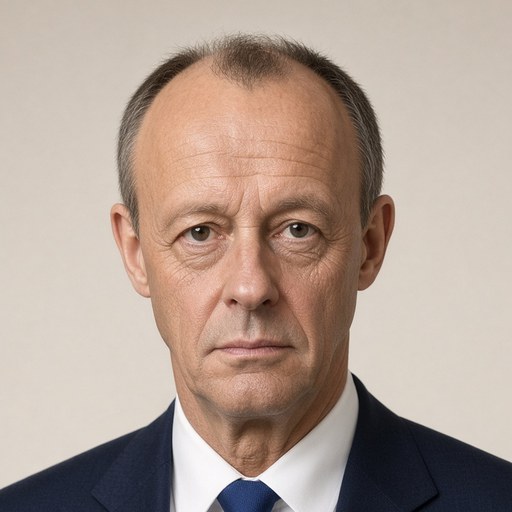
Speech by Federal Chancellor Friedrich Merz at the state ceremony for former President of the Bundestag Prof. Dr. Rita Süssmuth before the German Bundestag on February 24, 2026, in Berlin:
 Friedrich Merz · Chancellor of Germany
- Context
- Merz delivered a eulogy at the state ceremony for former Bundestag President Rita Süssmuth before the German Bundestag on February 24, 2026, in Berlin.
- Main themes
- Rita Süssmuth's legacy, human dignity, women's rights and gender equality, Christian democratic values, democratic politics and progress, academic and political career, family and labor policy, AIDS policy, freedom and self-realization, solidarity, reform and change
- Duration
- ~11 min
- Words
- 1,354
- Sentences
- 79
- Readability
- 39
- Grade
- 12.1
- Syntax
- 2.98
- Vocabulary
- 2.44
Translated from German
The broad sphere of national life a sentence belongs to. Every sentence has an Arena, so it is the denominator the other indices are read against.
Other79 sentences in 38 paragraphs
Mr. Federal President!
Madam President of the German Bundestag!
Mr. President of the Federal Council!
Mr. President of the Federal Constitutional Court!
Dear family Süssmuth Dyckerhoff!
Dear companions of Rita Süssmuth from the federal government, from the parliaments, from academia, from our civil society!
Excellencies!
Dear colleagues of the German Bundestag!
Ladies and gentlemen!
In 1956 – just over ten years after the end of World War II – a young woman sets out from her hometown on the Ems to two major, traditional German centers of study and finally to the world city on the Seine. Rita Süssmuth, born Kickuth, begins her studies in French, history, and education at the age of 19 in Münster, Tübingen, and Paris. This marks the beginning of an impressive academic career that will lead to a full professorship.
It is also the beginning of a professional life that tirelessly revolves around this question, both scientifically and politically, in theory and practice, in words and deeds: How can we lead a life together that is worthy of human dignity? How do we organize our state so that it serves human dignity?
I can imagine that this 19-year-old Rita Kickuth, on her journey to Paris, already has these words of Hölderlin in her mind, this Hölderlin call, as one might say, which she later quotes at times in her life:
“Let man examine everything, say the heavenly ones,
So that he, well-nourished, learns to give thanks for everything,
And understands freedom,
To set out wherever he wants.”
To examine everything, to examine critically: claims of knowledge, claims of authority, one-dimensional worldviews, one-dimensional images of humanity, one-dimensional images of women as well. To examine everything, to examine critically – that was Rita Süssmuth's guiding principle in life.
And her critical examination repeatedly led her to the conclusion about the human capacity for freedom and repeatedly to the observation: In the world, in Europe, in Germany, in her and our party, in schools and educational institutions, in the labor market, things are still not arranged in a way that serves the freedom of all people, that makes self-realization possible regardless of gender, social background, or sexual orientation, that allows man to “understand freedom, to set out wherever he wants,” as Hölderlin writes.
Rita Süssmuth later ventured into politics. And she became an exceptional politician. She shaped the face of the Federal Republic: as the first Minister for Women, as an education politician, as a health politician, as President of the Bundestag, as a member of the CDU. She was simply excellent in her field, and comprehensively excellent.
She was – and we have heard this multiple times today – persistent, combative, and quite often quite uncomfortable in all her offices and functions, even for my party. In many questions – perhaps in most – history has vindicated her. She was indeed ahead of her time in many respects.
In her insistence on a modern family policy, for example. On a labor market policy that strengthens the compatibility of work and family. In her pioneering AIDS policy.
She was indeed a Christian Democrat with body and soul. And by that, I mean: Her ethos of political design was, in every sense of the word, Christian democratic. For her, the dignity and vulnerability of human beings were at the center, but just as much the human capacity for self-realization and the common good.
She was unshakeably optimistic. Not a romantic. But an idealist in the sense that we all, as democrats, are obliged to be idealists. In the sense that she absolutely trusted in the judgment of human beings, in their, our ability to shape the world together, even under conditions of new complexity, even under the condition of crisis. She absolutely trusted in the human capacity for solidarity, and she demanded it as well. She absolutely trusted in the human thirst for knowledge, curiosity, capacity for learning, and desire for change. And that is why she was a driving force for reforms.
Democratic politics should be a politics that “addresses, strengthens, and seeks to transform into progress the offensive, change-ready, carefree, self-trusting side” of human beings. Those were her words.
We do well to remember this, especially today, that democratic politics must always and above all look to the future, that democratic politics carries a responsibility for progress, that this responsibility can bring joy, even if it means work and often requires courage.
And we also do well to continually ask ourselves the very question that Rita Süssmuth repeatedly asked herself and us: Has man been lost to us politicians? That was both her question and her concern: That in times of growing complexity in society, in times of internationalization, in times of globalization, in times of digitalization, man appears only as a functional element in the view of politics. That we here in the German Bundestag, that we in government work, in the suggestion of objective constraints lose sight of the human being.
These are legitimate concerns that Rita Süssmuth expressed. And Rita Süssmuth's political legacy reminds us of where we must start if we take these concerns seriously:
In the work on good, equitable educational institutions, where girls and boys from all social backgrounds can learn for life according to their abilities and talents.
In adult education.
In the work on a country that fulfills the promise of social participation for all citizens, that fully realizes the promise of lived equality between men and women.
In the work on a united Europe. Rita Süssmuth was also a passionate European.
Finally, last year – we have heard – she was honored for her decades-long intensive commitment to German-Polish reconciliation. She traveled repeatedly to this country and through this country. She repeatedly emphasized how valuable and important the relationship with our Polish neighbor is – for our two countries and indeed for the peace project Europe.
Rita Süssmuth was President of the German Bundestag for ten years – as the first woman from the Union in this office at all. She was also, so to speak, my President of the Bundestag; for she held the office when I first took my seat as a member of this house, in these rows here, in 1994. The constitutive session in 1994 took place here in the Reichstag building, before the renovation of the building.
And I remember her speech; it was a Rita Süssmuth speech. She spoke of the power of solidarity and the power of personal responsibility, of the joy of humanity and the joy of self-realization. She spoke of the fact that a good Germany needs the “creative participation of our youth,” the dialogue between generations. She spoke of the unceasing mandate of European unification. And she spoke of the dignity of man.
With the exception of Norbert Lammert, no one has presided over the German Bundestag longer in recent years than Rita Süssmuth. She was the first president of a unified German parliament. She guided our country through the world-historical weeks and months that we experienced after the fall of the wall.
I would like to conclude my reflections on Rita Süssmuth with words from her speech at the opening of the constitutive session of the German Bundestag on December 20, 1990, also here in Berlin, after Willy Brandt, as the elder statesman, opened the first parliamentary session of a unified Bundestag after reunification. She said: “Democratic traditions impose obligations, but nothing is stable without our continuous self-challenge and being challenged.” Quoting these words today, on the fourth anniversary of the beginning of Russia's unlawful war of aggression against Ukraine, carries special significance. “[…] nothing is stable without our continuous self-challenge and being challenged.”
Rita Süssmuth lived up to this, she did it tirelessly, until the end, also with active journalistic work. She continually challenged herself. She challenged herself, but she also challenged our common party. She challenged patriarchal power structures and regressive thinking. She demanded a better country from us. And that was, yes, that remains a great fortune.
We will preserve her memory, that of the humanist, the scholar, the President of the Bundestag, the Christian Democrat, with honor.
The original German. The tags above are read on the English translation's sentences.
Herr Bundespräsident!
Frau Präsidentin des Deutschen Bundestages!
Herr Präsident des Bundesrates!
Herr Präsident des Bundesverfassungsgerichtes!
Liebe Familie Süssmuth Dyckerhoff!
Liebe Wegbegleiterinnen und Wegbegleiter von Rita Süssmuth aus der Bundesregierung, aus den Parlamenten, aus der Wissenschaft, aus unserer Zivilgesellschaft!
Exzellenzen!
Liebe Kolleginnen und Kollegen des Deutschen Bundestages!
Meine sehr geehrten Damen und Herren!
1956 – das Ende des Zweiten Weltkrieges liegt gerade einmal gut zehn Jahre zurück – bricht eine junge Frau aus ihrer Heimatstadt an der Ems in zwei große, traditionsreiche deutsche Studienorte und schließlich in die Weltstadt an der Seine auf. Rita Süssmuth, geborene Kickuth, beginnt im Alter von 19 Jahren ihr Studium in den Fächern Französisch, Geschichte und Pädagogik in Münster, in Tübingen und in Paris. Es ist der Beginn einer beeindruckenden akademischen Karriere, die bis hin zu einer ordentlichen Professur führen wird.
Es ist auch der Beginn eines beruflichen Lebens, das wissenschaftlich und politisch, in Theorie und Praxis, in Worten und Taten unermüdlich um diese Frage kreist: Wie können wir Menschen ein menschenwürdiges Leben miteinander führen? Wie richten wir unseren Staat so ein, dass er der Menschenwürde dient?
Ich möchte mir vorstellen, dass diese 19-jährige Rita Kickuth auf der Reise nach Paris im Kopf schon diese Hölderlin-Worte hat, diesen Hölderlin-Ruf, muss man eigentlich sagen, den sie später im Leben manchmal zitiert:
„Alles prüfe der Mensch, sagen die Himmlischen,
Daß er, kräftig genährt, danken für Alles lern’,
Und verstehe die Freiheit,
Aufzubrechen, wohin er will.“
Alles zu prüfen, kritisch zu prüfen: Wissensbehauptungen, Autoritätsbehauptungen, eindimensionale Weltbilder, eindimensionale Menschenbilder, eindimensionale Frauenbilder auch. Alles zu prüfen, kritisch zu prüfen – das war Rita Süssmuths Lebensmaxime.
Und ihr kritisches Prüfen führte sie immer wieder zu dem Ergebnis von der Freiheitsbegabung des Menschen und immer wieder zu der Feststellung: In der Welt, in Europa, in Deutschland, in ihrer und unserer Partei, in den Schulen und Bildungseinrichtungen, am Arbeitsmarkt sind die Dinge noch nicht so eingerichtet, dass sie der Freiheit aller Menschen dienen, dass sie Selbstentfaltung unabhängig vom Geschlecht, von sozialer Herkunft, von sexueller Orientierung möglich machen, dass der Mensch „verstehe die Freiheit, Aufzubrechen, wohin er will“, wie Hölderlin schreibt.
Rita Süssmuth ist später in die Politik aufgebrochen. Und sie ist eine Ausnahmepolitikerin geworden. Sie hat das Gesicht der Bundesrepublik geprägt: als erste Frauenministerin, als Bildungspolitikerin, als Gesundheitspolitikerin, als Bundestagspräsidentin, als Abgeordnete der CDU. Sie war fachlich einfach exzellent, und zwar umfassend fachlich exzellent.
Sie war – und wir haben es heute mehrfach gehört – in allen ihren Ämtern und Funktionen beharrlich, streitbar und ziemlich oft ziemlich unbequem, auch für meine Partei. In vielen Fragen – vielleicht in den meisten – hat die Geschichte ihr recht gegeben. Sie war eben ihrer Zeit in mancher Hinsicht voraus.
In ihrem Beharren auf eine moderne Familienpolitik etwa. Auf eine Arbeitsmarktpolitik, die die Vereinbarkeit von Beruf und Familie stärkt. In ihrer wegweisenden Aidspolitik.
Sie war eben mit Leib und Seele Christdemokratin. Und damit meine ich: Ihr Ethos der politischen Gestaltung war im ganzen Sinn des Wortes christdemokratisch. Für sie stand die Würde und die Verletzlichkeit des Menschen im Zentrum, aber genauso des Menschen Begabung zur Selbstentfaltung und zum gemeinsamen Guten.
Sie war unerschütterlich optimistisch. Keine Romantikerin. Aber eine Idealistin in dem Sinne, in dem wir alle als Demokratinnen und Demokraten verpflichtet sind, Idealistinnen und Idealisten zu sein. In dem Sinne, dass sie unbedingt vertraut hat auf die Urteilskraft des Menschen, seine, unsere Fähigkeit, gemeinsam die Welt zu gestalten, und zwar auch unter den Bedingungen neuer Komplexität, auch unter der Bedingung von Krise. Sie hat unbedingt vertraut auf die menschliche Fähigkeit zur Solidarität, und sie hat sie auch eingefordert. Sie hat unbedingt vertraut auf die Erkenntnissehnsucht, die Neugier, Lernfähigkeit und Veränderungslust des Menschen. Und darum war sie eine Antreiberin für Reformen.
Demokratische Politik, das sollte eine Politik sein, die „die offensive, zum Umbruch bereite, die unbekümmerte, den eigenen Fähigkeiten vertrauende Seite“ des Menschen anspricht, stärkt, in Fortschritt verwandeln will. Das waren ihre Worte.
Wir tun gut daran, uns daran zu erinnern, gerade heute, dass demokratische Politik immer und vor allem den Blick in die Zukunft richten muss, dass demokratische Politik eine Fortschrittsverantwortung in sich trägt, dass in dieser Verantwortung Freude liegen kann, auch wenn sie Arbeit bedeutet und auch wenn es oft Mut erfordert.
Und genauso tun wir gut daran, uns immer wieder ebendiese Frage zu stellen, die Rita Süssmuth auch immer wieder sich selbst und uns gestellt hat: Ist denn der Mensch uns Politikern verloren gegangen? Das war zugleich ihre Frage und ihre Sorge: Dass in Zeiten wachsender Komplexität der Gesellschaft, in Zeiten der Internationalisierung, in Zeiten der Globalisierung, in Zeiten der Digitalisierung der Mensch sozusagen nur als Funktionselement in den Blick der Politik tritt. Dass wir hier im Deutschen Bundestag, dass wir in der Regierungsarbeit, in der Suggestion von Sachzwängen den Menschen aus dem Blick verlieren.
Das sind berechtigte Sorgen, die Rita Süssmuth geäußert hat. Und Rita Süssmuths politisches Erbe erinnert uns daran, wo wir ansetzen müssen, wenn wir diese Sorgen ernst nehmen:
In der Arbeit an guten, chancengerechten Bildungsinstitutionen, in denen Mädchen und Jungen aller sozialen Schichten nach ihren Fähigkeiten und Begabungen für das Leben lernen können.
In der Erwachsenenbildung.
In der Arbeit an einem Land, das das Versprechen der gesellschaftlichen Teilhabe für alle Bürgerinnen und Bürger einlöst, das das Versprechen der gelebten Gleichberechtigung von Mann und Frau eben vollumfänglich einlöst.
In der Arbeit an einem geeinten Europa. Auch das war Rita Süssmuth ja: eine leidenschaftliche Europäerin.
Zuletzt, im vergangenen Jahr – wir haben es gehört –, ist sie für ihren jahrzehntelangen intensiven Einsatz für die deutsch-polnische Aussöhnung ausgezeichnet worden. Sie reiste immer wieder in dieses Land und durch dieses Land. Sie mahnte immer wieder, wie wertvoll, wie wichtig die Beziehung zu unserem polnischen Nachbarn ist – für unsere beiden Länder und eben auch für das Friedensprojekt Europa.
Rita Süssmuth war zehn Jahre Präsidentin des Deutschen Bundestages – als erste Frau der Union in diesem Amt überhaupt. Sie war auch sozusagen meine Bundestagspräsidentin; denn sie übte das Amt aus, als ich 1994 erstmals als Abgeordneter in diesem Haus, in diesen Reihen hier Platz genommen habe. Die konstituierende Sitzung 1994 fand ja hier im Reichstagsgebäude statt, noch vor dem Umbau des Gebäudes.
Und ich erinnere mich an ihre Rede; es war eine Rita-Süssmuth-Rede. Sie sprach von der Kraft der Solidarität und von der Kraft der Eigenverantwortung, von der Freude der Mitmenschlichkeit und der Freude der Selbstentfaltung. Sie sprach davon, dass ein gutes Deutschland das „gestaltende Mitwirken unserer Jugend“ braucht, das Gespräch zwischen den Generationen. Sie sprach von dem unausgesetzten Auftrag der europäischen Einigung. Und sie sprach von der Würde des Menschen.
Mit Ausnahme von Norbert Lammert hat dem Deutschen Bundestag niemand in Jahren länger vorgestanden als Rita Süssmuth. Sie war die erste Präsidentin eines gesamtdeutschen Parlaments. Sie hat unser Land mit durch die welthistorischen Wochen und Monate geführt, die wir nach dem Fall der Mauer erlebt haben.
Ich möchte meine Betrachtungen zu Rita Süssmuth schließen mit Worten aus ihrer Rede zur Eröffnung der konstituierenden Sitzung des Deutschen Bundestages am 20. Dezember 1990, ebenfalls hier in Berlin, nachdem Willy Brandt als Alterspräsident die erste Parlamentssitzung eines gesamtdeutschen Bundestages nach der Wiedervereinigung eröffnet hatte. Sie sagte: „Demokratische Traditionen verpflichten, aber nichts ist stabil, ohne dass wir uns immer wieder selbst fordern und gefordert wissen.“ Diese Worte am heutigen Tag zu zitieren, am vierten Jahrestag des Beginns des völkerrechtswidrigen Angriffskrieges Russlands gegen die Ukraine, hat eine besondere Bedeutung. „[…] nichts ist stabil, ohne dass wir uns immer wieder selbst fordern und gefordert wissen.“
Rita Süssmuth hat sich genau daran bewährt, sie hat es unermüdlich getan, bis zuletzt, auch mit reger publizistischer Arbeit. Sie hat sich selbst immer wieder gefordert. Sie hat sich selbst, aber sie hat auch unsere gemeinsame Partei gefordert. Sie hat patriarchale Machtstrukturen und rückwärtsgewandtes Denken herausgefordert. Sie hat unser Land zum Besseren gefordert. Und das war, ja, das bleibt ein großes Glück.
Wir werden ihr, der Humanistin, der Wissenschaftlerin, der Bundestagspräsidentin, der Christdemokratin, wir werden Rita Süssmuth ein ehrendes Andenken bewahren.