




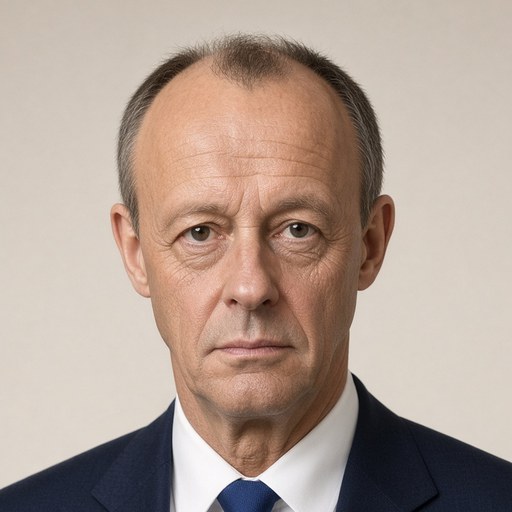
Speech by the Federal Chancellor at the business initiative "Made for Germany" on leveraging the opportunities of artificial intelligence for German industry.
 Friedrich Merz · Chancellor of Germany
- Context
- Merz addressed the 'Made for Germany' business initiative on April 20, 2026, speaking on AI opportunities for German industry and broader economic reforms.
- Main themes
- Artificial intelligence for German industry, Made for Germany initiative, European competitiveness and deregulation, German economic reform, investment in Germany, nuclear fusion and energy, digital infrastructure and data centers, healthcare reform, pension system reform, EU internal market, catching up in key technologies, Germany as EU locomotive
- Duration
- ~16 min
- Words
- 1,865
- Sentences
- 89
- Readability
- 49
- Grade
- 11.5
- Syntax
- 2.96
- Vocabulary
- 1.94
Translated from German
The broad sphere of national life a sentence belongs to. Every sentence has an Arena, so it is the denominator the other indices are read against.
Other89 sentences in 23 paragraphs
Dear Roland Busch, on behalf of all co-initiators of the initiative "Made for Germany", distinguished ladies and gentlemen, thank you very much for the warm welcome, and thank you for being willing to adjust the schedule a bit this morning. We are still not quite back on track since we started the tour of the fair a little late this morning.
I want to take this opportunity to express my heartfelt thanks to all those who founded this initiative nearly a year ago, which has now developed into a truly impressive entity. There are now well over a hundred companies. We just saw in the numbers: over 800 billion euros in investment commitments for Germany as part of "Made for Germany." This is a great initiative. Dear Roland Busch, on behalf of all who have contributed: Thank you for doing this!
We know that we, on the part of the federal government and our location conditions, need to improve something. You have kindly not only shown the building of the German Bundestag, the old Reichstag building, but also the Commission in Brussels.
Let me start with this: Some may be tempted to criticize me for being very focused on cooperation within the European Union. I am even occasionally referred to as the Foreign Chancellor. I now perceive this as a compliment because in this way I try to connect foreign policy, foreign economic policy, European policy, and German economic policy. We want to advance Europe, and I know: If we do not succeed in Europe, we will not succeed in Germany either. That is why I will continue to engage strongly in the European Union.
We also need a new beginning in Europe. We have started an intensive discussion about deregulation and the reduction of excessive European bureaucracy. On February 12, we took a full day off with all 27 heads of state and government of the European Union and focused solely on two questions: What can advance the European internal market and how can we strengthen European competitiveness?
Once again, I stand by it: We Germans, the German federal government, will and must engage strongly to ensure that the European framework conditions improve beyond what they currently are, even though we already have great opportunities and many possibilities in Europe together.
In this European Union, Germany must be the driving force, Germany must be the locomotive. That is why we have set out to implement truly comprehensive reforms in Germany. Yes, it is true, we have neglected this for at least a decade. We have become too slow. We have not properly assessed the train of time and the developments in the world in many respects. We have underestimated the dynamics that have developed around us. But we are catching up now, and the good news is: It is not too late. You discussed this here this morning, and we just saw it again in the short video.
I want to add something: A year or two ago, I would not have believed that we could still catch up in these key technologies, such as storage technology, quantum computing, and AI – especially industrial AI. Today we know: We can do it, we want to do it, and we will succeed in continuing to accelerate this catch-up process and ensuring that we actually utilize all the opportunities associated with these modern technologies in Germany.
We have the companies, we have the employees, we have the scientists who are now accelerating this with considerable energy and speed. I was able to see this morning how we are making great progress in the field of nuclear fusion. Our ambition is and remains: We want to connect the first nuclear fusion reactor in Germany to the grid, thereby developing energy production and generation into a whole new dimension. We also have an increasingly positive development in the area of data centers. Things are happening here, and we are on a good path.
However, it is also true: It is not enough yet; we need to do more. I know, after nearly a year of leading the federal government: We are still behind schedule. We are not fast enough. We need to achieve more, and we also need to implement more in the legislation of the German Bundestag. That is exactly what we have a plan for, and we have concrete projects.
The first project will be that next week, when all preliminary discussions have been successfully completed, we will pass the most comprehensive reform of our healthcare system in the Cabinet and then submit it to the parliamentary consultation and decision-making processes. This comprehensive reform project should be completed before the summer.
We then want to move on to a reform of the pension systems. This is also a comprehensive reform, and I say quite deliberately: not just of the pension insurance, but of the entire pension system. We have agreed with our coalition partners to enable a new overall provision consisting of the statutory pension insurance, but also of better company pension schemes and, above all, private pension provision – the latter two being capital-based.
The third major project will be an income tax reform in January next year. This reform is also intended to provide relief, especially for middle incomes, so that employees in Germany retain more net from their gross. This is ambitious, and it will also require us to have many discussions. However, we are doing this in an environment, ladies and gentlemen, that you represent: these are the research institutions, these are the research facilities of our country, but also the companies that conduct research and development themselves and are now also moving into the concrete implementation of what we mean by Industry 4.0.
I would like to sincerely thank you for the suggestions and the intensive discussions we have had in this circle; because with AI – as you have discussed here – our industry is now taking the next step. I am pleased that this development is now progressing so quickly. However, despite all the enthusiasm, I do not want to miss the opportunity to say: This enthusiasm also generates a certain skepticism among many people. Many people have reservations, even fears about the loss of jobs. The question is not whether we want AI or not.
AI is here and is in practical application. However, we now decide what happens in the transformation with AI. We can decide. It is up to us how we use AI responsibly to maintain and increase production, jobs, and prosperity in our country.
In international comparison, Germany is among the leading nations, especially in the application of AI, and this is particularly true for industry. At the same time, we are under significant pressure from our competitors regarding innovations and investments. We must now truly leverage our good starting position. Large AI computing capacities and language models are not enough for further growth. We need, in Germany and in Europe, a sovereign access to all parts of the AI value chain, to hardware, software, chips, cloud technologies, models, and data. I am convinced – and I want to say this to you not out of purpose-driven optimism, but it is my deep, firm conviction – that if Germany does it right now, then AI will contribute to creating and maintaining industrial value creation and high-quality jobs in the country, and from that, we can really create opportunities for all of us.
It is therefore essential to implement AI in the core sectors of our industry and especially in small and medium-sized enterprises. We, as the federal government, stand by the side of industry and employees. We are relying on a bundle of measures, both nationally and at the European level, to best support all of us in utilizing the enormous potential of AI.
We have underpinned this with a recently adopted data center strategy. We want to maximize our digital capacities. Our goal is – and I want to state this again here – to double the IT connection capacity of data centers in Germany by 2030 and to quadruple the connection capacity for high-performance computing and AI in the same period. In the strategy, we focus on central areas of action: energy and sustainability, location and space, technology and sovereignty. We are working hard on energy supply security and lower prices, for example, with the grid connection package and the reduction of system costs. It is clear to all of us: AI and data centers need baseload-capable and as climate-neutral as possible electricity. We are also working on that.
Last but not least: With the adopted High-Tech Agenda Germany, we prioritize and promote a total of six key technologies that we consider central to the technological progress of our country: quantum technology, microelectronics, biotechnology, fusion and climate-neutral energy generation, technologies for climate-neutral mobility, and indeed artificial intelligence. As part of this High-Tech Agenda, we will set up flagship projects for AI to advance the development of tailored, domain-specific AI and derive transfer blueprints from it. We are also strengthening the service offerings for small and medium-sized enterprises to support them in integrating AI.
By the way, let me say at this point: In our small and medium-sized enterprises, there is probably the greatest potential for the use of AI: these are the data that are available in these companies and that would be available if we collectively utilized them sufficiently. I want to call on all of us to make the best possible use of this data. If changes to the legal framework are necessary – whether it be the General Data Protection Regulation or other regulations – we are open to doing so. Because this is also a European task. We have already seriously initiated this in the European Union with corresponding projects – I am thinking of IPCEI-AI – as an AI ecosystem that the industry needs, openly available without login effects, adaptable, powerful, and compatible with the European legal framework and the European internal market.
Ladies and gentlemen, I wanted to convey this to you in somewhat greater detail so that you know and hopefully also understand that we are now genuinely serious about wanting something new on this path and that we expect really effective incentives for investments in Germany, innovation, data centers, cloud, and new capacities from the Cloud and AI Development Act that the European Commission is expected to present at the end of May.
Many regions in this world – this will be my concluding remark – are more open to new technologies than we are, and AI is no exception. We must now collectively counter this if we want to continue to play at the top level in the future. We, as the federal government, want to contribute our part. Please do the same. Thank you once again to all of you for committing to this goal with us. Let us dare something, let us be confident, let us get to work, take off the blinders, and show what we can do! Germany can truly compete at a world-class level in this league, and that is exactly our common aspiration.
Thank you very much!
The original German. The tags above are read on the English translation's sentences.
Lieber Roland Busch, stellvertretend für alle Mitinitiatoren der Initiative „
Made for Germany
“,
meine sehr geehrten Damen und Herren,
herzlichen Dank für die freundliche Begrüßung, und herzlichen Dank dafür, dass Sie bereit waren, den Zeitablauf heute Morgen etwas anzupassen. Wir sind noch nicht so ganz wieder im Zeitplan zurück, seitdem wir heute Morgen mit etwas Verspätung den Messerundgang begonnen haben.
Ich will die Gelegenheit nutzen und einen ganz herzlichen Dank sagen an alle diejenigen, die vor knapp einem Jahr diese Initiative gegründet haben, die sich jetzt zu einer wirklich eindrucksvollen Größe entwickelt hat. Es sind jetzt weit über hundert Unternehmen. Wir haben es eben in den Zahlen gesehen: über 800 Milliarden Euro Investitionszusagen für Deutschland im Rahmen von „
Made for Germany
“. Das ist eine großartige Initiative. Lieber Roland Busch, stellvertretend für alle, die daran mitgewirkt haben: Herzlichen Dank, dass Sie das machen!
Wir wissen, dass wir seitens der Bundesregierung und seitens unserer Standortbedingungen etwas verbessern müssen. Sie haben dankenswerterweise nicht nur das Gebäude des Deutschen Bundestages, das alte Reichstagsgebäude, eingeblendet, sondern auch die Kommission in Brüssel.
Lassen Sie mich deshalb damit beginnen: Manch einer wird immer wieder versucht sein zu kritisieren, dass ich mich sehr intensiv um die Zusammenarbeit in der Europäischen Union kümmere. Ich werde hin und wieder sogar als Außenkanzler apostrophiert. Ich nehme das mittlerweile als ein Kompliment wahr, weil ich nämlich auf diese Art und Weise versuche, Außenpolitik, Außenwirtschaftspolitik, Europapolitik und deutsche Wirtschaftspolitik miteinander zu verbinden. Wir wollen Europa voranbringen, und ich weiß: Wenn es uns in Europa nicht gelingt, dann wird es uns auch in Deutschland nicht gelingen. Deswegen werde ich mich weiterhin so stark in der Europäischen Union engagieren.
Wir brauchen auch in Europa einen neuen Aufbruch. Wir haben eine intensive Diskussion über Entbürokratisierung und den Rückbau der überbordenden europäischen Bürokratie begonnen. Wir haben mit allen 27 Staats- und Regierungschefs der Europäischen Union am 12. Februar eine ganztägige Auszeit genommen und uns nur mit den beiden Fragen beschäftigt: Was kann den europäischen Binnenmarkt voranbringen und wie können wir die europäische Wettbewerbsfähigkeit stärken?
Noch einmal, ich bleibe dabei: Wir Deutsche, die deutsche Bundesregierung, werden und müssen uns stark engagieren, damit die europäischen Rahmenbedingungen besser werden, als sie gegenwärtig sind, obwohl wir in Europa gemeinsam schon große Chancen und viele Möglichkeiten haben.
In dieser Europäischen Union muss Deutschland das Zugpferd sein, muss Deutschland die Lokomotive sein. Deswegen haben wir uns auf den Weg gemacht, wirklich umfassende Reformen in Deutschland zu verwirklichen. Ja, es ist so, wir haben das über mindestens eine Dekade versäumt. Wir sind zu langsam geworden. Wir haben den Zug der Zeit und die Entwicklungen auf der Welt in vielerlei Hinsicht nicht richtig eingeschätzt. Wir haben die Dynamik, die sich um uns herum entwickelt hat, unterschätzt. Das holen wir jetzt aber auf, und die gute Nachricht ist: Es ist noch nicht zu spät. Das haben Sie heute Morgen hier diskutiert, und das haben wir gerade in dem kleinen Einspielfilm auch noch einmal gesehen.
Ich will etwas hinzufügen: Ich hätte vor einem Jahr oder vor zwei Jahren noch nicht daran geglaubt, dass wir in diesen zentralen Schlüsseltechnologien, also etwa in der Speichertechnologie, im Quantencomputing und bei der
KI
–
vor allen Dingen der industriellen
KI
–
doch noch aufholen können. Heute wissen wir: Wir können es, wir wollen es und wir werden es auch hinbekommen, diesen Aufholprozess weiter zu verstetigen, zu beschleunigen und dafür zu sorgen, dass wir alle diese Chancen, die sich mit diesen modernen Technologien verbinden, auch tatsächlich in Deutschland nutzen.
Wir haben die Unternehmen, wir haben die Mitarbeiterinnen und Mitarbeiter, wir haben die Wissenschaftler, die das jetzt mit einer beachtlichen Energie und Geschwindigkeit beschleunigen. Ich konnte mir heute Morgen anschauen, wie wir im Bereich der Kernfusion große Fortschritte machen. Unsere Ambition ist und bleibt: Wir wollen den ersten Kernfusionsreaktor in Deutschland ans Netz nehmen, um auf diese Weise Energieproduktion und Energieerzeugung noch einmal in eine ganz neue Dimension zu entwickeln. Wir haben außerdem auch eine zunehmend besser werdende Entwicklung im Bereich der Rechenzentren. Hier tut sich etwas und hier sind wir auf einem guten Weg.
Richtig ist aber auch: Es reicht noch nicht, wir müssen noch mehr tun. Ich weiß auch nach knapp einem Jahr der von mir geführten Bundesregierung: Wir sind immer noch hinter dem Zeitplan. Wir sind nicht schnell genug. Wir müssen mehr schaffen und wir müssen auch mehr umsetzen in der Gesetzgebung des Deutschen Bundestages. Genau dafür haben wir einen Plan, dafür haben wir feste Vorhaben.
Das erste Vorhaben wird sein, dass wir in der nächsten Woche, wenn alle Vorgespräche erfolgreich abgeschlossen sein werden, die umfassendste Reform unseres Gesundheitssystems im Kabinett verabschieden und dann in die Prozesse der parlamentarischen Beratung und Beschlussfassung geben werden. Noch vor dem Sommer soll dieses umfassende Reformvorhaben abgeschlossen sein.
Wir wollen dann in eine Reform der Alterssicherungssysteme gehen. Auch dies ist eine umfassende Reform, und ich sage ganz bewusst: nicht nur der Rentenversicherung, sondern des gesamten Alterssicherungssystems. Wir haben uns mit den Koalitionspartnern darauf verständigt, eine neue Gesamtversorgung zu ermöglichen, bestehend aus der gesetzlichen Rentenversicherung, aber eben auch einer besseren betrieblichen Altersversorgung und vor allem einer privaten Altersversorgung ‑ die beiden Letztgenannten kapitalbasiert.
Das dritte große Vorhaben wird im Januar nächsten Jahres eine Einkommensteuerreform sein. Auch diese Reform soll dem Zweck dienen, eine Entlastung vor allen Dingen der mittleren Einkommen so zu ermöglichen, dass Arbeitnehmerinnen und Arbeitnehmer in Deutschland vom Brutto wieder mehr Netto übrigbehalten. Das ist anspruchsvoll, und das wird uns auch noch manche Diskussionen abverlangen. Wir tun das aber in einem Umfeld, meine Damen und Herren, und das repräsentieren Sie: Das sind die forschenden Institutionen, das sind die Forschungseinrichtungen unseres Landes, das sind aber auch die Unternehmen, die Forschung und Entwicklung selbst betreiben und die jetzt auch in die ganz konkrete Umsetzung dessen gehen, was wir mit Industrie 4.0 meinen.
Ich bedanke mich herzlich für die Anregungen und für die intensiven Diskussionen, die wir auch in diesem Kreis geführt haben; denn mit
KI
–
das haben Sie hier diskutiert
–
geht unsere Industrie jetzt den nächsten Schritt. Ich freue mich darüber, dass diese Entwicklung jetzt so schnell vorangeht. Bei aller Euphorie will ich aber trotzdem nicht versäumen zu sagen: Diese Euphorie erzeugt bei vielen Menschen gleichzeitig auch eine gewisse Skepsis. Bei vielen Menschen gibt es Vorbehalte, gibt es geradezu Ängste auch vor dem Verlust von Arbeitsplätzen. Die Frage ist aber nicht, ob wir
KI
wollen oder nicht.
KI
ist da und ist in der praktischen Anwendung. Wir entscheiden jetzt aber selbst, was in der Transformation mit
KI
geschieht. Wir können es entscheiden. Es liegt bei uns, wie wir
KI
verantwortungsbewusst einsetzen, um Produktion, Arbeitsplätze und Wohlstand bei uns zu erhalten und zu mehren.
Im internationalen Vergleich gehört Deutschland vor allem in der Anwendung von
KI
zu den führenden Nationen, und das gilt ganz besonders und vor allem für die Industrie. Bei Innovationen und Investitionen stehen wir gleichzeitig unter erheblichem Druck durch unsere Wettbewerber. Unsere gute Ausgangsposition müssen wir jetzt wirklich nutzen. Große
KI
-Rechenkapazitäten und Sprachmodelle reichen dabei für weiteres Wachstum nicht aus. Wir brauchen in Deutschland und in Europa vielmehr einen souveränen Zugang zu allen Teilen der
KI
-Wertschöpfungskette, zu
Hardware
,
Software
, Chips, Cloudtechnologien, Modellen und Daten. Ich bin davon überzeugt ‑ und das will ich Ihnen hier nicht aus Zweckoptimismus sagen, sondern es ist meine ganz tiefe, feste Überzeugung
–
: Wenn Deutschland es jetzt richtig macht, dann wird
KI
dazu beitragen, industrielle Wertschöpfung und hochwertige Arbeitsplätze im Land zu schaffen, zu erhalten und daraus dann wirklich Chancen für uns alle zu machen.
Es gilt also,
KI
in die Kernbranchen unserer Industrie und vor allem auch in den Mittelstand zu implementieren. Wir stehen dabei als Bundesregierung an der Seite der Industrie und der Beschäftigten. Wir setzen national wie europäisch auf ein Bündel von Maßnahmen, um uns alle bestmöglich zu unterstützen, die enormen Potenziale von
KI
zu nutzen.
Wir haben das mit einer kürzlich beschlossenen Rechenzentrumsstrategie unterlegt. Wir wollen unsere digitalen Kapazitäten maximal ausbauen. Unser Anspruch ist ‑ das will ich auch hier noch einmal formulieren
–
, die
IT
-Anschlussleistung von Rechenzentren in Deutschland bis zum Jahr 2030 zu verdoppeln und die Anschlussleistung für High Performance Computing und
KI
im selben Zeitraum mindestens zu vervierfachen. In der Strategie konzentrieren wir uns dabei auf zentrale Handlungsfelder: Energie und Nachhaltigkeit, Standort und Fläche, Technologie und Souveränität. Wir arbeiten mit Hochdruck an der Energieversorgungssicherheit und an niedrigeren Preisen, etwa mit dem Netzanschlusspaket und der Senkung der Systemkosten. Für uns alle ist klar:
KI
und Rechenzentren brauchen grundlastfähigen und möglichst klimaneutralen Strom. Auch daran arbeiten wir.
Last, but not least: Mit der beschlossenen
Hightech
Agenda Deutschland priorisieren und fördern wir insgesamt sechs Schlüsseltechnologien, die aus unserer Sicht zentral sind für den technologischen Fortschritt unseres Landes: Quantentechnologie, Mikroelektronik, Biotechnologie, Fusion und klimaneutrale Energieerzeugung, Technologien für die klimaneutrale Mobilität und eben künstliche Intelligenz. Im Rahmen dieser
Hightech
Agenda werden wir Leitprojekte für
KI
aufsetzen, um die Entwicklung maßgeschneiderter, domänenspezifischer
KI
voranzutreiben und daraus auch Transferblaupausen abzuleiten. Wir stärken außerdem das Serviceangebot für die kleinen und mittleren Unternehmen, um sie bei der Integration von
KI
zu unterstützen.
Lassen Sie mich übrigens an dieser Stelle einmal sagen: In unserem Mittelstand, in den kleinen und mittleren Unternehmen, liegt für die Nutzung von
KI
vermutlich das größte Potenzial: Das sind die Daten, die in diesen Unternehmen vorhanden sind und die verfügbar wären, wenn wir sie denn gemeinsam ausreichend nutzten. Ich möchte uns alle dazu aufrufen, die Nutzung dieser Daten bestmöglich auf den Weg zu bringen und zu ermöglichen. Wenn es dazu Änderungen der gesetzlichen Rahmenbedingungen bedarf ‑ sei es der Datenschutzgrundverordnung, sei es anderer Regulierungen ‑, dann sind wir offen dafür, dies zu tun. Denn auch das ist eine europäische Aufgabe. Wir haben dies in der Europäischen Union mit entsprechenden Projekten – ich denke nur einmal an
IPCEI-AI
– bereits wirklich ernsthaft als
KI
-Ökosystem auf den Weg gebracht – ein Ökosystem, wie es die Industrie braucht, offen verfügbar ohne
Log-in
-Effekte, adaptierbar, leistungsfähig und kompatibel mit dem europäischen Rechtsrahmen und dem europäischen Binnenmarkt.
Meine Damen und Herren, ich wollte Ihnen das einmal in dieser etwas größeren Detailtiefe sagen, damit Sie wissen und hoffentlich auch nachvollziehen, dass wir auf diesem Weg jetzt wirklich ernsthaft Neues wollen und dass wir vom
Cloud
and
AI
Development Act
, den die Europäische Kommission voraussichtlich Ende Mai vorlegen wird, wirklich effektive Anreize für Investitionen in Deutschland, Innovation, Rechenzentren,
Cloud
und neue Kapazitäten erwarten.
Viele Regionen auf dieser Welt – das soll meine abschließende Bemerkung sein – sind offener für neue Technologien als wir, und da ist
KI
keine Ausnahme. Dem müssen wir jetzt gemeinsam etwas entgegensetzen, wenn wir auch in Zukunft ganz oben mitspielen wollen. Wir als Bundesregierung wollen unseren Teil dazu beitragen. Bitte tun Sie es ebenso. Danke noch einmal an Sie alle, dass Sie sich genau diesem Ziel mit uns verschrieben haben. Trauen wir uns etwas zu, seien wir zuversichtlich, machen wir uns an die Arbeit, legen wir die Scheuklappen ab und zeigen wir, was wir können! Deutschland kann in dieser Liga wirklich auf Weltniveau mitspielen, und genau das ist unser gemeinsamer Anspruch.
Herzlichen Dank!