




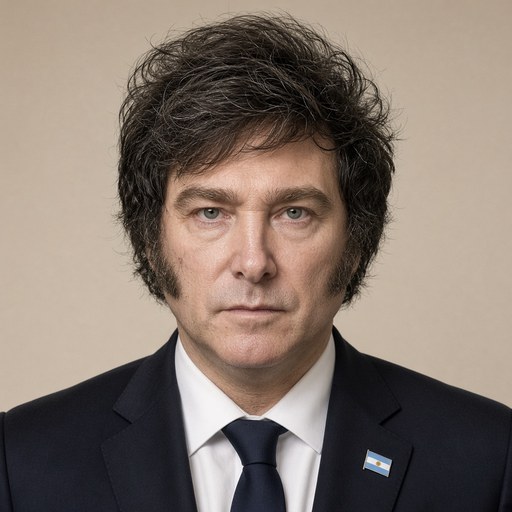
End of the Ceilings: National Broadcast by President Javier Milei
 Javier Milei · President of Argentina
- Context
- Milei addressed Argentinians in a national broadcast on April 11, 2025, announcing the permanent elimination of currency controls and a new IMF program.
- Main themes
- Elimination of currency controls, macroeconomic stabilization, fiscal surplus achievement, monetary reform and inflation reduction, IMF agreement and international financing, peso appreciation, central bank reserves, economic freedom, poverty reduction, gratitude to Argentinians and political allies
- Duration
- ~29 min
- Words
- 3,438
- Sentences
- 138
- Readability
- 49
- Grade
- 12.5
- Syntax
- 3.21
- Vocabulary
- 2.13
Translated from Spanish
The broad sphere of national life a sentence belongs to. Every sentence has an Arena, so it is the denominator the other indices are read against.
Other138 sentences in 38 paragraphs
Dear Argentinians: I am pleased to address you with news that many of us have been waiting for a long time. A few hours ago, the Ministry of Economy of the Nation and the Central Bank of the Argentine Republic have finished breaking the last link in the chain that has kept our national economy tied to the ground for 15 years. From this moment on, we are eliminating the currency controls of the Argentine economy forever.
When I asked for your vote, I said that I came to fix the economy at its roots, without shortcuts or gradualism, under the premise that a healthy and sustainable economy has three foundations: fiscal order, monetary order, and exchange rate order. After a tough first year of work, today we can conclude the process of macroeconomic stabilization in Argentina, having brought order to these three fundamental pillars.
Therefore, I would like to first thank you for having the courage to change the course of your destiny as Argentinians and thank you even more for having gone through the turbulence we experienced during this almost year and a half that we have been in government in the way that you did. I also want to thank those political leaders who understood the process of change we were living, without selfishness or conditions.
For example, those 87 heroes who defended the fiscal surplus, defending the vetoes we were forced to make to stop the populist demagoguery of some others. Without distinction of political colors, each of the 46 million Argentinians who inhabit this land had to go through a trial by fire. And today, with great pride, we can look back and say that we have overcome it. You have had the courage to choose freedom over servitude and thus left behind the slow agony in which we had been immersed for almost 15 years, to take the bitter drink all at once and forever, knowing that it would be definitive.
This was not a whim on our part, but a necessary step to correct decades of economic horrors that brought us to December 10, 2023. Thus, we went from being the worst student in the world in economic matters to doing our homework and becoming the exemplary student.
First, we passed the fiscal exam: we went from more than 100 years of chronic fiscal deficit to being one of the five countries in the world that only spend what they collect and not a peso more. Second, we passed the monetary exam: we went from being a country with uncontrolled inflation for decades, to the point that we destroyed five monetary signs, to having put a cap on the amount of pesos issued, which has caused the inflation rate to fall between 10 and 25 times, depending on whether you look at the consumer price index or the wholesale price index, which has led us to see an unprecedented appreciation of the peso, with its consequent drop in poverty. And today, thirdly, we were able to remove the last thorn that inflicted deep pain on us; we got rid of the currency controls that were an aberration that should never have existed.
A few minutes ago, the International Monetary Fund announced an unprecedented program for Argentina that will play an important role in making this possible. I say unprecedented because it is the first time in history that the Fund approves a program that is not to finance the transition from a disordered macroeconomy to an ordered one, but to support an economic plan that has already borne fruit. For that vote of confidence, I want to thank the entire board of the International Monetary Fund and especially Kristalina Georgieva, the president of the organization.
Historically, the programs of the International Monetary Fund were designed to finance fiscal imbalance in the face of the impossibility of obtaining financing in the capital markets. At the same time, fiscal correction was always carried out through tax increases. However, with us, this changed. We not only put the fiscal accounts in order in record time, but also almost the entire adjustment fell on the State and not on the good Argentinians. This program, between the International Monetary Fund, the World Bank, the Inter-American Development Bank, and a repo from the Central Bank, amounts to 32 billion dollars, of which 19.6 billion will be disbursed immediately. In this way, by May, the gross reserves of the Central Bank will be around 50 billion dollars.
With this level of reserves, we can comfortably back all the existing pesos in our economy, providing more monetary security to our citizens. To explain it, the Central Bank, like any agent in the economy, has a balance sheet, whose accounting identity indicates that its net worth is given by the difference between its assets and liabilities. The assets of the Central Bank consist of international reserves and public securities issued by the National Government. As for the liabilities, we find the monetary base, which is the money in the hands of individuals and banks as reserves; and the remunerated debt, the famous Lebacs, then Leliqs, and later repos. In this sense, when the liabilities of the Central Bank rise, either due to the issuance of pesos against public securities that have no market, that is, spurious issuance, or due to the accrual of interest on repos, the net worth of the Central Bank deteriorates.
Thus, as the net worth becomes increasingly negative, a higher level of prices is needed to liquidate the debts of the Central Bank, so that it adjusts to the real size of its assets. In this sense, as the treasury finances itself by placing worthless securities in the Central Bank, the long-term price level is higher and, with it, the inflation rate in the present is greater. Put this way, it is very easy to understand why since the exit from convertibility, the price of the dollar has multiplied by 1,200 times. In the last 25 years, policy via the Central Bank has robbed Argentinians of more than 100 billion dollars. Therefore, given such destruction of the asset, it should not be surprising the inflationary disaster we have experienced in the last 20 years. And, since the dollar is just another price in the economy, it is almost natural that it has systematically skyrocketed, without finding a ceiling.
The present agreement seeks to restore the asset of the Central Bank and with it its net worth, so that inflation will only be a bad memory of the past. Thus, the money that enters the national treasury will be used to pay off its debt with the BCRA. Moreover, since these securities do not trade at par, the gross debt of the treasury will fall.
Put in other terms, in the coming days we will reach a level of gross reserves such that the monetary base could be redeemed at an exchange rate of 650 pesos, while, if we take the definition of broad monetary base, it could be done at 911 pesos. Furthermore, if we use the ceiling of the band presented by Minister Caputo, not only could the entire broad monetary base be redeemed, but there would be about 15 billion dollars left over.
Consequently, and returning to what I mentioned earlier, we are finally passing the exchange rate exam. We would have loved to eliminate the currency controls faster, but we always told you that we preferred to eliminate them well and definitively, rather than eliminate them quickly and have that haste mean that the measure would be temporary as it happened in the past. That was one of the many uncomfortable truths we presented to society at the beginning of our mandate and that you accepted with determination and patience. I want to be clear about something: never in the last 120 years have we had fiscal order, monetary order, and exchange rate order at the same time. Never, this is the first time. So, don’t come to say that you have seen it before, because this time it truly is different.
There has always been something missing, which is why every time we set out to do things right, we ended up falling short and thus we ended up colliding with reality. The worst part is that we got our hopes up so many times that many Argentinians resigned themselves to never getting their hopes up again. That is why today it ends, today we break the wheel, the disillusionment, and the disenchantment, and we begin to walk forward once and for all. Because finally, for the first time in history, Argentina has a macroeconomy with all its subjects in order.
This new fiscal, monetary, and exchange rate reality means two things for the country: on the one hand, that from now on there is no reason for Argentina to have self-inflicted turbulence. And, secondly, that we are also in better conditions than ever to withstand external turbulence. Argentina has never been so well equipped in its economic fundamentals to withstand the tensions of the global economy. This does not make us impervious; no country in the world is. But it means that, should something happen, we will absorb less damage than at any other time in our history and we will recover at a greater speed.
We must not underestimate this advantage that others do not have, because today we are witnessing an important transition in how the global economy works. Not only in Argentina is history being rewritten, but also in the United States and in the rest of the countries in the world. There are tectonic plates that are shifting rapidly after decades of stillness. The international order as we know it after World War II has ended, and processes of change like these always involve intervals of great volatility.
In this sense, in a sea of volatility, we are no longer a wooden raft adrift; we are a true battleship. Moreover, in the face of the possibility that the external shock intensifies, we will respond with greater fiscal adjustment by reducing public spending. Specifically, when these shocks occur, it is required that the economy improves its current account. At the same time, given that our commitment to honor our debts is unbreakable, that implies improving the trade balance. This means that domestic absorption must decrease.
However, in Argentina, this has always been done by devaluing the currency, thus punishing the most vulnerable sectors. At other times, it was done by raising taxes to distribute the burden of the adjustment. In our government, absorption will fall due to a reduction in the size of the State, so that the adjustment does not impact the private sector, the true engine of the economy.
In this sense, while to ensure a zero deficit we need a primary surplus of 1.3% of GDP, in light of recent international events, we have decided to raise it to 1.6%. With fiscal risk eliminated, monetary risk eliminated, and now also exchange rate risk eliminated, the foundations for stability and sustained growth for the medium and long term have been laid. From now on, the real economy of Argentinians will improve the framework of that stability and will grow like never before.
The savings of 15 percentage points of GDP that politics previously squandered have been returned to the private sector, which will increase investment and consumption. In addition, the normalization of the Argentine macroeconomy that culminates today will necessarily imply a decrease in country risk and consequently in the interest rate, lowering the cost of private credit and also producing more investment.
In fact, the fiscal adjustment carried out will ensure a long-term growth floor of 4.5%, to which we should add the structural reforms we have implemented with Decree 70/23, the Framework Law, and the deregulations carried out by the Ministry of Deregulation, which together in the first year of management amount to more than 1,700 structural reforms. In the short term, the economy will continue to grow due to the recomposition of company stocks, which had been used to protect against inflation.
Moreover, the fall in inflation has revalued wages and pensions, improving the purchasing power of all our citizens. At the same time, private credit has returned, and we have been seeing a sustained boom in mortgage loans for more than a year. At the same time, we are already on the path to lowering taxes, making our private sector more competitive. And as if all this were not enough, we are opening up to the world like never before. In the long term, we will grow even more, because our goal is to become the freest country in the world.
For that, we will continue to reduce the total tax burden, either by eliminating the inflation tax or by reducing direct taxes that we are undertaking alongside the fiscal surplus.
Finally, the normalization of the foreign exchange market that we are announcing today, which makes foreign direct investment possible, given that one only invests when one knows that they will be able to dispose of the fruits of their investment as they wish, will be a new engine of growth. That is, for the last 15 years, policy put a clamp on investment and opened the tap of public spending and monetary issuance. We did the opposite; we put a clamp on the State, a clamp on issuance, and we have freed the tap of private initiative so that investments can finally come to Argentina.
For all these reasons, the recovery we have been seeing for months will accelerate and transform into sustained growth. Under these conditions, Argentina will be the country with the highest economic growth over the next 30 years. Instead of talking about growth at Chinese rates, soon the world will talk about growing at Argentine rates. And at this pace, after a few years, Argentina will be great again.
This will not happen overnight. Nothing valuable in life works that way, but rather little by little and with the certainty that, both on the internal front and the external front, we have done our homework to mitigate as much as possible any type of volatility. In the medium term, given the fundamentals of the program, inflation has no other destination but to collapse, because there will never again be issuance of pesos without backing. Inflation will inevitably collapse, despite the attempts to generate instability from those who still want to stop the change.
I say "still" because, as we have seen in recent weeks, given the volatility and uncertainty generated by those who spread lies without any shame, this month we have seen an interruption in the disinflation process. Unfortunately, these are the effects of the aberration of the Guzmán law that forced us to go to Congress to seek authorization to approve this agreement with the Fund, when that does not happen in any country in the world. Tied by the necessary reserve typical of these agreements, we had to watch as for weeks politicians and economists generated panic and uncertainty among the population. However, beyond the short-term victories they may achieve, inflation has no other destination but to disappear, because inflation is always and everywhere a monetary phenomenon, which occurs due to an excess in the money supply, whether because the supply increases, the demand falls, or both things happen at the same time.
As our program contemplates eliminating the issuance of pesos without backing forever, Argentine inflation will sooner or later disappear. Except for the largest, most Argentines have never seen anything like this. All of this means that by clearing all the risk factors that historically complicated Argentines' ability to get ahead, we can begin to take advantage as a country of all the virtues and comparative advantages that we do have. All our talent, all our resources, all the capacity for cooperation, the effort and ambition of Argentines will now find a channel for progress and will no longer clash with the usual obstacles.
We have a diversity of ecosystems envied by practically any nation in the world. Each of these biomes represents different potential opportunities, from soybean cultivation in the plains to oil extraction, tourism in the lakes, or mining in the mountains. We have hundreds of thousands of Argentines distributed around the world who testify to Argentine talent occupying senior positions in leading companies, whether in Silicon Valley, the Middle East, or Europe, eager to return to rebuild the country that saw them born and to see their children grow up in their homeland.
We also have top-level human capital here, human capital that has managed to become globally competitive despite having monthly inflations that other countries do not experience in decades. The same human capital that has managed to overcome one of the highest fiscal pressures in the world. Argentines have learned to squeeze water from stones and with all macroeconomic factors against us. For a reason, we are the country with the most tech unicorns per capita in the region, even with the least investment. Imagine how we can fare with the wind at our backs.
For a year now, we have had the RIGI, which already made us fiscally attractive for investments of over 200 million dollars, of which we have already approved more than 12 billion dollars. Now, without capital controls, there will be no exchange restrictions for any investment, and all this potential can be unleashed, and to top it off, we have a strong will to become the freest country in the world.
The only conclusion that can be drawn from all this is that, in the coming years, in Argentina, it will be about moving forward. We will convert all our potential energy contained into kinetic energy that will lead us to be a thriving country. Because as the holy scriptures say: "The last shall be first," and Argentina, after marching for decades with the last, is destined to regain its place among the first.
Therefore, to all Argentines who work, who save, to those who are employees, self-employed, to those who have a business, to those who risk capital and invest, and also to those who observe from the outside wondering if it makes sense to bet on Argentina, I want to tell you to see our management as an ally, as a true opportunity. If the private sector is the train that takes us to a better future, our role is to be the ones who remove the obstacles from the path, eliminating all regulations, fees, taxes, and tariffs that hinder work, investment, and innovation.
This train of progress is already in motion. I dare to say that it is unstoppable. But we do not want it to be a journey for the few; its doors are and will remain open, and our ambition is that no Argentine is left out. Men, women, young people, adults, in Buenos Aires, in Santa Fe, in Tierra del Fuego, in all latitudes of the homeland, believers and non-believers, liberals, radical Peronists, PRO, it does not matter what party or creed they adhere to. It does not matter who they voted for. It does not even matter if they have conspired for this government to fail. If the country grows, we will all do better. Those who like our government will do better, and those who do not will also do better.
For too long, Argentina has been unjustly punished by a long list of wrong decisions made by a long list of politicians. They made a great country feel small. And they made a noble people feel powerless. That will also come to an end. All Argentines deserve much more than that, and all Argentines will finally have what they deserve.
We will have a country where moving forward is easy for those who do things right; we will have a country where, with effort, with work, or with talent, everyone will be able to pursue their life project. And thus, a golden era will begin for all who want to prosper on Argentine soil. It will place Argentina back in the position it deserves in the global economy as an example of freedom and prosperity.
Everyone has my unbreakable promise that we will not rest for a second until we achieve it. Rest assured that everything is proceeding according to plan. This is the future of Argentina. This is the future of Argentines. And this is the message I wanted to bring to all of you today.
May God bless Argentines, and may the forces of heaven accompany us. Thank you very much.
The original Spanish. The tags above are read on the English translation's sentences.
Queridos Argentinos: tengo el agrado de dirigirme a ustedes con una noticia que muchos estábamos esperando hace mucho tiempo. Hace unas horas el Ministerio de Economía de la Nación y el Banco Central de la República Argentina han terminado de romper el último eslabón de la cadena que mantenía nuestra economía nacional atada al piso hacía ya 15 años. Desde este momento, eliminamos el cepo cambiario de la economía argentina para siempre.
Cuando les pedí el voto les dije que venía a arreglar la economía de raíz, sin atajos ni gradualismo, bajo la premisa de que una economía sana y sostenible tiene tres fundamentos: orden fiscal, orden monetario y orden cambiario. Luego de un duro primer año de trabajo, hoy podemos dar por concluido el proceso de saneamiento macroeconómico argentino habiendo traído orden a estos tres pilares fundamentales.
Por eso, me gustaría agradecerles primero por haber tenido el coraje de cambiar el rumbo de su destino como argentinos y agradecerles, aún más, por haber atravesado las turbulencias que atravesamos durante este casi año y medio que llevamos como gobierno de la forma que lo hicieron. También quiero agradecerles a aquellos actores de la dirigencia política que sí entendieron el proceso de cambio que estábamos viviendo, sin mezquindades ni condicionamientos.
Por ejemplo, aquellos 87 héroes que defendieron el superávit fiscal, defendiendo los vetos que fuimos forzados a realizar para frenar la demagogia populista de algunos otros. Sin distinción de colores políticos cada uno de los 46 millones de argentinos que habitan este suelo tuvieron que atravesar una prueba de fuego. Y hoy, con mucho orgullo, podemos mirar hacia atrás y decir que la hemos superado. Han tenido la valentía de elegir la libertad por sobre la servidumbre y así abandonaron la lenta agonía en la que estábamos sumidos hacía casi 15 años, para pasar el trago amargo de una sola vez y para siempre, sabiendo que sería definitivo.
Esto no fue por un capricho de nuestra parte, sino un paso necesario para corregir décadas de horrores económicos que nos trajeron hasta el 10 de diciembre de 2023. Así pasamos de ser el peor alumno del mundo en materia económica a hacer los deberes y pasar a ser el alumno ejemplar.
En primer lugar, aprobamos el examen fiscal: pasamos de más de 100 años de déficit fiscal crónico a ser uno de los cinco países del mundo que solo gastan lo que recaudan y ni un peso más. En segundo lugar, aprobamos el examen monetario: pasamos de ser un país con inflación descontrolada por décadas, al punto que destruimos cinco signos monetarios, a haberle puesto un tope a la cantidad de pesos emitidos, que ha hecho caer la tasa de inflación entre 10 y 25 veces, según se mire el índice de precios al consumidor o el índice de precios mayoristas, lo que nos hizo ver una apreciación del peso sin precedentes, con su consecuente caída de la pobreza. Y hoy, en tercer lugar, pudimos sacar la última espina que nos infligía un dolor profundo, nos deshicimos del cepo cambiario que era una aberración que nunca debería haber existido.
Hace algunos minutos el Fondo Monetario anunció un programa inédito para la Argentina que cumplirá un papel importante en hacer esto posible. Digo inédito porque es la primera vez en la historia que el Fondo aprueba un programa que no es para financiar la transición de una macroeconomía desordenada a una ordenada, sino para respaldar un plan económico que ya ha rendido sus frutos. Por ese voto de confianza quiero agradecerle a todo el board del Fondo Monetario Internacional y en especial a Kristalina Georgieva la presidente del organismo.
Históricamente los programas del Fondo Monetario Internacional estaban diseñados para financiar el desequilibrio fiscal ante la imposibilidad de conseguir financiamiento en el mercado de capitales. Al mismo tiempo, la corrección fiscal siempre se llevaba a cabo mediante suba de impuestos. Sin embargo, con nosotros, esto cambió. No solo pusimos las cuentas fiscales en orden en tiempo récord, sino que además casi la totalidad del ajuste recayó en el Estado y no en los argentinos de bien. Este programa, entre Fondo Monetario Internacional, Banco Mundial, BID y un repo del Banco Central, asciende a 32.000 millones de dólares, de los cuales 19,600 millones serán desembolsados de modo inmediato. De esta manera, para el mes de mayo, las reservas brutas del Banco Central estarán en torno a los 50,000 millones de dólares.
Con este nivel de reservas podemos respaldar tranquilamente todos los pesos existentes de nuestra economía, brindándole más seguridad monetaria a nuestros ciudadanos. Para explicarlo, el Banco Central como cualquier agente de la economía tiene un balance patrimonial, cuya identidad contable señala que el patrimonio neto del mismo viene dado por la diferencia entre sus activos y pasivos. Los activos del Banco Central se componen de reservas internacionales y títulos públicos emitidos por el Gobierno Nacional. En cuanto al pasivo ahí encontramos la base monetaria, esto es el dinero que está en manos de los individuos y los bancos como encajes; y la deuda remunerada, las famosas Lebacs, luego Leliqs y después pases. En este sentido, cuando suben los pasivos del Banco Central, ya sea por emisión de pesos contra títulos públicos que no tienen mercado, es decir emisión espuria o por el devengamiento de intereses de los pases, el patrimonio del Banco Central se deteriora.
De este modo, en la medida que el patrimonio neto se hace cada vez más negativo, se necesita un mayor nivel de precios para licuar las deudas del Banco Central, tal que se ajuste al tamaño real de los activos del mismo. En este sentido, en la medida que el tesoro se financia colocando títulos sin valor en el Central, el nivel de precios de largo plazo es más alto y, con ello, mayor la tasa de inflación en el presente. Puesto así es muy fácil entender por qué desde la salida de la convertibilidad el precio del dólar se multiplicó por 1200 veces. En los últimos 25 años, la política vía el Banco Central, le robó a los argentinos más de 100 mil millones de dólares. Por lo tanto, ante semejante destrucción del activo, no debería sorprender el desastre inflacionario que hemos vivido en los últimos 20 años. Y, dado que el dólar es un precio más de la economía, es casi natural que se haya disparado sistemáticamente, sin encontrar techo.
El presente acuerdo lo que busca es restaurar el activo del Banco Central y con ello su patrimonio, para que de este modo la inflación sea solo un mal recuerdo del pasado. Así, el dinero que ingrese al tesoro nacional, el mismo lo usará para cancelar su deuda con el BCRA. Es más, dado que estos títulos no cotizan a paridad, la deuda bruta del tesoro caerá.
Puesto, en otros términos, en los próximos días vamos a un nivel de reservas brutas tal que se podría rescatar la base monetaria a un tipo de cambio de 650 pesos, mientras que, si tomamos la definición de base monetaria amplia, se podría hacer a 911 pesos. Es más, si utilizamos el techo de la banda presentada por el Ministro Caputo, no solo podría rescatarse toda la base monetaria amplia, sino que sobrarían cerca de 15 mil millones de dólares.
En consecuencia y retomando lo que mencionaba anteriormente, estamos finalmente aprobando el examen cambiario. Nos hubiera encantado eliminar el cepo cambiario más rápido, pero siempre les dijimos que preferíamos eliminarlo bien y definitivamente, por sobre eliminarlo rápido y que este apuro significará que la medida fuera transitoria como sucedió en el pasado. Esa fue una de las tantas verdades incómodas que le planteamos a la sociedad al principio de nuestro mandato y que supieron aceptar con determinación y paciencia. Quiero ser claro con algo: nunca jamás en los últimos 120 años tuvimos orden fiscal, orden monetario y orden cambiario a la vez. Nunca, esta es la primera vez. Por eso, no vengan a decir que ya la vieron, porque esta vez verdaderamente sí es diferente.
Siempre faltó algo, por eso cada vez que nos encaminamos a hacer las cosas bien nos terminamos quedando cortos y así nos terminamos golpeando con la realidad. Lo peor es que nos ilusionamos tantas veces que muchos argentinos se resignaron a no volver a ilusionarse. Por eso hoy se termina, hoy rompemos la rueda, la desilusión y el desencanto y comenzamos a caminar de una vez hacia adelante. Porque finalmente por primera vez en la historia la Argentina tiene una macroeconomía con todas sus asignaturas en orden.
Esta nueva realidad fiscal, monetaria y cambiaria, significa dos cosas para el país: por un lado, que de aquí en adelante no hay razón para que la Argentina tenga turbulencias autoinfligidas. Y, en segundo lugar, que también estamos en mejores condiciones que nunca para resistir turbulencias externas. Nunca la Argentina estuvo tan bien equipada en sus fundamentos económicos para resistir las tensiones de la economía global. Esto no nos vuelve impermeables, ningún país del mundo lo es. Pero significa que, en caso de que algo ocurriera, absorberemos menos daño que en cualquier otro momento de nuestra historia y nos recuperaremos a una mayor velocidad.
No hay que subestimar esta ventaja con la que otros no cuentan, porque hoy estamos siendo testigos de una transición importante en cómo funciona la economía global. No solo en Argentina la historia se está reescribiendo, sino también en Estados Unidos y en el resto de los países del mundo. Hay placas tectónicas que se están desplazando rápidamente luego de décadas de quietud. El orden internacional tal como lo conocemos después de la Segunda Guerra Mundial ha terminado y procesos de cambio como estos siempre conllevan intervalos de mucha volatilidad.
En este sentido, en un mar de volatilidad, ya no somos una balsa de madera a la deriva; somos un verdadero acorazado. Es más, frente a la posibilidad de que el shock externo se agudice, responderemos con mayor ajuste fiscal reduciendo el gasto público. Concretamente cuando estos shocks ocurren, se requiere que la economía mejore su cuenta corriente. A su vez, dado que nuestro compromiso de honrar nuestras deudas es inquebrantable, eso implica mejorar la balanza comercial. Esto es tiene que bajar la absorción doméstica.
Sin embargo, en Argentina esto se hizo siempre devaluando la moneda, castigando así a los sectores más vulnerables. En otros momentos se lo hizo subiendo impuestos para repartir la carga del ajuste. En nuestro gobierno la absorción caerá por una reducción del tamaño del Estado, de modo tal que el ajuste no impacte sobre el sector privado, el verdadero motor de la economía.
En este sentido, si bien para asegurar el déficit cero necesitamos un superávit primario del 1,3% del PBI, a la luz de los acontecimientos internacionales recientes, hemos decidido elevarlo al 1,6%. Ya eliminado el riesgo fiscal, ya eliminado el riesgo monetario y ahora también eliminando el riesgo cambiario, han quedado asentadas las bases para la estabilidad y el crecimiento sostenido para el mediano y largo plazo. De aquí en más la economía real de los argentinos mejorarán el marco de dicha estabilidad y crecerá como nunca antes.
El ahorro de 15 puntos del PBI que antes dilapidaba la política ha sido devuelto al sector privado, lo que aumentará la inversión y el consumo. Además, la normalización de la macroeconomía argentina que hoy culmina implicará necesariamente la baja del riesgo país y en consecuencia de la tasa de interés, abaratando el costo del crédito privado y produciendo también más inversión.
De hecho, el ajuste fiscal llevado a cabo nos asegurará un piso de crecimiento de largo plazo del 4,5%, a lo cual deberíamos sumarle las reformas estructurales que hemos implementado con el DNU 70/23, la Ley Bases y las desregulaciones realizadas por el Ministerio de Desregulación, que sumadas en el primer año de gestión ascienden a más de 1700 reformas estructurales. En el corto plazo, la economía seguirá creciendo por la recomposición de los stocks de las empresas, los cuales habían sido utilizados para protegerse de la inflación.
Además, la caída de la inflación ha revalorizado los salarios y las jubilaciones, mejorando el poder de compra de todos nuestros ciudadanos. A su vez volvió el crédito privado y estamos viendo un boom sostenido de créditos hipotecarios hace más de un año. Al mismo tiempo, ya estamos transitando el camino de la baja de impuestos, volviendo más competitivo a nuestro sector privado. Y como si todo esto fuera poco estamos abriéndonos al mundo como nunca antes lo hicimos. En el largo plazo creceremos aún más, porque nuestro objetivo es convertirnos en el país más libre del mundo.
Para eso seguiremos reduciendo la carga impositiva total, ya sea, por la eliminación del impuesto inflacionario o por la reducción de impuestos directos que estamos encarando de la mano del superávit fiscal.
Por último, la normalización del mercado de cambios que estamos anunciando hoy que vuelve posible la inversión directa extranjera, dado que uno solo invierte cuando sabe que podrá disponer del fruto de su inversión como quiera, será un nuevo motor de crecimiento. Esto es, durante los últimos 15 años, la política le puso un cepo a la inversión y abrió la canilla del gasto público y de la emisión monetaria. Nosotros hicimos lo contrario, le pusimos un cepo al Estado, un cepo a la emisión y hemos liberado la canilla de la iniciativa privada para que las inversiones puedan finalmente llegar a la Argentina.
Por todos estos motivos la recuperación que venimos viendo hace meses se acelerará y se transformará en un crecimiento sostenido. En estas condiciones, Argentina será el país con mayor crecimiento económico de los próximos 30 años. En vez de hablar de crecimiento a tasas chinas pronto el mundo hablará de crecer a tasas argentinas. Y a este ritmo después de algunos años Argentina será grande nuevamente.
Esto no ocurrirá de la noche a la mañana. Nada valioso en la vida funciona así, pero sí poco a poco y con la certeza de que, tanto en el frente interno como el frente externo, tenemos los deberes hechos para mitigar lo más posible cualquier tipo de volatilidad. En el mediano plazo, dados los fundamentos del programa, la inflación no tiene ningún otro destino que colapsar, porque nunca más volverá a ver emisión de peso sin respaldo. La inflación va a colapsar indefectiblemente, pese a los intentos de generar inestabilidad de quienes todavía quieren detener el cambio.
Digo todavía porque, como hemos visto durante las últimas semanas, dada la volatilidad y la incertidumbre generada por quienes esparcieron mentiras sin ningún tipo de tapujo, este mes hemos visto una interrupción en el proceso de desinflación. Lamentablemente estos son los efectos de la aberración de la ley Guzmán que nos obligó a ir al Congreso a pedir autorización para aprobar este acuerdo con el Fondo, cuando eso no ocurre en ningún país del mundo. Atados por la reserva necesaria propia de estos acuerdos, tuvimos que ver cómo durante semanas los políticos y los economistas generaron pánico e incertidumbre en la población. Sin embargo, más allá de las victorias de corto plazo que puedan obtener, la inflación no tiene otro destino más que desaparecer, porque la inflación es siempre y en todo lugar un fenómeno monetario, que se produce por un exceso en la oferta de dinero, ya sea porque aumenta la oferta, porque cae la demanda u ocurren las dos cosas a la vez.
Como nuestro programa contempla eliminar la emisión de pesos sin respaldo para siempre, la inflación argentina tarde o temprano va a desaparecer. Salvo los más grandes, la mayoría de los argentinos no ha visto nunca algo así. Todo esto significa que despejando todos los factores de riesgo que históricamente complicaron que los argentinos pudieran salir adelante, podemos empezar a aprovechar como país todas las virtudes y ventajas comparativas que sí tenemos. Todo nuestro talento, todos nuestros recursos, toda la capacidad de cooperación, el esfuerzo y la ambición de los argentinos ahora encontrará un cauce de progreso y ya no se chocará con los obstáculos de siempre.
Tenemos una diversidad de ecosistemas envidiada por prácticamente cualquier nación del mundo. Cada uno de estos biomas representa diferentes oportunidades potenciales, desde el cultivo de la soja en la llanura a la extracción del petróleo, el turismo en los lagos o la minería en las montañas. Contamos con cientos de miles de argentinos distribuidos por el mundo que dan testimonio del talento argentino ocupando cargos jerárquicos de empresas líderes, ya sea en Silicon Valley, en medio oriente o en Europa, ansiosos de volver a reconstruir el país que los vio nacer y de ver crecer a sus hijos en su tierra natal.
Contamos con capital humano de primer nivel aquí también, un capital humano que logró volverse competitivo a nivel global teniendo inflaciones mensuales que otros países no tienen en décadas. El mismo capital humano que logró sobreponerse a una de las presiones fiscales más altas del mundo. Los argentinos aprendimos a sacarle agua hasta las piedras y con todos los factores macroeconómicos en contra. Por algo somos el país con más unicornios tecnológicos per cápita de la región, aún con la menor inversión. Imagínese cómo nos puede ir con el viento a nuestro favor.
Desde hace un año contamos con el RIGI que ya nos volvía atractivo fiscalmente para inversiones de más de 200 millones de dólares, de las cuales ya aprobamos más de 12 mil millones de dólares. Ahora, sin control de capitales, ya no habrá ningún tipo de restricción cambiaria para ninguna inversión y todo este potencial podrá ser desatado y por si fuera poco contamos con una voluntad férrea de convertirnos en el país más libre del mundo.
La única conclusión que se puede sacar de todo esto es que, en los próximos años, en la Argentina será salir adelante. Convertiremos toda nuestra energía potencial contenida en energía cinética que nos llevará a ser un país pujante. Porque como dicen las sagradas escrituras: “Los últimos serán los primeros” y Argentina, luego de marchar durante décadas con los últimos, está destinada a recuperar su lugar entre los primeros.
Por eso, a todos los argentinos que trabajan, que ahorran, a los que son empleados, cuentapropistas, a los que tienen un negocio, a los que arriesgan capital e invierten y también a quienes observan desde afuera preguntándose si tiene sentido apostar por la Argentina, quiero decirles que vean nuestra gestión como un aliado, como una verdadera oportunidad. Si el sector privado es el tren que nos lleva a un mejor futuro, nuestra función es ser quienes quitan los estorbos del camino, eliminando todas las regulaciones, tasas, impuestos y aranceles que dificultan el trabajo, la inversión y la innovación.
Este tren del progreso ya está en marcha. Me animo a decir incluso que es imparable. Pero no queremos que sea un viaje para pocos, sus puertas están y seguirán abiertas y nuestra ambición es que ningún argentino se quede afuera. Hombres, mujeres, jóvenes, adultos, en Buenos Aires, en Santa Fe, en Tierra del Fuego, en todas las latitudes de la patria, creyentes y laicos, liberales, peronistas radicales, PRO, no importa el partido o credo al que adhieran. No importa a quién votaron. No importa, inclusive, si han conspirado para que este gobierno fracase. Si el país crece, a todos nos va a ir mejor. Les irá mejor a los que les guste nuestro gobierno y a los que no, también les irá mejor.
Durante demasiado tiempo la Argentina fue injustamente castigada por una larga lista de decisiones equivocadas de parte de una larga lista de políticos. Hicieron sentir chico a un país grande. E hicieron sentir impotente a un pueblo noble. Eso también se terminará. Todos los argentinos nos merecemos mucho más que eso y todos los argentinos tendremos finalmente lo que nos merecemos.
Tendremos un país en el que salir adelante sea fácil para el que hace las cosas bien, tendremos un país en el que, con esfuerzo, con trabajo o con talento le alcance a cada uno para poder perseguir su proyecto de vida. Y comenzará así una era dorada para todo aquel que quiera prosperar en el suelo argentino. Que pondrá a la Argentina nuevamente en el lugar que se merece en la economía global como un ejemplo de libertad y de prosperidad.
Todos tienen mi promesa inquebrantable de que no descansaremos ni un segundo hasta lograrlo. Tengan la tranquilidad de que todo marcha acorde al plan. Este es el futuro de la Argentina. Este es el futuro de los argentinos. Y este es el mensaje que quería traerles a todos ustedes hoy.
Que Dios bendiga a los argentinos y que las fuerzas del cielo nos acompañen. Muchas gracias.