




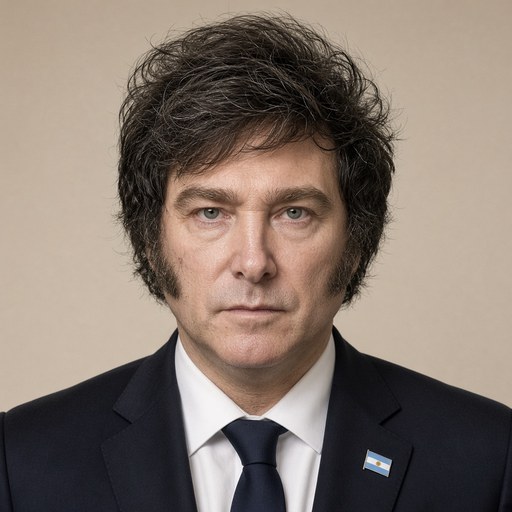
Speech by President Javier Milei at the 11th edition of the Latam Economic Forum 2025, in the City of Buenos Aires.
 Javier Milei · President of Argentina
- Context
- Milei addressed the 11th Latam Economic Forum in Buenos Aires on May 8, 2025, presenting his concept of endogenous dollarization while also denouncing political opposition and media attacks.
- Main themes
- Endogenous dollarization, monetary policy reform, political corruption, media bias, anti-corruption fight, Argentine economic liberalization, opposition criticism, state party conflict, fiscal spending, La Libertad Avanza legislative strategy
- Duration
- ~56 min
- Words
- 6,719
- Sentences
- 319
- Readability
- 67
- Grade
- 9.0
- Syntax
- 2.92
- Vocabulary
- 1.95
Translated from Spanish
The broad sphere of national life a sentence belongs to. Every sentence has an Arena, so it is the denominator the other indices are read against.
Other319 sentences in 41 paragraphs
Good morning everyone. Thank you Rab, thank you Darío for inviting me again and for being part of this forum, which I attend with such pleasure and pride. Today's talk will be about a topic that - at this moment - is gaining public notoriety, which is the idea of what we had already called endogenous dollarization back in September of last year. So I will try to make it as intuitive as possible; on Tuesday I have one that is a bit rougher, but – basically – I will try to do it in a fairly intuitive way, and I believe that if we essentially understand the nature of money, it will be very simple to understand what we want to do, why we want to do it, and how we are going to do it. Aside from that, it is clear that, even though it is a technical talk, I am still a politician now, and I am still the President of the Nation. And it is clear that, last night, the state party, the corrupt ones, won a battle, but they will not win the war. We will continue to fight against corruption - with all our might - until we kick them out.
At the same time, the media operations are repugnant, for example, the one that the infamous Clarín Group has undertaken - as usual - slandering and defaming. But well, if you look at my Twitter cover, you will see why there is so much hatred. But well, they want to take over a business by force, they want to take over Telefónica by force; and since that goes against the guidelines of competition defense, they want to subject us - to smear campaigns, lies, slanders, and insults - all the time. But - unlike the corrupt ones who have been before - I will not yield. So yes, I will continue to fight, and the reality is that there were no votes, it was all a media operation - tinged with yellow -, there were no votes, there were no votes. That is why the head of the Senate caucus of La Libertad Avanza requested that - beforehand - a commitment be signed so that when we had the 37 signatures, we could go to the chamber and be sure that we could pass the project.
Because we needed a qualified majority, which was 37 votes, moreover, there are the cuts - in “La Nación” - that people from Juntos por el Cambio refused to sign, and - at the same time - that they refused to do that, they were moving - in the media - the idea that we did not want to go to the chamber. So, we ended up going to the chamber and what happened happened.
I am not surprised that they do such things, I had warned about it on Tuesday in a note - in “Neura”, with Malena de los Ríos - and I am not surprised, for several reasons, because those who covered for Cristina Fernández de Kirchner were the same yellow ones who - via Pichetto - covered her immunity, and then gave her the position of vice president in the formula that competed against “Golperto” Fernández.
Not only that, but they have been in the City for 17 years - and they never got rid of her, and - in the four years of government they had - they also did not get rid of her. And so - now - the one who does not want to get rid of her is me; no, no, the one who does not want to get rid of her is the state party. And the truth is that I am deeply disappointed by what Deputy Lospennato is doing, lying - openly - because I already knew that the journalists were lying, and lying, moreover, by saying that there had been ATN and different things, for which the data is available and proves the lie.
If we want to end the corrupt, one of the things we have to end is the lie. Because the lie is also a form of fraud. So it was to make it clear. Because besides, that project - first - that had never passed through the Chamber of Deputies, passed when I moved - heaven and earth - with a project to make it pass; we took it to the Senate, but they tripped us up. No problem. We will try again. I will not yield an inch.
But what can they expect from those who claim to be in favor of freedom and say that public spending should not be cut in the City, when they quadrupled the size of the State? The question is: How many elections did they promise that they would lower taxes? Because they will not be able to lower taxes if they do not cut spending, just a heads up. I mean, to show you how they are lying to you. Or how they lie to you, when they have a candidate who talks about Universal Basic Income, that is, a typically socialist measure; or when they have a candidate who says she will provide subsidized credit, that is, against all market logic; or directly when they lie saying that we want to close schools and close hospitals, which is the same negative campaign that Massa ran in 2023. And it must be because they hired the same human trash, Gutiérrez Rubí, who specializes in negative campaigning. It seems that if we want to make a change, we need to get rid of the state party, but it seems they like to defend the State because they like to defend their little businesses.
That said, now I will talk about endogenous dollarization. To understand the issue of endogenous dollarization, the most important thing is to understand what money is. This may seem like an obviousness, a tautology, a nonsense, but I actually have my doubts that even my colleagues understand it, seriously. I mean, I have the feeling that… otherwise they wouldn’t say the number of absurdities they say; in fact, all those who listen when they say: “inflation is multicausal,” well, that is nonsense. They do not know what money is, which I will now prove; the nature of money, the monetary nature, and inflation; and from there I will go, after we understand how it works, I will go to the monetary part and explain exactly what the problem of endogenous dollarization is.
The first point is: the starting base is the barter economy, that is, we have to start thinking about an economy without money. That is, to understand why money appears. If you had a barter economy, you would have two problems: the first problem is what is called “the double coincidence.” You would need to find another person who wants what you are selling and you what the other person wants. That is a huge problem, in a small community not so much, but in a large community it becomes a Herculean task. Therefore, if that happens, many transactions are lost; if transactions are lost, the quality of life of the community falls dramatically. Now, let’s suppose you are so lucky that you find yourself in a context where you find the person, and then another problem appears, which is what is called the indivisibility problem. That is, it may be that a baker wants one of my conferences and I want to eat bread, but the problem is that suddenly in one of my conferences, so many kilos of bread not… my expectation post, this being many. So, you can imagine that - even being a mandrill - I could not keep so much bread. Well, then, there appear the two problems, under which one has to start to see: people did not start crying because there were these two problems. What did people do? They found a way around it.
And this is important because how did they find a way around it? How was this resolved? Then something appeared that is called: “indirect exchange goods.” That is, what did people see? That there were goods that had many exchanges, that many exchanges were made. So - in reality - they started buying those goods, not because they wanted them naturally, but because they used them to buy other goods; and those goods that were used for indirect exchange were what later ended up transforming into money. That is, what appeared in that context? Commodity money.
So, for example, what was the first money that humans used when they were still nomadic? The first money they used was livestock, basically why? Because they traveled with livestock, walked with livestock, moved with livestock, and what was livestock for? To eat. So they made exchanges, in terms of livestock. Now when man became sedentary, they found other ways to feed themselves as well. So, for example, a food that was used a lot was bread, that is, and bread is made with wheat. So wheat became, for example, a currency.
Let’s see, then, for example, the term: salary, where do you think it comes from? Precisely because it was paid in salt. This is interesting, the first question is have you ever tried food without salt? It’s a bit complicated, that’s why it was a fairly valuable good and spice merchants were a type that did well. And the other thing is, do you know why they say that when salt falls it’s bad luck? Because, what happens? You would go and make a transaction and carry a sack of salt, and what happens? If you handled the sack of salt, what could happen? That salt could fall to the floor. Consequently, you were losing money, it was bad luck, clearly.
So, how is the custom? So you would go, make the transaction, and put the sack on the scale, and then the other person would take it. Tobacco was also used, different types of goods were used, in fact, during the hyperinflation in Germany, nails were used; and there is an anecdote that says, for example, Milton Friedman, which is very funny, that says: “and they also came to use cognac,” which is the most liquid definition of money he ever knew.
Also - if you look - we are varied in ages here, but those who are more or less my age - over 50 - will have seen prison movies, and the money that was used in prison, what was it? Cigarettes. Now notice that that type of money fulfills two of the three functions that money has: it can be a unit of account, clearly you could set prices in cigarettes, or in salt, or in tobacco or in whatever you want. And also, that is, it was the unit of account and it was a generalized means of payment.
Now, what was the problem with that type of money? What was it not? A store of value. In fact, if you notice, a store of value, this is interesting, could you have ice cream as a store of value? No, why couldn’t you have ice cream as a store of value? Because it melts. What does it mean that it melts? That the interest rate then what does it have, how is it? Negative. I’ll give you a detail, everything you have in dollars under the mattress also has a negative interest rate because they are losing value with dollar inflation. I don’t know, I’m just giving you a detail so you have it in mind for when I talk about putting dollars into the system.
So, the problem with all those goods was that over time they degraded, consequently, they were not a store of value. So how did humans solve the problem of being a store of value? And then they went to something that would not degrade, and then, what appeared? Metals. So gold appeared, silver appeared, and bronze appeared. Gold for large transactions; silver for small transactions and, also, bronze for small transactions.
Now, that also allows them to what? Solve now; they can be: a unit of account, a generalized means of payment and, in addition, now it can also be a store of value. Now I’m going to go to something that particularly amuses me and with a hero, a purebred anarcho-capitalist, who was Zorro. Zorro was an anarcho-capitalist, even if it hurts Carmelian — who doesn’t understand anything — he was an anarcho-capitalist; because he lived in a place in Los Angeles, if I’m not mistaken, and what did they live off? Trade. So people came from other places and brought two things: goods to exchange and they also brought money to buy things which was gold. So what happens? When someone from outside came in a cart, they brought a sign - on their forehead - that said: “I have gold, I have gold, I have gold. Come rob me. Come rob me.” So one of the things Zorro did was what? Attack those vandals who attacked the visitors. That is, he protected commercial exchange. I mean, because if every time someone came they were going to be robbed by thieves, they would remain in autarky, and the quality of life would deteriorate a lot. Therefore, Zorro’s protections favored free trade and respected private property. And who was Zorro’s other enemy? The soldiers who represented whom? The State, which made him a textbook anarcho-capitalist. Now, that said, a new problem with money appears then, because they had to carry a lot of heavy metal. And what other problem happened? That it could be stolen. So, what did man discover? He discovered deposit houses. And what did they do? They left the gold, silver, or bronze, whatever it was, and in exchange they received what? Some bills, which were promissory notes, and that you, when you presented them, had to be given the gold. So - instead of traveling with all the metal on you - they made transactions with those papers and then there was a clearing: the problem was solved. The day you wanted to go to the deposit house, you presented the paper and took your metal holdings. Obviously - as expected - a rogue always appears who wants to take advantage of that. And what did he start doing? He started issuing papers without the metal being there. And what happened when that situation occurred? The number of papers increased, but the goods were - exactly - the same. So, the prices denominated in those papers, what happened? They rose. So, people also kept track of the time, and when that happened, they would go to withdraw the metal. And that was where problems arose.
So, what did the State do? Instead of addressing the problem of theft, what did it say? No, no, how? I can do this business myself. And what did it do? It took control of the production of money. So now it was the State doing it. That is to say, the State does not allow competition in theft; it has to be the only one. Have you thought that if you did the things the State does, you would go to jail? I mean, it's not a minor issue.
But beyond that, which is the interesting part. From there, another problem arose: because when the monarchs or feudal lords started to mess with the paper, there was a time when, for example, what they did was strike gold coins in a sack, and with what fell, they made another. The debasement, which was the seigniorage, was what defrauded the people. So the coins started to weigh less. Therefore - this is in the Parashah of this week - about what is just. And within the things that are just, you cannot use false weights.
This is basically the same. If you want, I can grab the phone and bring it to you more accurately, or later I can pass it to Darío so he can share it with you. So, everything is in accordance with the plan. Everything is going according to the plan. That said, what happens? When you started to degrade the coins too... So, what happened? They had to, instead of using the local currency, want to use another. Why? To avoid losing value. So, what did the monarchs or feudal lords impose? The forced currency, that is, forcing them to hold money. Why? To punish them with the inflation tax. But beyond all this, then a whole discussion began between two schools, which were the Currency School and the Banking School. And all that led to a debate that ended in 1844, with a law called Peel, which developed the financial system as we have it now. At that time, there was convertibility of the currency, and every time they went overboard and issued, they made a change. And that basically went on - until 1973 - when it ended with Bretton Woods. We now find ourselves with this financial system and with fiat money. But the important thing is that we do not lose the essence of money. Money is nothing more than an indirect medium of exchange for making transactions. Example: what good are all the greens I can accumulate in a wooden suit? I mean, on the other side, they buy nothing with that. So, no... it's like, it doesn't have much value taken from this place.
Moreover, look: I leave you alone on an island, and no matter how much I give you 5, 10, 20 million dollars, what do you do with that? Nothing. Just the island, no... moreover, perhaps, if you could infer that a plane passes by, you would burn it so they could see it. That said, then, what needs to be understood is that if money is an indirect medium of exchange, it means that you demand it because it serves to buy other goods. For example: you sell your labor to your employer in exchange for pesos, to - with those pesos - buy other goods. But you use it... I don't know if you just realized that I just used a format like Rothbard's, which just destroyed the Theory of Exploitation: you buy money from your employer. The Theory of Exploitation is over. I mean, just by framing the discussion differently, it ends the Theory of Exploitation, unless workers are exploiting employers. Because they are the ones who buy money in exchange for work. But beyond that, the important thing is to be clear, then, that the demand for money strictly is a derived demand. That is to say, it is a mirror of what happens on the real side, and therefore, it is a consequence of it, that then, the demand for money will be determined by the intertemporal path of consumption; that is, what you consume from today until the end of eternity. That is, when you see an economist who builds the money demand function and puts: "y" and "i" in Latin, that one is a fool. I mean, because if you build a general equilibrium system, all prices come in. And now I will explain the difference. So, the determination of income is determined by prices and quantity. You do not need to put incomes. That is a nonsense that economists have dragged - since Keynes - who only took one economics course with Marshall, and only, let's say, made an invalid transposition from a partial equilibrium case to general equilibrium.
And the other nonsense is to put the interest rate there, because in reality the interest rate is not determined in the money market; the interest rate exists even when there is no money; the interest rate exists because time exists because it means how I will be transferring consumption from the present to the future and vice versa. Therefore, the consumption functions are determined by all the prices of present goods to future goods and so on. And the reality is that - if you take a general equilibrium system seriously - you do this seriously, not in a shabby way, that is, instead of grabbing the books of the Keynesian current, you read books derived from Arrow, Bree, Jan, Mckenzie, or if you want to go earlier Wolf and if you want earlier Walras. You will have that the demand functions will depend on all prices.
But, fundamentally, what are the deep parameters on which those functions depend? Both demand and supply, and therefore excess demand, will depend on the deep parameters, which are: preferences, which are given; technology, which, unless you make some assumption about technological progress, is given; endowments, which are given; and the property system. Therefore - once you specify the model - that is as hard as a rock. That is granite. It is something granite. Consequently, if you do nothing, the system has a set of functions that only depend on prices. But, moreover, they are granite. Therefore, - under normal conditions of pressure and temperature - the demand for money is granite. Unless a sinister entity called the Central Bank appears. Why? Because they basically reflect deep parameters that are not under anyone's control. So, that real demand for money must be equal - in equilibrium in the money market - to the real supply of money, that is, the amount of money divided by the price level. And what do we reach there? We reach the monetary nature of inflation. Why? Because, if the amount of money is fixed and the demand is fixed, the money supply divided by the money demand gives you the price level. And if you increase the money supply, prices go up. That is to say, there arises the monetary nature of inflation, which is: inflation is, always and everywhere, a monetary phenomenon, generated by an excess of money supply, either because the supply rises, or because the demand falls, or because both things happen at the same time, which result in a loss of purchasing power of money. That is to say, that all prices - expressed in monetary units - rise. And let me tell you something: the exchange rate is one more of all those prices. None of that nonsense that the exchange rate determines prices. No. The amount of money determines prices, and one of those prices is the exchange rate. Which is the price of foreign currency, in the case of the dollar, from the United States. These are very important things to keep in mind.
In that context, and to not complicate you, I mean, there is a whole discussion about money supply, which we can have, but what matters to me, above all, to tell you today, is that the price level - fundamentally - is given by the quotient between the money supply and the money demand; and that the amount of money is what is called: “the nominal scale” and as I move the amount of money is how I move prices.
That - if you extend it to an open economy - you can say in the same way that I determine the local price by the local money supply against the local money demand; I can do the same, for whom? I can do the same, precisely for, for example, for the United States. So, it will also be given by the quotient of the price in the United States, by the quotient that will be given by the amount of money supplied over the amount of money demanded.
Why is this important? This is important because, if there is an arbitrage - which is called the Law of One Price or, also, extended to an open economy is called “purchasing power parity” -, that means that the local price is equal to the price of foreign currency, that is, the exchange rate, the dollar, by the price level of the United States. So, notice that the exchange rate is determined by the local price, divided by the price of the United States. And, as local prices rise relative to those in the United States, you then have reasons for the exchange rate to grow. Now, if I consider that the demand for money is a factor K, multiplied by national income - but that is a fraction of income -, it will remain that the exchange rate is determined by the quotient between the local money supply (I will do it divided by the foreign money supply), by the foreign monetization coefficient over the local one and by foreign income over local income. That is to say, to the extent that the money supply - I will do it directly with the case of Argentina so we can see the problem -: if in the United States the money supply grows faster than it does in Argentina, where the amount of money is fixed - therefore, the variation is zero -, that means that from the side of the money supply there are pressures for the exchange rate to fall.
If, in addition, I collect about a third of what the base is and, moreover, I have a fiscal surplus, I - instead of injecting pesos - am not only keeping the amount of money constant, I am taking pesos out. So, while in the United States the amount of money offered rises; in Argentina it remains constant or falls. Therefore, that puts pressure for the exchange rate to go down, that is, for the dollar to fall.
The other has to do with the monetization factor. In the United States that number is super stable; in Argentina it comes from a truly depressing number. Let's see, Argentina - during the first period of the Kirchnerist regime - had an average inflation of 10%; in the second 20; in the third period of the Kirchnerist regime, 30; with Macri almost 50; with “Golperto” they left with more than 200. Inflation was traveling at 1% daily, when you take the wholesale, it was 54 - in the month of December -, that annualized gives 17,000. That is to say, in that context, it is clear that the ice cream was in the middle of the Sahara desert in broad daylight. I mean, the money was melting in your hand, it was obvious. So, monetary holdings in Argentina were at levels very similar to those before the hyperinflation of Alfonsín. Interesting, then, what happens? Today when I take the broad monetary base I am around 6% of GDP, and that number under normal conditions should be around 12% of GDP. This means that Argentina, as a result of stabilization, must have a jump in the level of monetization of the economy. That generates a potential demand for pesos, relative to what could be in the United States regarding the dollar. Consequently, that also causes the exchange rate to fall.
And as if all this were not enough: Argentina, remember that there was a discussion that said: “No, if you make this adjustment you will plunge the economy into a great depression,” said the Keynesians; they must be... well, it doesn't matter. You have to recognize that I am holding back.
It makes me feel a bit awkward to be super Milei, in front of Reb, so that’s why I feel a bit shy. I am behaving well for you, Reb. Now, notice, first, they said we were going to sink into a great depression; second, that we were going to make an L, that is, we would hit a floor and not rise again; then, they started with that it was going to be the Nike swoosh, but soft; then the Nike swoosh; then, they recognized it was going to be a “V” and it ended up being a tilde because when I take..., that is, the annualized wholesale inflation went from 17,000 to levels of 10, because - in December - it was 0.8; and they predicted all kinds of aberrations, that GDP was going to be destroyed and everything, the seasonally adjusted - from December - ended up 6% above that of December 23. That is to say, we not only crushed the inflation rate like never before in history, but also the economy expanded. They certainly have to burn all the Keynesian textbooks.
Moreover, not only that: the last activity data gave 5.7. If you took the seasonally adjusted of 0.8 that is 10 annualized, but if you want to take them - by quarter - the first quarter of the year would be expanding the economy at 6%; in the second quarter it would be doing so at 8%. That is to say, the economy is growing strongly. You already know the metaphor: the bubbles are everywhere, OK? we are growing like a fish fart.
And that also generates an increase in the demand for money, and what that does is create downward pressure on the exchange rate. So, what is the problem we have now? That is to say, we have problems associated with the fact that we are growing a lot and the economy is very little monetized. The only way to monetize this economy is by forcing it. Right? So, due to these increases in the demand for money, the exchange rate goes to the floor of the band. And the problem is that the floor of the band is not enough, and if I issue... something happens that I do not like, which is to generate inflation. So, I don’t want that. Therefore, while there is still a remaining money overhang, we will not have a problem of monetary strangulation. But, at some point, the money overhang will run out, the exchange rate will hit the floor of the band, and at the pace at which we can monetize - and we do not know if we will do it well - it may not be fast enough and generate a high interest rate, which will end up slowing down the level of economic activity, and become a burden for economic growth, because it requires deflation. And since the economy is still not designed to have contracts, in real terms - to be neutral to the fact that the purchasing power of money strengthens so much - we said: “well, let the economy be monetized by the Argentines themselves.”
So, when you need to make transactions, you take your own dollars and inject them into the system. And that has two characteristics: it does not force the exchange rate to go down and - therefore - have to induce the entire economy into deflation, with all the trauma that can entail, but also the one who decides the amount of money within the economy is who has to decide it, which is the individual, or was the amount of money determined by someone else, if when we were looking at that - I used a whole part of the presentation - to talk precisely about the origins of money because the real amount of money within the economy is determined by individuals. Therefore, those who have to monetize the economy, without this meaning a risk in volatility, in the price of the unit of account, whether in pesos or in dollars, is with individuals monetizing. So, the question is, how are they going to do it? The reality is that today it is allowed in Argentina to make transactions in dollars, because we started to see this problem - back in August 2024 - that is why we went to the International Monetary Fund, we sought the recapitalization of the Fund. Do you remember everything that the “econochantas” said? That we were not going to achieve anything and all that? The total package ended up being 49 billion dollars, which “well” the “econochantas.”
So, we fulfilled phase one of the program, which was to close the fiscal tap; we fulfilled phase two of the program, which was to close the financial tap, that is, to end the quasi-fiscal; and in part three we capitalized the Central Bank. We always talk about three anchors: we had the fiscal anchor, which is fiscal balance, we have here the human computer, the genius Secretary of Finance whom I deeply admire, I believe he is not human, who is Carlos Guberman; a round of applause for this genius we have on the team. Just try to determine if he is human, I don’t think so because someone who has all those numbers in his head is not human, I mean I am a guy who rounds numbers, imagine that I look at him, I can’t believe the accuracy of this man. But not only that, then there is what is called the monetary anchor, that is, we fixed the amount of money since the middle of last year, the amount of money does not grow anymore, the broad monetary base is given, that is to say that since inflation has a lag that ranges - between 18 and 24 months - by the middle of next year inflation in Argentina will have been history. And the third anchor was an exchange rate path, as we had a crawling peg. And that was now happening and that worked and it was because - basically - we had to restore the balance of the Central Bank, think that we did a write-off of about 45 billion dollars at the Central Bank. Think that the disgraceful previous government left, for example, the debt of siras at 45 billion dollars, negative net reserves, debt maturing in pesos equivalent to 90 billion dollars; four monetary bases maturing in one day, and we had to clean up the balance of the Central Bank. And we finished doing that with the program with the International Monetary Fund, which involved 20 billion dollars from the International Monetary Fund; 12 billion dollars from the World Bank; 10 billion from the IDB; 2 billion from a RIPO and the 5 billion that the Chinese government renewed for us - ahead of time.
In light of that, we were able to recapitalize the Central Bank and we said: “let’s float.” So, today the anchor is not an exchange rate path, today the anchor is then, what is it? The capitalization that I have in the Central Bank that allows me to float without fear. So, we have Argentines who are learning to float today; and after all the catastrophic forecasts and that it was going to the ceiling of the band and that we were going to skate all the dollars and everything, it turns out that - every day - it is closer to the floor of the band. And if I have that the relative money supply falls; that the relative money demand rises and that, moreover, I grow more, it is obvious that the exchange rate will tend to go to the floor of the band. And to the extent that this is not mapped with the speed of economic growth, I will not monetize until it hits the floor; and - consequently - then I will have to monetize, in some way, and that is why we allowed the competition of currency.
I make a note of color because, if you remember, we said, there are the interviews, that I said: if I get 15 billion dollars, I will open the cepo. The reality is that we needed 12 billion dollars to do it, but - to be a little more secure - we said: 15 billion. You remember that everyone said: “no, in an election year he is not going to open, he is not going to dare to open the cepo; if he does it, he does it…” and I said: that for the year, for January 1, 2026, the cepo would no longer exist. And that if I got that money - the 15 billion dollars - I would open.
And everyone said: that he was not going to do it because it was an election year; well, guys, the cepo is an instrument of torture and there is nothing that justifies losing freedom or giving up freedom… so we got 20 billion dollars cash and despite all the forecasts we did what had to be done and lifted the cepo. And the idea, then, is how we do to monetize the economy, look in the mattresses, Argentines must have either 200 billion dollars or 300 billion dollars or 400 billion dollars, depending on whom you ask who makes the estimate. And that could be a huge injection that that savings enters the system, and that allows for a boom in investment and that Argentina accelerates the growth process, such that in a range - of 30 to 40 years - Argentina becomes one of the greatest world powers, with the note of color that two-thirds of that improvement could be seen, in the span of 10 to 15 years.
And that is why we are motivating endogenous dollarization; precisely so that this process is not hindered or delayed over time, or that it does so at a slower pace. And the point is the following: if today it is allowed to make transactions in foreign currency, why then do we need to advance? Do you know why? Because everyone who has dollars in the mattress is afraid that afterwards they will leave their fingerprints and they will come looking for them, that is the reality. Therefore, we are working - between ARCA, the Ministry of Economy, and the Central Bank - on the mechanism so that people can bring dollars into the system, can buy whatever they want, and that they do not leave fingerprints so that no one goes after them.
Still, you shouldn’t be surprised: I am liberal, libertarian, and I said this - at some point - and obviously with all the political caste, the state party came out to attack me. I wish, let’s see - at some point I said - that those who had dollars in the mattress were the heroes who were going to pull this country forward. Because what is the point? You did not put dollars under the mattress because you hate the country; you put dollars under the mattress because on the other side there was a bunch of sons of bitches, criminals, who robbed you with the inflation tax.
Not for nothing - from 1935 to date - we have removed 13 zeros from the currency. Clearly, we could take away 13 more zeros. That is to say, we could rescale everything to 1 equals 1000. So it is not that those who took the dollars to the mattress are criminals, they are people who escaped from the legal criminals, who are the politicians and thieves who steal everything, the thief has a thousand years of forgiveness.
In short, it is as if you defended yourself from a thief and they punish you to continue rewarding the thief. No, that is not right, that is wrong, here we are going to value good people and - therefore - they will be able to take out their dollars without having to leave fingerprints, because they were dollars earned honestly and to prevent the garbage of politicians from stealing them. The only clarification I want to make and - let it be clear - is that - in the transition - the peso will continue to exist and will be used to pay taxes. This means that you will continue to use pesos, you will use them to pay taxes. With economic growth and with this remonetization, the peso will continue to appreciate, but it will remain so small - in relation to the amount of dollars - that the system will remain endogenously dollarized and when that happens we will be in a position to be able to close that sinister institution, which has done so much harm to Argentines and end up winning our monetary freedom so that no politician, son of a bitch, can ever rob you with the inflation tax again. Long live freedom, damn it! Thank you.
The original Spanish. The tags above are read on the English translation's sentences.
Buenos días a todos. Gracias Rab, gracias Darío por invitarme nuevamente y ser parte de este foro, al cual asisto con tanto placer y tanto orgullo. La charla de hoy, va a ser sobre un tema que - en este momento - está tomando notoriedad pública, que es la idea de lo que ya - por el mes de septiembre del año pasado - nosotros habíamos llamado la dolarización endógena. Así es que voy a tratar de hacer la versión más intuitiva posible; el martes tengo una que es un poquito más áspera, pero – básicamente - voy a tratar de hacerlo de manera bastante intuitiva y que creo que si entendemos esencialmente la naturaleza del dinero va a ser muy simple entender qué es lo que queremos hacer y por qué lo queremos hacer y cómo lo vamos a hacer. Al margen de eso, está claro que, igual, por más que sea una charla técnica, no dejo de ser político ahora, y no dejo de ser el Presidente de la Nación. Y está claro que, anoche, el partido del Estado, los corruptos, ganaron una batalla, pero no van a ganar la guerra. Vamos a seguir dando la guerra contra la corrupción - a capa y espada - hasta que los terminemos de sacar a patadas en el culo.
Al mismo tiempo, es repugnante las operaciones mediáticas, por ejemplo, la que ha emprendido ese infame Grupo Clarín - para variar - ensuciando, calumniando. Pero bueno, si ustedes miran mi portada de Twitter van a ver por qué hay tanto odio. Pero bueno, se quieren quedar con un negocio de prepo, se quieren quedar con Telefónica de prepo; y como eso va en contra de los lineamientos de defensa de la competencia nos quieren someter - a carpetazos, a mentiras, a calumnias e injurias - todo el tiempo. Pero - a diferencia de los corruptos que han estado antes - yo no voy a ceder. Así es que sí voy a voy a seguir dando batalla y la realidad es que no estaban los votos, fue toda una operación mediática - teñida de amarillo -, no estaban los votos, no estaban los votos. Por eso, el jefe de la bancada de senadores de la Libertad Avanza pidió que - antes - se firmara un compromiso para que cuando tuviéramos las 37 firmas ir al recinto y estar seguros de que podíamos pasar el proyecto.
Porque necesitábamos una mayoría calificada, que era 37 votos, es más, están los recortes - en “La Nación” - que gentes, de Juntos por el Cambio se negaron a hacer esa firma, y - al mismo tiempo - que se negaron a eso, movían – mediáticamente - la idea de que no queríamos bajar a recinto. Entonces, se terminó bajando al recinto y pasó lo que pasó.
No me sorprende que hagan ese tipo de cosas, yo lo había alertado el día martes en una nota - en “Neura”, con Malena de los Ríos - y no me sorprende, por varias cosas, porque los que cubrieron a Cristina Fernández de Kirchner fueron los mismos amarillos que - vía Pichetto - cubriéndole los fueros, después le dieron el cargo de vicepresidente la fórmula que compitió contra “Golperto” Fernández.
No sólo eso, sino que llevan 17 años - en la Ciudad - y nunca la sacaron y - en los cuatro años de Gobierno que tuvieron - tampoco la sacaron. Y entonces – ahora - el que no la quiere sacar soy yo; no, no, quien no lo quiere sacar es el partido del Estado. Y la verdad que me decepciona profundamente lo de la diputada Lospennato mintiendo - abiertamente - porque de los periodistas ya lo sabía que mentían, y mintiendo, además, con que había habido ATN y distintas cosas, que están los datos disponibles y que prueban la mentira.
Si queremos terminar con los corruptos, una de las cosas con las que tenemos que terminar es con la mentira. Porque la mentira también es una forma de estafa. Así es que era para que quedara claro. Porque además, ese proyecto –primero - que nunca había pasado por Diputados, pasó cuando yo moví - cielo y tierra - con un proyecto para que pasara; lo llevamos al Senado, pero nos hicieron una zancadilla. No hay problema. Lo vamos a reintentar. No voy a ceder un milímetro.
Pero qué pueden pretender de aquellos que se dicen estar a favor de la libertad y dicen que no hay que recortar el gasto público en la Ciudad, cuando cuadriplicaron el tamaño del Estado. La pregunta es: ¿Cuántas elecciones les prometieron que iban a bajar impuestos? Porque no van a poder bajar impuestos si no bajan el gasto, aviso. O sea, para que vean cómo les están mintiendo. O cómo le mienten, cuando tienen un candidato que habla del Ingreso Mínimo Universal, o sea una medida típicamente socialista; o cuando tienen una candidata que dice que va a dar crédito subsidiados, es decir contra toda lógica de mercado; o directamente cuando mienten diciendo que queremos cerrar escuelas y cerrar hospitales, que es la misma campaña negativa que hizo Massa, en el año 2023. Y debe ser porque justamente contrataron a la misma basura humana de Gutiérrez Rubí, que se dedica a hacer campaña negativa. Parece que si queremos hacer el cambio necesitamos – entonces - sacarnos de encima el partido del Estado, pero parece que le gusta defender el Estado porque les gusta defender kioscos.
Dicho esto, ahora sí voy a hablar de dolarización endógena. Para entender la cuestión de la dolarización endógena, lo más importante es entender qué es el dinero. Esto que parece una obviedad, una tautología, una tontería, en realidad tengo mis dudas que hasta mis colegas lo entiendan, seriamente. O sea, tengo la sensación de que… sino no dirían la cantidad de barbaridades que dicen; de hecho, todos aquellos que escuchan cuando dicen: “la inflación es multicausal”, bueno, eso es burro. No sabe qué es el dinero, cosa que voy ahora a probar; la naturaleza del dinero, la naturaleza monetaria y la inflación; y de ahí voy, después, cuando entendamos cómo funciona, voy a ir a la parte monetaria y voy a explicar justamente cómo es el problema de la dolarización endógena.
El primer punto es: la base de inicio es la economía de trueque, es decir, hay que empezar a pensar una economía sin dinero. Es decir, para entender por qué aparece el dinero. Si ustedes tuvieran una economía de trueque van a tener dos problemas: el primer problema es lo que se llama “la doble coincidencia”. Ustedes van a necesitar encontrar otra persona que quiera lo que ustedes venden y ustedes lo que quiere de la otra persona. Eso es un problema enorme, en una comunidad chiquita no tanto, pero en una comunidad grande se vuelve una tarea ciclópea. Por lo tanto, si pasa eso se pierden muchas transacciones; si se pierde transacciones, la calidad de vida de la comunidad cae estrepitosamente. Ahora, supongamos que tienen tanta suerte que se encuentran con un contexto en el cual encuentran la persona, y ahí aparece otro problema, que es lo que se llama el problema de la indivisibilidad. Es decir, puede ser que un panadero quiera una conferencia mía y yo quiero comer pan, pero el problema es que de repente en una conferencia mía, tanto kilo de pan no… mi expectativa post, esto de que sean muchísimas. Entonces, se imaginarán que - ni siendo mandril - podría quedarme con tanto pan. Bien, entonces, ahí aparecen los dos problemas, bajo los cuales uno tiene que empezar a ver: la gente no se puso a llorar porque había estos dos problemas. ¿Qué es lo que hizo la gente? Y, le buscó la vuelta.
Y esto es importante porque ¿cómo es que le buscó la vuelta? ¿cómo se arregló esto? Entonces apareció algo que se llama: “los bienes de intercambio indirecto”. Es decir, ¿qué es lo que veía la gente? Que había bienes que tenían muchos intercambios, que se hacían muchos intercambios. Entonces - en realidad - empezaron a comprar esos bienes, no porque los querían naturalmente, sino que lo usaban para comprar otros bienes; y esos bienes que se usaban de intercambio indirecto era lo que después se termina transformando en dinero. Es decir, ¿aparecieron en ese contexto qué? El dinero-mercancía.
Entonces, por ejemplo, ¿Cuál fue el primer dinero que usó el ser humano cuando todavía era nómade? El primer dinero que usó era el ganado, básicamente ¿por qué? Y porque viajaban con el ganado, caminaban con el ganado, se movían con el ganado, ¿y el ganado para que le servía? Para comer. Entonces hacían intercambios, en términos de ganado. Ahora cuando el hombre se volvió sedentario encontraron otras formas de alimentarse también. Entonces, por ejemplo, un alimento que se usaba mucho era el pan, o sea, y el pan ustedes lo hacen con trigo. Entonces el trigo se convirtió, por ejemplo, en una moneda.
A ver, después, por ejemplo, el término: salario, ¿de dónde cree que vienen? Justamente porque se pagaba en sal. Esto es interesante, la primera cuestión es alguna vez, ¿probaron la comida sin sal? Es un poco complicado, por eso era un bien bastante valiosos y a los especieros eran un tipo que les iba bien. Y lo otro es, ¿saben por qué dicen que cuando se cae la sal es mala suerte? Porque, ¿qué pasa? Ustedes iban y hacían unas transacción y llevaban un saco de sal, ¿y qué pasa? Si ustedes manipulaban el saco de sal, ¿qué era lo que podía pasar? Que se cayera sal al piso. Consecuentemente estaban perdiendo plata, era mala suerte, claramente.
Entonces, ¿cómo es la costumbre? Entonces ustedes iban hacían la transacción y ponían el saco en la pesa, y después la otra persona se lo llevaba. También se usó el tabaco, se fueron usando distintos tipos de bienes, de hecho, en la hiperinflación alemana se usaron clavos; y hay una anécdota que dice, por ejemplo, Milton Friedman, que es muy divertido, que dice: “y también se llegó a usar el coñac”, que es la definición más líquida de dinero que él haya conocido.
También - si ustedes se fijan - acá estamos variados en las edades, pero los que tienen más o menos mi edad - más de 50 -, habrán visto películas de cárceles, y el dinero que se usaba en la cárcel, ¿cuál era? Los cigarrillos. Ahora fíjense que ese tipo de dinero cumple con dos de las tres funciones que tiene el dinero: puede ser unidad de cuenta, claramente ustedes podían poner los precios en cigarrillos, o en sal, o en tabaco o en lo que quieran. Y también, o sea, era la unidad de cuenta y era medio de pago generalizado.
Ahora, ¿cuál era el problema con ese tipo de dinero? ¿que no era qué cosa? Reserva de valor. Es más, si ustedes se fijan, reserva de valor, esto es interesante, ¿ustedes podrían tener como reserva de valor el helado? No, ¿por qué no podrían tener reserva de valor el helado? Porque se derrite. ¿Qué quiere decir que se derrite? Que la tasa de interés entonces qué tiene, ¿cómo es? Negativa. Les paso un detalle, todo lo que tienen los dólares en el colchón, también tienen tasa de interés negativa porque van perdiendo con la inflación del dólar. No sé, les paso un dato sólo para que lo tengan incorporado para cuando yo les hable de meter los dólares adentro del sistema.
Entonces, el problema de todos esos bienes era que con el paso del tiempo se degradaba, consecuentemente, no eran reserva de valor. Entonces ¿cómo arregló el ser humano el problema de que fuera reserva de valor? Y entonces fueron a algo que no se degradará, y entonces, ¿qué aparecieron? Los metales. Entonces apareció el oro, apareció la plata y apareció el bronce. El oro para las transacciones grandes; la plata para transacciones chicas y, también, el bronce para transacciones chicas.
Ahora, eso les permite también ¿qué? Resolver ahora; pueden ser: unidad de cuenta, medio de pago generalizado y, además, también ahora puede ser reserva de valor. Ahora voy a ir a algo, que me divierte particularmente y con un héroe, un anarcocapitalista de pura cepa, que era El Zorro. El Zorro era un anarcocapitalista, aunque le duela a Carmelian —que no entiende nada— era un anarcocapitalista; porque vivía en un lugar de Los Ángeles, si no me equivoco, ¿y vivían de qué? Del comercio. Entonces venían personas de otros lugares y traían dos cosas: bienes para intercambiar y traían también dinero para comprar cosas que era oro. Entonces ¿qué es lo que pasa? Cuando venía alguien de afuera en una carreta, traía un cartel - en la frente - que decía: “tengo oro, tengo oro, tengo oro. Vení a robarme. Vení a robarme”. Entonces una de las cosas que hacía El Zorro era ¿qué? Atacar a esos vándalos que atacaban a los visitantes. Es decir, que protegía el intercambio comercial. O sea, porque si todo el tiempo que viniera alguien iba a ser estafado por los ladrones, se iban a quedar en autarquía, y la calidad de vida iba a empeorar mucho. Por lo tanto, los cuidados de El Zorro favorecían el libre comercio y respetaban la propiedad privada. ¿Y quién era el otro enemigo del Zorro? Los soldados que representaban ¿a quién? Al Estado, con lo cual, era una anarcocapitalista de manual. Ahora, dicho esto, aparece un nuevo problema con el dinero entonces, porque o tenían que llevar mucho, mucho metálico, que era muy pesado. ¿Y qué otro problema más pasaba? Que lo podían robar. Entonces, ¿qué es lo que descubrió el hombre? Descubrió las casas de depósitos. ¿Y qué hacían? Dejaban el oro, la plata o el bronce, lo que fuera, y a cambio se recibían ¿qué? Unos billetes, que eran unos pagarés, y que ustedes, cuando se presentaban les tenían que entregar el oro. Entonces - en lugar de estar viajando con todo el metálico encima - hacían las transacciones con esos papeles y, después, había un clearing: se terminaba el problema. El día que ustedes querían ir a la casa de depósito, presentaban el papel y se llevaban sus tenencias de metálicos. Obviamente - como era de esperar - siempre aparece un pícaro que quiere tomar ventaja de eso. ¿Y qué empezó a hacer? Empezó a emitir papeles sin que estuviera el metálico. ¿Y qué era lo que pasaba cuando se daba esa situación? Aumentaban la cantidad de papeles, pero los bienes eran – exactamente - los mismos. Entonces, los precios denominados en esos papeles, ¿qué pasaba? Subían. Entonces, la gente también le tenía tomado el tiempo, y cuando eso pasaba, iban a retirar el metálico. Y ahí era donde se armaban los problemas.
Entonces, ¿qué hizo el Estado? En lugar de agarrar y resolver el problema del atraco, del robo, ¿qué dijo? No, no, ¿cómo? Este negocio lo puedo hacer yo. ¿Y qué hizo? Se quedó con la producción de dinero. Entonces ahora lo hacía el Estado. Es decir, el Estado no admite competencia en el robo, tiene que ser él solo. ¿Ustedes se pusieron a pensar que si ustedes hicieran las cosas que hace el Estado irían presos? Digo, es un tema no menor.
Pero más allá de eso, que es lo interesante. A partir de ahí surgió otro problema: porque cuando los monarcas o los señores feudales se le empezaban a rosquear el papel, había una época que, por ejemplo, lo que hacían era golpeaban en un saco las monedas de oro, y con lo que caían, hacían otro. El envilecimiento, que era el señoreaje, era lo que estafaban a la gente. Entonces las monedas empezaban a pesar menos. Con lo cual -eso está en la Parashá, de esta semana - sobre lo que es justo. Y sea dentro de las cosas que son justas, usted no pueden poner pesas falsas.
Esto es básicamente lo mismo. Si quieren, agarro el teléfono y se lo traigo más exacto, o después se lo paso - a Darío - que se los comparta. Así que, está todo acorde al plan. Todo marcha acorde del plan. Dicho esto, ¿qué es lo que pasa? Cuando ustedes empezaban a degradar las monedas también… Entonces, ¿qué pasó? Tenían que, en lugar de usar la moneda del lugar, querían usar otra. ¿Por qué? Porque, para no perder valor. Entonces, ¿qué es lo que impusieron, entonces, monarcas o señores feudales? El curso forzoso, es decir, obligarlos a retener dinero. ¿Para qué? Para castigarlos con el impuesto inflacionario. Pero, más allá de todo esto, después empezó toda una discusión entre dos escuelas, que era la Currency School y la Banking School. Y todo eso derivó en un debate que terminó en 1844, con una ley que se llama Peel, y nos desarrolló el sistema financiero, tal cual como lo tenemos ahora. En aquel momento, había convertibilidad de la moneda, y la cual, cada vez que se zarpaban y emitían hacían un cambio. Y eso, básicamente, estuvo dando vueltas - hasta 1973 - que se termina con Bretton Woods. Nos encontramos, ahora, con este sistema financiero y con dinero fiduciario. Pero lo importante es que no perdamos la esencia del dinero. El dinero no es ni más ni menos que un bien de intercambio indirecto para hacer transacciones. Ejemplo: ¿de qué me sirven todos los verdes que pueda acumular en el traje de madera? Digo, del otro lado no compran nada con eso. Así que, no… es como que, no tiene mucho valor sacado de este lugar.
Es más, fíjense: yo los dejo a ustedes solos en una isla, y por más que les dé 5, 10, 20 millones de dólares, ¿qué hacen con eso? Nada. Tan solo la isla no… es más, quizás, si pudieran inferir que pase un avión, lo van a quemar para que lo vean. Dicho esto, entonces, lo que hay que entender es que si el dinero es un bien de intercambio indirecto, quiere decir que ustedes lo demandan porque sirve para comprar otros bienes. Por ejemplo: ustedes le venden trabajo a su empleador a cambio de pesos, para - con esos pesos - comprar otros bienes. Pero lo utilizan... no sé si se acaban de dar cuenta de que acabo de usar un formato a la Rothbard, que acaba de destruir la Teoría de la Explotación: ustedes le compran dinero a su empleador. Se acabó la Teoría de la Explotación. Digo, sólo por plantear la discusión de una manera distinta, hace que se termine con la Teoría de la Explotación, salvo que los trabajadores estén explotando a los empresarios. Porque son los que compran dinero a cambio de trabajo. Pero, más allá de eso, lo importante es tener claro, entonces, que la demanda de dinero estrictamente, es una demanda derivada. Es decir, es un espejo de lo que pasa en el lado real, y por lo tanto, es consecuencia de ello, que entonces, la demanda de dinero va a estar determinada por el sendero intertemporal de consumo; es decir, lo que consuman desde hoy hasta el fin de la eternidad. Es decir, cuando ustedes vean un economista que les arma la función de demanda de dinero y le pone: "y" e “i” latina, ese es un bruto. Digo, porque si ustedes construyen un sistema de equilibrio general, entran todos los precios. Y ahora voy a explicar la diferencia. Entonces, la determinación del ingreso queda determinada por los precios y la cantidad. No necesitan poner los ingresos. Eso es una burrada que arrastran los economistas - desde Keynes - que solamente tomó un curso de economía con Marshall, y solo, digamos, hizo una transpolación inválida de un caso de equilibrio parcial a equilibrio general.
Y la otra burrada, es meter la tasa de interés ahí, porque en realidad la tasa de interés no se determina en el mercado de dinero, la tasa de interés existe aún cuando no exista dinero; la tasa de interés existe porque existe el tiempo porque significa cómo yo voy a estar pasando consumo del presente al futuro y, viceversa. Por lo tanto, las funciones de consumo quedan determinados por todos los precios de los bienes presentes a futuro y así en adelante. Y la realidad es que - si ustedes toman un sistema de equilibrio general en serio -, hacen esto de manera seria, no de manera berreta, es decir, en lugar de agarrar los libros de la corriente keynesiana, leen libros derivados de Arrow, de Bree, de Jan, Mckenzie, o si quieren ir antes Wolf y si quieren antes Walras. Ustedes van a tener que las funciones de demanda van a depender de todos los precios.
Pero, en el fondo, ¿cuáles son los parámetros profundos de los que dependen esas funciones? Tanto la demanda como las de oferta, y las de, por ende, exceso de demanda, van a depender de los parámetros profundos, que son: las preferencias, lo cual está dado; la tecnología, que, salvo que hagan algún supuesto sobre el progreso tecnológico, está dada; las dotaciones, que están dadas; y el sistema de propiedad. Por lo tanto - una vez que ustedes especifican el modelo - eso es duro como una roca. Eso es granítico. Es algo granítico. Consecuentemente, si ustedes no hacen nada, el sistema tiene un conjunto de funciones que solamente depende de los precios. Pero, además, son graníticas. Por ende, - en condiciones normales de presión y temperatura- la demanda de dinero es granítica. Salvo que aparezca un ente siniestro llamado Banco Central. ¿Por qué? Porque, básicamente, reflejan parámetros profundos que no están bajo el control de nadie. Entonces, esa demanda de dinero real tiene que ser igual - en equilibrio en el mercado monetario - a la oferta real de dinero, es decir, la cantidad de dinero dividida por el nivel de precios. ¿Y ahí a qué llegamos? Llegamos a la naturaleza monetaria de la inflación. ¿Por qué? Porque, si la cantidad de dinero está fija y la demanda está fija, la oferta monetaria dividida por la demanda monetaria les da el nivel de precios. Y si ustedes incrementan la oferta de dinero, los precios suben. Es decir, ahí surge la naturaleza monetaria de la inflación, que es: la inflación es, siempre y en todo lugar un fenómeno monetario, generado por un exceso de oferta de dinero, ya sea porque sube la oferta, o porque cae la demanda, o porque ocurren las dos cosas a la vez, que derivan en una pérdida de poder adquisitivo del dinero. Es decir, que todos los precios - expresados en unidades monetarias - suben.Y les cuento algo: el tipo de cambio es uno más de todos esos precios. Nada de esa burrada que el tipo de cambio determina los precios. No. La cantidad de dinero determina los precios, y uno de esos precios es el tipo de cambio. Que es el precio de la moneda extranjera, en el caso del dólar, de Estados Unidos. Esto son cosas muy importantes para tener en cuenta.
En ese contexto, y para no complicarlos, o sea, hay toda una discusión sobre oferta monetaria, que podemos hacer, pero lo que a mí me importa, sobre todo, para contarles hoy, es que el nivel de precios - en el fondo - viene dado por el cociente entre la oferta de dinero y la demanda de dinero; y que la cantidad de dinero es lo que llama: “la escala nominal” y conforme yo muevo la cantidad de dinero es como muevo los precios.
Eso - si ustedes lo extienden, a una economía abierta - ustedes pueden decir de la misma manera que yo el precio local lo determino por la oferta monetaria local contra la demanda de dinero local; puedo hacer lo mismo, ¿para quién? Puedo hacer lo mismo, justamente para, por ejemplo, para Estados Unidos. Entonces, también va a venir dado por el cociente el precio en Estados Unidos, por el cociente va a venir dado de la cantidad ofrecida de dinero sobre la cantidad demandada de dinero.
¿Por qué es importante esto? Esto es importante porque, si existe un arbitraje - que se llama Ley del Precio Único o, también, extendido a una economía abierta se llama “paridad del poder de compra” -, eso significa que el precio local es igual al precio de la moneda extranjera, o sea, el tipo de cambio, el dólar, por el nivel de precios de Estados Unidos. Entonces, fíjense que el tipo de cambio queda determinado por el precio local, dividido el precio de Estados Unidos. Y, conforme los precios locales vayan subiendo respecto a los de Estados Unidos, ustedes entonces ahí tendrían motivos para que el tipo de cambio crezca. Ahora bien, si yo considero que la demanda de dinero es un factor K, multiplicado por el ingreso nacional - pero que es una fracción del ingreso -, me va a quedar que el tipo de cambio viene determinado por el cociente entre la cantidad de dinero local (lo voy a hacer dividido la oferta monetaria extranjera), por el coeficiente de monetización extranjero sobre el local y por el ingreso extranjero sobre el ingreso local. Es decir, que en la medida que la oferta monetaria - lo voy a hacer ya directamente con el caso de Argentina para que ya pasemos a ver el problema -: si en Estados Unidos la oferta monetaria crece más rápido que lo que crece en Argentina, donde la cantidad de dinero está fija - por ende, la variación es cero -, eso significa que desde el lado de la oferta monetaria hay presiones a que el tipo de cambio baje.
Si, además, yo recaudó cerca de un tercio de lo que es la base y, además, tengo superávit fiscal, yo - en lugar de estar inyectando pesos - no sólo que estoy manteniendo la cantidad de dinero constante, estoy sacando pesos. Entonces, mientras que en Estados Unidos la cantidad de dinero ofrecía sube; en Argentina queda constante o cae. Por lo tanto, eso mete presión a que el tipo de cambio vaya a la baja, es decir, que el dólar caiga.
Lo otro tiene que ver con el factor de monetización. En Estados Unidos ese número es súper estable; en Argentina viene de un número verdaderamente deprimente. A ver, Argentina - durante el primer periodo del régimen kirchnerista - tuvo una inflación promedio del 10%; en el segundo 20; en el tercer periodo del régimen kirchnerista, 30; con Macri casi 50; con “Golperto” se fueron con más de 200. La inflación viajaba al 1% diaria, cuando ustedes toman la mayorista, fue 54 - en el mes de diciembre -, eso anualizado da 17,000. Es decir, en ese contexto, está claro que el helado estaba en el medio del desierto de Sahara a plena luz del día. O sea, se les derretía el dinero en la mano, era obvio. Con lo cual las tenencias monetarias, en Argentina, estaban en sus niveles muy similares a la previa de la hiperinflación de Alfonsín. Interesante, entonces, ¿qué es lo que pasa? Hoy cuando yo tomo la base monetaria amplia estoy en torno de 6% del PBI, y ese número en condiciones normales debería estar en torno al 12% del PBI. Quiere decir que Argentina tiene como fruto la estabilización tiene que tener un salto en el nivel de monetización de la economía. Eso genera una potencial demanda de pesos, relativa a la que podría haber en Estados Unidos respecto al dólar. Consecuentemente eso hace también que caiga el tipo de cambio.
Y como si todo esto fuera poco: Argentina, se acuerdan que había una discusión que decían: “No, si hacen este ajuste van a meter a la economía en una gran depresión”, decían los keynesianos; se deben estar…, bueno, no importa. Tiene que reconocer que me estoy conteniendo.
Es que me da no sé qué ser súper Milei, frente al Reb, entonces por eso me da un poco de pudor. Me estoy portando bien por usted Reb. Ahora fíjense, primero, dijeron que nos íbamos a hundir en una gran depresión; segundo, que íbamos a hacer una L, o sea, que íbamos a llegar un piso y no levantábamos más; después, empezaron con que iba a ser la pipita de Nike, pero suave; después la pipita de Nike; después, reconocieron que iba a ser en “V” y terminó siendo una tilde porque cuando yo tomo…, es decir, la inflación mayorista anualizada paso del 17.000, a niveles del 10, porque - en diciembre - fue 0,8; y pronosticaban todo tipo de aberraciones, que el PBI se iba a destruir y todo, el lema desestacionalizado - de diciembre - terminó 6% arriba del de diciembre de 23. Es decir, no solo derrumbamos la tasa inflación como nunca en la historia, sino que además la economía se expandió. Vaya que tienen que quemar todos los libros de textos, keynesianos.
Es más, no sólo eso: el último dato de actividad dio 5,7. Si ustedes tomarán el desestacionalizado de 0,8 eso es 10 anualizado, pero si quieren tomarlos - por trimestre - el primer trimestre del año se estaría expandiendo al 6% la economía; en el segundo trimestre lo estaría haciendo al 8%. Es decir, que la economía viene creciendo fuerte. Ya saben la metáfora: las burbujitas están por todos lados, ¿OK? venimos creciendo como pedo de buzo.
Y eso también genera aumento de la demanda de dinero, y eso lo que hace es que haya presión a la baja en el tipo de cambio. Entonces, ¿cuál es el problema que tenemos, ahora? Es decir, tenemos problemas asociados a que estamos creciendo mucho y la economía está muy poco monetizada. La única forma que tiene de monetizar esta economía es forzando. ¿Si?, entonces, por estos aumentos en la demanda de dinero que el tipo de cambio se vaya al piso de la banda. Y el problema es que no alcanza con el piso de la banda, y si emito… pasa algo que a mí no me gusta, que es generar inflación. Entonces, no quiero. Entonces, mientras todavía haya money overhang remanente, no vamos a tener un problema de estrangulamiento monetario. Pero, en algún momento, el money overhang se va a acabar, el tipo de cambio se va a ir al piso de la banda, y al ritmo al cual podemos monetizar - y que no sabemos si lo vamos a hacer bien - puede que no sea lo suficientemente rápido y genere una alta tasa de interés, y termine desacelerando el nivel de actividad económica, y termine siendo un lastre para el crecimiento económico, porque requiere de deflación.Y como la economía todavía no está diseñada para tener contratos, en términos reales - para que sean neutrales a que el poder adquisitivo del dinero se fortalezca tanto -, es que entonces dijimos: “bueno, que la economía la moneticen los mismos argentinos”.
Entonces, cuando ustedes necesitan hacer transacciones, sacan sus propios dólares y los vuelcan en el sistema. Y eso tiene dos características: no fuerza a que el tipo de cambio baje y - por ende - tener que inducir a toda la economía a una deflación, con lo traumático que puede ser eso, sino que además quien decide la cantidad de dinero dentro de la economía es quién lo tiene que decidir, qué es el individuo o acaso la cantidad de dinero estuvo determinado por alguien distinto, si cuando estuvimos viendo por eso - usé toda una parte la presentación - en hablar justamente de los orígenes del dinero porque la cantidad real de dinero, dentro de la economía la determinan los individuos. Por lo tanto, los que tienen que monetizar la economía, sin que esto signifique un riesgo en volatilidad, en el precio de la unidad de cuenta, ya sea en los pesos y ya sean los dólares, es con los individuos monetizando. Entonces y la pregunta es, ¿y cómo lo van a hacer? La realidad es que hoy está permitido en Argentina hacer transacciones en dólares, porque nosotros este problema lo empezamos a ver - allá por agosto del año 2024 - por eso fuimos al Fondo Monetario, buscamos la recapitalización del Fondo. ¿Se acuerdan todo lo que decían los “econochanta”? ¿que no íbamos a conseguir nada y todo? El paquete total terminó siendo de 49 mil millones de dólares, que “bien” los “econochantas”.
Entonces, cumplimos con la fase uno del programa, que fue cerrar el grifo fiscal; cumplimos con la fase dos del programa, que era cerrar el grifo financiero, es decir, terminar con el cuasi fiscal; y en la parte tres capitalizamos el Banco Central. Siempre hablamos de tres anclas: teníamos el ancla fiscal, que es el equilibrio fiscal, lo tenemos acá a la computadora humana, al genio el Secretario de Hacienda a quien admiro profundamente, yo creo que no es humano, que es Carlos Guberman; un aplauso para este genio que tenemos en el equipo. Igual traten de determinar si es humano, yo creo que no porque alguien que tiene todos esos números en la cabeza no es humano, o sea yo que soy un tipo que redondea los números, imagínese que lo miro quedó, no puedo creer la exactitud de este hombre. Pero no sólo eso después está lo que llama el ancla monetaria, es decir fijamos la cantidad de dinero desde mediados del año pasado la cantidad de dinero no crece más la base monetaria amplia está dada es decir que dado que la inflación tiene un rezago que oscila - entre 18 y 24 meses - para mitad del año que viene la inflación en Argentina habrá sido historia. Y el tercer ancla era un sendero del tipo de cambio, pues teníamos un crawling peg. Y eso era ahora sucede que y eso funcionaba y era porque – básicamente - teníamos que recomponer el balance del Banco Central piensen que hicimos un write-off, de cerca de 45,000 millones de dólares el Banco Central. Piensen que el impresentable del gobierno anterior dejó por ejemplo la deuda de siras en 45,000 millones de dólares reservas netas negativas deuda venciendo en pesos por el equivalente 90,000 millones de dólares; cuatro bases monetarias venciendo en un día, y hubo que sanear el balance del Banco Central. Y eso lo terminamos de hacer con el programa con el Fondo Monetario Internacional, que implicó 20 mil millones de dólares del Fondo Monetario Internacional; 12,000 millones de dólares del Banco Mundial; 10,000 del BID; 2000 de un RIPO y los 5000 que nos renovó - antes de tiempo - el Gobierno chino.
A la luz de eso pudimos, recapitalizar el Banco Central y dijimos: “vamos a flotar”. Entonces, hoy el ancla no es un sendero de tipo de cambio, hoy el ancla entonces, ¿qué es? La capitalización que yo tengo en el Banco Central que me permite flotar sin miedo. Entonces, tenemos a los argentinos que están hoy aprendiendo a flotar; y después de todos los pronósticos catastróficos y que se iba al techo de la banda y que íbamos a patinarnos todos los dólares y todo, sucede que - cada día - está más cerca del piso de la banda. Y si yo tengo que la oferta monetaria relativa cae; que la demanda monetaria relativa sube y que, además, crezco más es obvio que el tipo de cambio va a tender a ir al piso de la banda. Y en la medida que eso no esté mapeado con la velocidad de crecimiento de la economía, yo no voy a monetizar hasta que toque el piso; y - consecuentemente - entonces voy a tener que monetizar, de alguna manera, y por eso permitimos la competencia de moneda.
Hago una nota de color porque, si ustedes se acuerdan, nosotros decíamos, están los reportajes, que yo decía: si consigo 15.000 millones de dólares, abro el cepo. La realidad necesitábamos 12.000 millones de dólares para hacerlo, pero - para estar un poco más seguros - dijimos: 15.000 millones. Ustedes recuerdan que todos decían: “no, en un año electoral no va a abrir, no se va a animar a abrir el cepo; si lo hace lo hace…” y yo dije: que para el año para, el 1° de enero del 26, no iba a existir más el cepo. Y que si conseguía ese dinero - los 15,000 millones de dólares - abría.
Y todos que decían: que no lo iba a hacer porque era un año electoral; bueno, muchachos el cepo es un instrumento de tortura y no hay nada que justifique perder la libertad o entregar la libertad… entonces conseguimos 20 mil millones de dólares cash y a pesar de todos los pronósticos hicimos lo que había que hacer y sacamos el cepo. Y la idea, entonces, es cómo hacemos para monetizar la economía miren en los colchones los argentinos debemos tener o 200,000 millones de dólares o 300 mil millones de dólares o 400 mil millones de dólares, según a quién le pregunten que hace la estimación. Y eso podría ser una inyección enorme que ese ahorro entre en el sistema, y eso permita un boom de inversión y que Argentina acelere el proceso de crecimiento, tal que en un rango - de 30 a 40 años - Argentina se convierta en una de las máximas potencias mundiales, con la nota de color que dos tercios de esa mejora se podría ver, en el lapso, de 10 a 15 años.
Y para eso es que nosotros estamos motivando la dolarización endógena; justamente para que ese proceso no se vea empastado o retrasado en el tiempo, o que lo haga a menos velocidad. Y el punto es el siguiente: si hoy está permitido hacer transacciones en moneda extranjera, ¿por qué entonces necesitamos avanzar? ¿saben por qué? Porque todo lo que tienen los dólares en el colchón tienen miedo que después dejan los dedos marcados y los vayan a buscar, esa es la realidad. Por lo tanto, nosotros estamos trabajando - entre ARCA, Ministerio de Economía y Banco Central - el mecanismo como para que la gente pueda ingresar los dólares adentro del sistema, pueda comprar lo que quieran y que no deje los dedos marcados para que nadie los vaya a perseguir.
Igual no les deberías llamar la atención: soy liberal, libertario y esto yo lo dije - en algún momento - y obviamente con toda la casta política, el partido del Estado salió a pegarme. Yo le deseo, a ver - en algún momento dije - que los que tenían los dólares en el colchón eran los héroes que iban a sacar adelante a este país. Porque ¿cuál es el punto? Ustedes no metieron dólares abajo del colchón porque odian al país; ustedes metieron dólares abajo del colchón porque del otro lado había un conjunto de hijos de puta, delincuentes, que les afanaron con el impuesto inflacionario.
No por nada- desde 1935 a la fecha - le quitamos 13 ceros a la moneda. Claramente que le podríamos sacar 13 ceros más. Es decir podríamos rescalar todo a 1 igual a 1000. Entonces no es esos que esos que llevaron los dólares al colchón no son delincuentes, son personas que se escaparon de los delincuentes legales, que son los políticos y ladrón que roba todo el ladrón tiene mil años de perdón.
En definitiva, es como que ustedes se defendieron de un chorro y los castiguen a ustedes para seguir premiando el chorro. No, eso no, eso está mal, acá se va a ponderar a la gente de bien y - por ende - van a poder sacar sus dólares sin tener que dejar los dedos marcados, porque fueron dólares ganados honestamente y para evitar que los robaran la basura de los políticos Lo único, la única aclaración que quiero hacer y - que quede bien claro - es que - en la transición - el peso va a seguir existiendo y se va a utilizar para pagar impuestos. Esto quiere decir que van a seguir utilizando pesos, lo van a usar para pagar impuestos. Con el crecimiento económico y con esta remonetización el peso se va a seguir apreciando, pero va a quedar tan chiquito - respecto a la cantidad de dólares - que el sistema va a quedar dolarizado endógenamente y cuando eso pase vamos a estar en condiciones de poder cerrar esa institución siniestra, que tanto daño le ha hecho a los argentinos y terminar ganándonos la libertad monetaria para que nunca más ningún político, hijo de puta, pueda robarlos con el impuesto inflacionario. ¡Viva la libertad carajo! gracias.