




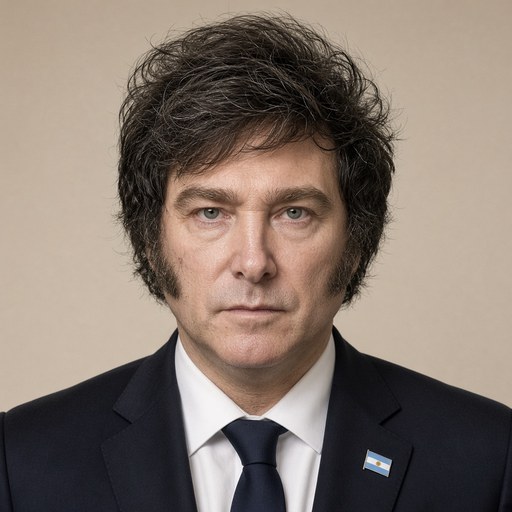
Speech by President Javier Milei at the ExpoEFI Argentina 2025
 Javier Milei · President of Argentina
- Context
- Milei addressed the ExpoEFI Argentina 2025 conference on April 30, 2025, presenting Argentina's economic stabilization achievements and outlining the path toward growth.
- Main themes
- Economic growth, fiscal adjustment, inflation stabilization, fiscal deficit reduction, monetary policy reform, Argentine economic crisis, Central Bank balance sheet cleanup, history of Argentine economic crises, government economic program
- Duration
- ~98 min
- Words
- 11,700
- Sentences
- 477
- Readability
- 58
- Grade
- 11.1
- Syntax
- 3.13
- Vocabulary
- 2.05
Translated from Spanish
The broad sphere of national life a sentence belongs to. Every sentence has an Arena, so it is the denominator the other indices are read against.
Other477 sentences in 55 paragraphs
Good morning. Thank you very much to the authorities of Congress for allowing me this opportunity to be with you. Today's talk is about economic growth. In other words, it is time for economic growth. We have completed the stabilization phase. This does not mean that things are perfect, but we have indeed concluded the stabilization. Specifically, when we arrived, we were on the brink of the biggest crisis in Argentine history, as we combined, on one hand, the monetary imbalance prior to the Rodrigazo; in fact, the money overhang was double what we had before the Rodrigazo. For those who are younger, the Rodrigazo occurred in 1975, after years of price controls, fiscal deficits, monetary issuance, all kinds of controls. And one day a man named Celestino Rodrigo came along and had no choice but to liberalize, devalue, and that led to an acceleration of the inflation rate by 6 times, going from 30% to 180%, and the number of poor people multiplied by five; it went from 5 to 25. We also combined - in this inheritance we received - a Central Bank imbalance three times worse than what existed before the hyperinflation of Alfonsín in 1989, an episode that ended with wholesale inflation around 5,000%.
Specifically, we had four monetary bases maturing in one day, and therefore - in the face of any complicated event - the amount of money could have quintupled in one day, which was also fuel for hyperinflation. And as if that were not enough, we had social indicators worse than those of 2001. Therefore, we faced the worst economic crisis in history, and that is why I always have great gratitude for the entire Government team, for the courage to accompany me in this truly heroic endeavor and - especially - to the one who sat in the worst of electric chairs, the best Minister of Economy in all of history, Luis “Toto” Caputo.
From there, we, with “Toto,” with whom I sincerely have a symbiotic relationship - basically - shared the diagnosis that while inflation is always and everywhere a monetary phenomenon, the origin of that issuance was due to the fiscal deficit. Probably, one of the most impressive talks was the first talk that “Toto” gave at the beginning of the Government, when he announced the characteristics of the program and showed how - in reality - the whole problem was fiscal. The regulations come from the fiscal problem; all the issues of the Argentine framework are the result of not wanting to correct the true cause of the problem, which is the fiscal deficit, basically putting patches elsewhere. That is to say, fiscal deficit financed with monetary issuance. So, it generated inflation. What did they do? Price controls. Shortages appeared; Supply Law. Reserves began to dwindle; capital controls were imposed. The central axis is always fiscal balance. In fact, there is a memorable graph that the professor Espert, president of the Budget and Finance Commission of Congress, who fights so hard against the orcs and is present; thank you, professor, for being here, used for a long time.
The professor showed - for example - the Argentine crises; the Rodrigazo exploded with a fiscal deficit of 14 points of GDP; the exchange rate table with 11; Alfonsín's hyperinflation with 8, convertibility with 7. Well, we inherited a fiscal deficit of 15 points of GDP: 5 in the Treasury and 10 in the Central Bank. And, in that context, we revved up the chainsaw and initiated the largest fiscal adjustment not only in Argentine history but in the history of humanity. While they said it was impossible to make an adjustment of 1 point of GDP, we managed to make a fiscal adjustment that, in fact, at the beginning was 7 points of GDP, then the allocations were rearranged, and it ended up being 5 points of GDP. And - after 123 years of always having a fiscal deficit - it was the first year we had fiscal balance in a year, and we achieved it in just one month. But also, as “Toto” recently brilliantly explained, that was not enough. That is to say, we could have made the fiscal adjustment and still fallen into hyperinflation due to the situation we had in the monetary market. And that is when what is called stage 2 of the program began, which is when we started to clean up the balance sheet of the Central Bank, and in 6 months, thanks not only to “Toto's” work but to the enormous work of Santiago Bausili and his entire team, in coordination with Pablo Quirno, they managed to eliminate the quasi-fiscal deficit in Argentina in 6 months. Therefore, we made an adjustment of 15 points of GDP in 6 months; that is indeed something for the Guinness World Records.
And from there, the inflation rate, and I usually talk about wholesale inflation because it did not have the strong contamination of the relative price problem as a consequence of the price suppression that the previous cave government did, and the inflation, which was at 54%, ended the year around 1%; the last wholesale figure was 1.5%, which still had the crawling peg of 1%, so one could say it is an inflation of 0.5% monthly. This means that inflation went from traveling at levels of 17,000% annually to 6% annually. That is indeed a miracle as well.
And that, moreover, was done without expropriations, that is to say, we avoided hyperinflation, which makes stabilization programs simpler because everything gets liquefied and it becomes easier; we, precisely, what we tried to avoid was that, since that was what they left us planted so that, with all the machinery of Peronism, by December we would no longer be here, by the end of December, when the holidays arrived. But not only that, but also, it was done without expropriating. For example, we did not implement a Bonex Plan. Everything we did to restore the balance of the Central Bank was done respecting property rights. Not only that, but there were also no price controls; the exchange rate was not fixed, and despite that, the speed at which inflation fell was much faster than what was achieved in the case of convertibility when you look at it in dollars.
But, of course - when we started to stabilize - first, it was that we were not lowering inflation… Ah, and we also did it by recomposing relative prices, in a context where tariffs only covered 20% of the cost or the aberration we had in the Central Bank, that we only had… just from the SIRAs we had more than 40 billion dollars in debt, so we were on the brink of an external commercial collapse; an internal financial collapse, and moreover, only 15% of imports were being paid. And, in that context, first, they said we would not be able to lower inflation in the first months from 30 to 20%; then that we would not be able to lower it from 8; then that we could not lower it from 4; then that we could not lower it from 2. And the reality is that - when one starts to look at the data from the last year - cleaning it from the effect of the crawling peg, it was an inflation that was traveling at 1.5. There is a special chapter on what happened in March; not only because of the issue of seasonality, which in fact in González Rozada's estimation shows that that 3.7 corrected for seasonalities is 2.6. But I am not here to complain, but the most serious problem was that stupidity of a law, that the idiot, incapable, and underqualified Guzmán passed, which forces having to pass a program from the International Monetary Fund through Congress. That is to say, the place where the fiscal degenerates are.
Look, I am going to tell you something that happened to me when I was a deputy, and it is an interesting anecdote because it includes both Professor Espert and me. Let's see, the Budget when you have… the democratic construction is no taxation without representation. So - consequently - the Budget has to enter through the Chamber of Deputies, because they are the representatives of the people, let’s suppose. I don’t know why he is laughing. Well, but follow my argument. You see? Then I talk about the republican nerds and I am right, if I just said this and they laughed at me. So, it is interesting because it is the initiating chamber of the Budget, because - deep down - money has to be forcibly taken from the taxpayer to finance public spending. That is to say, it is the place where budgetary restraint should be breathed, and Argentina has had 123 consecutive years of fiscal deficit, so they should be breathing with scuba masks, I don’t know. But beyond that, it is interesting because when you are there and a project is being presented and a law is discussed, we were assigned time, we were assigned time; I am now in another power, but we were assigned time. And this is very interesting because - except for José Luis (Espert) and me - every Deputy who was assigned, I don’t know, 5 minutes, spoke for 10; if they were given 10, they spoke for 20; if they were given 15, they spoke for 30. That is to say, how could one expect them to comply with budgetary restraint if they could not even comply with the Budget restraint, which implied complying with the amount of time to speak…
Imagine - if on top of that - they cannot draw a zero, not even with a glass, of course, that is why we systematically had fiscal deficits and the disasters we had. Now - once inflation started to go down - what did the beasts with Keynesian genes tell us? That we were going to fall into a great depression. The truth is that adjustments of half the size generated GDP drops of 15%, so they had something to say, I am not going to get… imagine that when you are in the electric chair pragmatism has a significant dose, you do not stop looking at the other side of the library. That said, then they said that - when the economy started to rebound around April, they began to say that this was going to be an L and that we were going to stabilize, but that the level of activity was going to remain fixed there. But it turns out that activity began to grow, the seasonally adjusted figures began to show positive rates. So, they started to say that we were going to have a Nike swoosh, but very soft. Then it was the Nike swoosh; then they began to understand that it was indeed a V or - as I said - we are going to rise like a scuba diver's fart and we ended up having a tilde.
And that is indeed the case. When one takes the seasonally adjusted EMAE, it ended 6 points above the level of December of the previous year. So, not only did we make the largest adjustment in history, but it also ended up being expansive. You bet this man “Toto” Caputo deserves a round of applause.
And then they started to cry to us about the social issue, and they said that we did not have a heart, what do I know, about those things they say. And the reality is that - for the past 11 months - real wages have not stopped rising; the unemployment rate did not increase, and, between the work done from macroeconomics, the enormous work of Sandra Pettovello cutting off the scam to the managers of poverty, and with Patricia Bullrich maintaining order on the streets, that improvement in activity, improvement in employment, improvement in real wages made poverty - measured in monthly frequency - which is also in González-Rozada's work, the methodologies are all similar, they only change in the temporal frequency they are measured, and that number, which - when we made the economy honest - jumped to 57%, is now at 35%. This means that poverty fell by 22 percentage points. That is to say that the heartless liberals who do not care about people lifted 10 million human beings out of poverty, something that had never happened in Argentine history with such strength and in such a short time.
Finally, in light of so many achievements - they always had something to criticize - and the sanateros of the delayed real exchange rate started; it seems they did not understand that the logic of the model had changed, that we were working and there were those who said: “I have seen this before.” No, you have not seen a damn thing, literally. Basically because you have never seen fiscal balance, you have never seen a fixed monetary base. So it was: “no, well, but why don’t you open up?” Well, there was a problem of stocks; and we said that as soon as we could solve the stock problem, we would open the capital controls. Moreover, we had said that - in any case - the capital controls would end on December 31, the 25th.
So, obviously, the political misery and incompetence of a large part of the local economists said that we were not going to lift the restrictions in an election year; that we were going to wait for the elections to pass. And, as a result of the damn Guzmán Law, we announced on March 1 that we were going to make a program with the Fund, that we were going to clean up the balance of the Central Bank, something we had been working on since August/September of the previous year, when we began to see that the economy was not going to have monetary input and, in that context, when we announced, on March 1, that we were going to reach an agreement with the Fund and that it had to go through Congress; something that had never happened in history because that restriction was not there before, until Guzmán imposed it. Therefore, all those who made agreements with the Fund without that restriction and who complained about the way we masterfully handled the politics, and who hurt because everyone expected that we would not be able to pass it through Congress, began to cry - as always - the republican crybabies; who, by the way, I honestly do not care about their feelings, I play within the law, I am a Bilardista and within the field, everything is allowed, everything that the regulations permit… was it allowed in the regulations? Yes, well, let them go look for it, it’s inside. And then, all the doomsayers began to say that the exchange rate was lagging and that this had to soar through the clouds and all that mountain of nonsense and, during March and mid-April, we had a confidentiality agreement with the Fund and we could not talk, and while we remained silent, while the idiots in the media said that we were not talking because we were scared. But we did not talk because we could not release information. And that, all the enemies of the Argentines, because it is no longer a problem of being enemies of the Government, but they are the enemies of the Argentines, those who have profited over the last hundred years with this impoverishing model, whether they are patronage-seeking businessmen, corrupt politicians, bribed journalists, union bosses, or professionals functional to this group of sons of bitches who ruined the country.
And, in that context, they predicted the worst of results when we wanted to open up, they said that this was a symptom that we were acknowledging the problem of the lagging exchange rate… And we opened up, and, nothing, the laboratories that sell Adermicina are happy with so much pain in the monkeys. So… it’s incredible that there are still some who talk about a lagging exchange rate, in a context where the exchange rate is free. Not only was the apocalyptic scenario that it would break 1,400 and go who knows where not given… the truth is that it is getting closer to the lower band. And as time goes by and we continue to have a fiscal surplus and take pesos out of circulation and when we make the placement of the BOPREAL and take out more pesos and when the dollars from abroad start to come in… Oh, how it will hurt them. But, all this and it’s like I made a catharsis, and now the reality is that from now on, the only note - in the margin - that I will add is, well, but you could tell me: “inflation is still high.” Yes, it is still high. But I want to tell you that inflation - by the middle of next year - will end. And, basically, it is because monetary policy acts with a lag that ranges from 18 to 24 months. We fixed the amount of money in the middle of last year. That means that inflation has a date of death, and it is in the middle of next year. So now is the time to start thinking about growth.
So, before we start talking about economic growth, there are two reflections that - for the talk, for me - are very important: one that has to do with crises, which is a phrase from Murray Newton Rothbard, the inventor of anarcho-capitalism, because this is central, this is central, and he says: “The crisis is not economic but ethical. Although its manifestation is material, its root is spiritual; we are immersed in a despicable philosophy, a philosophy that puts the individual at the service of the State, exposed to the shadow of coercion.” This is not a minor issue, you know that we are in an election year; yesterday we had a great rodeo festival in two places, because that giant I have as Chief of Staff, a great coordinating minister and who is the great responsible for the acceleration that the reform took in the second half of last year, and that makes this Government travel at a stellar speed. We recently celebrated 500 days of Government, with how many structural reforms? 2,000. We are the most reformist Government in history. We made a structural reform 8 times larger than the one Menem made, only if we take DNU 70/23 and the Base Law. But - in the year - we also included 900 more deregulations, we have already reached 2,000 structural reforms and, in addition, we have lowered the inflation rate faster than in Menem’s Government, therefore, whether our detractors like it or not, this is the best Government in Argentine history.
And why do I cite Rothbard and the issue of why the crisis is ethical in nature? The best example is the restrictions. You know me: for years I have been a liberal-libertarian, and that has not changed one bit. And, in that sense, the restrictions are a monstrous tool because - basically - what it does is not allow you to choose how you want to save, which not only has negative effects on the present but also has negative effects on the future. That is to say, it produces enormous intertemporal damage, where basically, you, with the restrictions… think of someone who, in December 2001, had 1,000 dollars and 1,000 pesos, if they had stayed with 1,000 pesos - today - they would have one dollar (if we were at the floor of the band, which we believe we will reach at some point, if not a little less). But clearly, it would have gone very badly for them. So - in that context - that generates a big problem, it generates a big problem also of macroeconomic discoordination because when you set a price generating excess demand, the counterpart is an excess supply, in the rest of the system. That is, the excess demand for foreign currency implies an excess supply of bonds. That is to say, low bond prices and high interest rates, therefore excess supply in the goods market, so the economy does not grow, it stagnates. So, that generates an excess supply in the labor market; wages are destroyed; you have more poor people, more indigents and, consequently, the State thinks it has to intervene and spend more, which creates a vicious circle.
But, in addition, it has another immorality. You end up having more money than you want to have, the famous “money-overhang” and that means that it is a tax increase, where you are increasing the tax base of the inflation tax, a total immorality, a robbery, a scam. And the reality is that we - as liberals - could not allow that, but we also could not be so irresponsible as to let the issue of stocks explode. And in that context, we had done the math and the reality is that, with 12 billion dollars, we could get out, so I said: “that if I got 15 billion dollars I would open up.” And then they started to say: “that we were not going to open up because it was an election year, that we were not going to take risks, that we were not going to accept paying the cost of exchange rate freedom” and the package ended up being a package of 42 billion dollars; if you want to add the early renewal of the Swap with China, it’s even more. But we had 20,000 cash and, contrary to what the econochantas and politicians said, we opened the restrictions because freedom is not negotiable; we got the stock; we cleaned up the Central Bank and we opened because the policy - in this Government - is guided by ethics, it is guided by moral values and that - inevitably - will generate a better Argentina.
But - now - it is time for growth and I would like to share some stylized facts about growth so that - more or less - you can understand or assimilate the way in which we think about these issues. When one studies the growth books, the vast majority of them start with something that those of us who are used to the literature call: ‘The hockey stick’. It is a series of per capita GDP, from the year zero of the Christian era until the year 2000, where basically you see that until the year 1800 it is a straight line and, suddenly, it takes a turn and starts to accelerate. In fact, if you want to break down the GDP, in all that period it multiplied per capita by 13.8 times. However, in the span from the year 1 to 1800, it only increased by 50%. That is to say, it multiplied by 1.5. And all of it concentrated after the discovery of America. While when you look at what happened between the year 1800 and the year 2000, it multiplied by 9.2 times. That is to say, we are living in a moment that is the best moment in the history of humanity. I don’t know where the leftists see that this is the end of capitalism, truly these kids use one that is really good.
You did well yesterday, Manuel, when you said that if a leftist insults you and calls you a “ñoqui” it is a compliment and when you said that you didn’t even want to listen to the other leftist, the truth is that… and also, thank you for so much rodeo, thank you, Manuel. Don’t laugh because it’s not just the ridiculous leftists; there are others who share a program with the Nazi Biondini, who self-identifies as a Nazi and wants to persecute people on social media. The worst of all is that there are other spaces that propose the same thing and would not assimilate them that way or people who want to go for Universal Basic Income, which is something very, very socialist; or people who want to put controls on the interest rate and subsidize it, while saying that the size of the State should not be touched, in a State that has quadrupled. Let’s talk about other things better.
What is interesting? What happened with the growth rate in that period. In the period between the year zero and 1800, the world economy grew the per capita GDP at a rate of 0.02%. That is to say, to double the per capita GDP it took 3,500 years. Between the year 1800 and 1900, it jumped to 0.65%. That is to say that we went from needing 3500 years to needing 107 years to double the per capita GDP. If we take the first half of the 20th century, the growth rate jumped to 1.1% and it took 66 years to double the per capita GDP, and if you take the second half of the 20th century, the rate is 2.1%, which means it took 33 years. If you take the latest numbers, we are at 20-something years. So, what do you see? The growth rate is also accelerating. That is to say: the hockey stick is becoming steeper and steeper. The consequence, the counterpart of this is that, while in the year 1800 there were about 1 billion human beings living (a number that was reached exactly in the year 1810, the day of the May Revolution, which had a few anarchists inside, so there’s a reason we love the May celebration so much), 95% of the population lived in extreme poverty. That is to say, with less than 1 dollar a day.
If you looked at the data in 2020, before the disaster of the pandemic, that number had fallen to 5%. Moreover, that number is constantly being adjusted to modify the figure because it has become almost irrelevant, that is to say, that free enterprise capitalism - despite all the attacks made by all the States in the world - has managed to lift 90% of the population out of extreme poverty.
Now, faced with such evidence, for those who are familiar with the microfoundations - what you will see is that this behavior of production, and if you take it in terms of the increasing population, that means that there are what are called: “increasing returns.” That is to say, for each unit of labor that increases, production rises more than proportionally and there is a problem that economic theory does not get along well with the issue of increasing returns. And that is something that is very important to understand the logic of how we think about the problems of economic growth.
I am not going to bother you with the entire history of economic growth theory, I will work with very basic models that you can access and know. But if one thinks about the modern theory of economic growth, in the neoclassical approach, the first article in that family is that of Solow and, in parallel, that of Trevor Swan, which is known as the Solow-Swan Model, and that in 1957, Robert Solow went and tested it. Basically, the problem is that this model explained only 15%. That is to say, a model that only explained the evolution of per capita GDP with the accumulation of per capita capital stock explained only 15%. So, to put it another way, empirically it was quite poor. Obviously, various ways were attempted to fix this problem but one of the most interesting criticisms that appeared was the criticism from the director of the Department of Economics at Chicago at that time, who was George Stigler, who told him: “your problem is that you did not incorporate human capital.” In that sense, two lines of human capital were born inside the University of Chicago: one is the microeconomics line, which was developed by Gary Becker. And the other, very important for all of us, is the line - in terms of economic growth - that was developed by Hirofumi Uzawa, and who was the tutor of, without a doubt, one of the greatest economists in the history of Argentina, who was Miguel Sidrauski.
However, when the profession decided to take a path, it chose not to go that way and decided to adopt the idea of placing technological progress in an exogenous manner. Thus, all growth within the model was explained by hand, which means that it is not a model. This obscurantist relationship found light back in 1983 when Paul Romer, in his doctoral thesis, developed the first endogenous growth model based on human capital, whose thesis advisor was Robert Lucas, who was basically following the works of Uzawa; and thus the theory of endogenous growth emerged, where the hypothesis with human capital gained greater relevance. A very strong debate began during the late 80s and throughout the 90s until the year 2000. And in all that debate, Gregory Mankiw, David Romer, not Paul Romer, David Romer, and David Weil proceeded to empirically test that model. That model shows that when they incorporate human capital, the model explains 85% instead of 15%, meaning that 70 percentage points of the explanation for economic growth is human capital. Therefore, one of the very relevant things within our policy is human capital. So much so that I am not saying this now because the time to grow has arrived; it is such that today we are admired around the world, and Sandra Pettovello, from the Ministry of Human Capital, is traveling the world explaining the Argentine case; we already saw it the day we arrived.
In fact, in Human Capital, we made a very interesting partition, which is that the Ministry was divided into four units, if you will. One is Childhood and Family, basically to catch them when they arrive because if the child does not develop their intellectual capacity when they are young, it becomes very difficult to work later. So, we increased the Universal Child Allowance; we increased the Food Card. Moreover, in the first phase, we were able to double it without spending an extra peso, and that was when they came at us and staged the first march, and that is when Dr. Bullrich implemented the Anti-Blockade Protocol that was not approved in her previous administration, and from that point on, we took back the streets from the criminals, and Argentina is a country without blockades.
The other area is health because you can feed them, but if people get sick, they cannot study either. So, we must ensure first-generation human capital. Obviously, the other part relates to education and retraining. Education is for those entering the educational system, and retraining is for those who have been left out of the system and have the will to return. And that area is linked to work, and that is where all the labor flexibility issues come in; there is a part in decree 70/23; we continue to advance in making reforms in the labor market to provide more flexibility and achieve that 40% in the informal sector moves to the formal sector, and once the labor market has the appropriate format, only then can we start to think about the solution to the pension problem. The rest is demagoguery.
On the other hand, we also launched a new Literacy Plan. But the issue of human capital, we have been addressing it from day one. Another issue that is extremely important to us is economic freedom. And what do you see? That those countries that are freer grow at a speed that is double that of repressed countries; not only that, those countries that are freer have a per capita GDP 12 times greater than that of repressed countries; and they have 25 times fewer poor people in the standard format and 50 times fewer in the extreme format. Therefore, all reforms that make the economy free will mean that as we advance in economic freedom, we will have a higher per capita GDP. And basically, I had pointed out the issue of reforms: the DNU 70/23 which includes 300 reforms; the Bases Law, 500. There you already had 800, and with that, you were already 8 times larger than what Menem had done. But, in addition, we included 900 more in the second half of the year, meaning we ended the year with 1,700 reforms.
It is important because, recently, the people from the Heritage Foundation, who calculate the index of economic freedom, came to congratulate us because no country had ever made such a significant leap in terms of economic freedom. And what was most interesting about all this? That it only considered the first half of 2024. That is to say, the reforms implied by the Bases Law and the 900 deregulations made by Dr. Sturzenegger are not yet included. Therefore, we will not yield; we will not stop until Argentina is the freest country in the world. I will tell you a very interesting anecdote, which shows the reformist spirit of this Government and how wonderful it is to work with the team I have, because they work together, it is truly a pleasure. But there is something very interesting; in the first half of January, I told them to take vacations and return for the second half of January, when we would go back to work. As you know, I like to work from Olivos because it saves me from traveling, and I get up at six in the morning, seven, coffee in hand, and I work until ten, twelve at night, so… Yes, I walk around in a jumpsuit because if I have a moment, I will go see my four-legged children Conan, Murray, Milton, Robert, and Lucas Junior, but aside from that, Federico Sturzenegger writes to me, and he says, “No, no, I have to talk because I am very worried.”
Well, then Federico comes to Olivos, and he says to me, “I am having a problem; the reforms are coming out very slowly. The reforms are coming out very slowly; I feel bad; this has to go faster.” Imagine that I read all of Federico's tweets every morning, and it is aaaah, it is like that all the time. So, I felt bad because I thought: in the end, I am a fool; I am getting happy with little. So he suggests making some modifications to the legal structure so that the reforms could advance more quickly, to give more to that brilliant, extraordinary woman who is María Irrazábal, who is the legal brain behind all the reforms, and he says: “No, give her more resources,” because she also has political clout when it comes to making laws, so she is a person of great talent; María is to our government what Liendo was to Cavallo, so you can visualize it. So, I start to look at everything… now, I grab and ask for a recount of what we were doing. Does anyone dare to think how many reforms Federico had implemented in just half a month? Because we were doing poorly, according to Federico, 65, that is, the equivalent of 130 monthly reforms. We are talking about 1,560 annually. That is what I want you to see. This is the most reformist government in history, and we will not stop until we are the freest country in the world. But the issue does not end there; there is another topic, now comes the part, if you will, rougher or harder in terms of economic theory, which is… I have already talked about the role of human capital; I talked about the role of economic freedom… Obviously, within economic freedom, there is a chapter that has to do with openness. That is to say, there you have three pillars.
By the way, from a huge job that Manuel Adorni did, the tamer of Abasto, because let’s say the City Canal, the one that should be closed, is in Abasto; I was a neighbor there… One of the things we did, we had a very ambitious Government program, and everyone said it was impossible. And one of the things that started to happen when we looked at social media, people said: “This is more than what I voted for.” So, we said: “Well, let’s test how we are doing.” And the reality is that Manuel started to gather information on what we had promised and what we were doing. Everyone said that what we were going to do was impossible, so if we had not fulfilled anything, we would be in line with any politician, but if we did it – linearly – we should have fulfilled at least 25% of the campaign promises. Well, we ended the year fulfilling 97% of the campaign promises, and since we have already lifted the currency controls and there is competition among currencies, we have done everything we promised. So, it is the first time in history that in less than a year and a half, you have a Government that is absolutely demanding with the goals that everyone said were impossible, and we have already fulfilled them all. That is to say, we are dedicated to making possible what everyone says is impossible.
And now I will go to the core of growth, which is the less traditional part and with which we are traveling around the world explaining to everyone the core of Argentine growth. Basically, there are some indications of this in my recent book called “Capitalism, Socialism, and the Neoclassical Trap.” And it is the issue of the role of increasing returns, but to understand the problem of increasing returns, one must understand the nature of neoclassical economics. Now, if I look at the increasing returns that, for those who know about general equilibrium, the literature calls “non-convexities,” concentrated market structures, up to monopolies. In that context - according to neoclassical theory - unconcentrated structures or monopolies are bad, and someone can explain to me why if - in the last 250 years - we went from extreme poverty of 95% to 5% in a world that multiplied its population by almost 10 times. Can someone explain to me why that is bad? Today, an average citizen of a reasonable country lives better than any emperor did.
Can someone explain to me why that is bad? Why are economists so arrogant that - when the model does not map with reality - we call it a market failure? No, it is not a market failure; it is a problem with the model that is garbage. So, now where do we get that some of these things are bad, and there, as could not be otherwise, it comes from someone who was a bit leftist, named Wilfredo Pareto, so… that is to say, when in the equilibrium problem, we originally studied whether it exists, whether it is unique, and whether it is stable… up to that point, things were not so skewed. The problem is when we wanted to introduce the Pareto Optimality, the Pareto efficiency. We had to choose between “the pin factory,” that is, increasing returns, or the invisible hand, and then we opted for a mathematical view of the invisible hand that involved throwing increasing returns out the window, and it turns out that the economy that supposedly was born with Adam Smith, I mean, there are some reflections from Xenophon that are worth renting balconies, but, I mean, that is…, and they are from 350 years before Christ, but it does not matter, what I mean is that we threw “the pin factory” out the window, we threw increasing returns out the window, and we cannot explain economic growth, and supposedly Adam Smith's book, what is it called? An Inquiry into the Nature and Causes of the Wealth of Nations, and what it tries to explain is economic growth. That is to say, due to a matter of misinterpreted mathematical priceism, we are left without explaining economic growth. Because if you have constant returns to scale, you cannot explain economic growth. And that is because of the damn Pareto Optimality. So, it is important that we understand well what the Pareto Optimality is. The Pareto Optimality is a situation where it is not possible to generate any type of improvement without harming another individual. That is to say, when is there a Pareto improvement? A Pareto improvement is when you can improve someone without screwing anyone's life. So, you do it, and that is a Pareto improvement, and when those possibilities for welfare gain are exhausted, you are already at the Pareto Optimality. That is to say, those possibilities are exhausted.
But there is another more complicated part; it is as if you were inside the production possibility frontier, and then, how do we get to the frontier? But there is also another discussion that is along the frontier, and that any allocation at any point on the frontier, that point is Pareto optimal; hence the two theories more of welfare economics. The first says: “that every competitive equilibrium is Pareto optimal,” there is a whole discussion about how we define free competition; you can imagine that as an adherent to the Austrian School of Economics, that term does not sit well with me, but I do not care because we are discussing different things, not so much, but well. But the second theorem is worse. The second theorem is aberrant and says: “that it is independent of the distribution of income,” that is to say, you can achieve Pareto optimality regardless of the distribution of income; that sounds very nice, but it is a tremendous mistake. If you have to define an economy, when you study general equilibrium, you study Brett. So, how does Brett define an economy? Then he defines an economy of private property; what does it have? He says: E={U, that is, the utility function, the preference; T, to reflect technology, has Ω, to represent initial endowments, and Pi=1; that is, the benefits remain entirely in the private sector.
According to this, it is independent of the distribution, and then by the theorem of the second welfare theorem, I can throw Pi out the window, it doesn't matter to me. And I am left only with preferences, technologies, and endowments. Do you realize the nonsense I am saying? Does no one realize, does no one stand up and say: “damn it, you leftist piece of trash”? I mean, are you going to tell me that living under capitalism is the same as living in real socialism? Let me tell you that - in 1989 - the Wall fell and it was a failure economically, socially, culturally; they killed 150 million people. It is not the same. It is wrong. It is false. Why? Because socialism is impossible. The second welfare theorem is nonsense, it is wrong. Basically, why is socialism impossible? Well, for a simple reason: without private property, there is no economic calculation. You exchange goods and, at the moment you exchanged the goods, let’s suppose there is money, then we can discuss what money is, what does that do? It marks a price. I give you my glasses in exchange for X amount of money. So, you take that, it becomes a mechanism for transmitting information, it coordinates: some will be buyers; others will be sellers, and it generates an adjustment, because if supply and demand do not match, the price will vary. If you do not have private property, you do not mark the price; if you do not mark the price, the system is adrift. That is why, in socialism, it would be the same to build a road or a bridge of gold, crystal, or cement, since there is no price, someone else pays anyway.
That is why part of what the communist spies did was send people to see what the prices were. The other is impossible because knowledge is dispersed, this is what Hayek said about the use of information in society. Knowledge is dispersed and the only mechanism that humanity invented, which must be one of the most wonderful inventions that humanity has had and that no one invented because it was created by spontaneous order, was the price system, where each one with their willingness to buy or sell transmits information. And for that, it does not need to be anything decentralized; it does not need a centralized organism to do that. In fact, no one can do that. And there also appears the argument made by Israel Kirzner and Jesús Huerta de Soto, about the impossibility of socialism and the role of information that must be created and discovered in this whole process.
If I have a company A, which produces a certain good and has waste; well, it wants to get rid of the waste, it will have to pay to get rid of the waste. But it happens that there is a company B, which produces another product, that needs - as an input - the waste from the other. So a guy can appear in the middle who says: “wait, wait, I can pay this one to take the input and sell it to the other and in the middle I make money,” that is, he discovered a business opportunity and was applying it. Consequently, there I have a gain in welfare, but that can only happen if there are prices; if there are no prices and if I want to engage in that activity, they will steal the results from me, it will not happen. So the coercion that the State generates makes that impossible. That is why socialism always generates misery, because it does not have the coordinating role of the price system and, moreover, it breaks any intention to do something; aside from the fact that there is an incentive problem that if the one who works well gets the same as the one who does nothing, then why would they work?
So, you have static problems and dynamic problems. That is, the first is how do you collect all that information. Let’s suppose you invent the mega-computer, that it could do it, even then you will not be able to do it. Do you know why? Because much of the information you need to act is tacit, it has to do with know-how. The other day, in a talk, I made a joke with my friend Mike Boggiano, I said: “Well, I call Michael Jordan, I tell him to tell me how he makes the ball go through the hoop.” Nothing, no matter how well Michael Jordan could make it go in, which I doubt he could do, but if he did, Mike cannot do it, he does not measure 1.98, imagine if we ask Shaquille O’Neal, who measures 2.30, even less. So, that makes it impossible. But one more thing, the market is a process of discovery and as it is a process of discovery, the information you need to act is information that is created at the very moment you are acting; however, that information can never arrive in time and form to the control body that needs that information to solve the allocation problem. Therefore, it will never arrive in time and form. When the information arrives and decisions are made, they are always wrong; it could only work by chance.
Not only that, but also how did people survive under real socialism? By making transactions in the illegal market, in parallel markets. That is, the only way socialism had for people not to starve was to allow people to evade controls, that is, it is an oxymoron. That is, for them to function, they had to stop doing controls, that is, they are contradictions in their terms and they do not realize it. Notice that the first year, I mean, when you start the year, they have to put a year, for example, “this year is the Year of Reconstruction.” But last year, what did we call it? “The year of Life, Liberty, and Property,” that is, we were precisely thinking about this so that the economy would start to grow. Hence, I have repeated - to the point of exhaustion - the definition of liberalism by Alberto Benegas Lynch (h): “Liberalism is the unrestricted respect for the life project of others, based on the principle of non-aggression and in defense of the right to life, liberty, and property.” Notice that this shows something about how the system should function and that when we get to the auction…, I am close, believe me I am not that far, you will see that it will make total sense. And in that regard, when we start to compare the damn Pareto Optimal against what happens in reality and when reality gives something else we call it: “market failure”; and there are four market failures: which are basically non-convexities, that is, monopolies; externalities; public goods and information failures that, on the one hand, we have all the work of Contract Theory, with problems of adverse selection, moral hazard, and signaling or coordination failures. That is, it is basically a problem of game theory. Did anyone realize what the prisoner’s dilemma is? Why does the prisoner’s dilemma work? Who blocks the information? The captors. That is, coordination failures, in the economy, are the result of the existence of the State blocking communication between agents. The State is always the problem, never the solution. That is why we have reduced the size of the State by 30% by making the adjustment we made, which mainly fell on the public sector. And that is what made the adjustment expansive.
But I am not going to get into each of the discussions about the so-called market failures. I will stick to the issue of non-convexities and the issue of technical progress. The first thing that will happen with the damn Pareto Optimal is that they cannot explain economic growth, they cannot explain technological progress. Let’s go and put ourselves in this situation: we stand at the end of the 19th century, and there was a group of happy people producing candles. Then a gentleman - named Thomas Alva Edison - came and invented the light bulb. How do you imagine the candle producers felt? Almost as hurt as the baboons. But they had something worse: I don’t know if they had Adermicina. That said, the first thing you have to understand is that this is not Pareto Optimal. I mean, technological progress is not Pareto Optimal, because one won and others lost. So, the question is: “hey, would you like to go back to the candle era for the fucking Pareto Optimal?” Aren’t we better off now with light, with air conditioning, all this, computers, phones, and everything we have today?
I think you are not hating the Pareto Optimal enough. I’m not saying it’s as bad as journalists, but the Pareto Optimal is bad. In that sense, there is a wonderful book called Economics in One Lesson, by Henry Hazlitt, the latest reprint of the book has my preface, where I tell what happened to me when I met the book, and it has a chapter called: ‘The Hatred of the Machine’, which basically mocks the Luddite fallacy, and which is basically a problem of equilibrium…, let’s say, Henry Hazlitt separates the first lesson, the lesson is… what is the difference between the good economist and the bad economist? The bad economist is the one who only looks at partial equilibrium, who only looks at one market and does not look at the consequences this has on other markets and the impacts in the future. I mean, he is a fool who makes a partial equilibrium model of a single period. There are plenty of those, don’t laugh. And on the other hand, then, the good economist is the one who looks not only at this market but also looks at the relationship with everything else and does not just look at this period, but also considers the impact on the future. That is, a guy who does intertemporal general equilibrium. So, the reality is: “No, well, but the machine is going to leave people unemployed.” That person who creates this technological progress, why does he do it? To make money.
Now, what does he do with the money he makes? Look, if he takes it and spends it, he will generate jobs where he is spending it. The alternative is that…, well, no, now he is not going to spend because he is a son of a bitch and he is going to save it. Imagine if he saves it, that finances investment elsewhere, which will generate growth and jobs elsewhere, in addition to more productivity. But let’s suppose he doesn’t, so if he consumes he does well; if he saves he does well; then he has to be more of a son of a bitch; he has to take that money and put it in the ground, he has to hide it in the earth. Well, they are taking money out of the economy, therefore, the price level goes down and it benefits everyone. That is, when you think in terms of general equilibrium, all these nonsense fall apart. But there is one, who the other day said: no, the minimum wage has to be 2 million pesos; idiot, why not make it from a green million? If it were that easy.
But the economy, then, tried to see how the hell to fix this problem. So, the first thing it did, well, let’s put a patch on the Solow model, then the first patch appeared, put by Edmund Phelps, called: “The Golden Rule.” So, he tried to find a maximization of consumption, it was a patch, like a patch, a patch does not fix the problem. Then they said: “no, well, the problem is that this model is not optimal,” that is, it was the problem of dynamic efficiency, let’s fix the problem of dynamic efficiency. When we want to fix the problem of dynamic efficiency, two authors, one Cass and the other Koopmans, separately; one in continuous, the other in discrete, start to review and find that - in 1928 - there was a kid named Frank Plumpton Ramsey, who had an excellent relationship with John Maynard Keynes, but not in the academic sense, extra-academic, I don’t know why you are laughing, bunch of machirulos. So, in that context, what happens? He had a model of optimal savings, so they rescue that model and it is what today - in the literature - is known as the Ramsey Model, it is not exactly because Ramsey had a problem of how to set the discount, he considered it immoral, there was a whole discussion there, but well, here it does not matter a damn, they needed to constrain the set, they put a rate of intertemporal preference discount greater than the population and constrained the utility function and they were able to solve the exercise.
Beyond that, of mathematical issues, what is the problem with this model? Well, yes, now it is optimal, everything, and what is the result? When it goes to the steady state, it collapses, the same result. Because what ends up dominating is the budget constraint, and the budget constraint is the production function. So, if you work with this neoclassical production function, which has constant returns to scale or diminishing marginal returns, you will have Pareto Optimal, it will allow you to achieve a maximum. But what is the problem? They cannot grow. Very nice for the Pareto optimality of the general equilibrium model, but we cannot explain economic growth. What do we do? Well, what we did was explore a work, which was what converted me to the Austrian School of Economics, called: "Monopoly and Competition," by Murray Newton Rothbard. And where basically what it says is: "Let’s see, monopolies are not bad, unless they are monopolies according to the original definition of Lord Coke, who said that a monopoly is when the monarch made sure that - within that place - only one type was sold, and if he did not do it, he executed anyone who wanted to compete.”
Fortunately, customs have changed over time and today, you could have a company, I mean, I don’t know, the mobile phone market, ten different companies, and one appears and makes a phone at a better price, with better quality, what do you think will happen to the other nine? They will go bankrupt. And you would say that this guy is a bad guy, he is bad because it’s a monopoly… why don’t you get angry with the nine that went bankrupt? Not with this one. This guy is a hero, he is a social benefactor. Because now you can have a phone of better quality or better price and on top of that, that money you save, you can spend on other goods. You live much better. Therefore, no jobs are lost, nothing is lost, and everyone lives better and has greater productivity. Therefore, monopolies are not bad. It is a problem in the minds of neoclassicals. Now, what is the problem? If I think in neoclassical terms, what will happen is that I will do what, when I see a monopoly: I will regulate it. And when you regulate it, you will regulate it so that, surely, based on capital or if you want to impose a price cap, let’s say, it always ends up collapsing because you have to map it with the capital base, which means you end up regulating based on capital. What does this mean? That it is a rule of average cost, and if you have a flat bottom in the average cost or it coincides with the marginal cost, consequently, that gives you a result that is, according to the literature, Pareto Optimal. And if you think in terms of contestable markets, and the average cost curve has a flat bottom, it doesn’t matter, it will also yield a Pareto Optimal, and if not, it will give you a second-best solution, which by the way, then, when you do that and regulate, what are you doing? You are making the competitive equilibrium assimilable and, therefore, you are assimilating it to a situation of constant returns to scale, and the day you assimilate it with constant returns to scale, you kill economic growth.
Do you want an example of this? The most regulated area in the world, Europe, is stagnant, it is not growing. Therefore, a central axis of our policy is deregulation, because - to the extent that we deregulate - we free up increasing returns. When we free up increasing returns, we start to grow, and that is the task that Federico Sturzenegger is carrying out and that is being admired by everyone; which is why Kristalina Georgieva incorporated him as an advisor to the International Monetary Fund to advance in all these matters, and it is a policy that is inspiring everyone. So, thanks to Toto and thanks to Federico, when my term ends I will be able to live peacefully, giving lectures.
And now yes, the last theoretical pill, and it is this issue of dynamic efficiency. I emphatically recommend reading either the original article or the book by Huerta de Soto. But there is a phrase that seems phenomenal to me, because dynamic efficiency is defined as that institutional arrangement that makes the production possibilities frontier expand as strongly as possible, that is, it shifts to the right, as God commands. But also, remember that I am a paleolibertarian, I am an anarcho-capitalist, who believes in God, that is, an anarchist, as God commands. But there is a phrase that seems fabulous to me, which is something incredible - I mean, it’s incredible - because if you understand this definition you may not know a thing about economics and make the economy go on the dynamically optimal path. And it says: “justice and efficiency are two sides of the same coin; what is just cannot be inefficient and what is efficient must always be just.” Notice that - at some point - I talked about how the policy in our government is guided by ethical and moral criteria. The general framework of that ethics and morality that this government carries out is the definition of liberalism given by Alberto Benegas Lynch (h). Therefore, I can put the economy on the dynamically optimal path, without knowing anything about economics, just by doing what is just, because what is just is efficient. That is, the only system that meets these characteristics is the system of free market capitalism.
There is a beautiful book called “Creativity, Capitalism, and Distributive Justice,” by an author named Israel Kirzner - with a z, not with a ch, please -. And one of the things that Israel Kirzner raises is something truly dazzling, for he says: “the capitalist system is labeled as unjust”; and he says “you know what? If the system is unjust, it is not worth defending. I don’t care if it is more productive, I don’t care if it is more efficient; if it is unjust, it cannot be defended. It is a giant with feet of clay and - therefore - does not deserve to be defended.” If I am defending these ideas with such fervor it is because the book progresses and using Locke’s principle of appropriation and Hayek’s idea of the market as a discovery process, plus everything I talked about before regarding entrepreneurship, all that conjunction demonstrates that the only system that is just is free enterprise capitalism. I emphasize: free enterprise capitalism, not crony capitalism and buddies of power.
Therefore, we return to Rothbard’s phrase: “the crisis is a problem of an ethical nature,” if we bring 100 years of moral decay it is obvious that this country was going to fall apart and the only thing that could get us out of all this is a revolution, which is not only economic, but is - essentially and above all - a moral revolution and that is why we are rising because we have lifted the values of the West again and that is why we are growing and we are going to become a world power, in 30 years.
And now yes, there is only this left, because it all seems very interesting, but…, come on, I need meat, I mean the skeleton is fine, but… Good. Why are we going to grow a lot? The last data showed 5.7% year-on-year, the seasonally adjusted 0.8%, that annualized says that we are traveling at a speed of 10%. The first quarter will be around 6%; the second at 8%; José Luis Daza himself says: “Argentina will be the country that grows the most in the region in the next 30 years.” Toto Caputo himself says, “we are going to stop talking about Chinese rates and we are going to talk about Argentine rates.” In fact, in the World Economic Outlook of the Fund, we are already second in the ranking. India comes first, then us. So, based on what do we say we are going to grow? Point one: fiscal adjustment. The fiscal adjustment of 15 points of GDP was 15 points of GDP of savings that the public sector was consuming and now it has been returned as income to Argentines, who can consume it or invest it. That, whether you like it or not, will generate greater expansion. When you save more, more is invested and more grows. The second point, which is not minor, is the issue of zero deficit.
The zero deficit means that you do not take on new debt… Rolling over debt is not taking on new debt, please, because if some Kirchnerist appears with an IQ below that of a primate “no, you are taking on debt.” So it’s like, sometimes, the discussion with those people is complicated.
Well, yesterday you had to deal with “Santongo”; Well, but he feels ashamed to be a Kirchnerist, how well you hit him there, “Manu.” Now, the flip side of this is that - then - if the economy does not grow or grows little, the debt-to-GDP ratio is then decreasing, if the debt-to-GDP ratio is non-increasing or saying that it remains constant or falls means that Argentina is solvent intertemporally; if Argentina is solvent intertemporally, inexorably, sooner or later the Country Risk must collapse, Argentina is one of the five countries in the world that have financial equilibrium, therefore, sooner or later, Argentina will be investment grade.
I make a clarification, because I see so many shortcomings in the topic of international monetary economics, of people who worry about the accumulation of reserves when there is a flexible exchange rate. I don’t know, the books I read didn’t bite. Besides, we recapitalized the Central Bank; we are going to go out to the markets, because the country risk is already below 700; we also have a put that the American government gave us. Can you really look for ghosts? Aside from that, I warn you that the fall of the Country Risk will lower the interest rate; when the interest rate falls, be careful that the countries that lower the interest rate, do you know what happens to the external accounts? Since internal equilibrium implies a higher interest rate, it generates a current account deficit. But since that current account deficit is generated by the private sector, it is a problem of the private sector and is resolved in the exchange market. Don’t be swayed by the “no, I saw it, the current account deficit…”. The problem of the current account deficit is if it is generated by the fiscal deficit; if it is a private problem, it is a problem between privates. Please, start to get rid of the chips of those idiots who sank this country. Or the others: “People are going on trips.” I mean, what do you want us to be a bunch of miserable people, who can’t even move from the house? What do we do in summer, put a basin of water to cool off? Yes, man, we are going to be rich and as part of that we are going to travel all over the world, yes. What’s the problem if I take it out of my pocket? Many laundered money and that money they laundered, which comes in as capital income, yes, they went and spent it, in another country on vacation. What’s the problem?
Please: try to identify the apes, well, no, the Planet of the Apes is smarter than these beasts. But beyond that, there is a wonderful work by Juan Pablo Nicolini that says: “the zero deficit guarantees me a per capita growth floor of 4%.” I can assure you that I am strongly committed to maintaining fiscal balance, in fact, in the face of the deterioration of external conditions, we only need 1.3% of primary surplus and I decided that we pass it to 1.6%; and to have a magnitude order, from what we are doing because there will be no shortage of the idiot who says: “no, but last year it was 1.7%.” First, if GDP expands and the interests are the same, it’s less money, but then in terms of GDP it’s less, but beyond that there is a data that they are not considering is that we removed 16 taxes; one of the taxes we removed was the Country Tax which is 1.5% of GDP, so we are going to an equivalent of last year of 3.1%; do you realize what happens, what happens is what we said, that to the extent that the economy grows we are going to lower taxes. The economy is growing, what do we do? We lower taxes, we are the first Government in history that lowered taxes.
But as Professor Juan Pablo Nicolini says, that work they did only contemplates fiscal balance. But that fiscal balance you could have achieved by raising taxes. We did it by cutting spending, therefore we have more to grow. And it also does not contemplate structural reforms. Therefore - I repeat it, and I will say it in Latin - the Argentine economy is going to rise like a diver’s fart. Not only that, but we are also going to end inflation, therefore the distortion of relative prices that killed economic growth will also disappear. In addition, we are planning to make a tax reform that generates competition among the different provinces, that is, that people start to vote with their feet. Look at how in the United States - for example - one was in California, went to Texas. Galperín did it too. So, basically we are going to generate fiscal competition. For example, we are going to collect our VAT - the national VAT -, the provincial one that the provinces sort themselves out, and let them compete. Do you want, let’s say, more investments? They will have to charge less taxes. Enough of the lack of fiscal correspondence. I mean, there will be fiscal correspondence now. Do you want to spend more? Charge taxes. And put the local and show it to your people. And that those taxes have a counterpart in spending. Because if not - probably - you end up in the bonfire. With luck.
So, and to all this we add what we are doing, in Human Capital, deregulation… until we become the freest country in the world. And also, an increase in economic openness. Consequently, dear ones: welcome to the New Argentina, because we are making Argentina great again. May God bless you, may the forces of heaven accompany us, and long live freedom, damn it!
The original Spanish. The tags above are read on the English translation's sentences.
Buenos días. Muchísimas gracias a las autoridades del Congreso por permitirme esta oportunidad de estar con ustedes. Y la charla de hoy es sobre crecimiento económico. Es decir, es la hora del crecimiento económico. Hemos concluido la etapa de la estabilización. Esto no quiere decir que las cosas estén perfectas, pero sí hemos concluido con la estabilización. Concretamente, cuando llegábamos, estábamos al borde de la crisis más grande de la historia argentina, pues combinábamos, por un lado, el desequilibrio monetario en la previa al Rodrigazo; de hecho, el money overhang era el doble que el que teníamos en la previa del Rodrigazo. Para los que son más jóvenes, el Rodrigazo ocurrió en 1975, luego de años de controles de precios, déficit fiscal, emisión monetaria, todo tipo de controles. Y, un día llegó un señor llamado Celestino Rodrigo y no le quedó otra que liberar, devaluar y eso implicó una aceleración de la tasa de inflación de 6 veces, pasó el 30% al 180% y la cantidad de pobres se multiplicó por cinco; pasó de 5 a 25. También combinamos -en esta herencia que recibimos- un desequilibrio en el Banco Central tres veces peor que lo que había en la previa de la hiperinflación de Alfonsín, en el año 1989, episodio que terminó con una inflación mayorista en orden al 5.000%.
Concretamente, nosotros teníamos cuatro bases monetarias venciendo en un día, y por lo tanto -ante algún evento complicado- se podría haber quintuplicado la cantidad de dinero en un día, lo cual también era combustible para una hiperinflación. Y, como si esto fuera poco, teníamos indicadores sociales peores que los del año 2001. Por lo tanto, teníamos enfrente la peor crisis económica de la historia y por eso siempre tengo un gran agradecimiento a todo el equipo de Gobierno, por el coraje de acompañarme en esta jugada verdaderamente heroica y -muy especialmente- a quien se sentó en la peor de las sillas eléctricas, el mejor Ministro de Economía de toda la historia, Luis “Toto” Caputo.
A partir de ahí, nosotros con “Toto”, con quien sinceramente, tenemos una relación simbiótica -básicamente- compartíamos el diagnóstico de que si bien la inflación es siempre y, en todo lugar, un fenómeno monetario, el origen de esa emisión estaba dada por el déficit fiscal. Probablemente, una de las charlas más impresionantes fue la primera charla que dio “Toto” al inicio del Gobierno, cuando anunciaba las características del programa y mostró cómo -en realidad- todo el problema era fiscal. Las regulaciones vienen del problema fiscal; todas las cuestiones del entramado argentino son fruto de que, al no querer corregir la verdadera causa del problema, que es el déficit fiscal, básicamente se ponían parches por otros lados. Es decir, déficit fiscal financiado con emisión monetaria. Entonces, generaba inflación. ¿Qué hacían? Controles de precios. Aparecía el desabastecimiento; Ley de Abastecimiento. Se empezaban a perder reservas; se ponían controles de capitales. Siempre el eje central es el equilibrio fiscal. De hecho, hay un gráfico memorable, que usó -durante mucho tiempo- el profe Espert, presidente de la Comisión de Presupuesto y Hacienda del Congreso que tanto lucha contra los orcos y que está presente; gracias, profesor, por estar acá.
El profe mostraba - por ejemplo - las crisis argentinas; el Rodrigazo estalló con un déficit fiscal de 14 puntos del PBI; la tablita cambiaria con 11; la hiper de Alfonsín con 8, la convertibilidad con 7. Bueno, nosotros heredamos un déficit fiscal de 15 puntos del PBI: 5 en el Tesoro y 10 en el Banco Central. Y, en ese contexto, prendimos la motosierra e iniciamos el ajuste fiscal más grande no sólo de la historia Argentina, sino de la humanidad. Mientras que decían que era imposible hacer un ajuste de 1 punto del PBI, nosotros logramos hacer un ajuste fiscal en rigor, al inicio fueron de 7 puntos del PBI, después se fueron reacomodando las partidas y terminó siendo de 5 puntos del PBI. Y -después de 123 años de tener siempre déficit fiscal- fue el primer año que tuvimos equilibrio fiscal en un año y lo logramos en un solo mes. Pero también como de manera brillante expuso recientemente “Toto”, eso no era suficiente. Es decir, podríamos haber hecho el ajuste fiscal y aún así podríamos haber caído en una hiperinflación por la situación que teníamos en el mercado monetario. Y ahí es cuando se empezó, lo que se llama, la etapa 2 del programa, que es cuando se empezó a sanear el balance del Banco Central, y en 6 meses, fruto ahora no sólo del trabajo de “Toto”, sino de la enorme trabajo de Santiago Bausili y todo su equipo, en coordinación con Pablo Quirno, lograron que -en 6 meses- en Argentina desapareciera el déficit cuasifiscal. Por lo tanto, hicimos un ajuste de 15 puntos del PBI, en 6 meses; vaya que eso sí es para el libro Guinness de los Récords.
Y, a partir de ahí, la tasa de inflación, y yo suelo hablar de la mayorista, porque es la que no tenía la contaminación tan fuerte del problema de precios relativos como consecuencia de la pisada de precios que hizo el Gobierno cavernícola anterior, y, la inflación, que estaba en el 54%, terminó el año en torno al 1%; el último dato de mayorista fue 1,5%, que todavía estaba vigente el crawling peg de 1%, con lo cual uno podría decir que es una inflación del 0,5% mensual. Esto significa que la inflación pasó de viajar a niveles del 17.000% anual al 6% anual. Vaya que eso sí es un milagro también.
Y eso, además, se hizo sin expropiaciones, o sea, se evitó una hiperinflación, que hace que los programas de estabilización sean más más simples, porque agarra todo licuado y se hace más fácil; nosotros, justamente, lo que tratamos de evitar fue eso, ya que eso fue lo que nos dejaron plantado para que, con toda la maquinaria el peronismo, en diciembre ya no estuviéramos más, a fin de diciembre, cuando llegaran las fiestas. Pero no sólo eso, sino que, además, se hizo sin expropiar. Por ejemplo, nosotros no hicimos un Plan Bonex. Nosotros, todo lo que hicimos de la recomposición del balance del Banco Central, fue hecho respetando los derechos de propiedad. No sólo eso, sino que, además, tampoco hubo controles de precios; tampoco se fijó el tipo de cambio y, a pesar de eso, la velocidad a la que bajó la inflación es mucho más rápida que lo que se logró en el caso de la convertibilidad, cuando ustedes miran en dólares.
Pero, claro -cuando empezamos a estabilizar- primero, era que no bajábamos la inflación… Ah, y además lo hicimos recomponiendo precios relativos, en un contexto donde las tarifas solamente cubrían 20% del costo o la aberración que teníamos en el Banco Central, de que solamente teníamos… solo de las SIRAS teníamos más de 40 mil millones de dólares de deuda, con lo cual estábamos al borde de un colapso comercial externo; un colapso financiero interno y además se pagaban solamente 15% de las importaciones. Y, en ese contexto, primero, decían que no íbamos a poder bajar la inflación en los primeros meses del 30 al 20%; después que no la íbamos a poder bajar del 8; después que no la podíamos bajar del 4; después que no la podíamos bajar del 2. Y la realidad es que -cuando uno empieza a mirar los datos del último año- lo limpiara del efecto del crawling peg, era una inflación que estaba viajando al 1 y medio. Hay un capítulo especial de lo que pasó en el mes de marzo; no sólo por la cuestión de la estacionalidad, que de hecho en la estimación de González Rozada muestra que ese 3,7 corregido por estacionalidades es 2,6. Pero yo no vengo acá a llorar, sino que el problema más grave fue esa estupidez de ley,que sacó el imbécil, incapaz e infradotado de Guzmán, que obliga a tener que pasar un programa del Fondo Monetario Internacional por el Congreso. Es decir, el lugar donde están los degenerados fiscales.
Miren, les voy a contar algo que me pasó a mí siendo diputado, y es interesante la anécdota porque nos incluye al profe Espert y a mí. A ver el Presupuesto cuando ustedes tienen… la construcción democrática es no taxation without representation. Entonces – consecuentemente - el Presupuesto tiene que entrar por la Cámara de Diputados, porque son los representantes del pueblo, supongamos. No sé por qué se ríe. Bueno, pero síganme el argumento. ¿Ven? Después yo hablo de los ñoños republicanos y tengo razón, si acabo de decir esto y se me cagaron de la risa. Entonces, es interesante porque es la Cámara iniciadora del Presupuesto, porque -en el fondo- va a haber que quitarle por la fuerza el dinero al pagador de impuestos para financiar el gasto público. Es decir, es el lugar, donde debería respirarse la restricción presupuestaria, y Argentina tuvo 123 años seguidos de déficit fiscal, o sea, con lo cual, deben respirar con las máscaras de buzo, no sé. Pero más allá de eso, es interesante porque cuando ustedes están y se está presentando un proyecto y se discute una ley y demás, se nos asignaba tiempo, se nos asigna tiempo; yo ahora estoy en otro poder, pero se nos asignaba tiempo. Y esto es muy interesante porque -salvo José Luis (Espert) y yo- cada Diputado que se le asignaba, no sé, 5 minutos, hablaba 10; si se le daba 10, hablaba 20; si se le daba 15, hablaba 30. Es decir, ¿cómo podía pretender que cumplan con la restricción presupuestaria, si ni siquiera podían cumplir con la restricción de Presupuesto, que implicaba cumplir con la cantidad de tiempo para hablar…
Imagínese - si encima - no saben dibujar un cero, ni con un vaso, claro, por eso sistemáticamente tuvimos déficit fiscal y los desastres que tuvimos. Ahora -una vez que empezó a bajar la inflació - ¿qué nos dijeron las bestias con genes keynesianos? Que nos íbamos a meter en una gran depresión. La verdad que ajustes de la mitad del tamaño generaban caídas del PBI de 15%, con lo cual algo para decir tenían, tampoco me voy a poner… imagínense que cuando ustedes están en la silla eléctrica el pragmatismo tiene unas dosis importante, no dejan de mirar el otro lado de la biblioteca. Dicho esto, después, dijeron que -cuando empezó a rebotar la economía allá por abril, empezaron a decir que esto iba a ser una L y que entonces íbamos a estabilizar, pero que iba a quedar fijo el nivel de actividad ahí. Pero sucede que la actividad empezó a crecer, el desestacionalizado empezaba a mostrar tasas positivas. Entonces, ahí empezaron a decir que íbamos a tener una pipita de Nike, pero muy suave. Después era la pipita de Nike; después empezaron a entender que efectivamente era una V o -como dije yo- vamos a subir como pedo de buzo y terminamos teniendo una tilde.
Y efectivamente eso es así. Cuando uno toma el EMAE desestacionalizado terminó 6 puntos por encima del nivel de diciembre del año anterior. Con lo cual, no sólo que hicimos el ajuste más grande de la historia, sino que, además, terminó siendo expansivo. Vaya si no se merece un aplauso este señor “Toto” Caputo.
Y después nos empezaron a llorar con la cuestión social, y decían que nosotros no tenemos corazón, qué sé yo, de esas cosas que dicen. Y la realidad es que -hace 11 meses- que el salario real no para de subir; la tasa de desempleo no aumentó y, entre el trabajo hecho desde la macroeconomía, la enorme labor de Sandra Pettovello cortándole el curro a los gerentes de la pobreza y, con Patricia Bullrich, manteniendo el orden en la calle, esa mejora de la actividad, mejora del empleo, mejora de los salarios reales hizo que la pobreza -medida en la frecuencia mensual- que también está en los trabajos de González-Rozada, las metodologías son todas similares, cambian solamente en la frecuencia temporal que se miden, y ese número, que -cuando sinceramos la economía- saltó al 57%, hoy está en el 35%. Quiere decir que la pobreza cayó 22 puntos porcentuales. Es decir que los liberales desalmados que no quieren a la gente sacaron de la pobreza a 10 millones de seres humanos, algo que nunca había pasado en la historia argentina con tanta fuerza y en tan poco tiempo.
Finalmente, ante tantos logros -siempre algo tenían que criticar- y empezaron los sanateros del tipo de cambio real atrasado; parece que no entendían que había cambiado la lógica del modelo, que estábamos trabajando y había quienes decían: “yo ya la vi”. No, no viste un carajo, literalmente. Básicamente porque nunca viste equilibrio fiscal, nunca viste base monetaria fija. Entonces era: “no, bueno, pero ¿por qué no abrís?” Bueno, había un problema de stocks; y nosotros dijimos que en cuanto pudiéramos resolver el problema del stock, íbamos a abrir el cepo. Es más, nosotros habíamos dicho que -de cualquier manera- el cepo se terminaba el 31 de diciembre, el 25.
Entonces, obviamente que la miserabilidad política y la incompetencia de gran parte de los economistas locales decían que no íbamos a abrir el cepo en un año electoral; que íbamos a esperar que pasaran las elecciones. Y, fruto de la maldita Ley Guzmán, nosotros el 1° de marzo anunciamos que íbamos a hacer un programa con el Fondo, que íbamos a sanear el balance del Banco Central, algo que veníamos trabajándolo desde agosto/septiembre del año anterior, cuando empezamos a ver que la economía no iba a tener insumo monetario y, en ese contexto, cuando nosotros anunciamos, el 1° de marzo, que íbamos a ir a un acuerdo con el Fondo y que tenía que pasar por el Congreso; algo que no pasó nunca en la historia porque antes no estaba esa restricción, hasta que la puso Guzmán. Por lo tanto, todos los que hicieron acuerdos con el Fondo sin esa restricción y que se quejaron del modo de la masterclass que le metimos a la política, y que les duele porque todos esperaban que no lo pudiéramos pasar por el Congreso, empezaron a llorar -como siempre- los ñoños republicanos; que, dicho sea de paso, la verdad no me importan sus sentimientos, yo juego dentro de la ley, soy bilardista y dentro de la cancha vale todo, todo lo que permite el reglamento… ¿estaba permitido en el reglamento? Sí, bueno, que la vayan a buscar, la tiene adentro. Y, entonces, empezaron todos los agoreros de que el tipo cambio atrasado y que esto tenía que volar por las nubes y toda esa montaña de estupideces y, durante marzo y mitad de abril, nosotros teníamos un acuerdo de confidencialidad con el Fondo y no podíamos hablar, y mientras que nosotros permanecíamos callados, mientras que los imbéciles de los periodistas decían que no hablábamos porque estábamos asustados. Pero no hablábamos porque no podíamos soltar información. Y eso, todos los enemigos de los argentinos, porque ya no es un problema de que sean enemigos del Gobierno, sino que son los enemigos de los argentinos, los que han lucradodurante los últimos cien años con este modelo empobrecedor, ya sea los empresarios prebendarios, ya sean los políticos corruptos, ya sean los periodistas ensobrados, ya sean los sindigarcas o sean los profesionales funcionales a este conjunto de hijos de puta que cagaron el país.
Y, en ese contexto, vaticinaban el peor de los resultados cuando queríamos abrir, decían que esto era un síntoma de que estábamos sincerando el problema del atraso cambiario… Y abrimos, y, nada, los laboratorios que venden Adermicina están felices con tanto dolor en los mandriles. Así es que… es increíble todavía hay algunos que hablan de atraso cambiario, en un contexto donde el tipo de cambio está libre. No sólo que no se les dio el escenario apocalíptico de que iba a romper los 1.400 y que se iba a ir no sé a dónde… la verdad que cada vez está más cerca de la banda de abajo. Y conforme pasa el tiempo y sigamos teniendo superavit fiscal y sacando pesos del medio y que cuando hagamos la colocación del BOPREAL y saquemos más pesos y cuando empiecen a ingresar los dólares de afuera… Ay, cómo les va a doler. Pero, todo esto y es como que hice catarsis, y ahora la realidad es que esto es, a partir de ahora, la única nota -al pie- que voy a agregar es, bueno, pero ustedes me podrían decir: “la inflación aún es alta”. Sí, aún es alta. Pero quiero decirles que la inflación -a mitad del año que viene- se va a terminar. Y, básicamente, es porque la política monetaria actúa con un rezago que oscila entre 18 y 24 meses. Nosotros hemos fijado la cantidad de dinero a mitad del año pasado. Eso quiere decir que la inflación tiene fecha de defunción, y es a mitad del año que viene. Así es que ahora es el momento de empezar a pensar en crecer.
Entonces, antes de empezar a hablar de crecimiento económico, hay dos reflexiones que -para la charla, para mí- son muy importantes: una que tiene que ver con las crisis, que es una frase de Murray Newton Rothbard, el inventor del anarcocapitalismo, porque esto es central, esto es central, y él dice: “La crisis no es económica sino ética. Aunque su manifestación es material, su raíz es espiritual; estamos inmersos en una filosofía deleznable, filosofía que pone al individuo al servicio del Estado, expuesto a la sombra de la coerción”. Esto no es un tema menor, ustedes saben que estamos en año electoral; ayer tuvimos gran festival de doma en dos lugares, pues ese gigante que tengo de Jefe de Gabinete, un gran ministro coordinador y que es el gran responsable de la aceleración que tomó la reforma, en la segunda parte del año pasado, y que hace que este Gobierno viaje a una velocidad sideral. Nosotros festejábamos hace poco, 500 días de Gobierno, ¿con cuántas reformas estructurales? 2.000. Somos el Gobierno más reformista de la historia. Hicimos una reforma estructural 8 veces más grande que la que hizo Menem, solamente si tomamos el DNU 70/23 y la Ley Bases. Pero -en el año- además metimos 900 desregulaciones más, ya llegamos a 2.000 reformas estructurales y, además, hemos bajado más rápido la tasa de inflación, que en el Gobierno de Menem, por lo tanto, les guste o no a nuestro detractores, este es el mejor Gobierno de la historia argentina.
¿Y por qué cito a Rothbard y la cuestión de por qué la crisis es de índole ética? El mejor ejemplo es el cepo. Ustedes me conocen: hace años yo soy liberal-libertario, y eso no ha cambiado en un ápice. Y, en ese sentido, el cepo es una herramienta monstruosa porque – básicamente - lo que hace es no permitirles que ustedes elijan en qué quieren ahorrar, con lo cual no sólo tiene efectos negativos sobre el presente, sino que, además, tiene efectos negativos sobre el futuro. Es decir, produce un daño intertemporal enorme, donde básicamente, ustedes, con el cepo… piensen alguien que, en diciembre del 2001, tenía 1000 dólares y 1000 pesos, si se hubiera quedado con 1000 pesos –hoy- tendría un dólar (si estuviéramos en el piso de la banda, al cual creemos que en algún momento vamos a llegar, si no tienen un poquito menos). Pero claramente les hubiera ido muy mal. Entonces -en ese en ese contexto- eso genera un gran problema, genera un gran problema también de descoordinación macroeconómica porque cuando ustedes fijan un precio generando un exceso de demanda, la contracara es un exceso de oferta, en el resto del sistema. O sea, el exceso de demanda de divisas implica un exceso de oferta de bonos. Es decir, precios de los bonos bajos y altas tasas de interés, por ende exceso de oferta en el mercado de bienes, por lo tanto la economía no crece, se estanca. Entonces, eso genera un exceso de oferta en el mercado de trabajo; los salarios se destruyen; ustedes tienen más pobres, más indigentes y, consecuentemente, el Estado cree que tiene que intervenir y gastar más, con lo cual es un círculo vicioso.
Pero, además, tiene otra inmoralidad. Ustedes pasan a tener más dinero que el que desean tener el famoso “money-overhang” y eso significa que es un aumento de impuestos, donde ustedes están aumentando la base imponible del impuesto inflacionario, una inmoralidad total, un robo, una estafa. Y la realidad es que nosotros - como liberales - no podíamos permitirnos eso, pero tampoco podíamos ser tan irresponsables de dejar reventar la cuestión de los stocks. Y en ese contexto, nosotros habíamos hecho la cuenta y la realidad es que, con 12 mil millones de dólares, podíamos salir, entonces yo dije: “que si conseguía 15 mil millones de dólares iba a abrir”. Y ahí empezaron a decir: “que no íbamos a abrir porque era año electoral, que no nos íbamos a arriesgar, que no íbamos a aceptar pagar el costo de la libertad cambiaria” y el paquete terminó siendo un paquete de 42 mil millones de dólares; si le quieren agregar la renovación anticipada del Swap de China, es más todavía. Pero teníamos 20,000 cash y, a contrasentido de lo que decían los econochantas y los políticos, abrimos el cepo porque la libertad no se negocia; conseguimos el stock; saneamos el Banco Central y abrimos porque la política - en este Gobierno - se guía por la ética, se guía por los valores morales y eso – indefectiblemente - va a generar una Argentina mejor.
Pero – ahora - es la hora del crecimiento y a mí me gustaría contar algunos hechos estilizados del crecimiento para que - más o menos - puedan entender o asimilar la forma en la cual nosotros pensamos este tipo de cuestiones. Cuando uno estudia los libros de crecimiento, la gran mayoría de ellos arranca con algo que los que estamos acostumbrados a la literatura se llama: ‘El palo de hockey’. Es una serie del PBI per cápita, desde el año cero de la era cristiana hasta el año 2000, donde básicamente ustedes ven que hasta el año 1800 es una línea recta y, de repente, pega una vuelta y empieza a acelerar. De hecho, si lo quieren fraccionar el PBI, en todo ese periodo se multiplicó per cápita, por 13,8 veces. Sin embargo, en el lapso que va del año 1 al 1800, sólo subió 50%. Es decir, se multiplicó por 1,5. Y todo se concentró después del descubrimiento de América. Mientras que ustedes cuando miran lo que ocurrió entre el año 1800 y el año 2000, se multiplicó por 9,2 veces. Es decir, estamos viviendo un momento que es el mejor momento de la historia de la humanidad. Yo no sé dónde los zurdos ven que esto es el fin del capitalismo, verdaderamente esto pibes usan una que es buenísima.
Estuviste bien ayer, Manuel, cuando le dijiste que te insulte un zurdo y que te diga ñoqui es un elogio y cuando dijiste que ni lo querías escuchar al otro zurdo la verdad que… y además, gracias por tanta doma, gracias, Manuel. No se rían porque no sólo están los zurdos ridículos; hay otros que comparten programa con el nazi de Biondini, quien se autoreconoce nazi y quiere perseguir a la gente en redes sociales. Lo peor de todo es que hay otros espacios que proponen lo mismo y no los asimilarían así o gente que quiere ir por el Ingreso Mínimo Universal, que es algo bien, bien socialista; o gente que quiere poner controles a la tasa de interés y subsidiarla, al tiempo que dicen que no hay que tocar el tamaño del Estado, en un Estado que se cuadruplicó. Hablemos de otras cosas mejor.
¿Qué es lo interesante? Qué es lo que pasó con la tasa de crecimiento en ese periodo. En el período entre el año cero y el 1800, la economía mundial crecía el PBI per cápita, a un ritmo de 0,02%. Es decir, para duplicar el PBI per cápita hacía falta 3500 años. Entre el año 1800 y el 1900, saltó a 0,65%. Es decir que pasamos a necesitar 107 años para duplicar el PBI per cápita. Si tomamos la primera mitad del siglo XX la tasa de crecimiento saltó al 1,1% y se necesitaban, para duplicar el PBI per cápita, 66 años, y si ustedes toman la segunda mitad del siglo XX, la tasa es 2,1%, con lo cual pasó a demandar 33 años. Si toman los últimos números, estamos en 20 y pico de años. O sea, ¿qué es lo que uno ve? Es que la tasa de crecimiento, además, se acelera. Es decir: el palo de hockey se hace cada vez más empinado. La consecuencia, la contracara de esto es que, mientras que en el año 1800 vivían cerca de 1000 millones de seres humanos, (número que se alcanzó exactamente en el año 1810, el día de la Revolución de Mayo, que ahí adentro había unos cuantos anarquistas, así que por algo nos gusta tanto la fiesta de mayo a nosotros), el 95% de la población vivía en condiciones de pobreza extrema. Es decir, con menos de 1 dólar diario.
Si ustedes miraban los datos en el 2020, antes del desastre de la pandemia, ese número había caído a 5%. Es más, ese número se está corriendo todo el tiempo la línea para que justamente ir modificando el número porque ya se ha vuelto casi irrelevante, es decir, que el capitalismo de libre empresa - a pesar de todos los ataques que hacen todos los Estados del mundo - ha logrado sacar de la extrema pobreza al 90% de la población.
Ahora, frente a semejante evidencia, para aquellos que están familiarizado con los microfundamentos - lo que van a ver es que ese comportamiento de la producción, y si ustedes lo van tomando, en términos de población que va aumentando, eso significa que hay lo que se llaman: “rendimientos crecientes”. Es decir, por cada unidad de trabajo que suben la producción sube más que proporcionalmente y ahí hay un problema que la teoría económica no se lleva bien con el tema de los rendimientos crecientes. Y eso es algo que es muy importante entender a la lógica de cómo nosotros pensamos los problemas de crecimiento económico.
Yo no los voy a estar fastidiando con toda la historia de la teoría del crecimiento económico, voy a trabajar con modelos muy básicos que ustedes pueden acceder y los conocen. Pero si uno piensa en la teoría moderna del crecimiento económico, en el enfoque neoclásico, el primer artículo en esa familia es el de Solow y, en paralelo, el de Trevor Swan, que se conoce como Modelo Solow-Swan, y que en el año 57, Robert Solow fue y lo testeó. Básicamente, el problema es que ese modelo explicó solamente el 15%. Es decir, que un modelo donde solamente se explicaba la evolución del PBI per cápita con la acumulación de stock de capital per cápita solamente explicaba el 15%. O sea, por decirlo de alguna manera, empíricamente era bastante pedorro. Obviamente que se intentó distintas formas de arreglar este problema pero una de las críticas más interesantes que aparecieron fue la crítica del director del Departamento de Economía de Chicago, de ese momento, que era George Stigler, quien le dijo: “tu problema es que no incorporaste el capital humano”. En ese sentido, ahí nacen dos líneas de capital humano adentro de la Universidad, de Chicago: una es la línea de microeconomía, que es la que desarrolló Gary Becker. Y la otra, muy importante debería ser para todos nosotros, es la línea - en términos de crecimiento económico - que desarrolló Hirofumi Uzawa, y que fue el tutor de, sin dudas, uno de los más grandes economistas de la historia de Argentina, que fue Miguel Sidrauski.
Sin embargo - cuando la profesión decidió tomar un camino - decidió no ir por ese lado y decidió ir por la idea de poner el progreso tecnológico de manera exógena. Entonces todo el crecimiento dentro del modelo estaba explicado a dedo, con lo cual eso no es un modelo. Y esta relación oscurantista, encontró la luz - allá por el año 1983 - cuando Paul Romer, en su tesis doctoral, desarrolla el primer modelo de crecimiento endógeno basado en capital humano, cuyo tutor de tesis era Robert Lucas, quien – básicamente - andaba atrás de los trabajos de Uzawa; y así es que aparece la teoría del crecimiento endógeno y donde la hipótesis con el capital humano toma una mayor relevancia. Se inicia un muy fuerte debate durante todo lo que es la parte tardía de los 80 y durante todos los 90 hasta el año 2000. Y en todo ese debate, Gregory Mankiw, David Romer, no Paul Romer, David Romer y David Weil proceden a testear – empíricamente - ese modelo. Ese modelo hace que cuando incorporan el capital humano, el modelo en lugar de explicar 15% salta a explicar 85%, es decir, 70 puntos porcentuales de la explicación del crecimiento económico es el capital humano. Por lo tanto, una de las cosas muy relevantes - dentro de nuestra política - es el capital humano. A punto tal que no es que lo estoy diciendo ahora porque ahora llegó el momento de crecer, es tan así que hoy nosotros somos admirados en el mundo y anda recorriendo el mundo explicando el caso argentino Sandra Pettovello, por el Ministerio de Capital Humano, es decir, nosotros ya la veíamos el día que llegamos.
De hecho, en Capital Humano, nosotros hicimos una partición muy interesante, que es que el Ministerio quedó particionado en cuatro unidades, si ustedes quieren. Una es la que es Niñez y Familia, básicamente para atajarlos cuando llegan porque si el niño no forma su capacidad intelectual de chiquito, después se hace muy difícil trabajar. Entonces, ahí aumentamos la AUH; aumentamos la Tarjeta Alimentar. Es más, en el primer tramo, pudimos duplicarlo sin gastar un peso más, y ahí fue cuando se nos vinieron y nos hicieron la primer marcha, y ahí es, donde la doctora Bullrich puso el Protocolo Antipiquetes que no se lo avalaron en su anterior gestión, y a partir de eso le ganamos la calle a los delincuentes y Argentina es un país sin piquetes.
El otro área es la salud porque ustedes sí los pueden alimentar, pero si la gente se enferma tampoco puede estudiar. Entonces, hay que asegurar el capital humano de primera generación. Obviamente que la otra parte tiene que ver con lo que es la educación y la recapacitación. La educación para los que ingresan al sistema educativo y la recapacitación son para los que acá esos que se quedaron afuera del sistema y tienen la voluntad de volver. Y ese área está ligado con el trabajo, y ahí ingresa toda la cuestión de la flexibilización laboral; hay una parte en el decreto 70/23; seguimos avanzando en hacer reformas en el mercado de trabajo para dar más flexibilización y lograr que ese 40% que esté en el plano informal pase al plano formal, y -una vez que el mercado laboral tiene el formato que corresponde - recién ahí se puede empezar a pensar la solución del problema previsional. Lo demás es demagogia.
Por otra parte, también lanzamos un nuevo Plan de Alfabetización. Pero entonces el tema del capital humano, nosotros lo estamos atacando, desde el primer día. Otro tema que para nosotros es extremadamente importante, es el de la libertad económica. Y ustedes qué es lo que ven, que aquellos países que son más libres crecen a una velocidad que es el doble que lo que crecen en los países reprimidos; no sólo eso, aquellos países que son más libres tienen un PBI per cápita 12 veces mayor que el de los países reprimidos; y tienen 25 veces menos de pobres en el formato estándar y 50 veces menos en el formato extremo. Por lo tanto, todas las reformas que hagan a que la economía sea libre, eso va a ser que en la medida que avancemos en la libertad económica, vamos a tener un PBI per cápita más alto. Y básicamente, yo había señalado el tema de las reformas: el DNU 70/23 que son 300 reformas; el de la Ley Bases, 500. Ahí ya tenían 800 y ya con eso ya eran 8 veces más grandes que las que había hecho Menem. Pero, además, metimos en la segunda parte del año 900 más, es decir, terminamos el año con 1.700 reformas.
Es importante porque, hace poco, nos vino a ver la gente de Heritage Foundation, que calcula el índice de libertad económica, a felicitarnos porque nunca un país había hecho un salto tan grande en términos de libertad económica. ¿Y qué era lo más interesante de todo esto? Que solamente contemplaba la primera mitad del año 2024. Es decir, todavía no están ahí las reformas que implica la Ley Bases y tampoco las 900 desregulaciones que hizo el doctor Sturzenegger. Por lo tanto, no vamos a ceder; no vamos a parar hasta que Argentina sea el país más libre del mundo. Yo les voy a contar una anécdota muy interesante, y muestra el espíritu reformista de este Gobierno y lo lindo que es trabajar con el equipo que tengo, porque aparte trabajan integrados, es verdaderamente…, son un placer. Pero hay algo muy interesante, en la primera quincena de enero les dije que se tomaran vacaciones y que volvieran para la segunda quincena de enero, que ahí volvíamos a trabajar. Como ustedes saben, a mí me gusta trabajar desde Olivos porque me evita tener que viajar y ya bajo del dormitorio seis de la mañana, siete, café en mano le doy hasta las diez, doce de la noche, o sea… Entonces, sí, ando en mameluco porque si tengo un rato voy a ver a mis hijitos de cuatro patas Conan, Murray, Milton, Robert y Lucas Junior, pero al margen de eso, me escribe Federico Sturzenegger, y me dice; “no, no, tengo que hablar porque estoy muy preocupado”.
Bueno, entonces viene Federico a Olivos, y me dice: “estoy teniendo un problema, están saliendo muy lentas las reformas. Están saliendo muy lentas las reformas, me siento mal, esto tiene que ir más rápido”. Imagínense que yo le leo todos los tuits de Federico todas las mañanas y es aaaah, todo el tiempo es así. Entonces, nada, me sentí mal porque dije: al final soy un nabo, me estoy alegrando con poco. Entonces me sugiere hacer algunas modificaciones en la estructura de legales, para que las reformas avanzaran más rápido, para darle más a esa mujer brillante, extraordinaria que es María Irrazábal, que es el cerebro legal de todas las reformas, y dice: “no, dale más recursos”, porque además tiene además tiene censo político al momento de hacer las leyes, entonces es una persona de un talento; María es - a nuestro gobierno - lo que Liendo era a Cavallos, para que más o menos se lo puedan visualizar. Entonces, empiezo a mirar todo…, ahora, agarro y pido un racconto de lo que estábamos haciendo. ¿Alguien se anima a pensar cuántas reformas había metido Federico en sólo medio mes? Porque veníamos mal, según Federico, 65, es decir, el equivalente de 130 reformas mensuales. Estamos hablando de 1560 anuales. Es lo que quiero que vean. Es que este es el Gobierno más reformista de la historia y no vamos a parar hasta ser el país más libre del mundo. Pero no queda toda la cuestión ahí, hay otro tema, ahora viene la parte si ustedes quieren áspera o más dura en términos de teoría económica y que es… yo ya hablé del rol del capital humano; hablé del rol de la libertad económica… Obviamente que dentro de la libertad económica tienen un capítulo que tiene que ver con la apertura. Es decir que ahí tienen tres pilares.
Ah, dicho sea de paso de un trabajo enorme que hizo Manuel Adorni, el domador del Abasto, porque digamos el Canal de la Ciudad, el que deberían cerrar está en el Abasto, yo era vecino de ahí… Una de las cosas que hicimos, nosotros teníamos un programa de Gobierno muy ambicioso y todo el mundo decía que era imposible. Y una de las cosas que nos empezó a pasar cuando mirábamos las redes, la gente decía: “esto es más de lo que voté”. Entonces, dijimos: “bueno, vamos a testear cómo estamos”. Y la realidad es que entonces Manuel empezó a recabar la información de lo que habíamos prometido y lo que estábamos haciendo. Todo el mundo decía que era imposible lo que íbamos a hacer, con lo cual si no hubiéramos cumplido nada estaríamos en la regla de cualquier político, pero si lo hiciéramos – linealmente - tendríamos que haber cumplido por lo menos el 25% de las promesas de campaña. Bueno, el año lo terminamos cumpliendo el 97% de las promesas de campaña y - como ya abrimos el cepo y hay competencia de monedas - ya hicimos todo lo que habíamos prometido. Así que es la primera vez, en la historia que en menos de un año y medio tienen un Gobierno absolutamente exigente con las metas, que todo el mundo decía que eran imposible, y nosotros ya las cumplimos todos. Es decir, nosotros nos dedicamos a hacer posible lo que todo el mundo dice que es imposible.
Y ahora sí voy a ir al core central del crecimiento, que es la parte no tan tradicional y que es con la que nos estamos paseando por todo el mundo y explicándole a todo el mundo el core del crecimiento argentino. Básicamente, hay algunos indicios de esto en mi reciente libro que se llama “Capitalismo, socialismo y la trampa neoclásica”. Y es el tema del rol de los rendimientos crecientes, pero para entender el problema de los rendimientos crecientes hay que entender la naturaleza de la economía neoclásica. Ahora, si yo miro los rendimientos crecientes que, para los que saben de equilibrio general la literatura llama como “no convexidades”, estructuras de mercado concentrada, en el límite hasta monopolios. En ese contexto - según la teoría neoclásica - las estructuras desconcentradas o monopolios son malas, y alguien me puede explicar por qué si - en los últimos 250 años - pasamos de la pobreza extrema del 95% al 5% en un mundo, donde multiplicó por casi 10 veces la población. ¿Alguien me puede explicar por qué eso es malo? Hoy un ciudadano medio de un país razonable vive mejor que lo que vivía cualquier emperador.
¿Alguien me puede explicar por qué eso es malo? ¿Por qué los economistas somos tan arrogantes que - cuando el modelo no mapea con la realidad - lo llamamos fallo de mercado? No, no es un fallo de mercado, es un problema del modelo que es una porquería. Entonces, ahora de dónde sacamos que algo de estas cosas son malas, y ahí, como no podía ser de otra manera viene de alguien que era medio zurdito, que se llamaba Wilfredo Pareto, entonces… es decir, cuando en el problema del equilibrio, que originalmente estudiábamos si existe, si es único y es estable… hasta ahí la cosa no estaba tan desviada. El problema es cuando quisimos meter el Óptimo de Pareto, la eficiencia paretiana. Hubo que elegir entre “la fábrica de alfileres”, o sea los rendimientos crecientes, o la mano invisible, y entonces optamos por una visión matemática de la mano invisible que implicó tirar a la mierda los rendimientos crecientes y sucede que la economía que nació, supuestamente, con Adam Smith, digo, hay algunas reflexiones de Jenofonte que son para alquilar balcones, pero, digo, eso es…, y son de 350 años antes de Cristo, pero no importa, a lo que voy es que tiramos a la mierda “la fábrica de alfileres”, tiramos a la mierda los rendimientos crecientes y no podemos explicar el crecimiento económico, y supuestamente el libro de Adán Smith, ¿cómo se llama? Investigación sobre la naturaleza y causas de la riqueza de las naciones, y lo que trata de explicar es el crecimiento económico. Es decir que por una cuestión de preciosismo matemático malinterpretado nos quedamos sin explicar el crecimiento económico. Porque si ustedes tienen rendimientos constantes a escala, no pueden explicar el crecimiento económico. Y eso es por culpa del maldito Óptimo de Pareto. Entonces, es importante que entendamos bien qué es el Óptimo de Pareto. El Óptimo de Pareto es una situación donde no es posible generar ningún tipo de mejora, sin dañar a otro individuo. Es decir, ¿cuándo hay una mejora paretiana? Una mejora paretiana es cuando ustedes pueden mejorar a alguien sin joderle la vida a nadie. Entonces, ustedes lo hacen y eso es una mejora paretiana, y cuando se agotan esas posibilidades de ganancia de bienestar, ya están en el Óptimo de Pareto. Es decir, se agotan estas posibilidades.
Pero hay otra parte más complicada, es como que ustedes estuvieron adentro de la frontera de posibilidad de la producción y entonces, ¿cómo hacemos para llegar a la frontera? Pero también hay otra discusión que es a lo largo de la frontera, y que cualquier asignación en cualquier punto de la frontera, ese punto es óptimo de Pareto; de ahí los dos teorías más de la economía del bienestar. El primero dice: “que todo equilibrio competitivo es óptimo de Pareto”, hay toda una discusión cómo definimos del libre competitivo, se imaginan que como adherente a la Escuela Austríaca Economía ese término no me cae simpático, pero no me importa porque estamos discutiendo de cosas distintas, no tanto, pero bueno. Pero es peor el segundo teorema. El segundo teorema es aberrante y dice: “que es independiente de la distribución del ingreso”, es decir, ustedes pueden alcanzar el óptimo de Pareto, independientemente de la distribución del ingreso; eso suena muy simpático, pero es una tremenda cagada eso. Si ustedes tienen que definir una economía, cuando ustedes estudian equilibrio general, estudian de Brett. Entonces, ¿cómo define una economía de Brett? Entonces define economía de propiedad privada, ¿qué tiene? dice: E={U, o sea, la función de utilidad la preferencia; T, para reflejar la tecnología, tiene Ω, para representar las dotaciones iniciales, y Pi=1; es decir, que los beneficios quedan todos en el sector privado.
Según esto, es independiente de la distribución, y entonces por el teorema del segundo teorema de bienestar, yo puedo sacar Pi a la mierda, total me da lo mismo. Y me quedo sólo con las preferencias, con las tecnologías y con las dotaciones. ¿Ustedes se dan cuenta de la pelotudez que estoy diciendo? ¿Nadie se da cuenta, nadie se pone de pie y dice: “la reputa madre que te parió, zurdo de mierda”? Es decir, ¿ustedes me van a decir que es lo mismo vivir bajo capitalismo que vivir en el socialismo real? Les cuento que - en el año 89 - el Muro se cayó y fue un fracaso en lo económico, lo social, en lo cultural; mataron a 150 millones de tipos. No da lo mismo. Está mal. Es falso. ¿Por qué? Porque el socialismo es imposible. El segundo teorema del bienestar es una mierda, está mal. Básicamente, ¿por qué es imposible el socialismo? Bueno, por una cosa simple: sin propiedad privada no hay cálculo económico. Ustedes intercambian bienes y, en el momento que intercambiaron los bienes, supongamos que hay dinero, después podemos discutir qué es dinero, ¿eso qué hace? Marca un precio. Yo les doy mis anteojos a cambio de X cantidad de plata. Entonces, ustedes agarran, eso se convierte en un mecanismo de transmisión de información, eso coordina: algunos van a ser compradores; otros van a ser vendedores, y genera un ajuste, porque si no coinciden oferta y demanda va a variar el precio. Si ustedes no tienen propiedad privada no marcan el precio, si no marcan el precio el sistema queda a la deriva. Por eso, ustedes - en socialismo - le daría lo mismo hacer una ruta o un puente de oro de cristal o de cemento, si total no hay precio, total paga otro.
Por eso, parte de lo que hacían los espías comunistas era mandar gente a ver cómo eran los precios. La otra es imposible porque el conocimiento es disperso, este es lo que Hayek decía del uso de la información en la sociedad. El conocimiento está disperso y el único mecanismo que inventó el ser humano, que debe ser una de las invenciones más maravillosas que tuvo el ser humano y que no le inventó nadie porque lo inventó por el orden espontáneo, fue el sistema de precios, donde cada uno con su voluntad de comprar o vender transmite información. Y para eso no necesita que sea nada descentralizado; no necesita un organismo centralizado para hacer eso. De hecho, no lo puede hacer nadie eso. Y ahí aparece también el planteo que hace Israel Kirzner y Jesús Huerta de Soto, sobre la imposibilidad del socialismo y el rol de la información que hay que crear y descubrir en todo este proceso.
Si yo tengo una empresa A, que produce un determinado bien y tiene desperdicio; bueno, se quiere sacar el desperdicio de encima, va a tener que pagar para sacarse el desperdicio encima. Pero sucede que hay una empresa B, que produce otro producto, que necesita - como insumo - el desperdicio de la otra. Entonces puede aparecer un tipo en el medio que dice: “pará, pará, yo le puedo pagar a este para sacar el insumo este y vendérselo al otro y en el medio gano plata”, es decir, descubrió una oportunidad de negocio y la estaba aplicando. Consecuentemente, ahí yo tengo una ganancia de bienestar, pero eso solamente puede ocurrir si hay precios, si no hay precios y si quiero ejercer esa actividad me van a robar los resultados, no va a ocurrir. Entonces la coacción, que genera el Estado imposibilita que eso ocurra. Por eso el socialismo siempre genera miseria, porque no tiene el rol del sistema de precio coordinador y, además, rompe cualquier intención de hacer algo; al margen que hay un problema de incentivo de que si el que trabaja bien se lleva lo mismo el que el que no hace nada, pero ¿para qué van a trabajar.?
Entonces, ustedes tienen problema de índole estático y problemas de índole dinámico. Es decir, el primero es cómo hacen para recopilar toda esa información. Supongamos que inventan la megacomputadora, que lo hiciera, aún así no lo van a poder hacer. ¿Saben por qué? Porque mucha de la información que necesitan ustedes para actuar es tácita, tiene que ver con el know how. Yo, el otro día, en una charla hacía el chiste, con mi amigo Mike Boggiano, decía: “Bueno, yo lo llamo a Michael Jordan, le digo que me diga cómo hace para volcar la pelota en el aro”. Nada, por más bien que lo pueda llegar a volcar Michael Jordan, cosa que dudo que lo pueda hacer, pero sí lo hiciera, Mike no lo puede hacer, en principio no mide un 1,98, miren si se lo pedimos a Shaquille O’Neal, que mide 2,30, menos. Así que, con lo cual eso hace que ya no se puede hacer. Pero otra cosa más, el mercado es un proceso de descubrimiento y como es un proceso de descubrimiento, la información que necesitan para actuar es una información que se va creando en el mismo momento que van actuando; sin embargo, esa información nunca puede llegar en tiempo y forma al órgano de control que necesita esa información para resolver el problema de la asignación. Por lo tanto, nunca va a llegar en tiempo y forma. Cuando la información llegue y tome decisiones son siempre equivocadas; sólo de casualidad podría funcionar.
No sólo eso, sino que además ¿Cómo es que se salvaba la gente bajo el socialismo real? Haciendo transacciones en el mercado ilegal, en los mercados paralelos. Es decir, que la única forma que tenía el socialismo de que la gente no se le cagaron de hambre, es permitir que la gente evadiera los controles, o sea, es un oxímoron. Es decir, para que pudieran funcionar tenían que dejar de hacer controles, o sea, son unas contradicciones en sus términos y no se dan cuenta encima. Fíjense que el primer año, o sea, usted cuando empieza el año le tienen que poner un año, por ejemplo, “este año es el Año de la Reconstrucción”. Pero el año pasado, ¿Cómo le pusimos? “El año de la Vida, la Libertad y la Propiedad”, es decir, justamente estábamos pensando en esto para que la economía empezara a crecer. De ahí que he repetido - hasta el cansancio - la definición del liberalismo de Alberto Benegas Lynch (h): “El liberalismo es el respeto irrestricto del proyecto de vida del prójimo, basado en el principio de no agresión y en defensa al derecho a la vida, la libertad y a la propiedad”. Fíjense, que esto está mostrando algo de cómo debe funcionar el sistema y que cuando lleguemos al remate…, estoy cerca, créanme que no estoy tan lejos, van a ver que va a tomar total sentido. Y en esa cuestión, cuando empezamos a comparar el maldito Óptimo de Pareto contra lo que pasa en la realidad y cuando la realidad da otra cosa lo llamamos: “fallo de mercado”; y hay cuatro fallos de Mercado: que, básicamente, son las no convexidades, es decir, los monopolios; las externalidades; los bienes públicos y los fallos de información que, por un lado, tenemos todo el trabajo de la Teoría de Contratos, con los problemas de selección adversa, con riesgo moral y el señalamiento o los fallos de coordinación. Es decir, que básicamente es un problema de teoría de los juegos. ¿Alguien se dio cuenta qué es el dilema de los prisioneros? ¿Por qué funciona el dilema de los prisioneros? ¿La información está bloqueada por quiénes? Por los captores. Es decir, que los fallos de coordinación, en la economía, son frutos de que existe el Estado bloqueando la comunicación entre los agentes. El Estado siempre es el problema, nunca la solución. Por eso es que hemos achicado 30% el tamaño del Estado haciendo el ajuste que hicimos y que recayó, principalmente, en el sector público. Y eso es lo que hizo que el ajuste fuera expansivo.
Pero no voy a entrar en cada una de las discusiones de los problemas de los mal llamados fallos de mercado. Voy a quedarme con el tema de las no convexidades y con el tema del progreso técnico. Lo primero que les va a pasar con el maldito Óptimo de Pareto es que no pueden explicar el crecimiento económico, no pueden explicar el progreso tecnológico. Vamos y nos ponemos en esta situación: nos paramos, a finales del siglo XIX, y había un conjunto de personas felices produciendo velas. Entonces llegó un señor - llamado Thomas Alva Edisson - e inventó la lamparita. ¿Cómo se imaginan que estaban los productores de velas? Casi tan dolidos como los mandriles. Pero tenían algo peor: no sé si tenían Adermicina. Dicho esto, lo primero que tienen que comprender es que eso no es Óptimo de Pareto. Digo, el progreso tecnológico no es Óptimo de Pareto, o sea, porque ganó uno y perdieron otros. Entonces, la pregunta es: ¿che, a ustedes les gustaría volver a la época de las velas por el fucking Óptimo de Pareto? ¿No estamos mejor ahora con la luz, con el aire acondicionado, todo esto, las computadoras, los teléfonos y todo lo que tenemos hoy?
Me parece que no están odiando lo suficiente al Óptimo de Pareto. No digo que sea tan malo como los periodistas, pero el Óptimo de Pareto es malo. En ese sentido, hay un libro maravilloso que se llama La economía en una lección, de Henry Hazlitt, la última reimpresión del libro tiene prólogo mío, que cuento lo que me pasó cuando conocí el libro, y tiene un capítulo que se llama: ‘El odio a la máquina’, que – básicamente - se mofa de la falacia ludita, y que básicamente es un problema de equilibrio…, digamos, separa Henry Hazlitt, la primer lección, la lección es… ¿cuál es la diferencia entre el buen economista y el mal economista? El mal economista es el tipo que solamente mira el equilibrio parcial, que solamente mira un mercado y no mira las consecuencias que esto tiene sobre otros mercados y los impactos en el futuro. O sea, es un pelotudo que hace un modelo de equilibrio parcial de un solo periodo. Está lleno de esos, no se rían. Y por otro lado, entonces, el buen economista es el que mira no sólo este mercado, sino que mira la relación con todo lo demás y no se queda mirando este periodo, sino que, además, contempla el impacto sobre el futuro. Es decir, un tipo que hace equilibrio general intertemporal. Entonces, la realidad es: “No, bueno, pero la máquina va a dejar la gente desempleada”. Esa persona que crea este progreso tecnológico, ¿para qué lo hace? Para ganar plata.
Ahora, ¿qué hace con esa plata que gana? Mire, si agarra y se la gasta, va a generar puesto de trabajo, donde la está gastando. La alternativa es que…, bueno, no, ahora no va a gastar porque es un hijo de puta y la va a ahorrar. Miren si la ahorra, eso financia la inversión en otro lado, con lo cual va a generar crecimiento y puesto de trabajo en otro lado, además, de más productividad. Pero supongamos que no, entonces si consume hace bien; si ahorra hace bien; entonces tiene que ser más hijo de puta; tiene que agarrar y meter ese dinero en el piso, lo tiene que esconder en la tierra. Bueno, están sacando dinero de la economía, por lo tanto, baja el nivel de precio y lo favorece a todos. Es decir, que cuando piensas en términos de equilibrio general, todas estas pelotudes se caen todas. Pero hay uno, que el otro día, decía: no, el salario mínimo tiene que ser de 2 millones de pesos; boludo, ¿por qué no es desde un palo verde? si fuera tan fácil.
Pero la economía, entonces, trató de ver cómo carajo arreglaba este problema. Entonces, lo primero que hizo, bueno, vamos a meterle un parche al modelo de Solow, entonces apareció el primer parche, lo puso Edmund Phelps, que se llama: “La regla de oro”. Entonces, trató de buscar una maximización del consumo, era un parche, como parche, parche no arregla el problema. Entonces dijeron: “no, bueno, el problema es que este modelo no es óptimo”, o sea, era el problema de la eficiencia dinámica, vamos a arreglar el problema de la eficiencia dinámica. Cuando queremos arreglar el problema de la eficiencia dinámica, dos autores uno Cass y el otro Koopmans, por separado; uno en continuo, el otro en discreto, empiezan a revisar y encuentran, que - en el año 1928 - había un pibe que se llamaba Frank Plumpton Ramsey, que tenían una excelente relación con John Maynard Keynes, pero no en lo académico, extra académico, no sé porque se ríe manga de machirulos. Entonces, en ese contexto, ¿qué es lo que sucede? Tenía un modelo de ahorro óptimo, entonces rescatan ese modelo y es lo que hoy - en la literatura - se conoce como Modelo de Ramsey, no es tal cual porque Ramsey tenía un problema de cómo poner el descuento, consideraba que era inmoral, había todo una discusión ahí, pero bueno, acá no le importa un tres carajo, necesitaban acotar el conjunto, le pusieron una tasa de descuento de preferencia intertemporal más grande que la población y acotar la función de utilidad y pudieron resolver el ejercicio.
Más allá de eso, de cuestiones de índole matemática, ¿cuál es el problema con este modelo? Bueno, sí, ahora es óptimo, todo, ¿y cuál es el resultado? Cuando va al steady state, colapsa, el mismo resultado. Porque lo que termina mandando es la restricción de presupuesto, y la restricción de presupuesto es la función de producción. Entonces, si usted trabaja con esta función de producción neoclásica, que tiene rendimientos constantes a escala o rendimientos marginales decrecientes, tendrán Óptimo de Pareto, les permitirá conseguir un máximo. Pero ¿cuál es el problema? No pueden crecer. Muy lindo para la optimalidad de Pareto del modelo de equilibrio general, pero no podemos explicar el crecimiento económico. ¿Qué hacemos? Bueno, lo que nosotros hicimos fue explorar sobre un trabajo, que fue el que me convirtió a mí a la Escuela Austríaca de Economía, que se llama: "Monopolio y competencia", de Murray Newton Rothbard. Y donde básicamente lo que dice es: "A ver, los monopolios no son malos, salvo que sean monopolios acorde a la definición original de Lord Coke, que decía que monopolio es cuando el monarca se ocupaba de que - dentro de ese lugar - solamente vendia un tipo solo, y si no lo hacía, ejecutaba al que quería competir”.
Afortunadamente, las costumbres han cambiado en el tiempo y, hoy, ustedes podrían tener una empresa, o sea, no sé, el mercado de celulares, diez empresas distintas, y aparece una y hace un celular de mejor precio, con mejor calidad, ¿qué creen que va a pasar con las nueve restantes? Van a quebrar. Y ustedes dirían que ese tipo es un mal tipo, es malo porque es monopolio…, ¿por qué no se enojan con los nueve que quebraron? No con este. Este tipo es un héroe, es un benefactor social. Porque ahora ustedes pueden tener un celular de mejor calidad o mejor precio y encima esa plata, que se ahorran, se la pueden gastar en otros bienes. Ustedes viven mucho mejor. Con lo cual no se pierde trabajo, no se pierde nada y además todos viven mejor y tienen mayor productividad. Por lo tanto, los monopolios no son malos. Es un problema en la cabeza de los neoclásicos. Ahora, ¿cuál es el problema? Que si yo pienso, en términos neoclásicos, lo que va a ocurrir es que voy a hacer qué cosa, cuando vea un monopolio: lo va a regular. Y cuando ustedes lo regulen, lo van a regular para que, seguramente, por base de capital o si le quieren poner el price- cap, digamos, siempre termina colapsando que lo tienen que mapear con la base capital, con lo cual terminan regulando por base de capital. ¿Qué quiere decir esto? Que es una regla de costo medio, y si ustedes el costo medio tiene fondo plano o coincide con el marginal, consecuentemente eso les da un resultado que es, acorde a la literatura, Óptimo de Pareto. Y si se piensa, en términos de mercado disputable, y la curva de costo medio tiene fondo plano, le da lo mismo, va a dar un Óptimo de Pareto también, y si no les dará una solución de segundo mejor, que dicho sea de paso, entonces, cuando ustedes hacen eso y regulan, ¿qué están haciendo? Lo están volviendo asimilable el equilibrio competitivo y, por ende, lo están asimilando a una situación de rendimientos constantes a escala, y el día que ustedes asimilan con rendimientos constantes a escala, mataron el crecimiento económico.
¿Quieren un ejemplo de esto? La zona más regulada del mundo, Europa, está estancada, no crece. Por lo tanto, un eje central de nuestra política es la desregulación, porque - en la medida que desregulamos - liberamos rendimientos crecientes. Cuando liberamos rendimientos crecientes, empezamos a crecer, y esa es la tarea que está llevando a cabo Federico Sturzenegger y que está siendo admirada por todo el mundo; motivo por el cual Kristalina Georgieva lo incorporó como asesor del Fondo Monetario Internacional para avanzar en todas estas cosas, y que es una política, que está inspirando a todo el mundo. Con lo cual, gracias a Toto y gracias a Federico, cuando termine mi mandato voy a poder vivir tranquilo, dando conferencias.
Y ahora sí, la última pastilla teórica, y es este tema de la eficiencia dinámica. Recomiendo – enfáticamente - leer ya sea el artículo original o el libro, de Huerta de Soto. Pero hay una frase que a mí me parece fenomenal, porque la eficiencia dinámica se define como aquel arreglo institucional que hace que la frontera de posibilidades de la producción se expanda lo más fuerte posible, es decir, se corra hacia la derecha, como Dios manda. Pero además, recuerden que yo soy paleolibertario, soy un anarcocapitalista, que cree en Dios, o sea, un anarquista, como Dios manda. Pero hay una frase que a mí me parece fabulosa, que es algo increíble - digo, es increíble - , porque si ustedes entienden esta definición pueden no saber un porongo de economía y hacer que la economía vaya por el sendero dinámicamente óptimo. Y dice: “justicia y eficiencia son dos caras de la misma moneda; lo justo no puede ser ineficiente y lo eficiente siempre debe ser justo”. Fíjense que - en algún momento - yo hablé de cómo la política, en nuestro gobierno está guiada por criterios éticos y morales. El marco general de esa ética y moral que lleva a cabo este gobierno es la definición de liberalismo que ha dado Alberto Benegas Lynch (h). Por lo tanto, yo puedo meter a la economía en el sendero dinámicamente óptimo, sin saber nada de economía, sólo con hacer lo justo, porque lo justo es eficiente. Es decir, el único sistema que cumple con estas características es el sistema del capitalismo de libre mercado.
Hay un libro hermoso, que se llama: “Creatividad, capitalismo y justicia distributiva”, de un autor que se llama Israel Kirzner - con z, no con ch, por favor -. Y una de las cosas que plantea Israel Kirzner es una cosa verdaderamente deslumbrante, pues él dice: “al sistema capitalista se lo tacha de ser injusto”; y dice “¿saben qué? Si el sistema es injusto no vale la pena defenderlo. No me importa que sea más productivo, no me importa que sea más eficiente; si es injusto no puede ser defendido. Es un gigante con pies de barro y - por ende - no merece ser defendido”. Si yo estoy defendiendo estas ideas con tanto ímpetu es porque el libro avanza y utilizando el principio de apropiación de Locke y la idea de Hayek del mercado como proceso de descubrimiento, más todo lo que les hablé antes de empresarialidad, toda esa conjunción demuestra que el único sistema que es justo es el capitalismo de libre empresa. Remarco: capitalismo de libre empresa, no de empresarios prebendarios y amigotes del poder.
Por lo tanto, volvemos a la frase de Rothbard: “la crisis es un problema, de índole ético”, si nosotros traemos 100 años de decadencia moral es obvio que este país se iba a hacer pelota y lo único que podía sacarnos de todo esto es una revolución, que no es solamente económica, sino que es - esencialmente y sobre todas las cosas - una revolución moral y por eso saliendo porque hemos levantado nuevamente los valores de Occidente y por eso estamos creciendo y vamos a convertirnos en una potencia mundial, de acá 30 años.
Y ahora sí, solo queda esto, porque parece todo muy interesante, pero…, dale, necesito carne, digo el esqueleto está bien, pero… Bien. ¿Por qué vamos a crecer mucho? El último dato dio 5,7% interanual, el desestacionalizado 0,8%, eso anualizado dice que venimos viajando a una velocidad del 10%. El primer trimestre va a estar, en torno al 6%; el segundo al 8%; el propio José Luis Daza dice: “Argentina va a ser el país que más crezca en la región, en los próximos 30 años”. El mismo Toto Caputo dice. “vamos a dejar de hablar de tazas chinas y vamos a hablar de las tasas argentinas”. De hecho, en el World Economic Outlook del Fondo ya estamos segundos en el ranking. Viene primero India, después nosotros. Entonces, ¿en base a qué decimos que vamos a crecer? Punto uno: el ajuste fiscal. El ajuste fiscal de 15 puntos del PBI eran 15 puntos del PBI del ahorro que se lo comía el sector público y ahora se le devolvió como forma de ingresos a los argentinos, que lo pueden consumir o lo pueden invertir. Eso, quieran o no, va a generar mayor expansión. Cuando ustedes más ahorren, más se invierte y más se crece. El segundo punto que no es menor, es el tema del déficit cero.
El déficit cero significa que ustedes no toman nueva deuda… Rolear deuda no es tomar nueva deuda, por favor, porque si aparece algún kirchnerista con un coeficiente intelectual debajo del de un primate “no, está tomando deuda”. Entonces es como que, a veces, la discusión con esa gente es complicada.
Bueno, ayer tuviste que lidiar con “Santongo”; Bueno, pero siente vergüenza de ser kirchnerista, qué bien lo embocaste ahí, “Manu”. Ahora, la contracara de esto es que – entonces - si la economía no crece o crece poquito la relación deuda producto entonces es decreciente, si es la relación deuda producto es no creciente o decir que queda constante o cae quiere decir que Argentina es solvente intertemporalmente; si Argentina es solvente intertemporalmente, inexorablemente, tarde o temprano el Riesgo País se tiene que desplomar, Argentina es uno de los cinco países del mundo que tienen equilibrio financiero, por lo tanto, más tarde o más temprano, Argentina va a ser investment grade.
Hago una aclaración, porque veo tantas falencias en el tema de economía internacional monetaria, de gente que se preocupa por la acumulación de reservas cuando hay tipo de cambio flexible. No sé, los libros que yo leía no mordían. Aparte recapitalizamos el Banco Central; vamos a salir a los mercados, porque el riesgo país ya está debajo de 700; además tenemos un put que nos puso el gobierno americano. ¿Pueden buscar fantasmas de verdad? Al margen de eso, aviso que la caída del Riesgo País va a hacer bajar la tasa de interés; cuando baja la tasa de interés, ojo que los países que baja la tasa de interés, ¿saben que pasa con las cuentas externas? Como el equilibrio interno implica una tasa de interés más alta, genera déficit de cuenta corriente. Pero como ese déficit de cuenta corriente lo generan los privados es un problema de los privados y se resuelve en el mercado de cambio. No se dejen llevar por los “no, yo lo vi, el déficit de cuenta corriente…”. El problema del déficit de cuenta corriente es si lo genera el déficit fiscal; si es un problema de privado, es un problema entre privados. Por favor, empiecen a sacarse los chips de esos estúpidos que hundieron a este país. O los otros: “La gente se va de viaje”. Digo, ¿qué quieren que seamos una manga de miserables, que no podemos ni movernos de la casa? ¿En verano qué hacemos, ponemos un fuentón de agua para refrescarnos? Sí, man, vamos a ser ricos y como parte de eso vamos a viajar por todo el mundo, sí. ¿Cuál es el problema si la saco del bolsillo mío? Muchos blanquearon y esa plata que blanquearon, que entra como ingreso de capitales, sí se la fueron y se la fumaron, en otro país de vacaciones. ¿Cuál es el problema?
Por favor: traten de poder identificar a los simios, bueno, no, lo del Planeta de los Simios son más inteligentes que estas bestias. Pero más allá de eso hay un trabajo maravilloso de Juan Pablo Nicolini que dice: “el déficit cero me asegura un piso de crecimiento per cápita del 4%”. Te puedo asegurar que estoy fuertemente comprometido con mantener el equilibrio fiscal, de hecho, frente al deterioro de las condiciones externas, necesitamos solamente 1.3 de superávit primario y decidí que lo pasemos a 1.6; y para tener un orden de magnitud, desde lo que estamos haciendo porque no va a faltar el pelotudo que diga: “no, pero el año pasado era 1,7”. Primero si el PBI se agranda y los intereses están siendo los mismos es menos plata, pero entonces en término de PBI es menos, pero más allá de eso hay un dato que no están contemplando es que sacamos 16 de impuestos; uno de los impuestos que sacamos fue el Impuesto País que es un 1.5 del PBI, con lo cual estamos yendo a un equivalente del año pasado de 3.1; se dan cuenta lo que pasa, lo que pasa es qué es lo que dijimos nosotros, que en la medida que la economía crezca vamos a bajar impuestos. La economía está creciendo ¿qué hacemos? bajamos impuestos somos el primer Gobierno de la historia que baje impuestos.
Pero como dice el profesor Juan Pablo Nicolini, ese trabajo que ellos hicieron solamente contempla el equilibrio fiscal. Pero ese equilibrio fiscal ustedes lo podrían haber hecho aumentando impuestos. Nosotros lo hicimos bajando gasto, por lo tanto tenemos más para crecer. Y tampoco contempla las reformas estructurales. Con lo cual -vuelvo a repetirlo, y lo voy a decir en latín - la economía argentina va a subir como pedo de buzo. No solo eso, sino que además vamos a terminar eliminando la inflación, por lo tanto la distorsión de precios relativos que mataba el crecimiento económico también va a desaparecer. Además, estamos planeando hacer una reforma tributaria que genere competencia entre las distintas provincias, es decir, que la gente empiece a votar con los pies. Miren cómo en Estados Unidos - por ejemplo- uno estaba en California, se fue a Texas. Lo hizo también Galperín. Entonces, básicamente vamos a generar competencia fiscal. Nosotros, por ejemplo, el IVA lo vamos a cobrar nuestro - el IVA nacional -, el provincial que se arreglen las provincias, y que compitan. ¿Quieren, digamos, más inversiones? Van a tener que cobrar menos impuestos. Basta de la falta de correspondencia fiscal. O sea, va a haber correspondencia fiscal ahora. ¿Querés gastar más? Cobrá impuestos. Y poné el local y mostraselo a tu gente. Y que esos impuestos tengan una contrapartida en gasto. Porque sino – probablemente - termines en la hoguera. Con suerte.
Entonces, y a todo esto le sumamos lo que estamos haciendo, en Capital Humano, la desregulación… hasta que nos vamos a convertir en el país más libre del mundo. Y además, un incremento de la apertura económica. Consecuentemente, estimados: bienvenidos a la Nueva Argentina, porque estamos haciendo Argentina grande nuevamente. ¡Que Dios los bendiga, que las fuerzas del cielo nos acompañen y viva la libertad, carajo!