




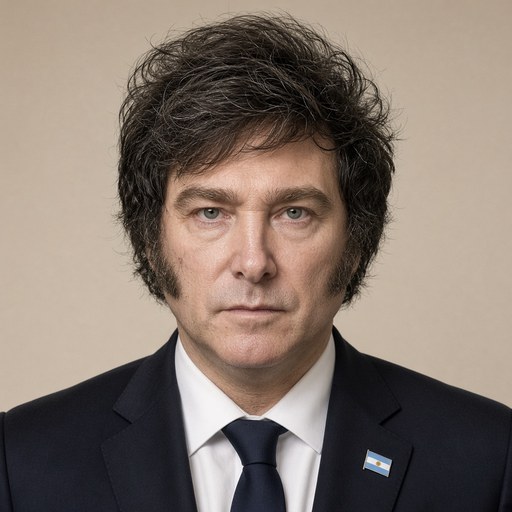
Words of the President of the Nation, Javier Milei, at the decoration with the Order of May to Dr. Jesús Huerta de Soto.
 Javier Milei · President of Argentina
- Context
- Milei addressed a ceremony in Buenos Aires on April 27, 2025, awarding the Order of May to Austrian economist Jesús Huerta de Soto, one of his intellectual mentors.
- Main themes
- Austrian economics and libertarian ideas, Order of May decoration for Jesús Huerta de Soto, Argentina's economic stabilization program, fiscal adjustment and inflation reduction, deregulation and state reform, dynamic efficiency theory, poverty reduction, economic growth recovery, free market principles, intellectual mentorship
- Duration
- ~63 min
- Words
- 7,502
- Sentences
- 328
- Readability
- 51
- Grade
- 11.6
- Syntax
- 3.17
- Vocabulary
- 2.15
Translated from Spanish
The broad sphere of national life a sentence belongs to. Every sentence has an Arena, so it is the denominator the other indices are read against.
Other328 sentences in 53 paragraphs
Good morning everyone. It is a great pleasure and a tremendous honor for me to have the opportunity to recognize this colossus of the ideas of freedom, Professor Jesús Huerta de Soto. As I always say, alongside our greatest champion of freedom, Professor Alberto Benegas Lynch (son), they are my intellectual mentors.
The mistakes are mine, but the good part I owe to them. And this distinction is not merely a personal matter or something of the sort; it is due to the enormous contribution they are making to humanity with their wonderful contributions, through their online classes, and for everything we are constantly learning from them, both inside and outside the classrooms.
Moreover, given the current situation in Argentina, I am very involved with one of Professor Huerta de Soto's contributions, which is the theory of dynamic efficiency. And that is precisely why I wanted to talk about how important that concept is today - Professor Martín Krause is here, another colossus. Thank you very much. I am having a tremendous luxury. And look, you have one of the interpreters of the ideas, Dr. Federico Sturzenegger, who is deregulating left and right. Or Professor Espert, who defends cuts in Congress. Beyond that, we have undoubtedly achieved the most successful stabilization case in the history of the world. We made a fiscal adjustment of 15 points of GDP; 5 in the Treasury, 10 in the Central Bank, the wholesale inflation of 54% monthly dropped to 1.5%; and if we clean up the crawling peg that was in effect, it is at 0.5%; which means that, in annual terms, we went from 54,000 annually to 6 annually. But not only that, because when we started doing all this, they said that the adjustment was impossible, and as Dr. Sturzenegger brilliantly points out, he said: “we broke three dimensions of the nature of the adjustment.” The first is the quantum and the time. Federico is often called to say, well, the adjustment I have to make. Well, what can you do? And they say, no, well, one point per year. And Federico replies: What if you do five in a month? That is what Javier did. And, moreover, after 6 months we also ended the deficit of the Central Bank - we have Furiase here, who is part of the Central Bank and of that huge achievement as well. But not only that. When we made the adjustment and inflation started to drop, they said we were going to plunge the economy into a great depression and that GDP was going to be destroyed; and that according to the fact that there had been an adjustment of half the size and they had made GDP fall by 15 points, therefore we were set to create a disaster. And then they started with the idea that it was going to be an L: it was going to fall and then stay flat there. Then they started with that it was going to be the Nike tick, very soft. Then the tick became stronger. Then it was a V. The reality is that it is a tick. And pardon the poetic license, but the Argentine economy rises like a diver's fart and you see little bubbles everywhere.
And that is, when you look at the data from December to December, in seasonally adjusted terms in the EMAE, which is the Monthly Economic Activity Estimator, that is a proxy for GDP, it grew by 6%. The latest available data is 5.7%, but the seasonally adjusted is 0.8. That is to say: Argentina is currently growing at a speed of 10%. Indeed, we are achieving it!
And they also said that we were an inhumane government, without sensitivity, that we did not care about the most vulnerable. Once we acknowledged the disaster left by the previous government… Obviously, acknowledging the prices clearly made poverty jump to 57%. Today that number, thanks to the drop in inflation, the recovery of activity, and the cuts in political graft, carried out by Minister Pettovello, who is not here because she was exhausted from the trip we just took from Rome, all sunburned, besides, which is not noticeable thanks to Lilia doing a neat job in my face - she did magic directly - poverty has fallen by more than 20 percentage points. That is to say, in one year we have lifted more than 10 million people out of poverty in Argentina. Talk about having sensitivity in carrying out the ideas of the free market.
And as if that were not enough, throughout the first 500 days of government we made 2,000 reforms. That is to say, four reforms per day for 500 days, paraphrasing Minister Petri. A true machine of deregulation and getting rid of the oppressive foot of the State. So, I believe we are honoring my mentors, Professor Huerta de Soto, Professor Benegas Lynch, and Professor Krause with everything we are doing. I also warn you that we are going for more.
But beyond the results of a successful stabilization program and the good things that lie ahead for Argentines, it seems to me that - and beyond the fact that by the middle of next year inflation will have been left as a problem of the past, given the lags of monetary policy, since we fixed the money supply starting from the middle of last year, so it is to be expected that by the middle of next year inflation will have ceased to be a problem in Argentina, today then the central issue of the debate is, and that is why this is the topic I wanted to address, in honor of Professor Huerta de Soto, the issue of growth. That is to say: how are we going to make Argentina great again? And here there is a very important role in terms of ideas. And I can assure you that the debate of ideas is much more important, and having a clear understanding of the role of ethical and moral values of a society, which is what will make Argentina great again. In this sense, what I am going to talk about is optimal growth and dynamic efficiency.
And the first point, I am going to take issue with someone I usually take issue with regularly, which is Mr. Vilfredo Pareto and his definition of Pareto optimality. Basically, how is a situation of Pareto optimality usually defined? It is when the possibilities of welfare gains are exhausted. Specifically, if you are in a situation that is not optimal and you can improve someone without worsening anyone, that is called a Pareto improvement. And when that is exhausted, it means you are at the optimum. And that is Pareto optimality. That is to say, it would be something like how we move from some point inside the production possibilities frontier to the limit of the production possibilities frontier. And then there is a whole discussion about optimality moving along the production possibilities frontier. And then there - and this is a point that is excellently treated by Professor Huerta de Soto - he goes and directly attacks the two theorems of welfare economics. The first theorem states that the system of perfect competition is efficient in Pareto terms. And now, in a little while, we will see the number of monstrosities that this implies. Because associated with this, the discussion I raise in "Capitalism and Socialism and the Neoclassical Trap," which I say that when the model does not map with reality, instead of changing the model, they get angry with reality and call it market failure. That atrocity derives from the first theorem of welfare economics, which is that competitive equilibrium is Pareto optimal. And so when reality does not map with that monstrosity, then it is called market failure and that is where all the monstrosities of intervention arise.
And the second, which is also another monstrosity, and which is key in Huerta de Soto's work, is the second theorem of welfare economics, which is that Pareto efficiency is compatible with different types of initial endowments. In other words: you take that idea to the extreme - and in the microeconomics or price theory textbooks, as you want to call it, it is there - it is the fact that optimality is independent of distribution. An idea that the first to install it was John Stuart Mill. Well, that is truly an aberration. And with that, Professor Huerta de Soto directly engages at some point. Because the whole debate between free market capitalism, the free market model, the free market society, versus socialism or statism, in its different versions, whether right or left, but all statist at heart… what we know is not trivial. The result is not independent of distribution. It is not in static terms, which is serious; but it is even worse in dynamic terms. And if we understand this point, we will be clear that embracing the ideas of socialism can destroy a society. The best example is Argentina: from being one of the richest countries in the world, the different shades of socialism sank the economy and left us with a disaster that would have been the worst crisis in Argentine history, because it combined the worst of the Rodrigazo, the worst of the hyperinflation of Alfonsín, and the worst of the exit from convertibility in 2001.
So, it is no longer just that it is not feasible, and that it is false, and that it can generate a disaster in static terms; but that the dynamic consequences are atrocious. That is to say: it is false that you can separate efficiency from the issue of property. And that is a central point. Now I am going to get into the first point. The first point is when the first theorem of welfare is not fulfilled, that is, a market failure appears. Now, if you look, all market failures are problems with which we get into the mathematics of equilibrium, not with real-life problems. The first is non-convexities. That is to say, the counterpart of this technical name, non-convexities, is the existence of concentrated market structures, or if you want, in the most extreme case, monopolies. In fact, I always tell that I converted to the Austrian school by reading the article "Monopoly and Competition," by Murray Rothbard, which is in the book "Man, Economy, and State," whose Spanish translation was done by the father of the great Alberto Benegas Lynch; that is to say, the father of the great, grandfather of Bertie. So, basically it has to do with a characterization by the mathematics of the general equilibrium model for it to be an optimum, and the underlying mathematical structures for that result to be an optimum. But that is a problem of mathematics, it is a problem in the heads of economists; it has nothing to do with the real life of individuals. That is to say, monopolies are only bad if they were created artificially by the State. Otherwise, as Mises said: if there is only one supplier, what? Am I going to fight with the only one there is?
The other is the issue of public goods, with this question of rivalry and exclusion, where clearly Ronald Coase laughed at everyone showing how lighthouses, which were a typical case of public goods, in the 19th century. He took the trouble and went one by one to check: they were all private. That is to say, with which the role of the entrepreneur within and the nature of the firm is poorly defined. That is why Coase's work is so important. Moreover, in a brilliant talk on this subject, Martín Krause points out: he goes and reviews the best microeconomics book of the moment, which is undoubtedly Varian's, at the intermediate level, and looks for the concept of entrepreneur. It was not there. So he looks for firm. Well, it appears four times. Firm and company. Four times. Well, then it is not difficult to understand that we have a point against that and the ridiculous… moreover, there is a phrase from Israel Kirzner, who has worked as hard as Professor Huerta de Soto, for example in his doctoral thesis "Socialism, Economic Calculation, and the Entrepreneurial Function," there is a phrase in Israel Kirzner's book "Creativity, Capitalism, and Distributive Justice," where he says that the model of perfect competition is as if it were implicit in the deep parameters, as Robert Lucas Jr. used to say, may he rest in peace. That is to say, preferences, technology, and endowments. It was as if the car was implicit in the amount of steel, rubber, glass, leather… a stupidity. But of course, you have to see it. Well, we live dealing with people who do not see it.
The other issue is the issue of externalities. Consumption externalities have to do with a problem of circularity, of solving the general equilibrium model. Of course, because if the consumption of one individual depends on what another consumes, if that is crossed it generates a circularity and the model cannot be solved. But there is a more amusing case that the professor cites in the article. For example, the case of envy. And so, that would also be an interesting problem in the resolution of the models. And there are so many of those. Well, then there is in production, analyzing this topic has brought me to so many malicious misinterpretations. And obviously, there are the problems of asymmetric information, moral hazard, adverse selection, how this is resolved with signaling; but more amusing also within this family - and that neokeynesians often use to annoy with their interventions - is the idea of the prisoners' dilemma, which is behind all those called coordination failure problems.
And that is one of the problems. The other problem is that the Pareto optimum clashes with economic growth. In other words, let me put it more simply: we are at the end of the 19th century and a man named Thomas Alva Edison appears and invents the light bulb. Then there are a lot of people who go bankrupt, called candle manufacturers. If you think in terms of Pareto optimum, the situation for those people is disastrous. In other words, there is nothing more anti-Pareto than technological progress. Now, if you kill technological progress, you will be killing the last 250 years of human history, which are the best 250 years that mankind has ever had in all its existence. Before the industrial revolution, the natural condition of man was poverty. And in a situation where initially 95% of people lived below the extreme poverty line, the extreme poverty line has to be changed all the time because it has become absolutely irrelevant. Capitalism with free enterprise has brought benefits, despite all the interventions that exist.
So basically there are a couple of problems there. The first problem is that growth has come from technological progress. And if we, instead of treating it as a blessing, are going to pursue it because of the second derived issue, which is income distribution, what we are going to be doing is killing economic growth, because we will be pursuing those who generate wealth. That is why I want to emphasize this point so much, and I may come across as heavy and dense, but it is the challenge we have for the future. Because now comes the problem or the issue of economic growth. And that is why the cultural battle is so important. Because if we allow leftist ideas to permeate, all they will do is abort economic growth, as they do every time they intervene. Notice that, in line with this problem, there is a very nice article in the book "Economics in One Lesson" by Henry Hazlitt, which attacks the Luddite fallacy and is precisely the hatred of the machine. This is exactly it, and that book is inspired by Bastiat, in what is seen and what is not seen. And if one wanted to put it in neoclassical terminology, when Hazlitt distinguishes between the good and the bad economist, he says: What is the bad economist? The one who only looks at partial equilibrium, who only looks at one market and in a static way. The difference with the good economist is that the good economist looks at general equilibrium and looks at it in dynamic terms. He does not only look at a single market today, but looks at all markets today and in the future. Then we can discuss other issues, but conceptually, to put it in the language we all handle... That is why I make the neoclassical translation.
So, the first problem we have is... let's say, there is a problem of treatment of optimality with the issue of economic growth, because it clashes. But not only that, but we can continue to delve into the nature of growth models, such as the Ramsey model. Now, it is interesting, because if you look - and there appears the interventionist germ again, with the first theorem of welfare economics - if you present the Ramsey model - in fact, in the book by Xavier Sala i Martín it is presented: it presents the Ramsey model and presents the socialist solution. And guess what it gives? The same. Therefore, it gives the same, if you have a competitive model, beyond the differences we may have with the neoclassicals regarding what they define as competitive, it turns out that the result is the same. But, moreover, when they advance and, for example, address the issue of education, a topic that is not minor; because the whole debate on endogenous growth, when it restarted in the mid-80s from Romer's thesis and the impetus given by Robert Lucas Jr., which starts a whole debate, and that debate culminates in an empirical paper by Mankiw, David Romer, and David Weil, and demonstrates that 70 points of economic growth are explained by human capital. So the debate is over, they say. This is human capital. But it happens that when it addresses the issue of human capital, it says, well, but it has the characteristic of a public good. So to maximize growth, the State has to be involved.
I will advance a phrase from Professor Huerta de Soto that is wonderful. Because I can't wait: "Justice and efficiency are two sides of the same coin, since what is just cannot be inefficient and what is efficient must always be just." And here what we are talking about is that someone is going to come and rob someone, put their hand in someone's pocket, to transfer it to another. In other words, in the very system where we want to correct that problem, we are sowing the roots of destruction. And not to mention when they also interfere with public education; whether it is privately managed or state-managed. And there is the army of interventionists that the State is creating.
So that is one of the problems. The other, which is the one I am passionate about and working on, has to do with the presence of increasing returns. When you look at per capita GDP data, they take the shape of a hockey stick. So you will see that until the year 1800, per capita GDP was practically constant, and suddenly it starts to rise enormously, with the arrival of capitalism with free enterprise, despite all the interventions of the interventionists. In other words, the presence of increasing returns. Now, the presence of increasing returns, for neoclassical economics, is synonymous with concentrated structures. And those concentrated structures, at the limit monopolies, are supposed to be bad, they are not Pareto optimal; and therefore they need to be regulated. And what is the characteristic of regulation? Regulation makes companies behave as if it were a perfectly competitive model. In other words, they burst, they are killing the increasing returns. And, as a consequence of that, economic growth ends up being killed.
I remember that in one of the meetings I had with the director of the International Monetary Fund, Kristalina Georgieva, as a result of the talk we had at the G7 while we were waiting to take the family photo... we were waiting for the late Pope Francis, may he rest in peace. So we stood aside while we waited for him, because the cart he was coming in with Meloni had broken down, and we started talking about Artificial Intelligence, growth, and so on, and in that context she quoted a paper by Keynes, which is "The Economic Possibilities for our Grandchildren." And well, we were chatting about that. And at the next meeting, I explained this theoretical argument to her. And the funniest thing is that when we went to the next meeting, we hadn't even started the meeting and she said to me: "Mr. President, you are right." And I said, "About what?" I said, with all the economic achievements, it might have to do with that. And it was about this point. In addition, she had made the empirical estimate of how much regulations cost the economy; and it is estimated that it causes a loss of total factor productivity of more than one point. Which is a lot. It is a lot. One point of growth per year. It is a lot. Between one point and one and a half. And where if you have a good example for this is Europe. Europe does not grow because it is burdened with regulations.
And that is when she asked me for permission to call Dr. Sturzenegger, who is our deregulation man. That is why this point matters so much to me. And it is there that I want to enter now, in the last part of this talk. Because then what can we do to maximize growth? As a way to achieve dynamic efficiency. And there it is very important how Professor Huerta de Soto defines it. I will quote him verbatim: "The economic system will be more efficient as it better promotes creativity and business coordination." So that it continuously pushes outward the production possibility frontier. In other words, what is the institutional system, what is the framework in which I can push the production possibilities frontier harder? In other words, how do I expand? And that basically has to do with creativity, with the entrepreneurial function. How do I maximize that? What is the institutional framework that maximizes that? I will spoil it for you: obviously the capitalism of free enterprise, that is, anarcho-capitalism.
So it is basically built on three pillars. One is the issue of the entrepreneurial function, the role of discovery... There is a whole discussion about the principle of appropriation, extremely rich, and I do not want to extend it because here what is important is that the professor speaks, not me. And this combines with the idea of creative destruction from Schumpeter, that is, with a proactive way of looking at this process in terms of innovation and discovery. If you look, what this man is proposing, think about the deep parameters of a general equilibrium model. We are talking about, how Debreu would define an economy in terms of deep parameters. It would be: preferences, which we know can change; technology, and obviously to banish this idea of technological progress in the Pareto sense leaves it out. So, what we are saying is that technology can change. But not only that, because more or less the issue of technology, in some way we have included, but there is something even stronger: we are seeing the set of endowments. And as if all that were not enough, it shows that the property scheme - the quotes from Xenophon are a pleasure - shows that the institutional setup I have motivates or does not motivate that process of creation and discovery.
So, obviously, this ties in with North's concept of adaptive efficiency, where it is the institutions that allow all this to happen. I mean, if I have socialism this does not happen, because I cannot appropriate the results of my creative act, of my discovery, of my innovation. I will not do it, because if not, the State appropriates it. And it blocks that creative and discovery capacity. In what sense am I going to do it if I cannot appropriate it? It is all cost otherwise. And it is there that by combining these three elements he arrives at the theory of dynamic efficiency and makes it clear with this the impossibility of socialism in static terms - something he also discusses in the book which is his doctoral thesis - the inefficiency in the static sense, whether it has to do with the amount of information, which is impossible to process; but even if it were possible, the problem is that in static terms what matters most is the know-how. That is, Mr. Michael Jordan can come and describe to me how he does a dunk and I cannot, I cannot. For example, my friend Mike Boggiano could not either because the differences in terms of heights are non-trivial. And even so, not all people who are 1.98 meters tall will be able to do that either, right? I mean, I don't see you Manu doing dunks. And you Fede either, who are in the range.
And then another fabulous thing that Professor Huerta de Soto raises: dynamic problems. Because you need that information to be created, but the information that reaches socialism is always slow. And this is the best part of all, because you can imagine that behind all this there is a framework that you have to know about economics; you have to know it seriously. And what is the most brilliant part of Professor Huerta de Soto's contribution: you do not need to know any of this. Because in reality, what is important is the ethical and moral issue. For example, Argentina has not sunk because of a problem of how we did the accounts. The problem is of a moral nature. It is values. How we have prostituted our values. We stopped embracing the values of the West, the values of Judeo-Christian culture, to embrace the demon of woke socialism, and that is how we sank. And so, that is why this definition takes on more strength now. Because there could be a lot of supposedly optimal paths for growth. No. And in that, it is very clear. There is only one path that meets these characteristics. That is why I liked this definition so much: "Justice and efficiency are two sides of the same coin, since what is just cannot be inefficient, and what is efficient must always be just." And the only system that is just is capitalism with free enterprise. Therefore, if one embraces the moral and ethical values that make it clear what is right and what is wrong, and one follows those values, what is just will be going along the efficient system. Because, moreover, the only system that is just is capitalism with free enterprise. In Israel Kirzner's book on income distribution, he says: What is the capitalist system criticized for? It is criticized for being unjust. And what does Israel Kirzner say? He says: if that were true, that is, we are more productive; but if it were true that the system is unjust, it is not worth defending. And what is the central proof in that work? That the capitalist system is not only more efficient, but also, it is the only system that is just. Therefore, embracing the ideas of freedom we will enter the path of growth that will make Argentina great again. Thank you very much to everyone, and especially to you, Professor Jesús Huerta de Soto.
HUERTA DE SOTO.- Excellency Mr. President of the Argentine Nation, Mr. Javier Milei: what a class of economic theory, what a class. I don’t know, the economists present, of course, will have appreciated it; but, for this reason, I tell you, and those who are watching us outside of here, it is a luxury. In no place in the world does any Head of State possess this knowledge and, above all, is capable of explaining it in such a clear and concise manner. This is a fortune, a blessing from God for Argentina and for the world.
But I also wanted to acknowledge the members of your government, how could I not, Mr. Ambassador of Spain, Mr. Joaquín de Arístegui, the authorities, ladies and gentlemen. First of all, I wish to express my emotion, my excited and humble gratitude for this deserved and extraordinary Order of May for Merit that the Argentine Nation, represented by its President, Mr. Javier Milei, grants me today. And I want to take this unique opportunity to send a message of encouragement, support, and hope to all the Argentine people, and also, how could I not, to Spain and the rest of the world, who today follow with expectation and the utmost interest what is happening in this great country.
Since Javier Milei was elected by an overwhelming majority as President of Argentina, this country has become a model to follow for a world that, gripped by statism, finds itself at a historical crossroads of being able to choose, as has been done in Argentina, freedom as the only alternative in the face of the continuous political conflicts, wars, and social and economic upheavals of all kinds, which are the inexorable consequence of statism and which today ravage humanity.
The first idea of my intervention today is that the State is not necessary. Economic science has already demonstrated that the State is not only an unnecessary entity, but that it is also scientifically impossible for it to provide what it promises to humanity.
At a popular level, it is thought that the State is necessary because its existence is confused with the essential nature of many of the services and resources that it today poorly offers exclusively. Human beings observe that roads, hospitals, schools, public order, for example, are provided by the State and, since they are very necessary, they conclude, without further analysis, that the State is also indispensable. They do not realize that the cited resources can be produced with much higher quality and in a more efficient, cheaper, and, above all, moral way through the spontaneous order of the market, entrepreneurial creativity, and private property.
Moreover, they fall into the trap of believing that the State is also necessary to protect the vulnerable, defenseless, poor, and helpless, without understanding that the supposed protective measures systematically have the effect —as economic theory shows— of harming, in each case, precisely those whom they intend to protect.
On the other hand, it is important to understand that the definition, acquisition, exchange, and defense of property rights, which articulate and drive the social process, do not require a monopolistic agency of violence. And not only do they not require it, but, on the contrary, the State acts by trampling on multiple legitimate titles of property, defending them very poorly and corrupting individual behavior regarding respect for private property rights.
The legal system is the evolutionary embodiment that integrates the general principles of law, especially of property, inseparable from the nature of the human being. Law, therefore, is not what the State decides, democratically or not, but is already there, embedded in the nature of the human being. Although it is discovered and consolidated jurisprudentially and, above all, doctrinally in an evolutionary and customary manner. And the State is not only unnecessary to define the law, it is also unnecessary to enforce and defend it. And this should be especially obvious in current times, when the use, even by many governmental agencies —especially in my country— of private security companies is commonplace.
It cannot be expected that we detail here how the private provision of what is today considered public goods would work, and, in fact, it is not possible to know today all the business solutions that an army of entrepreneurs would provide to the problems posed, if they were allowed to do so. But what even the most skeptical must recognize is that what we already know today is that the market, driven by creative and coordinating human action, works, and it does so precisely to the extent that the State does not intervene coercively in its social process. And that difficulties and conflicts always arise precisely where the spontaneous order of the market is not allowed to develop freely.
Therefore, regardless of the effort that may be made imagining how the anarcho-capitalist network of private security, defense, and arbitration agencies, each sponsoring more or less marginally alternative legal systems, would function, we must never forget that what prevents us from knowing exactly what the future without the State will be like, precisely, the creative nature of the entrepreneurial function, is, as Kirzner says, what gives us the peace of mind of knowing that any problem will tend to be overcome by dedicating all the effort and entrepreneurial creativity of the human beings involved to its solution.
But the State is not only unnecessary, as we have just seen, but, in addition, and secondly, it is an impossible entity. In the sense that it cannot achieve what it promises. It is impossible for the State to fulfill its coordinating objectives in any area of the social cooperation process in which it intends to intervene, for the following four reasons that the Austrian School of Economics studies in detail, and some of which the President of the Argentine Nation has already touched upon.
First, due to the enormous volume of information it would need for this, which is only found in a dispersed or disseminated manner among the eight billion people who participate daily in the social process.
Second, given the predominantly tacit and unarticulable nature of the information, and therefore not unequivocally transmissible, that the state intervention body needs to give a coordinating content to its mandates.
Third, because the information used at the social level is not given nor is it static, but changes continuously as a result of human creativity, making it obviously impossible to transmit today information that will only be created tomorrow, and which is what the state intervention body needs to achieve its objectives tomorrow.
Finally, and fourthly, especially because the coercive nature of the State's mandates blocks the entrepreneurial activity of creating the information, which is precisely what the state intervention organization needs like water in May to give a coordinating content to its own mandates.
These are the four reasons developed by the Austrian School of Economics to explain the theorem of the impossibility of socialism, or rather, of statism, whether from the left or the right.
Moreover, once the State exists, it is almost impossible to limit the expansion of its power. The State has not ceased to grow, and it has not ceased to grow because the mix of the State as a monopolistic institution of violence with human nature itself is literally explosive. The State drives and attracts, like an irresistible magnet, the passions, vices, and most perverse facets of human nature, which tries, on the one hand, to evade its mandates and, on the other, to take advantage of the monopolistic power of the State as much as possible.
Furthermore, the combined effect of the actions of privileged interest groups, the phenomena of governmental myopia and vote-buying, the megalomaniacal nature of the political caste, and the irresponsibility and blindness of bureaucracies generate a dangerously unstable and explosive cocktail, continuously shaken by social, economic, and political crises that, paradoxically, are always used by the political caste to justify further doses of intervention that, instead of solving, aggravate the problems even more.
But, in addition to being unnecessary and impossible, the State, thirdly, is essentially immoral. The State has become the idol to which everyone turns and adores. Statolatry is undoubtedly the most serious and dangerous social disease of our time. We are educated to believe that all problems can and must be detected in time and solved by the State. Our destiny depends on the State and the politicians who control it, who must guarantee us everything that our well-being demands. The human being remains immature and rebels against his own creative nature, which inevitably makes his future uncertain. He demands a crystal ball that assures him not only to know what will happen but also that any problems that arise will be solved for him. This infantilization of the masses is deliberately fostered by the political caste, as it justifies its existence and ensures its popularity, situation of predominance, and capacity for control.
Moreover, a legion of intellectuals, supposed experts, and social engineers join this arrogant intoxication of power, and even the Church and the most respected religious denominations have not been able to diagnose that statolatry is today the main threat to the free, moral, and responsible human being. That the State is a false idol of immense power that everyone adores and that does not allow humanity to free itself from its control or have moral or religious loyalties outside of those it can control, has achieved something that at first glance might seem impossible: to sinuously and systematically hide from the citizenry that it itself, the State, is the true source of conflicts and social evils. Creating scapegoats everywhere like capitalism, the profit motive, private property, which are blamed for the problems and to which popular anger and the most serious and emphatic condemnations, even from moral and religious leaders themselves, are directed. Almost none of whom have accounted for the deception or dared until now to denounce that statolatry is the main threat, in this century, to religion, to morality, and therefore, to human civilization.
Perhaps the main exception within the Church is included in the brilliant biography of Jesus of Nazareth, written by Benedict XVI. That the State and political power are the institutional embodiment of the Antichrist should be obvious to anyone with minimal knowledge of history who reads Benedict XVI's considerations on the greatest temptation that the evil one can present to us.
And I quote Ratzinger. Now I will quote him literally. Pages 66, 67. Ratzinger says the following: “The tempter is not so crude as to propose directly that we worship the devil; he only proposes that we decide for the rational, prefer a planned and organized world, in which God can occupy some place, but as a private matter, without interfering in our essential purposes. Soloviev attributes a book to the Antichrist, titled The Open Path to World Peace and Welfare, which becomes, so to speak, the new Bible and whose essential content is the worship of welfare and the rational planning of the State.” And here ends the quote, without waste, from Benedict XVI.
And so, it should not surprise us that, for example, the great author of The Lord of the Rings (270 million copies sold), J.R.R. Tolkien, whom many of us have enjoyed and whose Catholic anarchism I fully share, even went so far as to say that he would arrest anyone for the mere fact of daring to utter the word State. Therefore, since the State is always and everywhere a reality of violence and systematic coercion against the most intimate essence of the human being, which is his capacity to act freely, creatively, and spontaneously, it is inevitable to conclude that the State is essentially immoral and that statism constitutes the main threat to humanity.
The revolution against the Old Regime was led by our predecessors, the great classical liberals, among whom stood out in this part of the world, to cite just two examples, the liberator José de San Martín, who wanted to convey to Merceditas the love of truth, the hatred of lies, respect for the property of others, and love for the homeland and, above all, for freedom.
Or the very father of Argentine liberal constitutionalism, the great Juan Bautista Alberdi. Well, if we want to be loyal to these heroes and fathers of the Argentine homeland who have preceded us, it is our responsibility to complete the work they began and to do so, recognizing that this work of the old liberals has its natural continuity in the anarcho-capitalist revolution of the 21st century.
Anarcho-capitalism is the purest representation of the spontaneous order of the market, in which all services, including those of defining law, justice, and public order, are provided through an exclusively voluntary process of social cooperation. In this system, no area is closed to the impetus of human creativity and entrepreneurial coordination, enhancing efficiency and justice in solving the problems that may arise and eliminating at the root the conflicts, inefficiencies, and corruption generated by any State or monopolistic agency of violence.
And I conclude: the message of anarcho-capitalism is, therefore, distinctly revolutionary. Revolutionary in terms of its objective, the dismantling of the State and its replacement with a competitive market process, constituted by a network of agencies, associations, and private organizations. And revolutionary in terms of its means, especially in the academic, economic, social, and political spheres. Firstly, in the academic field of economic science, which becomes the general theory of the spontaneous order of the market, extended to all social areas, and which is developed by the Austrian school of economics, incorporating the analysis of the effects of social discoordination generated by statism in any area it affects. And also the study of the different paths for dismantling the State, the necessary processes of transition, and the comprehensive privatization of all services that are currently considered public, which therefore constitutes a priority field of research within our discipline.
Secondly, the economic and social revolution. We cannot even begin to imagine the immense achievements, advances, and human discoveries that could be reached in a business environment completely free from statism. Even today, and despite the continuous governmental harassment, a previously unknown civilization is beginning to develop in an increasingly broad and globalized world, with a degree of complexity that is ungraspable and uncontrollable for political power. The force of human creativity is such that it ultimately emerges even through the narrowest cracks left by governments, and as human beings gain a greater awareness of the essentially perverse nature of the State that constrains them, and of the immense possibilities that are frustrated every day when it blocks the driving force of their creativity, citizens, human beings, will stop believing in the State. And the social clamor for its reform and dismantling will multiply.
And finally, for there are many people here who are protagonists in the tough field of politics. And finally, the political revolution. It is true that the less interventionist alternatives must always be supported in clear alliance with the efforts of classical liberals in pursuit of the democratic limitation of the State. But the anarcho-capitalist does not stop at that task, for they know that they can and must do much more. They know that the ultimate goal is the total dismantling of the State, and this drives all their imagination, agenda, and political action in their day-to-day lives. Incremental advances in the right direction are, without a doubt, welcome, but without falling into a pragmatism that could hinder the ultimate goal of achieving the end of the State. Which, for pedagogical reasons and popular influence, must always be pursued systematically and transparently. An exciting future opens up for us, in which multiple new paths will continuously be discovered that will allow us to advance towards the anarcho-capitalist ideal, helping everyone to break free from the drug of statism, so that we can live in freedom and responsibility, and, in any case, let us not forget, always receiving with open arms those who finally see the scientific and moral truth, regardless of where they come from.
A future that, although it may seem distant today, can witness giant steps at any moment that could even surprise the most optimistic. Who was able to predict just five years before that, in 1989, the Berlin Wall would crumble and, with it, all of communism in Eastern Europe? Who could have even imagined that, just a year and a half ago, the Argentine people would choose to assume the ideological and political leadership of humanity, freely electing the first libertarian liberal president in history?
And indeed, history has entered an accelerated process of change that will never stop and that, as the great Jorge Luis Borges wished, another conservative anarchist or, as Rothbard would say, paleolibertarian, will open a completely new and splendid path for humankind, when, for the first time in history, it manages to definitively free itself from the State and reduce it to nothing more than a dark historical memory. Thank you very much to all.
The original Spanish. The tags above are read on the English translation's sentences.
Buenos días a todos. Es para mí un placer y un honor mayúsculo tener la posibilidad de distinguir a este coloso de las ideas de la libertad, que es el profesor Jesús Huerta de Soto. Como digo siempre, junto a nuestro máximo prócer de la libertad, el profesor Alberto Benegas Lynch (hijo), son mis mentores intelectuales.
Los errores son míos, pero la parte buena se las debo a ellos. Y no es solamente esta distinción por una mera cuestión de algo personal o algo por el estilo; es por la enorme contribución que están haciendo a la humanidad con sus maravillosas contribuciones, por sus clases online y por todo lo que estamos aprendiendo todo el tiempo de ellos. Ya sea dentro de las aulas, como fuera de las aulas.
Y, además, dado el momento de Argentina, yo estoy muy involucrado con una de las contribuciones del profesor Huerta de Soto que es la teoría de la eficiencia dinámica. Y por eso mismo es que hoy quería contar lo importante que es ese concepto - está el profesor Martín Krause, otro coloso. Muchísimas gracias. Tremendo lujo me estoy dando. Y miren, tienen a uno de los intérpretes de las ideas, que es el doctor Federico Sturzenegger, que está desregulando a diestra y siniestra. O el profe Espert que defiende los recortes en el Congreso. Más allá de eso, nosotros hemos sin lugar a dudas logrado el caso de estabilización más exitoso en la historia del mundo. Hicimos un ajuste fiscal de 15 puntos del PBI; 5 en el Tesoro, 10 en el Banco Central, la inflación mayorista del 54% mensual pasó al 1 y medio; y si le limpiamos el crawling peg que estaba vigente, es del 0,5%; quiere decir que, en términos anuales, pasamos del 54.000 anual al 6 anual. Pero no solo eso, porque cuando empezamos a hacer todo esto dijeron que el ajuste era imposible, y tal como señala brillantemente el doctor Sturzenegger, dijo: “rompimos tres dimensiones de la naturaleza del ajuste”. La primera es el quantum y el tiempo. A Federico lo suelen llamar para decir, bueno, el ajuste que tengo que hacer. Bueno ¿Qué podés hacer? Y le dicen, no, bueno, un punto por año. Y Federico le contesta: ¿Qué tal si haces cinco en un mes? Es lo que hizo Javier. Y, además, a los 6 meses también habíamos terminado con el déficit del Banco Central - tenemos presente a Furiase aquí, que es parte del Banco Central y de ese logro enorme también. Pero no solo eso. Cuando hicimos el ajuste y empezaba a bajar la inflación, dijeron que íbamos a meter a la economía en una gran depresión y que el PBI se iba a destrozar; y que acorde a que había habido ajuste de la mitad del tamaño y habían hecho caer 15 puntos el PBI, por lo tanto estábamos para hacer un desastre. Y, después empezaron con que bueno entonces iba a ser una L: iba a caer y luego iba a quedar plano ahí. Después empezaron con que iba a ser la pipita de Nike, muy suave. Después la pipita se puso más fuerte. Después era en V. La realidad es que es un tilde. Y perdón la licencia poética, pero la economía argentina sube como pedo de buzo y se ven la burbujitas por todos lados.
Y eso es, cuando ustedes miran los datos de diciembre contra diciembre, en términos desestacionalizados en el EMAE, que es el Estimador Mensual de Actividad Económica, o sea un proxy del PBI, creció 6%. El último dato disponible es del 5,7%, pero el desestacionalizado es 0,8. Es decir: Argentina hoy viene creciendo a una velocidad del 10%. ¡Vaya que sí que lo estamos logrando!
Y también dijeron que éramos un gobierno inhumano, sin sensibilidad, que no nos importaban los más vulnerables. Una vez que sinceramos el desastre que nos dejó el gobierno anterior… Obviamente sincerar los precios hizo que claramente la pobreza saltara al 57%. Hoy ese número gracias a la baja de la inflación, la recuperación de la actividad y el recorte de los curros de la política, llevado a cabo por la ministra Pettovello, que no está porque quedó reventada del viaje que venimos de Roma, todos insolados, además, cosa que no se nota gracias a que Lilia hizo una cosa prolija en mi cara -magia hizo directamente- la pobreza cayó en más de 20 puntos porcentuales. Es decir, que en un año hemos sacado de la pobreza a más de 10 millones en la Argentina. Vaya si no es tener sensibilidad llevar adelante las ideas del libre mercado.
Y como si fuera poco, a lo largo de los 500 primeros días de gobierno hicimos 2.000 reformas. Es decir, cuatro reformas por día durante 500 días, parafraseando al ministro Petri. Una verdadera máquina de desregular y sacarnos de encima la pata opresora del Estado. Así es que, creo que le estamos haciendo honor a mis mentores al profesor Huerta de Soto, al profesor Benegas Lynch y al profesor Krause con todo esto que estamos haciendo. Igual les aviso que vamos por más.
Pero más allá de los resultados de un programa de estabilización exitoso y de las cosas buenas que vienen para adelante para los argentinos, me parece que -y más allá que a mitad del año que viene la inflación habrá sido dejada como un problema del pasado, dados los rezagos de la política monetaria, ya que nosotros dejamos la cantidad fija de dinero a partir de la mitad del año pasado, así que es de esperar que para mitad del año que viene la inflación haya dejado de ser un problema en Argentina, es hoy entonces el tema central del debate, y por eso este es el tema que a mí me gustó tratar, en honor al profesor Huerta de Soto, el tema del crecimiento. Es decir, lo que se viene ahora es el crecimiento en serio. Es decir: ¿Cómo vamos a hacer para que Argentina sea grande nuevamente? Y aquí hay un rol muy importante en materia de las ideas. Y les puedo asegurar que es mucho más importante el debate de las ideas, y tener claro el rol de los valores éticos y morales de una sociedad, que es lo que va a hacer que Argentina vuelva a ser grande nuevamente. En este sentido, de lo que voy a hablar es de crecimiento óptimo y eficiencia dinámica.
Y el primer punto, me la voy a agarrar con alguien que suelo agarrármela regularmente, que es con el señor Vilfredo Pareto y su definición del óptimo de Pareto. Básicamente ¿Cómo se suele definir una situación de un óptimo de Pareto? Es cuando se agotan las posibilidades de ganancias de bienestar. Concretamente, si ustedes están en una situación que no es óptima y ustedes pueden mejorar a alguien sin empeorar a nadie, eso se llama mejora paretiana. Y cuando eso se agota, quiere decir que ustedes están en el óptimo. Y eso es el óptimo de Pareto. Es decir, vendría a ser algo así como cómo nos movemos de algún punto de adentro de las fronteras de posibilidades de la producción hacia el límite de la frontera de las posibilidades de la producción. Y después hay toda una discusión sobre la optimalidad moviéndonos sobre la frontera de la posibilidad de la producción. Y entonces ahí -y esto es un punto que está excelentemente tratado por el profesor Huerta de Soto- él va y ataca directamente a los dos teoremas de la economía del bienestar. El primero de los teoremas dice que el sistema de competencia perfecta es eficiente en términos de Pareto. Y ahora, dentro de un rato, vamos a ver la cantidad de monstruosidades que implica ello. Porque asociado a esto, la discusión que yo planteo en “Capitalismo y Socialismo y la Trampa Neoclásica”, que digo que cuando el modelo no mapea con la realidad, en lugar de cambiar el modelo se enojan con la realidad y lo llaman fallo de mercado. Esa atrocidad deriva del primer teorema de la economía del bienestar y es que el equilibrio competitivo es óptimo de Pareto. Y entonces cuando la realidad no se mapea con esa monstruosidad, entonces se la llama fallo de mercado y ahí es donde nacen todas las monstruosidades de la intervención.
Y el segundo, que también es otra monstruosidad, y que es clave en el trabajo de Huerta de Soto, es el segundo teorema de economía del bienestar, y es que la eficiencia paretiana es compatible con distintos tipos de dotaciones iniciales. Dicho de otra manera: ustedes esa idea llevada al extremo -y en los manuales de microeconomía o teoría de los precios, como ustedes quieran decirle, está- es el hecho que la optimalidad es independiente de la distribución. Una idea que el primero que la instaló fue John Stuart Mill. Bueno, eso es verdaderamente una aberración. Y con eso se mete directamente el profesor Huerta de Soto en algún momento. Porque todo el debate entre el capitalismo de libre mercado, el modelo de libre mercado, la sociedad de libre mercado, versus el socialismo o el estatismo, en sus distintas versiones, de derecha o de izquierda, pero todos estatistas en el fondo… lo que sabemos no es trivial. No es independiente el resultado de la distribución. No lo es en términos estáticos, lo cual es grave; pero además es mucho peor en términos dinámicos. Y si nosotros comprendemos este punto, vamos a tener claro que abrazar las ideas del socialismo puede destruir una sociedad. El mejor ejemplo es Argentina: de ser uno de los países más ricos del mundo, los distintos pelajes del socialismo hundieron a la economía y nos dejaron plantado un desastre que hubiera sido la peor de las crisis de la historia argentina, porque combinaba lo peor del Rodrigazo, lo peor de la híper de Alfonsín y lo peor de la salida de la convertibilidad del 2001.
Entonces, ya no es solo que no es factible eso, y que es falso, y que puede generar un desastre en términos estáticos; sino que las consecuencias dinámicas son atroces. Es decir: es falso que la eficiencia ustedes la puedan separar de la cuestión de la propiedad. Y eso es un punto central. Ahora me voy a meter con el primer punto. El primer punto es cuando no se cumple el primer teorema del bienestar, o sea, aparece un fallo de mercado. Ahora, si ustedes se fijan, todos los fallos de mercado son problemas con los cuales nos metemos con la matemática del equilibrio, no con problemas de la vida real. El primero es las no convexidades. Es decir, la contraparte de este nombre técnico, no convexidades, es la existencia de estructuras de mercados concentrados, o si ustedes quieren, en el caso más extremo, monopolios. De hecho, siempre cuento que me convertí a la escuela austríaca leyendo el artículo “Monopolio y Competencia”, de Murray Rothbard, que está en el libro “El hombre en la Economía y el Estado”, cuya traducción al español la ha hecho el padre del prócer Alberto Benegas Lynch; o sea el papá del prócer, abuelo de Bertie. Entonces, básicamente tiene que ver con una caracterización por la matemática del modelo de equilibrio general para que sea un óptimo, y las estructuras matemáticas subyacentes para que ese resultado sea un óptimo. Pero eso es un problema de la matemática, es un problema en la cabeza de los economistas; eso no tiene nada que ver con la vida real de los individuos. Es decir, los monopolios solamente son malos sí solo sí fueron creados artificialmente por el Estado. Sino, como decía Mises: si hay un solo oferente ¿Qué? ¿Me voy a pelear con el único que hay?
La otra es la de los bienes públicos, con esta cuestión de la rivalidad y la exclusión, donde claramente Ronald Coase se les rió a todos mostrando cómo eran los faros, que era un típico caso de bien público, en el siglo XIX. Se tomó el laburo y fue uno por uno a chequear: eran todos privados. Es decir, con lo cual está pésimamente definido el rol del empresario dentro y la naturaleza de la empresa. Por eso es tan importante el trabajo de Coase. Es más, en una brillante charla al respecto de Martín Krause él señala: va y revisa el mejor libro de microeconomía del momento, que sin lugar a dudas es el de Varian, a nivel intermedio, y busca el concepto empresario. No estaba. Entonces busca empresa. Bueno, aparece cuatro veces. Empresa y firma. Cuatro veces. Bueno, entonces no es difícil de entender que tengamos un punto en contra de eso y de lo ridículo… es más, hay una frase de Israel Kirzner, quien ha trabajado tan fuertemente como lo ha hecho el profesor Huerta de Soto, por ejemplo en su tesis doctoral “Socialismo, cálculo económico y función empresarial”, hay una frase en el libro de Israel Kirzner que es “Creatividad, Capitalismo y Justicia Distributiva”, donde dice que el modelo de la competencia perfecta es como que estuviera implícito en los parámetros profundos, tal como decía Robert Lucas Jr., que en paz descanse. Es decir, preferencias, tecnología y dotaciones. Era como que el auto estaba implícito en la cantidad de acero, caucho, vidrio, cuero… una estupidez. Pero claro, hay que verlo. Bueno nosotros vivimos lidiando con gente que no la ve.
El otro tema es el tema de las externalidades. Las de consumo tienen que ver con un problema de circularidad, de resolver el modelo de equilibrio general. Claro, porque si el consumo de un individuo depende de lo que consume otro, si eso estuviera cruzado genera una circularidad y no se puede resolver modelo. Pero hay un caso más divertido que cita el profesor en el artículo. Por ejemplo, el caso de la envidia. Y entonces, eso también sería un problema interesante en la resolución de los modelos. Y hay tantos de esos. Bueno, después está en producción, analizar este este tema me ha traído lugar a tantas malas interpretaciones maliciosas. Y obviamente que están los problemas de información asimétrica, el riesgo moral, la selección adversa, cómo se resuelve esto con el signaling; pero más divertido también dentro de esta familia- y que suelen usarla mucho los neokeynesianos para molestar con sus intervenciones- es la idea del dilema de los prisioneros, que está detrás de todos los que se llaman los problemas de fallo de coordinación.
Y ese es uno de los problemas. El otro problema es que el óptimo de Pareto se da de patadas con el crecimiento económico. Es decir, lo planteo de una manera más simple: estamos a finales del siglo XIX y aparece un señor llamado Thomas Alva Edison e inventa la lamparita. Entonces hay un montón de tipos que van a la quiebra, llamados fabricantes de velas. Si ustedes se ponen a pensar en términos de óptimo de Pareto, la situación para esas personas es desastrosa. Es decir, no hay nada más anti-pareto que el progreso tecnológico. Ahora, ustedes matan el progreso tecnológico y van a estar matando los últimos 250 años de historia de la humanidad, que son los mejores 250 que haya habido el hombre en toda su existencia. Ya que previo a la revolución industrial la condición natural del hombre era la pobreza. Y en una situación donde de arranque el 95% de las personas vivían debajo de la línea de pobreza extrema, la línea de pobreza extrema tiene que ser cambiada todo el tiempo porque se ha vuelto absolutamente irrelevante. Vaya que ha traído beneficios el capitalismo de libre empresa, a pesar de todas las intervenciones que hay.
Entonces básicamente hay un par de problemas ahí. El primer problema es que el crecimiento se ha dado por el progreso tecnológico. Y si nosotros en lugar de tratarlo como una bendición lo vamos a perseguir por la segunda cuestión derivada, que es la distribución del ingreso, lo que vamos a estar haciendo es matar el crecimiento económico, porque vamos a estar persiguiendo a aquellos que generan riqueza. Por eso es que quiero hacer tanto énfasis en este punto, y me ponga como algo pesado y denso, pero es el desafío que tenemos a futuro. Porque ahora viene el problema o la cuestión del crecimiento económico. Y por eso es tan importante la batalla cultural. Porque si dejamos permear las ideas de los zurdos, lo único que van a hacer es abortar el crecimiento económico, como lo hacen cada vez que se meten. Fíjense que, en línea a este problema, hay un artículo muy lindo dentro del libro de “La economía en una lección”, de Henry Hazlitt, que ataca a la falacia ludita y que es justamente el odio a la máquina. Justamente es esto y ese libro está inspirado en Bastiat, en lo que se ve y lo que no se ve. Y si uno lo quisiera poner en terminología neoclásica, cuando Hazlitt distingue entre el buen y el mal economista dice: ¿Qué es el mal economista? El que mira solamente el equilibrio parcial, mira solamente un mercado y de manera estática. La diferencia con el buen economista es que el buen economista mira el equilibrio general y lo mira en términos dinámicos. No solo mira un solo mercado hoy, sino que mira todos los mercados hoy y en el futuro. Después podemos discutir otras cuestiones, pero conceptualmente, para ponerlo en el lenguaje que manejamos todos… Por eso hago la traducción neoclásica.
Entonces, el primer problema que tenemos es… ya digamos, hay un problema de tratamiento de la optimalidad con el tema del crecimiento económico, porque se va de patadas. Pero no solo eso, sino que podemos seguir ahondando sobre la naturaleza de los modelos de crecimiento, como el modelo a la Ramsey. Ahora, es interesante, porque si ustedes se fijan -y ahí vuelve a aparecer el germen intervencionista de vuelta, con el primer teorema de la economía del bienestar-, si ustedes plantean el modelo de Ramsey -de hecho, en el libro de Xavier Sala i Martín está planteado: plantea el modelo de Ramsey y plantea la solución socialista. ¿Y adivinen qué da? Lo mismo. Por lo tanto da lo mismo, si ustedes tienen un modelo competitivo, más allá de las diferencias que podamos tener con los neoclásicos respecto a qué definen como competitivo, sucede que el resultado es el mismo. Pero, es más, cuando avanzan y, por ejemplo, tratan el tema de la educación, tema que no es no es menor; porque todo el debate del crecimiento endógeno, cuando reinicia a mediados de los 80 a partir de la tesis de Romer y el impulso que le da Robert Lucas Jr., que empieza todo un debate, y que ese debate culmina en un paper empírico de, Mankiw, David Romer y David Weil, y demuestra que 70 puntos del crecimiento económico son explicados por el capital humano. Entonces se acabó el debate, dicen. Esto es capital humano. Pero sucede que cuando aborda la cuestión del capital humano dice, bueno, pero tiene la característica de un bien público. Entonces para maximizar el crecimiento hay que meter al Estado.
Voy a adelantar una frase del profesor Huerta de Soto que es una maravilla. Porque no puedo esperar: “Justicia y eficiencia son dos caras de la misma moneda, ya que lo justo no puede ser ineficiente y lo eficiente siempre debe ser justo”. Y acá lo que estamos hablando es que va a aparecer un tipo a robarle a alguien, meterle la mano en el bolsillo a alguien, para transferírselo a otro. Es decir, en el propio sistema, donde queremos corregir ese problema estamos sembrando las raíces de la destrucción. Y ni que hablar cuando además se meten con la educación pública; sea de gestión privada o de gestión estatal. Y ahí el ejército de intervencionistas que va creando el Estado.
Entonces ese es uno de los problemas. El otro, que es el que a mí me apasiona y en el que estoy trabajando, tiene que ver con la presencia de los rendimientos crecientes. Cuando ustedes miran los datos del PBI per cápita, llevan el formato de un palo de hockey. Entonces van a ver que hasta el año 1800 el PBI per cápita estaba prácticamente constante, y de repente empieza a subir enormemente, con la llegada del capitalismo de libre empresa, a pesar de todo lo que intervienen los intervencionistas. Es decir, la presencia de rendimientos crecientes. Ahora, la presencia de rendimientos crecientes, para la economía neoclásica, es sinónimo de estructuras concentradas. Y esas estructuras concentradas, en el límite monopolios, se supone que son malas, no son óptimas de Pareto; y por lo tanto hay que regular. ¿Y cuál es la característica de la regulación? La regulación hace que las empresas se terminen comportando como si fuera el modelo perfectamente competitivo. Es decir, revientan, están matando los rendimientos crecientes. Y, como consecuencia de ello, se termina matando el crecimiento económico.
Yo recuerdo que en una de las reuniones que tuve con la directora del Fondo Monetario Internacional, Kristalina Georgieva, a raíz de la charla que habíamos tenido en el G7 mientras que estábamos esperando para hacer la foto de familia… estábamos esperando al difunto Papa Francisco, que en paz descanse. Entonces nos pusimos, mientras que lo esperábamos, porque se había roto el carrito en el que venía con Meloni, nos fuimos a un costado y nos pusimos a hablar sobre la Inteligencia Artificial, el crecimiento y demás, y en ese en ese contexto ella me citó un paper de Keynes, que es el de “La economía de mis nietos”. Y bueno, estuvimos charlando sobre eso. Y a la otra reunión yo le expliqué esta argumentación teórica. Y lo más divertido es que cuando fuimos a la otra reunión, no habíamos empezado la reunión y me dijo: “Presidente usted tiene razón”. Y yo le dije, “¿De qué?”. Dije, con todos los logros económicos, quizás tenía que ver con eso. Y era sobre este punto. Además, había hecho la estimación empírica de cuánto le costaban las regulaciones a la economía; y se estima que hace perder productividad total de los factores por más de un punto. Lo cual es un montón. Es un montón. Un punto de crecimiento por año. Es un montón. Entre un punto y un punto y medio. Y donde si tienen un buen ejemplo para esto es Europa. Europa no crece porque está atestada de regulaciones.
Y ahí fue que me pidió autorización para para convocarlo al doctor Sturzenegger, que es nuestro hombre de la desregulación. Por eso, es un punto que a mí me importa tanto. Y es ahí entonces donde quiero entrar ya, en la última parte de esta charla. Porque entonces ¿Qué podemos hacer para maximizar el crecimiento? Como una forma de alcanzar la eficiencia dinámica. Y ahí es muy importante cómo lo define el profesor Huerta de Soto. Lo voy a citar textual: “El sistema económico será más eficiente conforme más y mejor impulse la creatividad y la coordinación empresarial”. De modo tal que mueva continuamente hacia afuera la frontera de posibilidad de la producción. Es decir, cuál es el sistema institucional, cuál es el marco en el cual yo puedo empujar con más fuerza la frontera de posibilidades para la producción. Es decir, cómo me expando. Y que básicamente tiene que ver con la creatividad, con la función empresarial ¿Cómo maximizo eso? ¿Cuál es el marco institucional que maximiza eso? Se lo voy spoileando: obviamente el capitalismo de libre empresa, o sea, el anarco-capitalismo.
Entonces básicamente está construido sobre tres pilares. Uno es el tema de la función empresarial, el rol del descubrimiento… Hay toda una discusión sobre el principio de apropiación, sumamente rica, y no me quiero extender porque acá lo importante es que hable el profesor, no yo. Y esto lo combina con la idea de la destrucción creativa de Schumpeter, o sea con una forma proactiva de mirar este proceso en materia de innovación y descubrimiento. Si ustedes se fijan, lo que está proponiendo este hombre, piensen en los parámetros profundos de un modelo de equilibrio general. Estamos hablando de, cómo definiría Debreu una economía en términos de parámetros profundos. Sería: preferencias, que sabemos que pueden cambiar; tecnología, y obviamente que desterrar esta idea del progreso tecnológico en lo paretiano lo deja fuera. Entonces, lo que estamos diciendo es que la tecnología puede cambiar. Pero no solo eso, porque más o menos el tema de la tecnología, de alguna manera lo hemos incluido, pero hay algo más fuerte todavía: es que estamos viendo el conjunto de dotaciones. Y como si todo eso fuera poco, muestra que el esquema de propiedad -las citas de Jenofonte son un placer -, muestra que el armado institucional que yo tenga, motiva o no ese proceso de creación y descubrimiento.
Entonces, obviamente que esto lo aúna con el concepto de eficiencia adaptativa de North, donde son las instituciones que permiten que todo esto ocurra. Digo, si yo tengo socialismo esto no ocurre, porque no me puedo apropiar de los resultados de mi acto creador, de mi descubrimiento, de mi innovación. No lo voy a hacer, porque si no me lo apropia el Estado. Y bloquea esa capacidad creadora y de descubrir. En qué sentido lo voy a hacer, si no me lo puedo apropiar. Es todo costo si no. Y es ahí que combinando estos tres elementos llega a la teoría de la eficiencia dinámica y deja claro con esto además la imposibilidad del socialismo en términos estáticos -cosa que también discute en el libro que es su tesis doctoral -, la ineficiencia en lo estático, ya sea lo que tiene que ver con la cantidad de información, que es imposible procesar; pero que aun cuando fuera posible el problema es que en términos estáticos lo que más importa es el know-how. Es decir, puede venir el señor Michael Jordan a describirme cómo hace una volcada y no puedo, no puedo. Por ejemplo, el amigo Mike Boggiano no podría porque las diferencias en términos de estaturas son no triviales. Y aun así no todas las personas que midan 1,98 metros van a poder hacer eso tampoco ¿no? O sea, no te veo Manu haciendo volcadas. Y a vos Fede tampoco, que están en el rango.
Y después otra cosa fabulosa que plantea el profesor Huerta de Soto: los problemas dinámicos. Porque ustedes necesitan que se vaya creando esa información, pero la información que le llega al socialismo siempre es lenta. Y esta es la mejor parte de todas, porque ustedes se imaginarán que detrás de todo esto hay un andamiaje que ustedes tienen que saber de economía; tienen que saber en serio. Y qué es lo más brillante de la contribución del profesor Huerta de Soto: no necesitan saber nada de esto. Porque en realidad lo importante es la cuestión ética y moral. Por ejemplo, Argentina no se ha hundido por un problema de cómo hacíamos las cuentas. El problema es de índole moral. Son los valores. Cómo hemos prostituido nuestros valores. Dejamos de abrazar los valores de Occidente, los valores de la cultura judeocristiana, para abrazarnos al demonio del socialismo woke, y así es como nos hundimos. Y entonces, por eso es que toma más fuerza, ahora sí, esta definición. Porque podría haber un montón de senderos supuestamente por los que sería óptimo el crecimiento. No. Y en eso es muy claro. Hay un solo sendero que cumple con estas características. Por eso me gustó tanto esta definición: “Justicia y eficiencia son dos caras de la misma moneda, ya que lo justo no puede ser ineficiente, y lo eficiente siempre debe ser justo”. Y el único sistema que es justo es el capitalismo de libre empresa. Por lo tanto, si uno abraza los valores morales y éticos de que queda claro lo que está bien y lo que está mal, y uno se sigue por esos valores, y lo que es justo va a estar yendo por el sistema eficiente. Porque además, el único sistema que es justo es el capitalismo de libre empresa. En el libro de Israel Kirzner sobre distribución del ingreso dice ¿De qué se lo tacha al sistema capitalista? Se lo tacha de injusto. ¿Y qué es lo que dice Israel Kirzner? Dice: si eso fuera cierto, es decir, somos más eficientes productivamente; pero si fuera cierto que el sistema es injusto, no vale la pena defenderlo. ¿Y cuál es la prueba central en ese trabajo? Que el sistema capitalista no solo es más eficiente, sino que además, es el único sistema que es justo. Por lo tanto, abrazando las ideas de la libertad vamos a entrar en el sendero de crecimiento que va a hacer grande a la Argentina nuevamente. Muchísimas gracias a todos, y en especial a usted, profesor Jesús Huerta de Soto.
HUERTA DE SOTO.- Excelentísimo señor Presidente de la Nación Argentina, don Javier Milei: menuda clase de teoría económica, menuda clase. No sé, los economistas, desde luego que estén presentes, lo habrán podido apreciar; pero, por lo cual se lo digo, y los que nos están viendo fuera de aquí, es un lujo. En ningún lugar del mundo, ningún Jefe de Estado dispone de este conocimiento y, sobre todo, es capaz de explicarlo de una manera tan clara y sintética. Esto es una suerte, una bendición de Dios para la Argentina y para el mundo.
Pero también quería señalar a los miembros de su gobierno, cómo no, al señor Embajador de España, don Joaquín de Arístegui, las autoridades, señoras y señores. En primer lugar, deseo manifestar mi emoción, mi emocionado y humilde agradecimiento por esta merecida y extraordinaria, Orden de Mayo al Mérito que hoy me concede la Nación Argentina, representada por su Presidente, don Javier Milei. Y quiero aprovechar esta oportunidad única para enviar un mensaje de ánimo, apoyo y esperanza a todo el pueblo argentino, y también, cómo no, a España y al resto del mundo, que hoy siguen con expectación y el máximo interés lo que está sucediendo en este gran país.
Y es que, desde que Javier Milei fue elegido por abrumadora mayoría como Presidente de Argentina, este país se ha convertido en un modelo a seguir por un mundo que, atenazado por el estatismo, se encuentra en la encrucijada histórica de poder optar, como se ha hecho en Argentina, por la libertad como única alternativa frente a los continuos conflictos políticos, guerras, y conmociones sociales y económicas de todo tipo, que son la consecuencia inexorable del estatismo y que hoy asolan a la humanidad.
La primera idea de mi intervención, hoy, es que el Estado no es necesario. La ciencia económica ya ha demostrado que el Estado no solo es una entelequia innecesaria, sino que, además, es científicamente imposible que pueda proporcionar lo que promete a la humanidad.
A nivel popular, se piensa que el Estado es necesario porque se confunde la existencia del mismo con el carácter imprescindible de muchos de los servicios y recursos que hoy, malamente, oferta con carácter exclusivo. Los seres humanos observan que las carreteras, los hospitales, las escuelas, el orden público, por ejemplo, son proporcionados por el Estado y, como son muy necesarios, concluyen, sin más análisis, que el Estado es también imprescindible. No se dan cuenta de que los recursos citados pueden producirse con mucha más calidad y de forma más eficiente, barata y, sobre todo, moral a través del orden espontáneo del mercado, la creatividad empresarial y la propiedad privada.
Además, caen en la trampa de creer que el Estado es también necesario para proteger a los vulnerables, indefensos, pobres y desvalidos, sin entender que las supuestas medidas de protección, sistemáticamente, tienen el efecto —como muestra la teoría económica— de perjudicar, en cada caso, precisamente a aquellos a los que se pretende proteger.
Por otro lado, es importante entender que la definición, adquisición, intercambio y defensa de los derechos de propiedad, que articulan e impulsan el proceso social, no requieren de una agencia monopolista de la violencia. Y no solo no la requieren, sino que, por el contrario, el Estado actúa pisoteando múltiples títulos legítimos de propiedad, defendiéndolos de forma muy deficiente y corrompiendo el comportamiento individual de respeto a los derechos de propiedad privada.
El sistema jurídico es la plasmación evolutiva que integra los principios generales del derecho, especialmente de propiedad, inseparables de la naturaleza del ser humano. El derecho, por tanto, no es lo que el Estado decida, democráticamente o no, sino que ya está ahí, inserto en la naturaleza del ser humano. Aunque se descubra y consolide jurisprudencial y, sobre todo, doctrinalmente de forma evolutiva y consuetudinaria. Y el Estado no solo no es preciso para definir el derecho, tampoco lo es para hacerlo valer y defenderlo. Y esto debe resultar especialmente obvio en los tiempos actuales, en los que el uso, incluso por muchos organismos gubernamentales —especialmente en mi país—, de empresas privadas de seguridad está a la orden del día.
No puede pretenderse que expongamos aquí con detalle cómo funcionaría la provisión privada de los que hoy se consideran como bienes públicos, y, de hecho, no pueden conocerse hoy todas las soluciones empresariales que un ejército de emprendedores daría a los problemas planteados, si se les dejase hacerlo. Pero lo que hasta los más escépticos han de reconocer es que lo que hoy ya sabemos es que el mercado, impulsado por la acción humana creativa y coordinadora, funciona, y precisamente lo hace en la medida en que el Estado no interviene coactivamente en su proceso social. Y que las dificultades y conflictos siempre surgen, precisamente, allí donde no se deja que se desarrolle libremente el orden espontáneo del mercado.
Por eso, y con independencia del esfuerzo que se pueda realizar imaginando cómo funcionaría la red anarcocapitalista de agencias privadas de seguridad, defensa y arbitraje, patrocinadoras cada una de ellas de sistemas jurídicos más o menos marginalmente alternativos, nunca debemos olvidar que lo que nos impide conocer con exactitud cómo será el futuro sin Estado, precisamente, el carácter creativo de la función empresarial, es, como dice Kirzner, lo que nos da la tranquilidad de saber que cualquier problema tenderá a ser superado al dedicarse a su solución todo el esfuerzo y la creatividad empresarial de los seres humanos implicados.
Pero el Estado no solo no es necesario, como acabamos de ver, sino que, además, y en segundo lugar, es una entelequia imposible. En el sentido de que no puede lograr lo que promete. Y es que es imposible que el Estado cumpla sus objetivos coordinadores en cualquier parcela del proceso de cooperación social en que pretenda intervenir, por los siguientes cuatro motivos que estudia con detalle la Escuela Austriaca de Economía, y alguno de los cuales me ha pisado el Presidente de la Nación Argentina.
Primero, por el enorme volumen de información que necesitaría para ello y que solo se encuentra de forma dispersa o diseminada en los ocho mil millones de personas que cada día participan en el proceso social.
Segundo, dado el carácter predominantemente tácito y no articulable, y por tanto no transmisible de forma inequívoca de la información que necesita el órgano de intervención estatal para dar un contenido coordinador a sus mandatos.
Tercero, porque la información que se utiliza a nivel social no está dada ni es estática, sino que cambia continuamente como consecuencia de la creatividad humana, siendo obviamente imposible transmitir hoy una información que solo será creada mañana, y que es la que necesita el órgano de intervención estatal para que mañana pueda lograr sus objetivos.
Por último, y, en cuarto lugar, sobre todo porque el carácter coactivo de los mandatos del Estado bloquea la actividad empresarial de creación de la información, que es precisamente la que necesita como agua de mayo, la organización estatal de intervención para dar un contenido coordinador a sus propios mandatos.
Estas son las cuatro razones desarrolladas por la Escuela Austríaca de Economía para explicar el teorema de la imposibilidad del socialismo, mejor dicho, del estatismo, sea de izquierdas o de derechas.
Pero es que, además, una vez que existe el Estado, es casi imposible limitar la expansión de su poder. El Estado no ha dejado de crecer, y no ha dejado de crecer porque la mezcla del Estado como institución monopolista de la violencia con la propia naturaleza humana es literalmente explosiva. El Estado impulsa y atrae, como un imán de fuerza irresistible, las pasiones, vicios y facetas más perversas de la naturaleza del ser humano, que intenta, por un lado, evadirse de sus mandatos y, por otro, aprovecharse del poder monopolista del Estado todo lo que pueda.
Además, el efecto combinado de la acción de los grupos privilegiados de interés, los fenómenos de miopía gubernamental y de compra de votos, el carácter megalómano de la casta política y la irresponsabilidad y ceguera de las burocracias generan un cóctel peligrosamente inestable y explosivo, continuamente zarandeado por crisis sociales, económicas y políticas que, paradójicamente, son siempre utilizadas por la casta política para justificar ulteriores dosis de intervención que, en vez de solucionar, agravan aún más los problemas.
Pero, además de innecesario e imposible, el Estado, en tercer lugar, es esencialmente inmoral. El Estado se ha convertido en el ídolo al que todos recurren y adoran. La estatolatría es, sin duda alguna, la más grave y peligrosa enfermedad social de nuestro tiempo. Se nos educa para creer que todos los problemas pueden y deben ser detectados a tiempo y solucionados por el Estado. Nuestro destino depende del Estado y de los políticos que lo controlan, que deben garantizarnos todo lo que exija nuestro bienestar. El ser humano permanece inmaduro y se revela contra su propia naturaleza creativa, que es la que hace ineludiblemente incierto su futuro. Exige una bola de cristal que le asegure no solo conocer lo que va a pasar, sino además que cualesquiera problemas que surjan le serán solucionados. Esta infantilización de las masas se fomenta de forma deliberada por la casta política, pues así justifica su existencia y asegura su popularidad, situación de predominio y capacidad de control.
Además, una legión de intelectuales, supuestos expertos e ingenieros sociales se suman a esta arrogante borrachera del poder, y ni siquiera la Iglesia y las denominaciones religiosas más respetables han sido capaces de diagnosticar que la estatolatría es hoy en día la principal amenaza al ser humano libre, moral y responsable. Que el Estado es un ídolo falso de inmenso poder al que todos adoran y que no consiente que la humanidad se libere de su control ni tenga lealtades morales o religiosas ajenas a las que él mismo pueda controlar, ha logrado algo que a priori podría parecer imposible: ocultar sinuosa y sistemáticamente a la ciudadanía que él mismo, el Estado, es el verdadero origen de los conflictos y males sociales. Creando por doquier cabezas de turco como el capitalismo, el ánimo de lucro, la propiedad privada, a los que se culpa de los problemas y se dirige la ira popular y las condenas más serias y rotundas, provenientes incluso de los propios líderes morales y religiosos. Casi ninguno de los cuales ha dado cuenta del engaño ni se atrevido hasta ahora a denunciar que la estatolatría es la principal amenaza, en el presente siglo, a la religión, a la moral y, por tanto, a la civilización humana.
Quizás la principal excepción dentro de la Iglesia sea la incluida en la brillante biografía sobre Jesús de Nazaret, escrita por Benedicto XVI. Que el Estado y el poder político son la encarnación institucional del Anticristo, debe resultar obvio para cualquiera con mínimos conocimientos de historia que lea las consideraciones de Benedicto XVI sobre la más grande tentación que pueda hacernos el maligno.
Y cito a Ratzinger. Ahora le voy a citar literalmente. Página 66, 67. Dice lo siguiente Ratzinger: “El tentador no es tan burdo como para proponernos directamente adorar al diablo; solo nos propone decidirnos por lo racional, preferir un mundo planificado y organizado, en el que Dios puede ocupar algún lugar, pero como asunto privado, sin interferir en nuestros propósitos esenciales. Soloviev atribuye un libro al Anticristo, titulado El camino abierto para la paz y el bienestar del mundo, que se convierte, por así decirlo, en la nueva Biblia y que tiene como contenido esencial la adoración del bienestar y la planificación racional del Estado”. Y aquí termina la cita, sin desperdicio, de Benedicto XVI.
Y no así, no debe extrañarnos que, por ejemplo, el gran autor de El señor de los anillos (270 millones de ejemplares vendidos), J.R.R. Tolkien, que muchos de nosotros hemos disfrutado y cuyo anarquismo católico comparto plenamente, incluso llegara a decir que arrestaría a cualquiera por el simple hecho de atreverse a pronunciar la palabra Estado. Por tanto, como el Estado es siempre y en todo lugar una realidad de violencia y coacción sistemática en contra de la más íntima esencia del ser humano, que es su capacidad para actuar libre, creativa y espontáneamente, es ineludible concluir que el Estado es esencialmente inmoral y que el estatismo constituye la principal amenaza para la humanidad.
La revolución contra el Antiguo Régimen fue protagonizada por nuestros predecesores, los grandes liberales clásicos, entre los que destacaron en esta parte del mundo, por citar solo dos ejemplos el libertador José de San Martín que nos quiso transmitir en sus máximas a Merceditas el amor a la verdad, el odio a la mentira, el respeto a la propiedad ajena y el amor a la patria y, sobre todo, a la libertad.
O el propio padre del constitucionalismo liberal argentino el gran Juan Bautista Alberdi. Pues bien, si queremos ser leales a estos próceres y padres de la patria Argentina que nos han precedido, es nuestra responsabilidad culminar la labor que iniciaron y hacerlo, reconociendo que esta labor de los viejos liberales, hoy tiene su continuidad natural en la revolución anarcocapitalista del siglo XXI.
El anarcocapitalismo es la representación más pura del orden espontáneo del mercado, en el que todos los servicios, incluyendo los de definición del derecho, justicia y orden público, son proporcionados a través de un proceso exclusivamente voluntario de cooperación social. En este sistema, ninguna parcela se cierra al ímpetu de la creatividad humana y de la coordinación empresarial, potenciándose la eficiencia y la justicia en la solución de los problemas que puedan plantearse y eliminando de raíz los conflictos, ineficiencias y corrupción que genera todo Estado o agencia monopolista de la violencia.
Y termino: el mensaje del anarcocapitalismo es, pues, netamente revolucionario. Revolucionario en cuanto a su objetivo, el desmantelamiento del Estado y su sustitución por un proceso competitivo de mercado, constituido por un entramado de agencias, asociaciones y organizaciones privadas. Y revolucionario en cuanto a sus medios, especialmente en los ámbitos académico, económico, social y político. Primeramente, en el ámbito académico de la ciencia económica, que se convierte en la teoría general del orden espontáneo del mercado, extendido a todas las áreas sociales, y que es la desarrollada por la escuela austriaca de economía, incorporando el análisis de los efectos de descoordinación social generados por el estatismo en cualquier parcela en que incida. Y también el estudio de los diferentes caminos de desmantelamiento del Estado, los necesarios procesos de transición y de la privatización integral de todos los servicios que hoy se consideran públicos, y que, por tanto, constituye un campo prioritario de investigación dentro de nuestra disciplina.
En segundo lugar, la revolución económica y social. No podemos siquiera intuir los inmensos logros, avances y descubrimientos humanos que podrán alcanzarse en un entorno empresarial totalmente libre del estatismo. Incluso hoy, y a pesar del continuo acoso gubernamental, ya empieza a desarrollarse, en un mundo cada vez más amplio y globalizado, una civilización desconocida, con un grado de complejidad inabarcable e incontrolable para el poder político. Y es que la fuerza de la creatividad humana es tal que termina aflorando incluso por los resquicios más estrechos que nos dejan los gobiernos, y en cuanto los seres humanos vayan adquiriendo una mayor conciencia de la naturaleza esencialmente perversa del Estado que les coarta, y de las inmensas posibilidades que cada día se frustran cuando este bloquea la fuerza impulsora de su creatividad, los ciudadanos, los seres humanos, dejarán de creer en el Estado. Y se multiplicará el clamor social en pos de su reforma y desmantelamiento.
Y finalmente, pues aquí hay muchas personas protagonistas del campo durísimo de la política. Y finalmente, la revolución política. Es cierto que siempre habrán de apoyarse las alternativas menos intervencionistas en clara alianza con el esfuerzo de los liberales clásicos en pos de la limitación democrática del Estado. Pero la anarcocapitalista no se queda en esa labor, pues sabe que puede y debe hacer mucho más. Sabe que el objetivo final es el desmantelamiento total del Estado y ello impulsa toda su imaginación, agenda y acción política en el día a día. Los avances incrementales en la buena dirección son, sin duda, bienvenidos, pero sin caer en un pragmatismo que pueda dificultar el objetivo último de lograr el fin del Estado. Que, por razones pedagógicas y de influencia popular, siempre ha de perseguirse de forma sistemática y transparente. Se nos abre, pues, un futuro apasionante en el que continuamente se descubrirán múltiples nuevos caminos que nos permitirán avanzar en pos del ideal anarcocapitalista, ayudando a todos a salir de la droga del estatismo, para que podamos vivir en libertad y responsabilidad, y, en todo caso, no lo olvidemos, recibiendo siempre con los brazos abiertos a los que finalmente vean la verdad científica y moral, provengan de donde provengan.
Futuro este que, aunque hoy nos pueda parecer lejano, en cualquier momento puede ser testigo de pasos de gigante que incluso sorprendan a los más optimistas. ¿Quién fue capaz de predecir tan solo cinco años antes que, en 1989, se desmoronaría el muro de Berlín y, con él, todo el comunismo del este de Europa? ¿Quién hubiera podido siquiera imaginar que, hace escasamente un año y medio, el pueblo argentino optaría por asumir el liderazgo ideológico y político de la humanidad, eligiendo en libertad al primer presidente liberal libertario de la historia?
Y es que la historia ha entrado en un proceso acelerado de cambio que nunca se detendrá y que, como deseaba el gran Jorge Luis Borges, otro anarquista conservador o, como diría Rothbard, paleolibertario, nos abrirá un camino totalmente nuevo y esplendoroso para el género humano, cuando, por primera vez en la historia, este logre desembarazarse definitivamente del Estado y reducirlo tan solo a un oscuro recuerdo histórico. Muchas gracias a todos.