




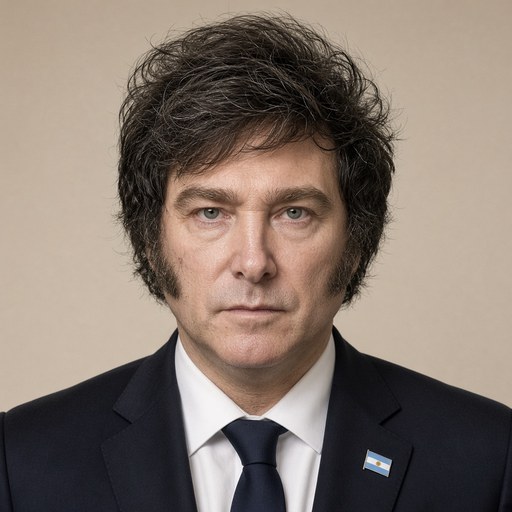
Speech by President Javier Milei at the Mercosur Summit and Associated States, at the San Martín Palace, in Buenos Aires.
 Javier Milei · President of Argentina
- Context
- Milei addressed the MERCOSUR Summit at San Martín Palace in Buenos Aires on July 3, 2025, concluding Argentina's Pro Tempore Presidency of the bloc.
- Main themes
- Free trade and commercial liberalization, MERCOSUR reform, common external tariff reduction, trade agreements with EFTA and EU, organized crime and drug trafficking, economic freedom, regional integration, bureaucratic reform, Argentina's Pro Tempore Presidency, comparative advantage and export potential
- Duration
- ~16 min
- Words
- 1,868
- Sentences
- 70
- Readability
- 44
- Grade
- 13.6
- Syntax
- 3.30
- Vocabulary
- 2.29
Translated from Spanish
The broad sphere of national life a sentence belongs to. Every sentence has an Arena, so it is the denominator the other indices are read against.
Other70 sentences in 19 paragraphs
Dear Presidents, Chancellors, Ministers, special guests, delegates, and citizens of the nations that make up MERCOSUR. Talleyrand once said that "language was given to man to conceal his thoughts." I believe he correctly characterized how diplomatic discourse has transformed — particularly — where often in forums and meetings like this, the norm is to speak by saying as little as possible or saying it in such a way that it remains in the realm of the subjective or interpretive.
At this point, you have come to know me, and you know that I do not believe in hidden messages. As we have always maintained, we prefer to speak a difficult truth rather than a comfortable lie. When one has a clear direction, speaking clearly is the best way to go in that direction, even if it is costly at first.
That is why — when we assumed the Pro Tempore Presidency of MERCOSUR — we dared to say something that many of us had shared for a long time, but that was taboo and no one dared to admit out loud. Although MERCOSUR was originally created — with the noble intention — of integrating the economies of the region, at some point the North became mired, and the joint commercial action ended up harming the majority of our citizens in favor of privileging some sectors. The barrier we raised to protect ourselves commercially at a time we considered valuable ended up excluding us from trade and global competition and — therefore — ended up punishing our populations with worse goods and services at worse prices, which contributed to stalling the growth of our economies.
At the same time, the organization required us to bear the burden of financing a bureaucratic structure, now already elephantine, dedicated to endless meetings; common guides and regulations on issues of internal law; and duplicating forums that do not achieve the effective promotion of the fundamental rights and freedoms of citizens. The result of all this was a MERCOSUR that failed to meet its original objective, curtailed economic freedoms, and deprived the private sector in the region of opportunities. MERCOSUR, which had less and less in common and in market.
We seek to put an end to what we consider a destructive inertia. For that reason, we proposed that — as a bloc — we move towards a much freer commercial and regulatory scheme, instead of the iron curtain to which we are currently subjected, in which each country can enjoy greater autonomy to take advantage of its comparative advantages and export potential. We understood the limitations we faced in proposing such a paradigm shift. On the one hand, because deep changes do not usually go well with rigid structures; on the other hand, because we know very well the difference between talking and doing, and we know that it is much easier to demand in the air than to propose actionable things. That is why we dedicated the exercise of our first Pro Tempore Presidency to translating the proposed path into tangible and achievable measures.
First, we expanded the list of exceptions to the common external tariff, so that our citizens and businesses can access more goods and services at international prices. We also advanced our proposal to review the common external tariff, which — as we all know — is excessively high and harmful to consumers in our countries. This tariff should — at the very least — be brought to international standards, which could facilitate new trade agreements in the future. In addition, Argentina led and successfully closed an agreement with MERCOSUR and the European Free Trade Association, EFTA. This outcome was possible thanks to the commitment of the member states and the professionalism of our negotiating teams, to whom I wish to express my recognition.
The agreement with EFTA connects MERCOSUR with a highly competitive bloc, whose Gross Domestic Product amounts to 1.5 trillion dollars and has an average GDP per capita close to 95,000 dollars per year, one of the highest in the world.
This understanding establishes a modern and predictable legal framework that will allow for deepening and expanding investments from EFTA countries in our region. We also celebrate the relaunch of the relationship with the European Union, convinced that the agreement between both blocs represents a historic opportunity to consolidate a strategic partnership based on the complementarity of our economies. Likewise, we have high expectations of finalizing — this year — negotiations to celebrate a trade agreement with the United Arab Emirates; to deepen the preferential trade agreement with India; and to also deepen the Free Trade Agreement between MERCOSUR and Israel. This adds to the negotiations we have launched between MERCOSUR and El Salvador, and to the negotiations we hope to begin soon with Panama in order to conclude free trade agreements.
In terms of security, we face the enormous challenge of eradicating the cancer of organized crime from the region, fundamentally, drug trafficking that recognizes no borders and destroys us all.
That is why — at the beginning of this Pro Tempore Presidency — I proposed the creation of a MERCOSUR Agency against transnational organized crime. This is a resource that cannot wait. We need to act urgently. We cannot stagnate in declarations or doubts. We must turn the commitments made by our governments into facts. Today I can announce that we have taken a great step, both in the recent meeting of our Ministers of Interior Security and Justice, as well as in the joint declaration of the MERCOSUR Political Consultation and Coordination Forum; which have recommended creating this much-needed agency during this year. If the Primeiro Comando da Capital and the Comando Vermelho were to spread throughout MERCOSUR, the entire region would be in danger, and it would be impossible to eradicate it from its country of origin.
That is why I conclude this Presidency leaving this commitment to the next Presidency of the bloc in charge of Brazil, confident that — together — we will provide MERCOSUR with a necessary tool to effectively combat transnational organized crime. In this same line, we cannot turn a blind eye to the numerous cases of illegal detentions in Venezuela. These are people deprived of their liberty in violation of any type of right, and we demand their prompt release, in particular, we reiterate our firm demand for the immediate release of Argentine Gendarme Nahuel Gallo.
As I said at the beginning: we seek to lubricate the gears of this body through dialogue, understanding dialogue as a starting point to achieve subsequent objectives and not an end in itself.
From now on, we will seek to accelerate the march towards a deeper commercial opening that is more suited to the reality of our peoples, which requires greater agility in bureaucratic terms. It should be remembered that the opportunity cost — due to administrative laziness — is never paid by the bureaucrat, but by the entrepreneur and, by extension, the worker. There can be no companies without markets, and there can be no workers without companies. Commercial legislation results in less and worse employment for our peoples; in depressed wages due to inactivity and closed markets due to hunting grounds that politics designs for its own benefit and that of its protected.
Every year that passes without greater commercial freedom is a year in which a company cannot grow or hire people, while the official in charge of managing these agreements will continue to receive a salary. We must — ultimately — stop thinking of MERCOSUR as a shield that protects us from the world and start thinking of it as a spear that allows us to effectively penetrate global markets, markets from which customs barriers have so far excluded us. And for that reason — as a bloc — we must establish logical trade conditions. We believe that the north of MERCOSUR is this. We know that many of you share it. We must not let our differences on accessory issues divide us. However, we also know that adopting these ideas will result in a new balance, and while we are confident that the balance will be beneficial for all, a new order always has its costs, especially on some sectors that were widely benefited by the previous status quo. We cannot let the defense of these interests — entrenched in the past — prevent the achievement of the essential agreements that this bloc needs to survive and prosper. The future of the region and its role in the world depend on it.
We must not lose sight of the fact that we are mere agents of the general will of our peoples, and not of the particular will of some sectors, whether they be entrepreneurs or political militants. Our task — in this Forum — cannot be divorced from this sacred mission, and it has informed each of the steps we have taken in our capacity as temporary Presidents of MERCOSUR.
Before I finish, I would like to thank the unwavering, unconditional support of all the member states of the bloc for our sovereign claim over the Malvinas Islands, South Georgia, and South Sandwich Islands, and the surrounding maritime spaces. The Islands are Argentine territory, occupied since 1833 by a population implanted by the United Kingdom, after forcibly expelling the Argentine authorities. I wish, therefore, to reiterate my gratitude to all of you for supporting the Special Declaration on the Malvinas Question. Your support reaffirms the regional commitment to a peaceful solution, in accordance with international law and the resolutions of the United Nations.
In closing, we want our Pro Tempore Presidency to be considered a sincere exercise for MERCOSUR to adopt, as a bloc, the reforms for commercial freedom that it needs. And for that reason, we hope, with the same sincerity, that the next Presidency will support the measures we have taken in this semester. In fact, it would be a great joy that, in a few years, when Argentina has — once again — the opportunity to preside over this bloc, we find ourselves in the home stretch to achieve this set of objectives. But if this is not possible, and the partners of the bloc prefer to resist, to persist in a path that has not worked for us, then we will have to insist on flexibilizing the conditions of the partnership that unites us. We will embark on the path of freedom, and we will do so accompanied or alone, because — as I have already said — Argentina cannot wait. We need more trade, more economic activity, more investment, and more work urgently. And for that, we also need more freedom, urgently.
Our Nation has decided to leave behind decades of stagnation and embark on the path of progress. It is up to our MERCOSUR partners to decide whether they want to help us embark on the path we have chosen, because our work is nothing but to seek prosperity for our peoples. And from history, we learned that it can only be found through free trade.
Thank you very much to all, may God bless you, and may the forces of heaven accompany us. Thank you very much.
The original Spanish. The tags above are read on the English translation's sentences.
Estimados Presidentes, Cancilleres, Ministros, invitados especiales, delegados y ciudadanos, de las naciones que integran el MERCOSUR. Talleyrand, dijo una vez que: “el lenguaje fue dado al hombre para ocultar sus pensamientos”. Creo que caracterizó de forma correcta en que se ha transformado - particularmente - el discurso diplomático, donde muchas veces en foros y encuentros como este, la norma es hablar diciendo lo menos posible o diciendo lo - de tal manera - que quede en el plano de los subjetivo o interpretativo.
A esta altura, ya me ha llegado a conocer y saben que yo no creo en los mensajes ocultos. Como siempre sostuvimos, nosotros preferimos decir una verdad difícil, a decir una mentira confortable. Cuando uno tiene un norte claro, hablar de forma clara es el mejor camino en esa dirección, aunque al principio sea costoso.
Por eso - cuando asumimos la Presidencia Pro tempore del MERCOSUR - nos animamos a decir algo que muchos compartíamos desde hace tiempo, pero que era tabú y nadie se animaba a admitir a viva voz. Si bien originalmente el MERCOSUR fue creado - con la intención noble - de integrar las economías de la región, en algún momento el Norte se fue empantanando y la acción comercial conjunta terminó por perjudicar a la mayoría de nuestros ciudadanos en pos de privilegiar a algunos sectores. La barrera que levantamos para protegernos comercialmente en un momento que lo considerábamos valioso, terminó excluyéndonos del comercio y de la competencia global y - por ende - terminó castigando a nuestras poblaciones con peores bienes y servicios a peores precios, lo cual contribuyó a frenar el crecimiento de nuestras economías.
En simultáneo, la organización exigió que carguemos con financiar una estructura burocrática, hoy ya elefantiásica, dedicada a reuniones eternas; guías y regulaciones comunes sobre cuestiones de derecho interno; y duplicar foros que no logran la promoción efectiva de los derechos y libertades fundamentales de los ciudadanos. El saldo de todo esto fue un MERCOSUR que incumplió su objetivo original, cercenó libertades económicas y privó de oportunidades a los privados de la región. El MERCOSUR, al que de mercado y de común, le quedó cada vez menos.
Nosotros buscamos ponerle fin a lo que consideramos una inercia destructiva. Por eso mismo, propusimos que - como bloque - nos movamos hacia un esquema comercial y regulatorio mucho más libre, en lugar de la cortina de hierro a la que hoy estamos sometidos, en el que cada país pueda gozar de mayor autonomía para aprovechar sus ventajas comparativas y su potencial exportador. Entendíamos las limitaciones que enfrentábamos al proponer un cambio de paradigma semejante. Por un lado, porque los cambios profundos no suelen llevarse muy bien con las estructuras rígidas; por otro lado, porque conocemos muy bien la diferencia entre hablar y hacer, y sabemos que es mucho más fácil exigir al aire, que proponer cosas concretables. Por eso, dedicamos el ejercicio, de nuestra primera Presidencia pro tempore, a traducir el camino propuesto a medidas tangibles y realizables.
En primer lugar, ampliamos la lista de excepciones al arancel externo común, para que nuestros ciudadanos y empresas puedan acceder a más bienes y servicios, a precio internacional. También avanzamos en nuestra propuesta de revisión de arancel externo común, que - como todos sabemos - es excesivamente alto y perjudicial para los consumidores en nuestros países. Este arancel debería - por lo menos - ser llevado a los estándares Internacionales, lo cual podría facilitar nuevos acuerdos comerciales a futuro. Además, Argentina lideró y logró cerrar un acuerdo con el MERCOSUR y la Asociación Europea de Libre Comercio, EFTA, según sus siglas en inglés. Este resultado fue posible, gracias al compromiso de los Estados partes y al profesionalismo, de nuestros equipos negociadores, a quienes deseo expresar mi reconocimiento.
El acuerdo con EFTA conecta al MERCOSUR con un bloque altamente competitivo, cuyo Producto Bruto Interno asciende a 1.5 billones de dólares y presenta un PBI per cápita promedio, cercano a los 95.000 dólares anuales, uno de los más elevados del mundo.
Este entendimiento establece un marco jurídico moderno y previsible que permitirá profundizar y expandir las inversiones de los países de la EFTA en nuestra región. También celebramos el relanzamiento del vínculo con la Unión Europea, convencidos de que el acuerdo entre ambos bloques representa una oportunidad histórica para consolidar una asociación estratégica basada en la complementariedad de nuestras economías. Así mismo, tenemos amplias expectativas de finalizar - este año - las negociaciones para celebrar un acuerdo comercial con los Emiratos Árabes Unidos; de profundizar el acuerdo preferencial de comercio con la India y de profundizar también el Tratado de Libre Comercio entre el MERCOSUR e Israel. Esto se suma a las negociaciones que hemos lanzado entre el MERCOSUR y El Salvador, y a las negociaciones, que esperamos comenzar próximamente con Panamá a fin de concluir tratados de libre comercio.
En materia de seguridad, enfrentamos el enorme desafío de extirpar de la región el cáncer del crimen organizado, fundamentalmente, el narcotráfico que no reconoce frontera alguna y nos destruye a todos.
Por eso - al iniciar esta Presidencia Pro tempore - propuse la creación de una Agencia del MERCOSUR contra el delito organizado transnacional. Se trata de un recurso que no puede esperar. Necesitamos actuar de forma urgente. No estancarnos en declaraciones ni dudas. Tenemos que transformar en hechos los compromisos asumidos por nuestros gobiernos. Hoy puedo anunciar, que hemos dado un gran paso, tanto en la reciente reunión de nuestros Ministros de Seguridad Interior y Justicia, como la declaración conjunta del Foro de Consulta y Concertación Política del MERCOSUR; que han recomendado crear esta agencia tan necesaria en el transcurso de este año. Si el primer comando de la capital y el comando Vermelho se extendieran por el MERCOSUR, toda la región estará en peligro y será imposible erradicarla desde su país de origen.
Por eso termino esta Presidencia dejando este compromiso a la siguiente Presidencia del bloque a cargo del Brasil, seguro de que – juntos - lograremos dotar al MERCOSUR de una herramienta necesaria para combatir eficazmente el crimen transnacional organizado. En esta misma línea, tampoco podemos hacer la vista gorda con los numerosos casos de detenciones ilegales en Venezuela. Se trata de personas privadas de su libertad en violación de cualquier tipo de derecho y exigimos su pronta liberación, en particular, reiteramos nuestro firme reclamo por la inmediata liberación del Gendarme argentino Nahuel Gallo.
Tal como dije al comienzo: buscamos aceitar desde el diálogo los engranajes de este cuerpo, entendiendo el diálogo como un Punto de partida para alcanzar objetivos subsecuentes y no un fin en sí mismo.
De aquí en adelante, buscaremos acelerar la marcha hacia una apertura comercial más profunda y adecuada a la realidad de nuestros pueblos, la cual exige una mayor agilidad en los términos burocráticos. Hay que recordar que el costo de oportunidad - por la pereza administrativa - nunca lo paga el burócrata, sino el empresario y, por extensión, el trabajador. No pueden existir empresas sin mercados, y no puede existir trabajador sin empresa. El legislacionismo comercial redunda en menos y peor empleo para nuestros pueblos; en salarios deprimidos por la inactividad y mercados cerrados por cotos de caza que la política diagrama en su propio beneficio y el de sus protegidos.
Cada año que pasa sin mayor libertad comercial es un año en el que una empresa no puede crecer ni contratar gente, mientras que el funcionario de turno a cargo de gestionar estos acuerdos seguirá cobrando un sueldo. Debemos - en definitiva - dejar de pensar al MERCOSUR como un escudo que nos proteja del mundo y comenzar a pensarlo como una lanza que nos permita penetrar de forma efectiva en los mercados globales, mercados de los cuales hasta ahora las barreras aduaneras nos han excluido. Y por eso - como bloque- tenemos que entablar condiciones de comercio lógicas. Creemos que el norte del MERCOSUR es este. Sabemos que muchos de ustedes lo comparten. No debemos dejar que nuestras diferencias en cuestiones accesorias nos dividan. Ahora bien, también sabemos que adoptar estas ideas va a redundar en un nuevo equilibrio, y si bien estamos seguros de que el equilibrio será beneficioso para todos, siempre un nuevo orden tiene sus costos, especialmente sobre algunos sectores, que eran ampliamente beneficiados por el statu quo anterior. No podemos dejar que la defensa de estos intereses - enquistados del pasado - impida la consecución de los acuerdos esenciales que este bloque necesita para sobrevivir y prosperar. El futuro de la región y su rol en el mundo dependen de ello.
No hay que perder de vista que somos meros agentes de la voluntad general de nuestros pueblos, y no de la voluntad particular de algunos sectores, ya sean empresarios o militantes políticos. Nuestra tarea - en este Foro - no puede escindirse de esta misión sagrada, y ha informado cada uno de los pasos que hemos dado de nuestra calidad de Presidentes temporales del Mercosur.
Antes de terminar, quisiera agradecer el apoyo permanente, incondicional de todos los Estados integrantes del bloque, a nuestro reclamo soberano por las Islas Malvinas, Georgias del Sur y Sándwich del Sur, y los espacios marítimos circundantes. Las Islas son territorio argentino, ocupado desde 1833 por una población implantada, por el Reino Unido, luego de expulsar - por la fuerza - a las autoridades argentinas. Deseo, por esto, reiterar el agradecimiento a todos ustedes por acompañar la Declaración Especial sobre la Cuestión Malvinas. Su respaldo reafirma el compromiso regional con una solución pacífica, conforme al derecho internacional y a las resoluciones de las Naciones Unidas.
Para cerrar, queremos que se considere nuestra Presidencia pro tempore como un ejercicio sincero de que el MERCOSUR adopte, como bloque, las reformas pro libertad comercial que necesita. Y por eso esperamos, con la misma sinceridad, que la próxima Presidencia acompañe las medidas que hemos tomado en este semestre. De hecho, sería una gran alegría que, dentro de unos años, cuando Argentina tenga – nuevamente - la oportunidad de presidir este bloque, nos encontremos en la recta final para lograr este conjunto de objetivos. Pero si esto no fuera posible, y los socios del bloque prefirieran resistir, persistir en un camino que no nos ha resultado, entonces tendremos que insistir en flexibilizar las condiciones de sociedad que nos unen. Emprenderemos el camino de la libertad, y lo haremos acompañados o solos, porque - como ya he dicho - Argentina no puede esperar. Necesitamos más comercio, más actividad económica, más inversión y más trabajo de manera urgente. Y por eso necesitamos más libertad, también de manera urgente.
Nuestra Nación ha decidido dejar atrás décadas de estancamiento y encarar el sendero del progreso. Está en nuestros socios del MERCOSUR decidir si quieren ayudarnos a emprender el camino que hemos elegido, porque nuestra labor no es otra que la de buscar la prosperidad para nuestros pueblos. Y de la historia aprendimos que sólo se encuentra a través del libre comercio.
Muchas gracias a todos, que Dios los bendiga y que las fuerzas del cielo nos acompañen. Muchas gracias.